


Paris, France
July 18, 2026
[NB: Previous installments are linked here, here, here, here, here, here, here, here, here, here, here, and here]
France has a knack for turning military disaster into cultural triumph. The flowering of the French novel followed the cataclysms of the Revolution and Napoleonic Wars.
After the Prussian War and catastrophic Commune, Impressionism lent flourish and color to a dreary scene… and enlivened the final decades of 19th century France.
Claude Monet was among the leaders of this movement. Born in Paris and raised in Le Havre, his formative years in Normandy molded perspective and influenced his art.
In Honfleur his style was developed. The white cliffs of Étretat helped show him the light. Proximity and immediacy of open air, sea, and sky (and the advent of paint tubes that alleviated need to mix fresh colors in a studio) were essential components of Impressionist art.
Monet returned to Paris, where he befriended Renoir, Bazille, Cézanne, and Pissarro as something of a supportive circle orbiting Manet. Unlike the proletarian Renoir, Monet was from a bourgeois background, and trained his brush more on visual reality than an assumed ideal.
He remained a provincial in Paris, and sought scenes outside the city. His art stayed on the periphery, with an emphasis on nature, and how it’s actually perceived thru sensory experience. Unlike images of ancient Greece or Rome, places Monet painted could be accessed by anyone in Paris.
Setting and Star
The countryside around the capital offered an abundance of subjects. The Environs de Paris abound in rolling fields, supple hills, inviting villages, and seductive swales carved by serene streams.
These landscapes became the setting and star of many of the great Impressionist paintings. A dozen miles north of Versailles sits a bend of the Seine that initially attracted the young practitioners of the new style, and became the “Cradle of Impressionism” five years before their first exhibition at Paris.
We glided around this bend last week, and return under the bluffs on our way back to Paris. Monet captured the essence of the area with his depiction of bathers at La Grenouillère. This “frog pond” was famous to contemporary Parisians, as a drinking and partying place for various classes… a societal hodgepodge of the Second Empire.
As always, the scene became the studio. Monet and Renoir would choose a place, set their easels side-by-side, and compare interpretations of the setting they’d decided to depict. They learned from each other while expressing personal impressions of what they saw.
Painting from direct observation entailed quick encapsulation of perpetual motion. Wind moved branches and massaged leaves; waves bobbed boats that oars threatened to pull away; and human actors came and went across a shifting stage.
Impressionist painters made air breathe and water move. They did so with “fat” unmixed paint, applied in brushstrokes that were often so long, broad, and blatant that to unacquainted eyes the finished whole seemed uncouth and incomplete.
In a way, it was… and it always is. Like a Heraclitian stream, whatever we see is a unique snapshot that will never repeat. Wherever we are (or aren’t), momentary lights, sounds, objects, and observers are unique fingerprints in passing time.
No one will ever see them again. Exact replication is impossible. Yet a painter’s champ de vision conveys abiding essence through fleeting impression.
Elusive Elements
After interludes in London, Paris, Argenteuil, and Vétheuil, Normandy became a magnet for Monet. Especially after his first wife died, he portrayed nature as a fierce force.
He captured rocks and caverns carved by the ferocity of La Manche. Along the coast, the beaches, bluffs, boats, cliffs, and channel became his subjects and studio, with natural interplays of light and people that enlivened his paintings.
His scenes had previously depicted local fishermen, or the urban bourgeois brought by train as tourists from Paris. At Étretat he’d captured bobbing boats and the bourgeois lounging on the beach.
The painting that gave a name to the movement for which Monet is known was Impression, soleil levant (1872), of a sunrise in Le Havre, depicting the port under an initial tinge of dawn.
His objective was for paint to capture the elusive elements of light and air. Monet was fascinated by atmospheric fluctuations that altered viewer interpretations, or impressions, of what he saw. But it took a while till others wanted to see it.
In Paris, Monet and his colleagues had trouble gaining traction. Their fuzzy, ill-defined work struggled for acceptance and failed to find buyers. They became fed up with public refusal to accept their work.
The term “Impressionist” was initially intended as an insult (the more explicit “intransigents” was often wielded to accuse the painters of being subversive). Critics applied the label to the fuzzy, ill-defined paintings that looked like preliminary sketches devoid of detail.
Composition defied convention. Line was more haphazard, and space often less (or un-) defined. Many of the works looked slapdash, with unsmoothed strokes of tangled colors and blurred boundaries.
Contemporary critics considered the technique to be workmanlike and crude, in contrast to the elegance and order of the Classical style.
Traditional paintings were supposed to be whole unto themselves, without referring to the world beyond them. But impressionist paintings defied this impulse by incorporating light and shadows from items outside the scene (like the shades of poplars in Pissarro’s Hoarfrost).
Happy Hues
The Impressionists were a loose coalition that came of age in the vast construction zone of Second Empire Paris. After the Prussian siege and the calamity of the Commune, they exhibited together in Paris eight times between 1874 and 1886.
These showcases featured thousands of works, in conjunction with an annual showcase of paintings called the “Salon”… a great national judgement of art named for the “rooms” in the Louvre where it was originally held.
Impressionism’s refreshing color and happy hues were a bright canvas for La Belle Époque. Like much of Western Civilization, the style met its demise in the Great War, displaced in its aftermath by the disillusionment of Dadaism and the disturbance of Surrealism.
Monet continued returning to Normandy. He went back to Étretat, where he spent two years capturing alluring scenes. On one occasion, he nearly drowned when the incoming tide broke his easel and took his canvas.
He was fascinated by water, whether the reflective limpidity of ponds, or the grey and white violence of a raging sea. On the coast at Étretat (as at Rouen, Giverny and elsewhere) Monet would set up several easels, bouncing from one to the other to catch changing light at different times.
Pleasant legend assures us he did this so well that the first time Rodin saw the ocean, he exclaimed, “it’s a Monet!”
Reflective Mirror
Monet’s most celebrated works were produced at Giverny, his adopted home fifty miles down the Seine from Paris. He moved here in 1883, and started extending his garden ten years later.
Particularly this time of year, waits are long and narrow passages are clogged. But we were blessed with a private guided visit. It was like a three-dimensional tour of the owner’s most famous canvas (none of his works are here; every “Monet” at Giverny is a reproduction).
A garden is never finished, but is always evolving into something else. This made it a perfect subject for Claude Monet. The colors are never fixed, and light and shade are always in motion.
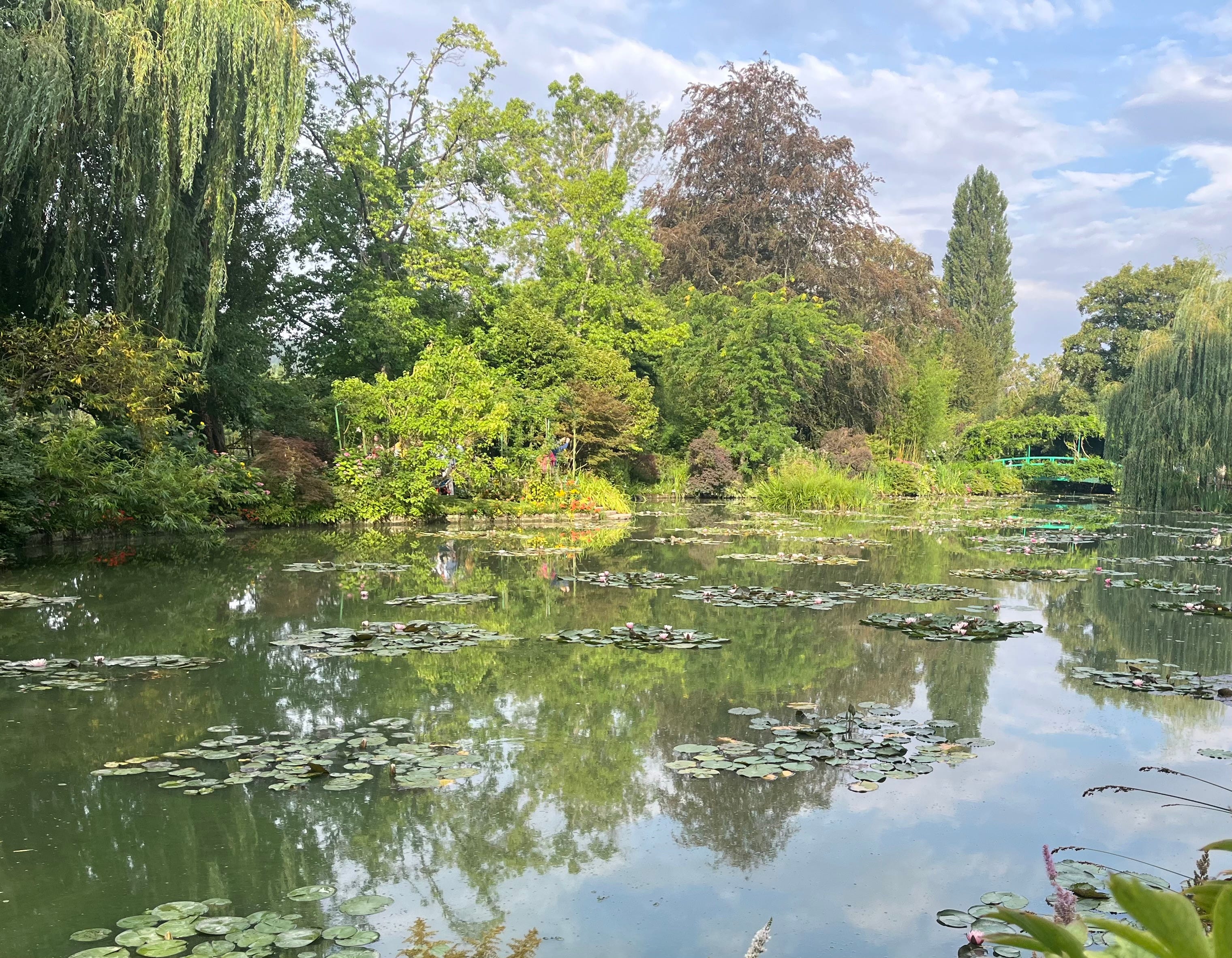
Water acts as a source of growth and reflective mirror. In 1893, excavation began on the property’s lily pond, the inspiration for which is inside the house.
The walls are covered with prints of Japanese origin. By the end of his life, Monet collected more than 230 Japanese woodblock prints. He was enthralled by their portrayal of the natural world.
Flowers are everywhere on the property. The pond is ringed by plantings that protect and enhance the floating lilies. Japanese-inspired bridges entice guests to gaze across the sublime scene.
Throughout the grounds, flowers are grouped by color and height, weaving a rich fabric distinct from the rigid order of formal French gardens. Monet organized his plantings in rectangular plots, then let them flourish with limited restraint.
No Color
Monet bought this house to care for his two sons from his first marriage, and to help support Alice Hoschedé and their six children after her art-collector husband Ernest went bankrupt and essentially abandoned his family.
Monet took them in while his first wife, Camille, was still alive. When she died, and after Ernest followed her to the grave, Monet married Alice, who remained his wife the rest of her life.
Giverny has a single street (one guess who it’s named for), featuring several cafés, a few homes, and some quaint B&Bs that look exactly as you’d expect.
The medieval Église Sainte-Radegonde anchors the far end of the road from Monet’s house. The church features a Romanesque apse from the 11th century, surrounded by Gothic additions dating up to five centuries later.
Affixed to one aisle is a plaque honoring the local dead from the First World War. Outside the west façade is a monument to those who fell in the sequel. To the north is the Giverny Churchyard, including a collective grave bearing remains of seven RAF airmen who died in Normandy two days after D-Day.
Tucked behind the church is a family tomb. Simple and modest under a sober white cross, it’s an understated contrast to the exuberant gardens at the other end of the road.
The vault holds the remains of a woman, her first husband, one of their kids, and the two sons of the man she’d later marry.
When her second husband joined her in the grave, former prime minister Georges Clemenceau reportedly pulled the cloth off the coffin, declaring that black was no color for Claude Monet.
JD
A very well read polymath indeed ... 👍👍👍
Exceptional report of your visit to Giverny.
Including a visual depiction of Monet's garden, and the lilies that are forever linked to him, added visual allure to your articulate text.