


Paris, France
July 11, 2026
[NB: Previous installments are linked here, here, here, here, and here]
Now we know why Napoleon invaded Russia. He was seeking a way to escape the heat. As I write, under a rising sun along the Seine, a cool breeze comforts Paris.
But morning air can be misleading. Yesterday’s temperatures tickled triple digits, pulling pedestrians into the shade, and making us appreciate that our lodgings offer chilled air.
We arrived Wednesday by rail from Reims, and settled into the Hotel Lutetia. My mother, brother, sister-in-law, and niece landed that morning. After several flight delays, our son and our niece’s fiancé joined us for dinner at Les Deux Magots.
After spending Thursday exploring some of the refurbished city, we spent Friday morning in the Marais.
Much as I admire Haussmann’s handiwork, I’m glad he missed the Marais. Straddling the Third and Fourth Arrondissements, this former “marsh” preserves the narrow streets, architectural styles, and Royal imprint that preceded the Empires.
The Rue St Antoine was a Roman road above the surrounding swamp. Philippe-Auguste drained the mire, paving the way to what became one of the more eclectic parts of Paris, and provided us a place to spend part of our day.
Trendy today, Le Marais had fallen on tough times at the turn of the 20th century, when city leaders considered razing it. Among the only blessings of World War I was that its expense (and its tendency to turn laborers into sacrificial lambs) stopped vast avenues from slicing this district.
Before the Sun King decamped to Versailles, Henri IV had created the Place des Vosges, and made the Marais a chic part of the city. But when Louis left, his sycophants followed. Their Marais mansions were subdivided into working class flats.
Since the 13th century, the Marais has also been the Jewish quarter of Paris. Because usury was prohibited for Christians, the king often encouraged Jews to lend money and get rich.
When popular resentment inevitably arose against this accumulation of wealth, the crown would squeeze the Jews like a soaked sponge, often expelling the victims to sop up their wealth. This cynical pattern of admission, exploitation, and expropriation would repeat for centuries.
After the Great War, Le Corbusier wanted to destroy the dilapidated Marais, replacing it with a district of 60-story skyscrapers, surrounded by “green spaces” laced with wide highways.
Minister of Culture André Malraux averted this vandalism with his eponymous 1962 law designed to protect traditional architecture, favor renovation over destruction, and preserve the identity and charm of old Paris.
The city was spared an unforgivable disfigurement. But not every wound can be avoided.
Urban Renewal
Like many of us, I tend to prefer what I know, and to resist change. Many of the cultural heirlooms I admire… be it Gothic cathedrals, Mozart’s music, or Shakespeare’s plays… were considered radical or wasteful in their day.
Most Parisians were appalled when Louis-Napoleon renovated their city. Swaths of buildings were demolished and vast neighborhoods ripped apart.
Residents were pushed out, some to settle on or beneath the Butte of Montmartre, where resentment simmered. After the Haussmann’s overhaul and the horrific siege and starvation of the Franco-Prussian war, many of these radicals had had enough.
They took to the new streets the Second Empire provided, laying down barricades and taking up arms. The Commune was the greatest revolt since the Revolution, and finally ended with fierce fighting at Père Lachaise cemetery, where its last leaders were placed against a wall.
A romantic nostalgia for Vieux Paris was created that lamented the replacement of the old city with a rigidly ordered modern (and sanitized) capital. Opposition was noted, but mostly ignored. The transformation of Paris would rank among the few urban renewals retrospect applauds.
After the Prussian conquest and Paris Commune, innovation revived under the Third Republic, and festivities flourished during la Belle Époque.
But after enduring desperate siege and humiliating defeat, the French retained an understandable disillusion. After being vanquished at Versailles, Paris had gone to war with itself… and with the rest of France. After the fighting stopped, life resumed with typical French flair.
Engineering Stunt
The first Impressionist exposition was held immediately after the Commune collapsed, reflecting an innate efflorescence after debilitating trauma. The Exposition Universelleof 1889 became an opportunity to boast of French accomplishments in the century since the Revolution.
Gustavo Eiffel led an engineering company known for building bridges. His firm was chosen to construct a centerpiece for the exposition.
He used the occasion to exalt iron as a construction material. The latticework of metal and pylons curving inward to meet at the center somewhat resemble a span turned on its side.
Eiffel’s tower was the tallest structure in the world. But it wasn’t supposed to stay. It was built as something of an engineering stunt, to make a statement by boasting what modern technology and French intelligence could accomplish.
That was good. Because much of Paris hated this “abomination”, what one writer called a “hollowed-out candlestick”. Another thought it resembled an “odious black factory chimney” casting its shadow across the city.
Guy de Maupassant used to dine in the tower because it was the only place in Paris from which he couldn’t see it. Even Eiffel called the impractical steeple a “three-hundred meter flagpole”.
Its main function has been to attract tourists and provide an emblem of Paris. It also became a radio transmitter, which was reason enough for the structure to stick around.
Visual Pollution
I can see how people could acclimate to the Eiffel Tower. But no one should get used to the Centre Pompidou, a multi-colored eyesore erected in 1971.
Among the many loathsome tendencies of modern architecture is the impulse to “turn the inside outside”, and display pipes, ducts, and escalators on the exterior so the interior receive maximum space.
This also expresses a desire to showcase the industrial mechanisms that make a building work. The pipe colors at Centre Pompidou represent the specific function each conveyance serves: blue for circulating air, white for subsurface ventilation, yellow for electricity, green for water, and red for people.
The effect is of a technicolor oil refinery that visually pollutes the elegant mansions of the nearby Marais. Locals were appalled… as they should’ve been.
Its sole merit is the great view, which is similar to that from the towers at Nôtre-Dame (with the added benefit of seeing the cathedral). It also is blessed by the advantage Maupassant ascribed to the Eiffel Tower: when you’re in it, you can’t see it.
As with much modern junk, the Centre Pompidou was wearing out mere decades after it was built. Predictably, its designer said that was proof of its “success”. In a way, he was right, much as Thomas Jefferson commended the drab buildings in Williamsburg for their susceptibility to fire.
Fortunately, aside from eyesores like the Opera Bastille, the Bibliothèque Nationale, Institut du Monde Arabe, and Musée du Quai Branly, the provocative urge Centre Pompidou represented wasn’t too contagious. Despite several infections, central Paris remains mostly immune from awful architecture.
Hate Crimes
Instead, the disease spread to the western periphery, to the modernist playpen at La Défense. Anchoring the area is La Grande Arche de la Défense, a horrid cube resembling an air conditioning unit that terminates Le Grand Axe connecting the Louvre, Champs Élysées, and Arc de Triomphe.
It should’ve stopped there.
Le Grande Arch “welcomes” us to a sterile village of hideous structures and banal towers of glass, concrete, and steel… a financial, commercial, and “entertainment” hub soulless enough to be a suburb of Houston.
As in Northern Virginia across from DC, skyscrapers assemble at La Défense to escape height restrictions in the capital. Unfortunately, one exception didn’t make it out of Paris. Like the monolith in 2001: A Space Odyssey, La Tour Montparmasse is hate crime looming over the south of the city.
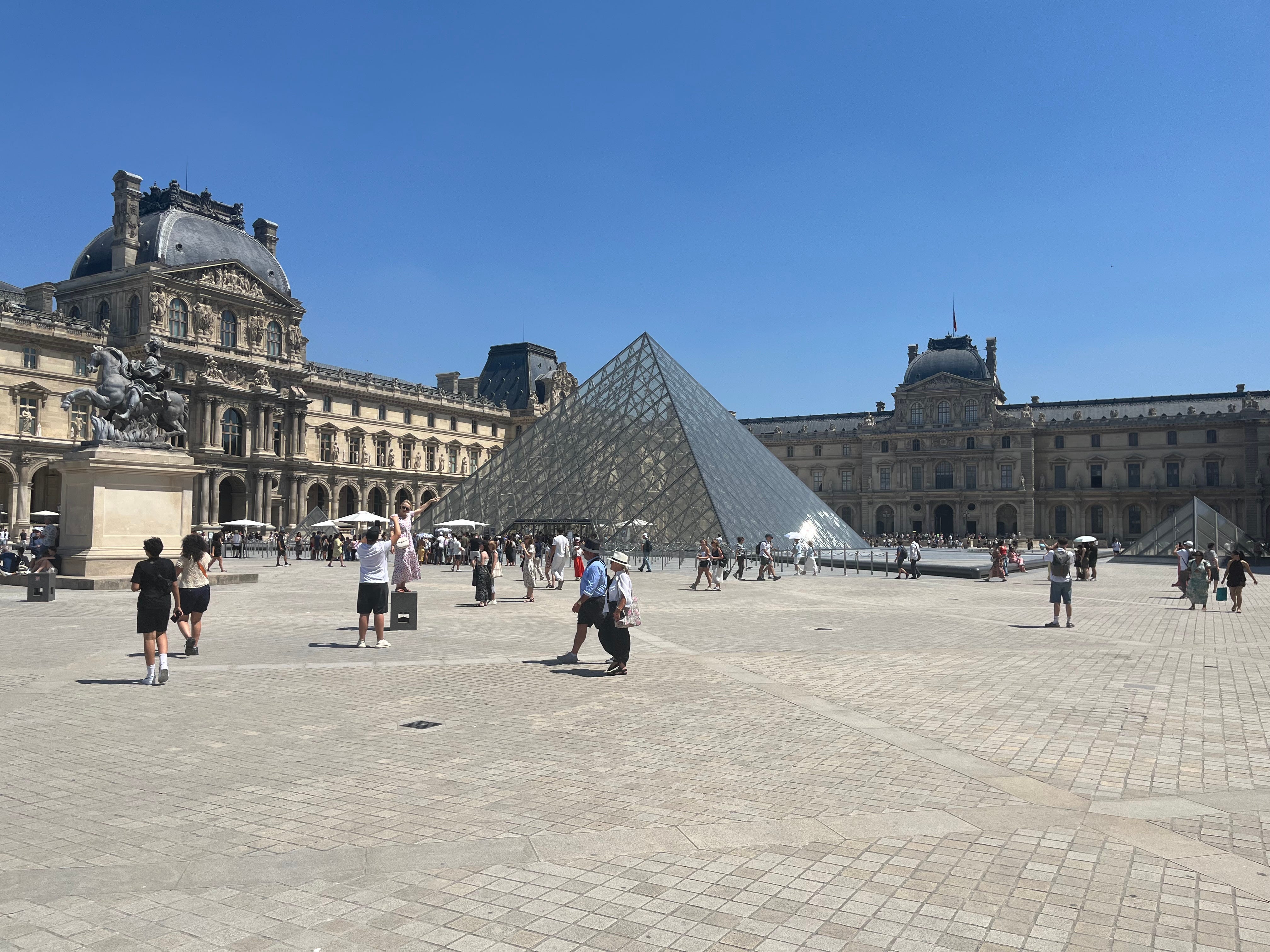
At the east end of Le Grand Axe, IM Pei vandalized the Louvre with his glass pyramid in the Cours Napoleon, which is akin to spraying whipped cream atop a glass of Margaux.
Three smaller offspring surround the main monstrosity, which also protrudes like a core drill bit into the entrance hall below.
The ostensible intent of this transparent wart was to offer easier access to the museum. But as with much of what Pei built, it was mostly a monument to the architect’s ego.
Like Bostonians when Pei afflicted their city with architectural abscesses decades earlier, Parisians were justifiably horrified.
Some were disturbed by connotations of death associated with pyramids. Most simply acknowledged the “innovation” as ugly and out of place. As usual, it was mostly tourists who thought it was cool.
Paying Respects
In fairness, many of the Grand Projet have been uplifting and useful, notably the TGV rail network, the Musée D’Orsay, and the Channel Tunnel.
A couple decades after the Eiffel Tower went up, cast iron made an appearance in the luminous glass-roofed Grand Palais, the Petit Palais across the street, and exquisite Pont Alexandre III that connects these Beaux-Arts edifices to the Left Bank.
Each of these were built during the Exposition of 1900, from which the greatest monument is underground. Distinctive Art Deco iron works grace many entrances to Le Metro, one of the most extensive subways in the world. The first line started at l’Étoile; now fourteen flow under the city.
But the main artery thru, to, and from Paris has always been the Seine. At the Île de la Cité, thé river splits around the island. On the parvis facing the cathedral, a pavement plaque marks “Point Zéro”, the spot from which all places in France are measured from Paris.
An oblivious crowd walked upon it, oblivious to the geographic benchmark beneath their feet. Most were also unaware of the holy relic inside the church. I’d not gone inside Nôtre-Dame since before the fire.
My son had never been. Before paying respects to literary luminaries at the shrine to St Genevieve that became the Panthéon, we decided he needed to see Nôtre-Dame.
Remembering it was Friday affirmed our choice. We waited about half an hour in searing heat. When we finally entered the nave, throngs filled the church.
But the back chapel was relatively empty. Almost everyone walked past, unaware of (or indifferent to) what was positioned on the altar. My son and I quietly entered a pew, took to our knees, and prayed to Christ before the Crown of Thorns.
JD