


Caudebec-en-Caux, France
July 16, 2026
[NB: Previous installments are linked here, here, here, here, here, here, here, here, here, and here]
We took the Seine as far as it will go. Upstream from Honfleur, we sailed under the suspension bridge at Tancarville, thru the last in a series of a half dozen locks, and into the Tancarville Canal that escorted us to Le Havre.
Residents of Honfleur have a condescending contempt for Le Havre, which they consider an industrial heap that lacks soul. From what we saw, they may have a point.
After centuries of Viking invaders and English ransackers sailing up the Seine, in 1517 Francois I founded Le Havre as a defensive port and (as its name attests) a commercial harbor.
Apparently, with the coastal suburb of Saint-Adresse (made famous by Claude Monet, who grew up in Le Havre) it held some appeal before the Second World War. Poet Casimir Delavigne said that “after Constantinople, there is nothing so beautiful”. We’ll have to take his word for it.
After the British (unnecessarily) bombed Le Havre to oblivion during the Battle of Normandy, the city was subjected to Communist politicians, awful architecture, and bland urban “planning”. Many French called it the ugliest city in the world, with critics decrying it as “Stalingrad-on-the-Sea”.
Our fleeting glances affirmed the gist of that description, if not the severity. But such a superficial assessment is probably unfair. Our only impressions were as passengers shuttling from the port, thru an industrial section of town, to other points further afield. One was across the estuary at Honfleur.
To reach it we crossed the Pont de Normandie, which spans the Seine estuary upstream from Le Havre. When finished in 1995, this artistic structure was the world’s longest cable-stayed bridge. Reflecting the subsequent shift in global influence, it’s since been surpassed by seven in China, and one each in Russia and Japan.
Before it was built, travelers transiting from Le Havre to Honfleur boarded ferries, or drove an extra twenty miles to cross the span at Tancarville. Even then, the trip would be worth it.
Founded at least a thousand years ago, Honfleur flourished as a transfer point at the mouth of the Seine, mostly for people and products flowing between Rouen, Paris, and ports across the channel.
Its port profited during the Hundred Years’ War and boomed till the foreign blockades on Revolutionary France. Displaced by the deep water option across the estuary at Le Havre, Honfleur declined in maritime importance after Napoleon.
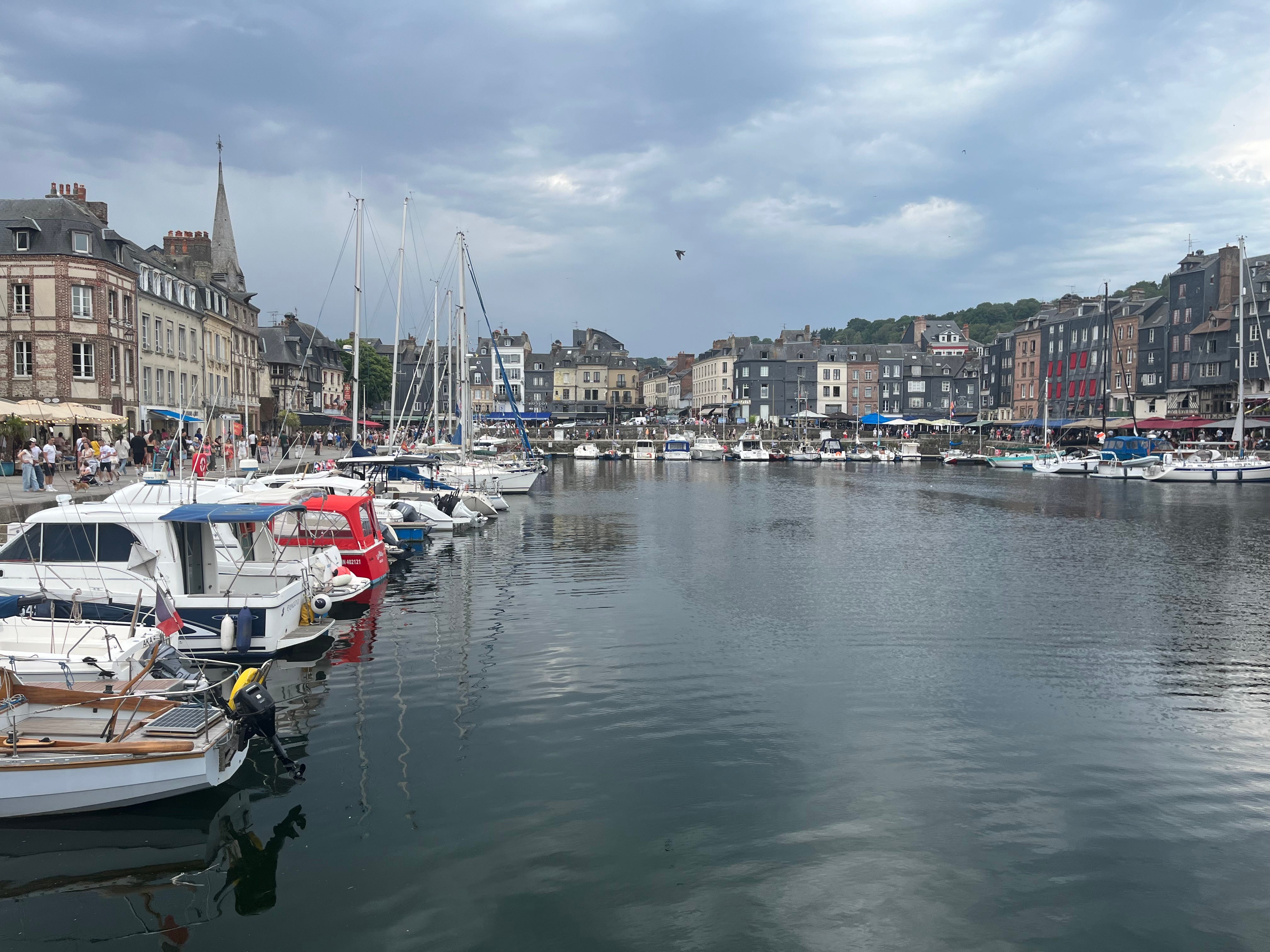
Adorned with an armada of masts and embraced by colorful structures of timber frames and slate façades, the inner harbor is lovely. Its beauty was admired and depicted by Boudin, Monet, and other Impressionists. And by us.
Tsunami on the Seine
After a couple nights at the mouth of the Seine, we reversed our bow and returned upstream.
Before the Revolution, about two hundred islands clogged the Seine between Le Havre and Rouen. Napoleon cleared them a decade later, easing passage and making river transit more reliable.
But the sea periodically pushed the Seine back into France, reversing its flow and flooding its banks. Four times a year, especially during powerful lunar pulls of Spring tides, the channel is thrust into the estuary. Sandbars at the shallow mouth inhibit flow, allowing a wall of water to build behind them.
The Seine narrows sharply just upstream from its mouth, creating a funnel that forces a small tsunami toward Rouen.
First recorded in the 9th century Latin chronicles of the Abbey of Saint-Wandrille, the phenomenon was easily observed at Caudebec-en-Caux, a Norman village founded near several streams that fed the Seine.
The French refer to this tidal bore as le mascaret, which was mitigated by postwar dredging, damming, and diversion of the river. But its historical force could be fierce, occasionally destroying modern vessels and previously slowing Viking advances.
Le mascaret is now rare on the Seine. But it’s found elsewhere, including the largest bore in the world up the Qiantang in China, the second largest at the mouth of the Severn in England, and the powerful “Pororoca”, which pushes the Atlantic hundreds of miles up the Amazon.
The most destructive wave to overwhelm Caudebec (“cold spring” in Viking vernacular) came from the east. The advancing Germans took the town in 1940, using incendiary bombs to keep the locals from leaving. Docks were destroyed, bridges burned, and most of the buildings reduced to rubble.
As in many cities in Europe, post-war rebuilding was aesthetically uninspiring. In most cases, it was for lack of funds. In some, it was for an over-abundance of architectural arrogance. In Caudebec, it was a bit of both.
Post-war inhabitants were afflicted with edifices of such people-repelling dreariness that they referred to them as “the barracks”. For their yellow tones and curved shapes, they’re more innocuously known as “banana” architecture.
But what survived aerial bombers and postwar rebuilders is worth seeing.
The turn of the 19th century Hotel de Ville… a classy Norman traditional cloaked in exposed brick and stone… is one of the them. As is the 12th century “House of the Knights Templar”, which is now a boutique exhibitionary that sells locally made ceramics and knives.
There’s no evidence the Templars ever used this place, but it’s a rare example of Romanesque civil architecture in Normandy.
As in many French villages, the most obvious gem is the main church. Henri IV called the 15th century Notre-Dame de Caudebec-en-Caux “the most beautiful chapel in the realm”.
He had a point.
Built on the ruins of a Merovingian abbey, the church is a masterpiece of Flamboyant Gothic. The western façade is a magnum opus of laced stone. Its portals boast three hundred apostles, saints, and scenes that inspired or frightened Medieval parishioners.
Atop it all is a magnificent openwork bell tower sculpted to resemble a papal tiara (regrettably scaffolded while we were there, its parapets and turrets are ostensibly marvelous). Mary’s Magnificat is carved in Gothic letters within the balustrade, and spiral stairways wind delicately toward the gates of Heaven.
Inside, massive pillars support the roof, shield the aisles, and define the nave. Elaborate tracery supplements and sustains 16th century stained glass.
Crafted in French and Dutch Renaissance workshops… many under the direction of Dutch glassmaker Arnold van Nijmegen…the pristine panes were spared by meticulous removal and storage during the Second World War.
Most Beautiful Ruins
Medieval Normandy was a kingdom of monks. Their ruins dot the region from Paris to the sea. Like a strand of pearls, several were commercially connected… with the winding Seine serving as a string.
Many rose from this river valley, accessible to its abundant fauna, flora, and fertile land. Vikings admired the bounty, and did what came naturally when something was appealing: They took it, raiding the hapless abbeys as they sailed upstream.
Among those they plundered and torched was the seventh century Jumieges abbey founded by St Philibert. The year after his invasion of England, William the Conqueror consecrated a replacement, which was reputedly larger than any Western building since Constantine.
Its Romanesque style was mostly frowned upon in the Île de France. But its sturdy construction and powerful aesthetic found favor among rugged Normans descended from Vikings.
Jumieges was a Medieval sanctuary of faith, food, shelter, and learning. It endured Huguenot looters during the Wars of Religion, and finally succumbed to the French Revolution.
As part of its aggressive antagonism toward the Church, the National Constituent Assembly suppressed the Benedictine monks at Jumieges, seized the property, sent its library to Rouen, and used the structure as a stone quarry for its fine cut masonry.
The surviving façade and towers preserve the virile form of Romanesque design. Behind and under them were eighty foot walls, composite arches, wood-beamed ceilings, and a Gothic choir.
Gardens surrounded a frescoed sixteenth century cloister and an eighteenth century dorm that accommodated the monks.
Around this proliferation of what Hugo called “the most beautiful ruins in France.” are rolling fields and farms filled with cattle, corn, wheat, and sugar beets.
Our shadows lengthened as we left the ruins and afternoon receded. After the short trip back to our boat, we gathered round a more active altar.
We joined other congregants in our usual pews. The priest took his place upon his altar. Within minutes, he began tolling cubes on the base of glasses, and called the faithful to evening prayers.
JD
Where are the photos of these historic sites you masterfully describe in word?
Thanks for your today's post !!! 👍👍👍
Reminds me of student-exchanges with Caudebec-en-Caux I participated in for a couple of consecutive yrs.; most regrettably more than half century ago ...
That was shortly before the Pont de Tancarville was inaugurated and "le bac" flipping between the river banks added some tranquil flair on the road leading to the hotel-de-ville situated shortly after the mini-golf, both in proximity to the flowing waters ...
Have a nice stay et salut a tous !!!