


Les Andelys, France
July 17, 2026
[NB: Previous installments are linked here, here, here, here, here, here, here, here, here, here, and here]
In the late 12th century, the Plantagenets ruled England and held half of France. Henry II started this Angevin Dynasty, and reigned thirty-five years before his son took the throne.
Richard was known for boldness long before he became Duke of Normandy, king of England, and ruler of half of what is now France. As a teenager, he crushed rebellions in Aquitaine, the duchy his mother Eleanor brought into her marriage to Henry II.
When Saladin captured Jerusalem for the Saracens, Pope Gregory VIII called the Third Crusade. Richard became known as the “Lionhearted” after his courageous escapades in the east.
He had a couple chances to capture Jerusalem. Knowing he couldn’t hold it, Richard opted for the better part of valor, and to resist reaching beyond his grasp.
On the return trip, he was captured by the Duke of Austria, in retribution for an insult in Acre. He was imprisoned for a year, partially at the behest of the French king.
Philippe Auguste had joined Richard on the journey east, yet came back sooner. As King of France, Philippe ruled a rump realm, essentially the Île de France around Paris. Much of the rest was ruled by Richard to the west, and rival duchies to the east.
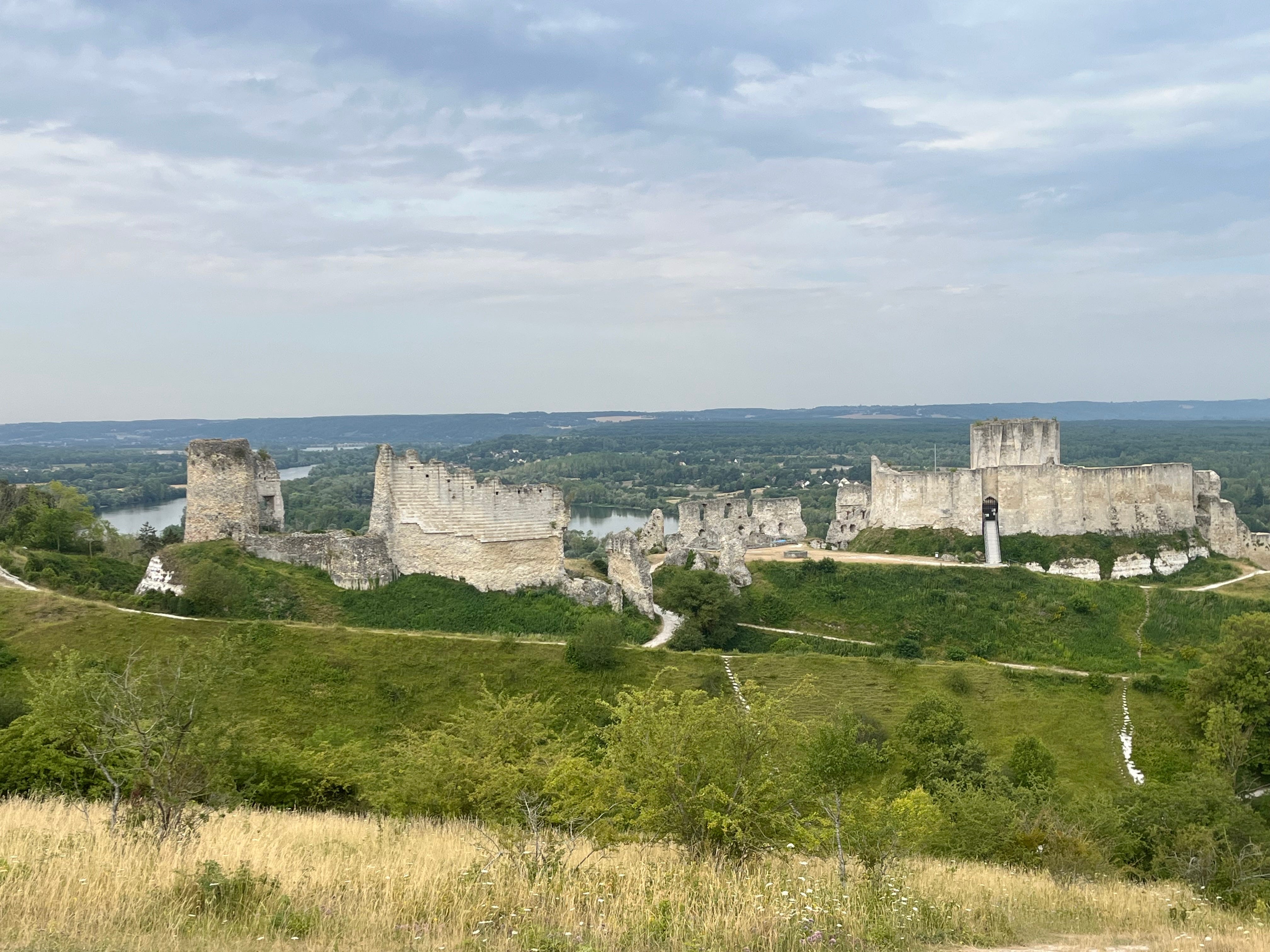
To reconquer and defend territory his enemies had taken while he was on crusade, Richard constructed the imposing Château Gaillard in eighteen months. On a limestone cliff beside Les Andelys, it anchors a Medieval Maginot Line guarding the approach to Rouen from above the Seine.
Six months after the strong castle was completed, the Lion Heart succumbed to gangrene after he pulled an enemy’s arrow from beneath his neck. While rival dukes competed for Normandy after Richard’s death, Philippe Auguste took advantage. In 1204, he came from Paris, captured Gaillard, and annexed Normandy into France.
Inspired by fortress design Richard saw in the Levant, the garrison was for several centuries a contested stronghold on the chalk cliffs overlooking the Seine. Despite man-made moats and a steep precipice that inhibited invaders, the château changed hands several times during the Hundred Years’ War.
It eventually became a prison and a hive of brigands before falling to such disrepair that Henri IV ordered it demolished around 1600. As we witnessed from atop its hill above the Seine, it’s remained in ruins ever since.
The lovely village of Le Petit Andely arose while the castle was constructed. Left largely untouched by the Second World War, it’s connected by a tree-lined avenue to Grand Andelys, which suffered extensive damage from aerial bombs. A wall once separated the rival communes, which now comprise the riverside hamlet of Les Andelys.
About twenty minutes away, Michel Galmel hosted us at his regenerative farm and artisanal cider facility, explaining his family history with sustainable farming, and how they produce Calvados, jams, and juice from blends of traditional apple varietals at La Ferme des Ruelles.
For decades, in France as in the U.S., mechanization, government regulation, and targeted subsidies have supported agribusiness at the expense of small-scale operators like the Galmels.
After the Second World War, France had well over two million farms. They averaged about 15 hectares, and were worked with horses and manual labor. Today there are around a fifth as many, with the average farm about five times as large.
Diner et Musée
The night before we saw the remnants of Richard’s fortress and the workings of Galmel’s farm, we visited a château that’s still intact.
Downstream from Les Andelys, at Duclair beside the Seine, Jehan du Fay du Tailly started building in 1530, on the foundations of a 13th-century house.
Reflecting Italian Renaissance influences that are unusual in this area, the structure remained unfinished at Tailly’s death. A couple Louis XIII style pavilions were appended by descendants the following century, with additional yellow-brick wings the one after that.
Constructed in three phases in as many centuries, the main edifice anchors extensive grounds that include a greenhouse, a Greco-Roman orangery now under renovation, English-style gardens, and exotic arboreal specimens that include a giant sequoia.
The château had assumed its current form by the French Revolution, which somehow left it largely untouched. Even the seigniorial coats of arms survived unscathed. The Taillis family wasn’t so lucky. Ruined by the Revolution, they sold the estate.
The history of the house was murky after the Quièveremont-Borde family bought it in 1807. In the next century it was rediscovered by the wrong people, when the Germans used it as an army hospital in the Second World War, after which the château was slowly abandoned.
The Navarro family bought it thirty years ago, and have devoted their lives to restoring it. They treated us to cocktails on the lawn and a six-course meal in the central rooms of the main building.
Among ground-floor rooms we didn’t see are a music room and a Chinese theater for private receptions. Above these are a chapel, lounge, and several eighteenth century bedrooms.
In a stone-walled stable beside the castle, the August ‘44 Museum houses artifacts of soldiers who fought and died in the Normandy campaign, and collections the family has gathered for thirty years from across Europe.
Aside from owning this estate, Nicolas Navarro is an amateur (that’s a compliment) historian who’s passionately preserved the collection, much of which he and his father compiled personally. The elder Navarro met us atop the steps, and graciously welcomed us to his unique exhibit.
Separate rooms are devoted to Allies and Germans, featuring mannequins wearing actual uniforms under helmets riddled with bullet holes.
The patriarch began gathering paraphernalia decades ago, and Nicolas grabbed the baton as a teenager. The museum is filled with dog tags, pocket knives, goggles, gas canisters, even the wing of a British Lancaster bomber. Navarro says he still finds empty cartridges that add to his hoard.
Façade Face-Off
Upstream from Les Andelys, about mid-way between Paris and Rouen, sits the village of Vernon. Like many French towns, its concentration of shops, grocers, boulangeries, and cafés makes this town of 25,000 feel larger than it is.
As with almost everywhere else in this area, architectural dichotomy betrays damage from the war. But in Vernon, the positioning of prominent buildings reflects the civic rivalry with France’s historic religion.
The Belle Époque Hôtel de Ville confronts the eleventh century Collegiate Church of Nôtre-Dame in a façade face-off in the city center. To assert secular supremacy, the late-19th century anti-Catholic mayor insisted that City Hall’s spire exceed the height of the church’s twin towers.
Apparently, it rose the exact same distance, implying an equality that’s remained elusive since and before the French Revolution.
As it always will.
JD
🎯🎯🎯👍👍👍😵😵😵💙🤍❤ ...