


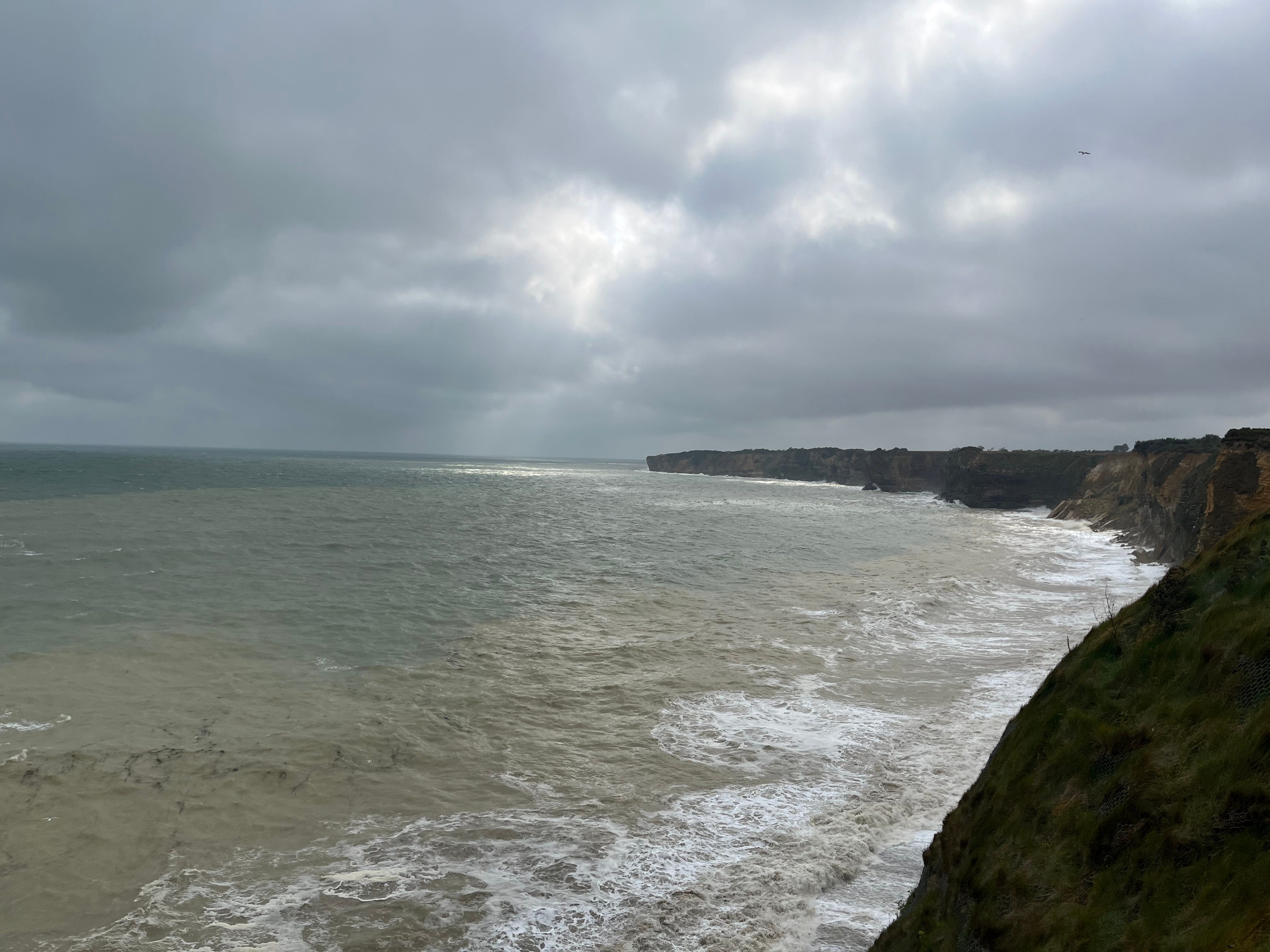
Arromanches-les-Bains, France
July 15, 2026
Under a grey canopy of low clouds, relentless waves lash the shore.
There are certain horrors few of us can imagine: Antietam….Verdun… The Holodomor… The Terror… The Cultural Revolution… The Khmer Rouge.
The Second World War produced a litany of nightmares: Stalingrad… Okinawa… Iwo Jima… Monte Cassino… Dresden… Dachau… Tokyo…Nagasaki… Nanking.
And Normandy.
On a clear day, the cliffs of Dover can be seen from France. From Picardy, Norman boats crossed the channel to conquer England. Down the coast, beneath bluffs overlooking the beaches, are bodies of boys who came from Britain on Higgins boats.
They came clutching crosses, counting rosary beads, and kissing faded photos of pretty girls. When they hit the beach they gave their lives to fate, the future… and to us.
Departure
When I was in Maine last fall learning to build a house, we were repeatedly reminded that intersections, boundaries, and joints are where problems occur. The English Channel has historically been such a seam.
The coastline of mainland France stretches a couple thousand miles. Along La Manche, the thread is well-worn. On three occasions, it was ripped apart: the Norman Invasion of England, the British and French evacuation from Dunkirk, and on D-Day.
Saint-Valery-sur-Somme was the final point of departure for the fleet of William of Normandy. Storms forced him to change plans and move up the coast.
His ships had initially assembled at Dives-sur-Mer in Normandy, but were blown off course and sought shelter outside their home region. After waiting out the weather at Saint-Valery, William crossed the channel and conquered England.
He claimed that Edward the Confessor had promised him the throne. When Harold Godwinson was instead picked to be England’s king, William decided to annul that decision. He did so at the Battle of Hastings in 1066.
Retreat
If northern France was a point of departure for the eleventh century Normans, it featured arrival and retreat during the Second World War.
The French are often ridiculed as cowardly cheese-eaters or wine-sipping surrenderers. But mockery is easy from the comfort of hindsight in countries unscarred by the ravages of war.
The First World War took an astounding toll on France. Between soldiers and civilians, almost two million Frenchmen were killed. Almost every village has a monument to the dead. After the war, birthrates collapsed as the Lost generation was unavailable to sire its successor.
Barely two decades after such devastation and carnage, it’s no wonder few wanted to fight, or that resources were lacking for those who did. For a while, it appeared direct conflict might be avoided.
Through late 1939 and early 1940, western Europe waged a “phony war.” The French and British dug in against a German attack that didn’t come.
Until it did.
The Wehrmacht rolled thru Holland and Belgium on May 10, and the Allies came north to counter. But the attack was something of a feint. The main thrust came further south, as a Blitzkrieg thru the poorly defended Ardennes. The British Expeditionary Force withdrew to Dunkirk for possible evacuation.
Dunkirk is as far north as the French coast goes. Nestled against the Belgian border, it’s the industrial hub of Le Nord. Le Plat Pays was once French coal country, but is now a bit of a rust belt. It was British territory in the 17th century, when Charles II sold the city to Louis XIV.
Almost three centuries later, the Germans surrounded it, forcing 340,000 British and French soldiers to evacuate. The nature of the aquatic retreat turned a humiliating defeat into an inspirational achievement.
Operation Dynamo was quickly devised for civilian vessels to transport tens of thousands of troops. Tensions rose between the British and French, who felt abandoned by their English “allies”.
German bombs had crippled the port, and beaches were too shallow for large ships to approach the coast. Conditions were dire.
An armada of small civilian vessels was quickly assembled to carry trapped soldiers to larger ships off-shore. But most men were retrieved from a flimsy breakwater known as the “East Mole”, that was never meant to serve as a dock.
Because it extended into deep water on either side, bigger boats could berth, picking up a greater number of passengers in shorter time. Low clouds also helped, keeping the Luftwaffe from attacking men lined up on the beaches.
French soldiers secured the perimeter, preventing Nazi advance and letting 340,000 men escape. Dunkirk fell a few days later. The rest of France followed that month, and succumbed to Occupation.
Les années noires of occupation, collaboration, and resistance lasted four years. It was finally relieved by a convoy crossing the channel from the other direction.
Arrival
If Dunkirk was the largest maritime evacuation in history, Normandy received the biggest amphibious invasion.
At Dieppe in 1942, the Allied raid was a disaster. Most of the invading force was lost. The rest were hauled to captivity.
Tentative planning for an amphibious assault had started in 1941, focused on the narrowest crossing at Calais, or in Normandy to the west.
Normandy was further from England, but less fortified, with firmer beaches, and with less clay to inhibit the landing of troops. It seemed the best spot to form a second front against Germans already entangled in the east.
To reach the beach, Operation Overlord needed 6,000 assault and landing craft, which had to be designed and built in short order. Planes and parachutes were also needed, to bring the troops that came from the air.
Others came amphibiously to scale cliffs. Waves would wreck the boats, and cast invaders away from the coast. The Germans laid hidden mines and other obstacles along the shore.
Everything depended on the weather. Well, almost everything. On June 3, embarkation began despite an ominous outlook. Most soldiers assumed it was yet another exercise.
Under inclement conditions, the invasion was delayed. For two days troops sat bored on the English coast, awaiting excitement they hoped never came. But for a brief window the forecast shifted, and Operation Overlord was on.
Gliders and parachutes preceded the boats. Expectations were that 70% of the pilots wouldn’t survive.
Off-shore, an armada steamed south, carrying thousands of men who’d given friends in Britain farewell letters to family they never expected to see again.
Waves lifted landing craft six or seven feet. Sea-sickness was rife. On the boats, helmets became vomitoria that were washed with sea water before returning to heads.
By 5:30, the French coast came to view. The first wave surprised the Germans, who expected an attack yet weren’t sure where it would be. But their batteries erupted when the naval assault started.
Chaos
General Eisenhower prepared two speeches before the defining moment of the war in France. One celebrated success; the other offered his resignation. On the morning of June 6, 1944, he had no idea which one he’d need to use.
Along the shore, dunes surround wide beaches, guarded by looming cliffs still littered with German pillboxes, bunkers, and gun emplacements. These were part of the Nazi defensive network that defended its overextended grasp on “Fortress Europe”.
In the overnight hours of June 5-6, American and British paratroopers dropped behind German lines, to help disable defenses and distract guns aimed over the sea.
The landings occurred the next morning, with Allied troops attacking five beaches beneath German guns atop commanding bluffs. With a favorable moon on the wane, 150,000 men, 2,000 ships, 4,000 landing craft, and 10,000 warplanes assaulted the shore.
The Americans formed the initial wave. British and Canadians came an hour later. Bad as the beaches were, sea sick soldiers were eager to get off the boats.
For the moment.
The beach was chaos. Bullets flew like insects in a swap. Some soldiers never made it to shore, their craft exploding on underwater mines.
Upon arrival, the Americans got the worst of it. The Air Force heavy bombers were supposed to provide cover. They never did.
On most beaches, German resistance was relentless. On others, they surrendered relatively quick.
Omaha Beach was particularly brutal. Along thirty miles of coast between Utah and Gold Beaches, Omaha was the only stretch where heavy equipment could land. The Germans knew this, and put a thousand gunmen atop the bluff.
The sea was rough and defenses stiff. Soldiers described so many bodies on the beach that men could walk across them without touching sand.
Battalions of men littered the shore, many with heads missing or limbs gone. Countless corpses bobbed in the water, recaptured by the channel they’d just crossed.
After taking the beaches, Allied armies established makeshift harbors to funnel supplies, vehicles, and reinforcements to sustain the move inland.
The Battle of the Bridgehead established space for the onslaught Overlord had opened. The Germans slowed the Allied advance. But within a week, Charles De Gaulle was in Bayeux.
Hedges
The worst storm in half a century struck the channel. The newly erected docks were damaged and supplies stalled. But quick action relieved the disruption.
After the Americans took Cherbourg, the British and Canadians targeted Caen. Over 2,000 bombers dropped high explosives, history’s heaviest air attack in support of ground forces.
Caen was reduced to rubble. The city was christened “The Crucible”. Half of it was destroyed. Several thousand residents became casualties.
Bloody fighting on the road to Paris devolved into “hedge warfare” amid the bocages normands… areas of dense hedges that cover much of Normandy.
By the end of August, Allied forces crippled the Germans, who surrendered France. But the Nazis planned to destroy Paris as they fell to defeat.
Demolition charges had been placed in the Opera, La Madeleine, and the Luxembourg. Trucks filled with explosives were sent around the city.
A communist uprising was also imminent, so Eisenhower diverted to Paris some of the troops headed from Normandy to Germany. Almost three months after the landings, city was saved.
Endless Jewels
As with the Great War cemeteries in eastern France, the rows of crosses that cover these cliffs reflect the courage and sacrifice of millions of men who freed France. Like veterans who are reluctant to discuss their experiences at war, the sand and surf give little hint of the horrors they saw.
The French suffered too. Preliminary bombings killed more than 15,000 civilians, with another 20,000 dying during the invasion. The fighting to break into France from the beaches was among the most brutal of the war.
The fight for France didn’t end on the beaches. That’s where it started.
Forty-four hundred Allied lives were lost on Normandy Beaches. Fighting in the hedgerows claimed almost twenty times as many. Hundreds of thousands of lives were lost in the months it took to reach Paris.
All Allied veterans who fought in France during World War II are eligible for the Légion d’honneur, the highest honor that country awards.
Tourisme de mémoire is an expression that pays homage to those who sacrificed, and ensures their survival in collective memory. Few places are as worthy of the label as the windswept shore of northern France.
On D-Day 150,000 troops came ashore, and gained footholds on five beaches. For those who were there, it was either the longest day of their lives… or the last.
For us it was among the most moving. We spent it at Pointe du Hoc, Omaha Beach, and Arromanches, where artificial ports were built to enable the incursion after the landing at Gold Beach.
Two and a half million Allied troops came thru this town, which was liberated by the British. Off-shore, remnants of the breakwaters still exist.
After lunch, we spent an hour at the American cemetery in Colleville-sur-Mer, overlooking the east end of Omaha Beach.
Like endless jewels on grass cloth, ninety-three hundred crosses cover the ground, of which more than three hundred surmount souls known only to God. Among the buried, the average age is 24.
Fought within living memory, the Second World War was the worst calamity in human history.
But below the bluffs that bear the dead, the waves continue their eternal assault.
JD
Great piece, JD Breen. You are a gifted writer.
In my long life, I've had the privilege to meet two individuals who were among the thousands of brave soldiers who were on Omaha Beach on D-Day
One was my college president, Earl Rudder, the commander of the unit that conquered Point du Hoc.
The other was the retired chairman of American International Group (AIG), Maurice Greenberg.
And only one survivor of the Bataan Death March, a neighbor, whose travails were horrific.
The bravery of these men and their colleagues -- all once young, soldiers all -- never ceases to astound me.