


Reims, France
July 6, 2026
[NB: The previous installment is linked here]
“When a man say no to Champagne, he say no to life.”
- Julien Grinda in The Deer Hunter
“The magnum is the best format for two people… when one of the parties is not drinking”
- Winston Churchill
Seventeen years after the Nazis surrendered in Reims, its cathedral was selected for a ceremony presided by Charles de Gaulle and Konrad Adenauer, to celebrate reconciliation between France and West Germany.
They picked a city with ample fuel to fill their glasses. The Benedictine monk Dom Pérignon is the reputed creator of the beverage named for this remarkable region. But no one really knows.
Family Business
Another Benedictine, historiographer and theologian Dom Thierry Ruinart, lived amid the aristocracy of Paris in the age of Louis XIV. Among them he witnessed a fascination for “wines with bubbles” from his home region of Reims.
He shared his perception of commercial potential with his family, but died two decades before his nephew, Nicolas Ruinart, started the business. Demand grew so quickly that within a decade Nicolas abandoned his textile ambitions to sell champagne.
Established in 1729 atop the Butte Saint-Nicaise southeast of Reims, Maison Ruinart is the oldest producer of champagne in Champagne. The cellars are spectacular, accessed thru enormous underground rooms, excavated from the surrounding chalk down to forty meters under the earth.
It was these caves that sixth-generation owner Andre Ruinart opened as shelter to locals when Reims was razed by German guns. Today his descendants opened them to us.
Almost 140 steps burrow into a five-mile network of tunnels carved thru the soft stone. Subterranean walls reveal marks third-century Romans made when they quarried chalk from tapered crayères resembling conical flasks, which Ruinart adapted to ferment and age his fine champagne.
Much as I shun dark enclosures, part of me resisted entering these confined spaces. But the chalk walls lend a light airiness that alleviates claustrophobia. And I had to go when I learned Thomas Jefferson ordered cases from these underground vaults. On our way out, we did too.
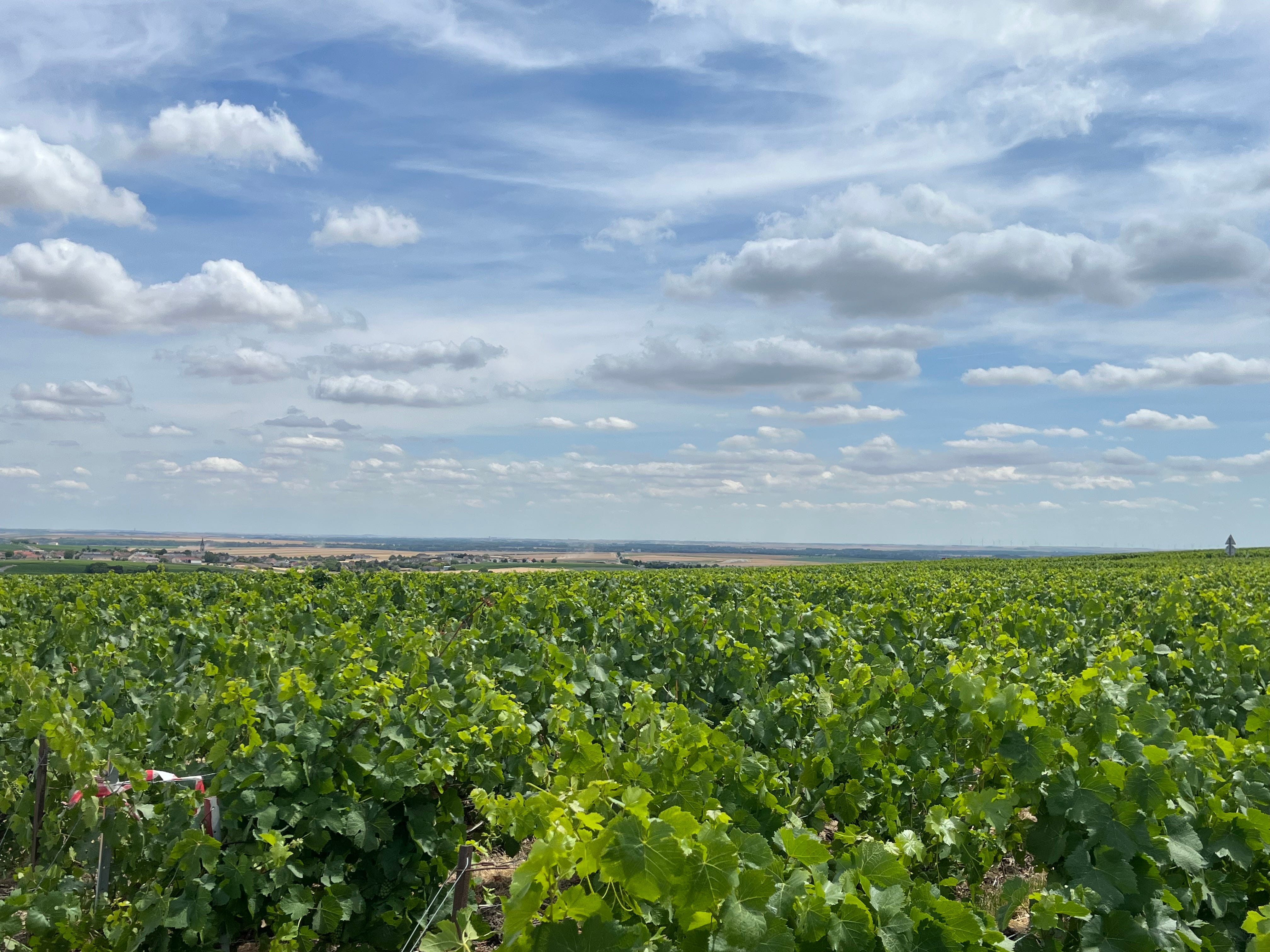
Twenty-four Grand Marques, hundreds of cooperatives, and thousands of small independent producers dot the rolling hills around Reims. Machine picking isn’t allowed on any of them.
In Champagne, all grapes must be picked by hand. Each August, a hundred thousand of workers take a couple weeks to relieve the vines of ripe fruit.
About a half hour from town toward Épernay, past the village of Bouzy, Ambonnay nestles in the valley of the Marne.
Ostensibly established by a third-century Roman who gave his name to the town, Ambonnay is now home to Champagne Dominique Foureur, where vigneron Gaëlle Foureur and her brother manage a small estate her ancestors started in the 1850s.
Gaëlle guided us thru the tunnels and workshops of the family business she now runs. Producing about 15,000 annual cases from her ten acres of vineyard, Foureur makes champagne from her own grapes, and sells excess supply to other operators.
She emphasizes environmentally-minded viticulture, grassing over the vineyard rows to avoid herbicides (a common practice among producers in Champagne, including Ruinart).
Biological controls displace insecticides to alleviate pests. Among Gaëlle’s techniques are applying moths’ pheromone so males can’t locate females, which disrupts reproduction without spraying poison on the vines.
Against caterpillars that eat the buds, she deploys a naturally occurring bacterium emitting a protein toxin that afflicts caterpillars, but that leaves people, animals, and other insects unimpaired.
She demonstrated manual and mechanized methods of yeast extraction, cork installation, and label application during the bottling process, then welcomed us to her small tasting room to share results of her tireless effort.
Window to Heaven
France is famous for the fruit of the vine. It pours into millions of homes, bistros, cafes, and bars. But even in a country where faith is fleeting and many churches serve as municipal museums, some wine still fills the occasional chalice.
Remnants of Christian culture remain in Reims, most emphatically in ecclesiastical edifices that embellish the town. Notre-Dame de Reims anchors the area. But the nearby Basilica of St Remi was built first.
This eleventh century abbey replaced a sixth century chapel from which remains of St. Remi were moved. Though it survived the Revolution, the basilica suffered extensive damage during the First World War, and was assiduously refurbished during subsequent decades.
Smaller and darker than the nearby cathedral, the basilica is more peaceful and intimate than that popular church. Because of its blend of styles, it’s in some ways more architecturally interesting.
Begun as a Benedictine abbey built in the 11th century, the Basilica of St Remi is the largest Romanesque church in northern France. As with most ecclesiastical architecture surviving from the Middle Ages, it accrued additions and upgrades in subsequent eras.
As well as any structure, the abbey epitomizes the transition from Romanesque to Gothic. It also reflects the Catholic notion… derived from Pythagoras and Plato… that mathematics reveals the world’s relation to God. Geometry in particular was perceived as humanity’s window to Heaven, a cosmic blueprint connecting man to the Divine.
Ecclesial architecture in the High Middle Ages was a mathematical depiction of theologic principles and celestial order that exemplified symmetry, proportion, harmony, and beauty. The 13th century choir at St-Remi Basilica epitomizes this devotion to geometric consonance.
St Augustine believed God ordered everything “according to measure, number, and weight”. This influence is obvious to anyone entering the choir, a masterpeice of Trinitarian symbolism. Triple windows light three levels of the main apse. Multiplying the eleven bays in the elevation by the three stories of the choir yields the number of years Christ spent on earth.
The basilica is a transitional structure bridging architectural eras. Consecrated by Pope Leo IX in 1049, the transepts intersect a galleried nave extending 125 feet. As the original part of the building, this Romanesque core features the hulking walls, rounded arches, and thick pillars typical of that sturdy style.
The magnificent choir, radiating chapels, pointed arches, and groined vaults rode the Gothic wave of the next couple centuries. The stained glass gracing the apse and transepts also dates from this period. But lower levels retain the Romanesque aversion to large windows that jeopardized structural stability before later buttresses relieved lateral thrust.
Nave windows are correspondingly small… or (along the north aisle) blocked to preserve strength in the walls. Inside, elevation guides the transition from Romanesque to Gothic. Roman arches ascend toward groined vaults above the rounded windows of the clerestory. Similar cross vaulting supports the ceiling above the aisles.
An interior wall near the north transept reveals the architectural groping of those who built the abbey. Several windows appear to have been sealed, likely to enhance structural support for the Gothic Rose above the doors. Remnants of a column protrude about halfway up, presumably to support the pointed arches around prior windows.
The basilica houses remains of St Remi, the fifth century bishop and patron saint of Reims who baptized Clovis as first King of the Franks. The tomb of Clovis is also here, as is the Holy Ampulla - the glass vial containing the chrism that anointed the kings of France.
When Remi baptized Clovis in 496, the ampulla was ostensibly brought from heaven by a divine dove. It was found in St Remi’s sarcophagus in the 12th century and first used to coronate Louis VII in 1131.
As with almost everything else they touched, Revolutionaries destroyed it in 1793… though fragments were preserved and used again when Charles X assumed the throne in 1825.
Three French kings were anointed at St Remi, all before the cathedral was constructed. Since that structure was completed, such ceremony has mostly shifted from this church.
The “new” cathedral warrants its praise. But the old basilica deserves a toast.
JD
It was a treat to read your eloquent assessment of your visit to Reims and its environs, especially your tour of the 13th century choir at St-Remi Basilica.
And to learn that geometry was revered by the early Christians as "humanity’s window to Heaven, a cosmic blueprint connecting man to the Divine." Who knew?
But it's Churchill's maxim that I'll commit to memory: “The magnum is the best format for two people… when one of the parties is not drinking”
😵😵😵🍾🍾🍾👍👍👍 !!!
Thanks so much for this erudite and interesting post written so vividly as if you were present during the events !!! Are you sure you were born once in the last century only, not plenty of times during the last millennium and at most different locations, always downloading info into the same neuronal network ??? ... 🤔🤔🤔
Well, it shows who turns into a book-worm before punching the tickets !!!
Have lots of fun and new experiences !!!
Vive la France et surtout les femmes et les boissons !!! ...