


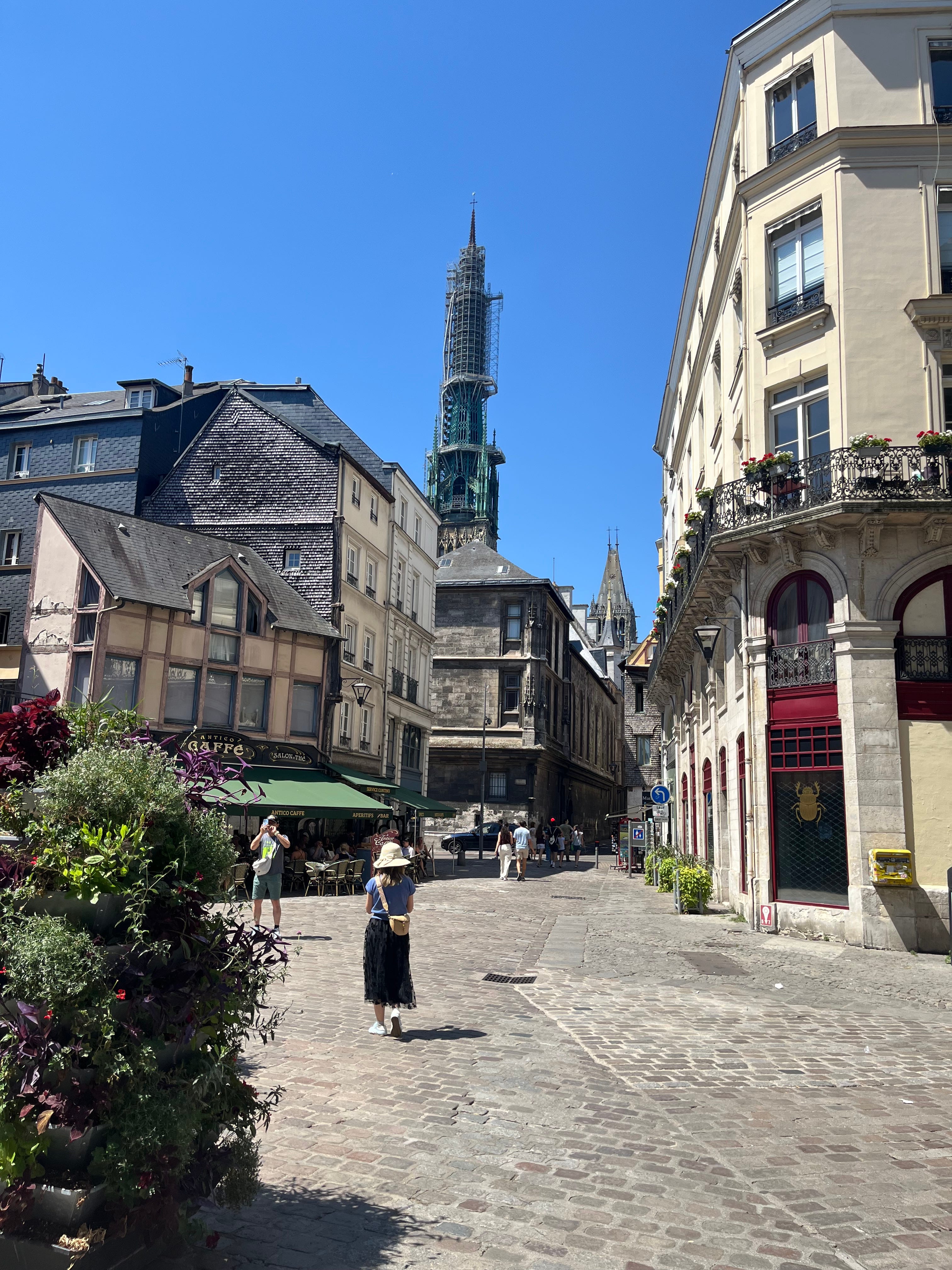
Rouen, France
July 13, 2026
[NB: Previous installments are linked here, here, here, here, here, here, and here]
Three centuries after Clovis founded France, the Carolingian Renaissance was a fleeting flicker in a dark age. Between the North Sea and the Mediterranean, from the Atlantic to the Elbe, Charlemagne consolidated a kingdom.
Papal coronation affirmed his rule, emboldened the Church, and created a Holy Roman Empire that lasted till Napoleon snuffed it out.
Charlemagne was strong glue. But when he died, he left his empire to his son, whose children were less reliable adhesives. Within a generation, their fighting frittered their patrimony to pieces.
The Vikings were pleased to pick them up. For decades they’d raided the coasts and rivers of northern France.
During the ninth and tenth centuries they launched forty-seven attacks, many featuring hundreds of vessels with fearsome warriors at the oars.
They ravaged land, raped women, murdered men, and burned cities. Paris and Tours were repeatedly pillaged.
In 840, a Norse expedition sacked Rouen, beginning the subjugation of a region that would bear their name. Within the next half century, Beauvais, Bordeaux, Burgundy, and Bayeux (among many others) suffered a similar fate.
The onslaught was so severe that a prayer was added to the Mass beseeching God to “deliver us from the Norsemen”. Medieval kings were generally much weaker than modern presidents, and offered little protection from Viking invaders.
Because of this scourge, most construction during this time was of defensive fortifications, with few resources for ecclesiastical structures. These châteaux shielded serfs in exchange for labor, fostering the feudal system in northern France.
In 885, the raiders returned to Rouen before sailing up the Seine to plunder Paris. We came the other direction, floating down the Seine from the City of Light.
Lived-In Look
Camille Pissarro called Rouen “the most splendid landscape a painter could ever dream of.” Known as the place where Joan of Arc was killed and Flaubert was born, homages to each are everywhere.
With magnificent churches, Medieval architecture, impressive museums, and the great clock over an arch carved in Paschal themes, Rouen offers ample attractions for tourists.
But it’s also a real city… Normandy’s administrative capital and commercial hub, and the leading grain exporter in Western Europe.
Hugo called Rouen “the city of a hundred spires”. We’ll have to take his word for it; most were razed by the Second World War. Yet more than thirty survived that intensive onslaught.
The Luftwaffe bombed bridges from above. Central Rouen burned for two days because the invading Germans kept French resistors from fighting the flames.
Four years later, the Allies dropped the bombs. Anticipating D-Day, they wanted to keep German guns from reaching the beaches. After the landing, bombing resumed, to oust German resistance on the road to Paris.
Though the Second World War wrecked most of Rouen, what it spared remains lovely. Cobblestone streets, half-timbered homes, and spectacular churches like St Maclou and St Ouen entice guests while preserving a “lived-in” look.
France reserves Sunday for families, so most shops were closed while we were in Rouen. That’s OK. Sidewalks brimmed, cafés bustled, and the Beaux-Arts museum offered a permanent exhibition featuring the likes of Velasquez, Caravaggio, Delacroix, Poussin, Rubens, and an entire wing of Impressionists, including one of Monet’s thirty paintings of Rouen Cathedral.
Through the ravages of war the cathedral (barely) survived. Its transept portals, Tour de Beurre, and west facade that fascinated Monet all epitomize “Flamboyant Gothic”, the final, most sophisticated phase of that distinctive style.
With those at Sens, Chartres, Amiens, and Reims, this masterpiece in Rouen is among the five great Gothic cathedrals that encircle Paris as spiritual statements making political points.
France is filled with these structures, many of which replaced modest predecessors. They started sprouting in 12th century. Construction slowed during the Hundred Years’ War, and reaccelerated after the Black Death.
Occasionally, new churches rose out of necessity, after fire or decay destroyed their predecessors. But usually the impetus was religious fervor, power politics, and local pride.
Many are stops along pilgrimage routes, and require prominence to beckon from a distance. The bishops obviously recognized this, and wanted more dramatic, impressive, imposing cathedrals to proclaim their authority to approaching pilgrims.
Kings and merchants also favored large cathedrals to enhance stature, promote commerce, and provide a place to honor the Blessed Virgin or patron saints. As with modern desires to erect gaudy stadiums or tall skyscrapers, large churches connoted community prosperity and civic pride.
Erected by local lords, clergy, peasants, and guilds who expected to expire before the structures were complete, these monuments were generational gifts. Builders bequeathed these heirlooms to their grandchildren… and to us.
Height and Depth
Rouen is as far up the Seine ocean-going vessels can reach. Its proximity to Paris makes it a main harbor for foreign commerce shipping to and from France.
It’s also an important port for vessels carrying foreign passengers. Among them were those that brought the Vikings into France.
Within a century of capturing Normandy, the Norse became enthusiastic Christians. Abbeys and monasteries blossomed as precursors to the marvelous monuments the Middle Ages.
The “Gothic” appellation was applied much later, as an Enlightenment insult. With their affinity for “Reason” and disdain for religion, these critics equated Medieval architecture with the barbarism of Germanic Goths that overran Rome.
After a multi-century cultural void afflicted the Western Empire, Romanesque buildings bequeathed their form to the High Middle Ages, which often added flying buttresses to alleviate the structural burden on exterior walls. This let ceilings soar, windows multiply, and light pour in.
As we’ve seen at Reims and Chartres, these buildings exude mathematical order and geometric coherence. The Medieval Church considered God the Universal Architect, and science the means to decipher His design. Like sunlight bouncing off a lake, geometry was His reflection.
Twice the size of Nôtre-Dame de Paris, Rouen Cathedral features three asymmetrical towers, all built in different architectural styles. A cast iron spire added in 1876 made the structure the tallest building in the world (Cologne took the title four years later).
But the cathedral is known less for its height than its depth. Monet painted it three dozen times, to capture elusive light as it danced through different hours, weather, and seasons.
But he never once stepped inside. The structure unnerved the artist: “I had a night filled with nightmares: the cathedral was falling down on me.”
The church houses the heart of Richard the Lionheart and of several Norman dukes… including Rollo the Viking, who made Rouen the capital of the kingdom he conquered.
Nôtre-Dame de Rouen features the verticality, permanence, and iconography common to all great cathedrals. During the Revolution and Second World War, its permanence seemed precarious.
The Revolution stripped much of its statuary, and Allied bombing destroyed parts of the structure. Fires and lightning strikes have also done damage, after which the church was rebuilt, reflecting an institution that outlasts any of its stones.
Washed Clean
Where Rouen Cathedral reaches for the sky, the Église Sainte-Jeanne-d’Arc stoops toward the earth. Located in the Place du Vieux Marche where Joan of Arc was martyred, this ghastly heap would’ve appalled La Pucelle. It’s bad enough St Joan was killed in Rouen. Must the city “honor” her with such an awful edifice?
Joan wouldn’t have recognized this church as Catholic, especially in the sacred shadow of the grand cathedral that reflected her faith. The structure was built in 1979, and looks like a metallic tee-pee (supposed to resemble a flame - get it?) atop a concrete pyre.
Sixteenth century stained glass somewhat redeems this architectural insult. But for her service to France and the Faith, Joan of Arc deserves better.
Joan of Arc is to any city in France what Bobby Jones is to every golf course in Georgia. They all claim her. But only Orléans, Chinon, Domrémy and Reims can make a case that rivals Rouen’s.
France was reeling after the defeat at Agincourt. In the heat of the Hundred Years’ war, it was essentially a rump realm when Rouen fell to Henry V.
The next few years, every battle went England’s way. Then Joan arrived, and saved France. But she had some help.
When she was 13, St Michael appeared, imploring her to honor God and follow his law. Soon, Saints Margaret and Catherine also paid visits.
They eventually told Joan to find Charles VII, and help him claim his crown as King of France. This entailed inspiring his soldiers, and perhaps leading them in battle.
She’d been chosen by God, whose messengers told her to complete the task within a year. She did. At Orléans, she broke a six month English siege, repelled the enemy, freed the city, and rode to Tours to urge Charles to be coronated at Reims.
Timid as ever, Charles dithered two more months, during which Joan won more victories along the Loire. After ten days of pleading, she finally convinced him to go. Charles went to Reims and received his crown.
Within a year Joan was captured the at Compiègne by the Burgundians, who sold her to the English. Bishop Cauchon, who’d collaborated with the English and lost his see when the French recaptured it, had a score to settle with Joan of Arc. He was also promised the bishopric of Rouen for bringing her here.
She was taken to the Château de Rouen, where she was held for three months during her “trial”. Denied council, the 19 year-old peasant girl faced interrogation from about sixty ecclesiastics determined to prove her a heretic or a sorceress.
But Joan wouldn’t renounce her angelic voices. For months, she refused to relent. Five days after she reluctantly signed an abjuration she couldn’t read, she retracted, and went to the stake. Tied to it, on May 30, 1431, Joan was burned in the Place de Vieux Marche in the middle of Rouen.
Twenty-five years later (570 years ago last week), in the cathedral of this city, its bishop reversed the verdict, and proclaimed Joan free of infamy and “washed clean”.
Joan the Maid turned the tide of the Hundred Years’ War. Within two decades, the English would be evicted from France (excepting Calais, which they lost a century later).
Almost 500 years after she gave her life rather than renounce her Faith, Joan of Arc was made a saint.
JD
Excellent and eloquent history lesson replete with masterful accomplishments by early architects.
It's a wonder that enough workers survived the conflicts to build the handsome religious structures which you extolled.
Sad too to learn that vicious ambition and duplicity that led to Joan of Arc's murder was as common then that it is now.
Thank you for the interesting history lesson JD🙏 and hope you’re enjoying your summer with your beautiful family.