


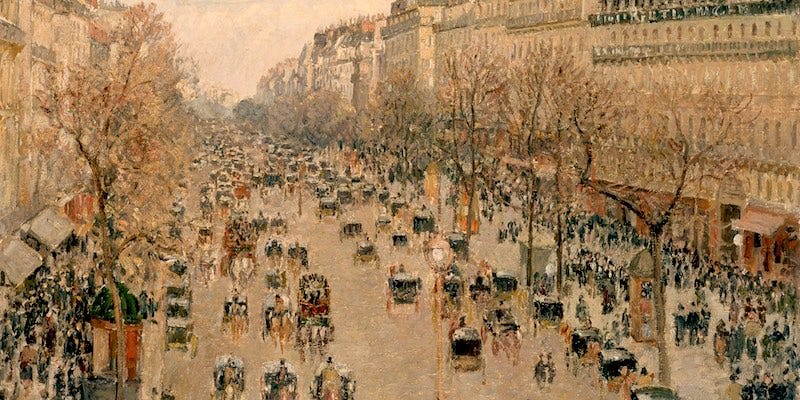
Paris, France
July 10, 2026
[NB: Previous installments are linked here, here, here, and here]
In a world drowning in disunity, it’s comforting to find a sense of order - a consistency of style leavened with variety in detail.
We appreciate trees lining streets like soldiers in formation, shielding pedestrians from summer sun and passing cars. Grand boulevards blending with cobblestone streets and hillside steps. Façades on buildings tastefully tall, that exude symmetry to exalt beauty. Low-slung bridges crossing the Seine, linking quais and quartiers that remain distinct on both banks, adorned with emblems and statuary exalting heroes that glorified France. Dozens of neighborhood churches and museums, any of which would be reason enough to visit most American cities, are almost afterthoughts amid the abundance.
But the greatest monument in Paris is the city itself. There’s no other like it. It’s the suave sister its urban siblings long to be. But reconstructive surgery was required to evoke their envy.
Ramshackle City
At the time of Philippe Auguste in the late twelfth century, Paris was a city of wooden shacks and muddy streets. Its original Roman name, Lutetia, was an apt appellation (“marsh” sounds much better when translated into Latin).
Philippe, appalled by the offal and filth that marred “roads” along the Seine, ordered all paths paved with stone. During his reign Notre-Dame’s façade was finished, and the Louvre was built as a fortress guarding the Seine.
All this helped… but not much. Under Philippe Auguste, Paris became permanent capital of France. But much of the city remained ramshackle. For several centuries, plague, war, and religious turmoil kept it mired in dilapidated chaos.
Even the arrival of the Renaissance focused affluence and art more along the Loire than beside the Seine. While Valois chateaux rose between Blois and Tours, Paris bided its time.
At the turn of the 17th century, the Bourbons began beautifying the city. The Protestant Henri IV decided Paris was worth a Mass, and became Catholic to be crowned king.
During his reign the Pont Neuf and Grande Galerie du Louvre were completed. But his greatest bequest was the Place des Vosges, the former jousting ground that graces the Marais. Tall privacy walls and large wooden doors shield exquisite mansions, museums, and corporate headquarters on the other side.
Venus from a Cesspool
Despite decamping to Versailles, the Sun King continued making improvements to Paris that his grandfather began. The Place Vendôme was his most significant development.
Started by the architect-developer Jules Hardouin Mansart in 1686 as a for-profit townhouse ploy, the project began to wobble. Louis XIV was importuned to rescue it by putting the royal mint and other offices along the site.
At first, Mansart had erected only the building façades… as a Potemkin gimmick to entice buyers. When the scheme failed, they were torn down and the plaza was redesigned in 1699 to the familiar octagon it is today.
The Place des Victoires was a more successful private venture, a 127-foot-diameter circular plaza, also by Mansart, focused on an equestrian statue of the king.
But the main problem persisted. The Royal purse couldn’t sustain both Versailles and the city. So Parisians suffered cramped streets, filthy slums, awful sanitation, and inhuman housing for much of the populace.
But like Venus from a cesspool, beauty occasionally popped its head above the mire. The marvelous dome and complex of Les Invalides rose in 1671 as a soldiers’ hospital and home in a rural quarter on the Left Bank.
Across the river about the same time, Lenôtre laid out the Champs-Élysées. The boulevard became an elaborate entrance to Paris and a formal approach to a Tuileries Palace that rarely saw the Royals.
Touristy and a bit tacky today, when it opened the avenue was essentially a grand, expansive road through the woods. Development around it would mostly wait till after the Revolution.
As trees were depleted in the 17th century, virtually all new buildings were combinations of dressed stone, brick, or stucco. In 1667, the crown attempted to place height restrictions on Parisian houses, limiting them to five stories plus an attic. These caps were loosely enforced and often ignored.
Pebble in a Pond
The beautification (and sanitation) of Paris would wait till after the wreckage of the Revolution, and of a few that followed in the next half century.
The re-design was (literally) the surface achievement of the Second Empire. Emperor Louis Napoleon styled himself a “second Augustus”, envying how the first one made Rome “a city of marble.” With Haussmann as his prefect, he “ripped open the belly of Paris”.
During the operation, the entire abdomen was removed. The patient was in rough shape. For three centuries the population of Paris had exploded, with hordes of unskilled workers drawn from the stingy soil of a harsh countryside to the Medieval maze of Parisian streets.
The Seine had become the city’s main sewer. Streets were a fetid stew of pestilence, trash, and excremental deposits from hundreds of horses and thousands of men. Tenants piled into dilapidated structures that rose up to six stories above the street, with residents’ wealth declining inversely with distance from the ground.
Like a pebble in a pond, the new Paris radiated outward from the Arc de Triomphe. The number of avenues extending from l’Étoile rose from five to twelve.
Their names recall famous Frenchmen and Napoleon’s victories. The two exceptions are the Champs Élysées and the Avenue de la Grande Armée that extend each direction from under the arch.
Haussmann oversaw destruction of about 20,000 buildings lodging more than 100,000 people, particularly along the narrow streets in the center of the city. The outlines of demolished structures and streets remain marked on the Parvis de Notre-Dame, the open plaza in front of the cathedral.
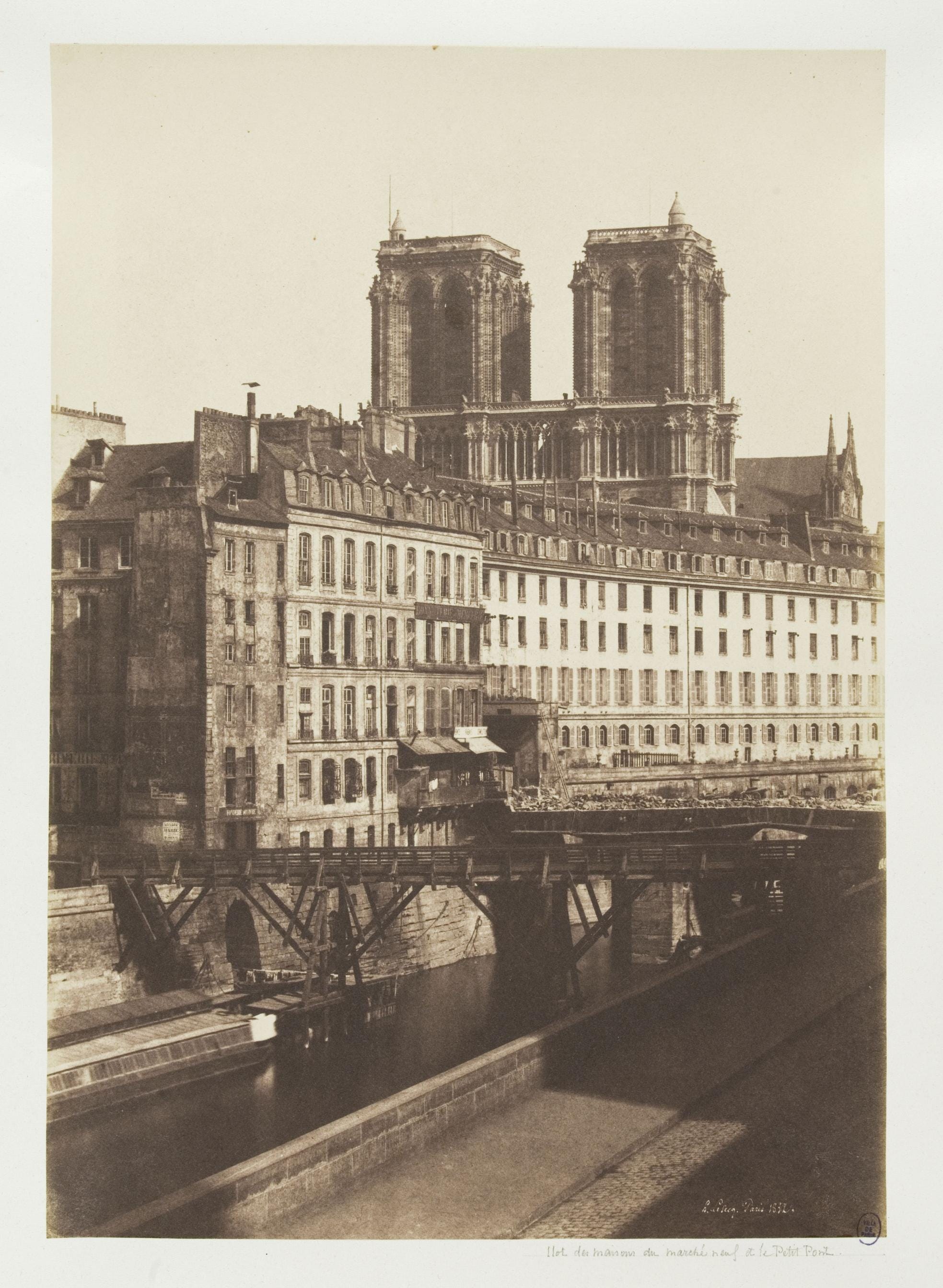
Some argue that the tight Medieval maze made Paris tough for authorities to control, prompting the emperor to open it up to crack down. Perhaps.
But sanitation was terrible, with trash, human waste, and animal excrement ubiquitous, flowing thru streets to streams, and into the septic system known as the Seine.
At mid-century fewer than 5% of the city’s dwellings had running water, none of it clean. It came from wells that fermented fatal diseases. Cholera outbreaks were common, and became more likely as crowding continued. Some alleys retain the camber that once carried sewage down their center.
Haussmann tapped springs from the Champagne region as sources of clean water, and appointed Eugene Belgrand to expand a subterranean sewer system for Paris. He harnessed the hydraulic power of waste and rainwater to propel flow thru his expanding network of underground pipes.
Horizontal Sutures
At the surface, Haussmann’s grand boulevards served as horizontal sutures after reconstructive surgery, with unifying apartment blocks featuring friezes and balconies as horizontal seams.
Adorning these immeubles haussmanniens, a couple stories below the Mansard roofs, transition lines of cast-iron verandas and decorative friezes are civilizing influences, using geometry to accentuate urban order thru architectural unity.
Immeubles can’t be taller than seven stories. The cut-stone façade is their distinctive feature. All floors and windows are set at the same level, giving the buildings an appealing cohesion that helps stitch the urban fabric.
Entrances are often double doors between shops or businesses on the ground level. These establishments usually have high ceilings and a narrow mezzanine corresponding to a second floor.
Parisian buildings exude decorum. Aside from monumental government or religious structures, they don’t strive to awe the bourgeois with bold statements. They’re unified by elegance and understatement, with diversity reserved for storefronts on the ground floor. Other than the occasional flair enlivening the entrance, Parisian edifices tend to be dignified backdrops to activity on the street.
Most of these streets, and particularly the grand boulevards, are also deliberately assembled. Even wide avenues convey the intimate sense of cozy corridors. Most Parisian streets predate the automobile, many by centuries. Some, like the Rue St Denis or roads to Montmartre, were once country lanes leading out of Paris.
But the city has done an admirable job accommodating the car. Parisian boulevards are pieced together in an elegant way, allowing motor traffic, parking, and pedestrians to share the corridor in an amenable manner.
Even the widest roads, which are usually garish and revolting in the United States, are pleasant thoroughfares in the heart of Paris. This is because of conscious coordination among constituent parts.
Small medians typically line each side, hosting series of identical trees formally planted at equal spacing and standard height. These form an emphatic line along the street, making it look less wide than it actually is, while also separating side (local) lanes with parallel parking from the main flow of traffic, and offering shade and a psychological shield to pedestrians.
Streets are very ordered, with disciplined architecture featuring rusticated neoclassicism, with arched doorways and cut stone incised into a uniform array of outer walls. The ensemble is bound by beautiful buildings of appropriate height, with façades fronting the edge of the sidewalk, and often anchored at either end by a terminating vista of an iconic edifice.
Paris reminds us that appealing urban places are contingent on the ability to shape space with public buildings. In its plazas, parks, avenues, alleys, and promenades, Paris does this.
Shops, bars, and bistros line sidewalks and surround plazas, with waitresses, patrons, and pedestrians flowing in and out of adjacent buildings. This scene is common all over Paris.
In this city, as in much of Europe, people congregate because the setting is inherently appealing. Concerts, games, and gimmicks aren’t needed to attract them to town.
Geometry, Proportion, and Scale
The French place greater emphasis on geometry, proportion, and scale than their English-speaking counterparts. They employ these elements to infuse order and unity into public spaces. This is particularly evident in their parks.
With some notable exceptions, such as the Parc des Buttes-Chaumont on the east side of the city, most Parisian parks retain the Baroque formality of Lenôtre. Unlike informal “green spaces” in England and America, Parisian parks respect their purpose to present a peaceful part of a civilized place, not to pretend to be wilderness in the middle of a city.
Urban greenery is necessarily formal. Parisians understand this, and don’t use parks as palettes to replicate the rural. Like Parisian streets, the city’s gardens are layered. Just like the people they were designed to please.
But no place is perfect. Like any of them, Paris makes mistakes. Tomorrow we’ll take a look at some of the few things it’s done wrong.
JD
Thanks very much for your detailed and very informative post !!!
🎯🎯🎯 👍👍👍 💙🤍❤ !!!
How is it possible that today, I'm the only one ??? ...