


Versailles, France
July 12, 2026
[NB: Previous installments are linked here, here, here, here, here, and here]
The Seine was a sewer. Effluents of tanneries, butchers, and human excrement flowed into the river.
This wasn’t unusual. Most cities were filled with filth. That’s why nobles and kings fled to the country, which was filled with fauna.
Louis XIII went to Versailles, where he built a hunting lodge twenty miles from Paris. But his successor turned his papa into a piker.
Palace in Paradise
Louis XIV hated Paris. From an early age when he and his mother fled the Fronde, the young Royal despised his capital.
Amid political intrigue that risked his crown, the Sun King decided to skip town. He went west, and settled at the modest lodge his father left him. Fearing betrayal within his Court, Louis plied courtiers with luxury to buy their obedience.
The “lodge” sat on a rising slope within a rich woodland. Andre Lenôtre saw art’s potential to turn the site into a garden of the gods. As the main beneficiary, the King gave his gardener free rein.
Louis Le Vau and Hardouin-Mansart pioneered French neoclassicism in the architecture of Versailles. The construction and expansion of service wings on the forecourts and of the classical garden façade are their signature contributions to the royal estate.
In the gardens, Lenôtre imposed geometric order on a haggard wilderness. Like a seventeenth century data center, the Châteaux at Versailles consumed more water than the city of Paris.
Because the palace sits on a dry plateau, rivers were diverted to nourish gardens, fill ponds, and feed fountains. Most was pulled from the Seine into elevated reservoirs, then guided by gravity into fountains servants activated sequentially as the king walked by.
To supply deficiencies gravity couldn’t accommodate, a pumphouse was built at Bougival. The impressive Machine de Marly was an array of fourteen waterwheels on the Île de Bernaches along the Seine, pumping additional flow to ensure sufficient storage. The gravity-fed system is essentially the same today, pumping recirculated water from its drainage at the Grand Canal to replenish the ponds.
Aqueducts filled baths that washed the women who graced Versailles. Within this Elysium, the king’s second wife got her own shack when the Grand Trianon became a retreat for Mme. de Maintenon.
While Lenôtre massaged the landscape, Le Vau and Mansart erected a palace in paradise. The small hunting lodge erupted into a riot of apartments, galleries, dance halls, reception rooms, and administrative offices.
Under Louis XIV, as Church succumbed to state, architecture subjugated religion to royalty, and expressed state power over sacred devotion.
The size of the Court grew as the estate expanded (the property would encompass territory ten times greater than the grounds today). It included about 600 hangers-on when Louis XIV came to Versailles, but increased more than twenty-fold at the height of his reign.
Tough to Absorb
Versailles is impressive, but it isn’t elegant. Le Vau’s Vaux-le-Vicomte, by which Versailles was inspired, is more intimate and harmonious.
Many parts of the palace are appealing, but the whole is haphazard. The chapel is stunning, tho’ the over-the-top ornamentation must’ve distracted from prayer.
The château can be tough to absorb. Rooms queue sequentially, requiring passage thru several to reach the one you want. Many are smaller than we’d expect in such a vast building.
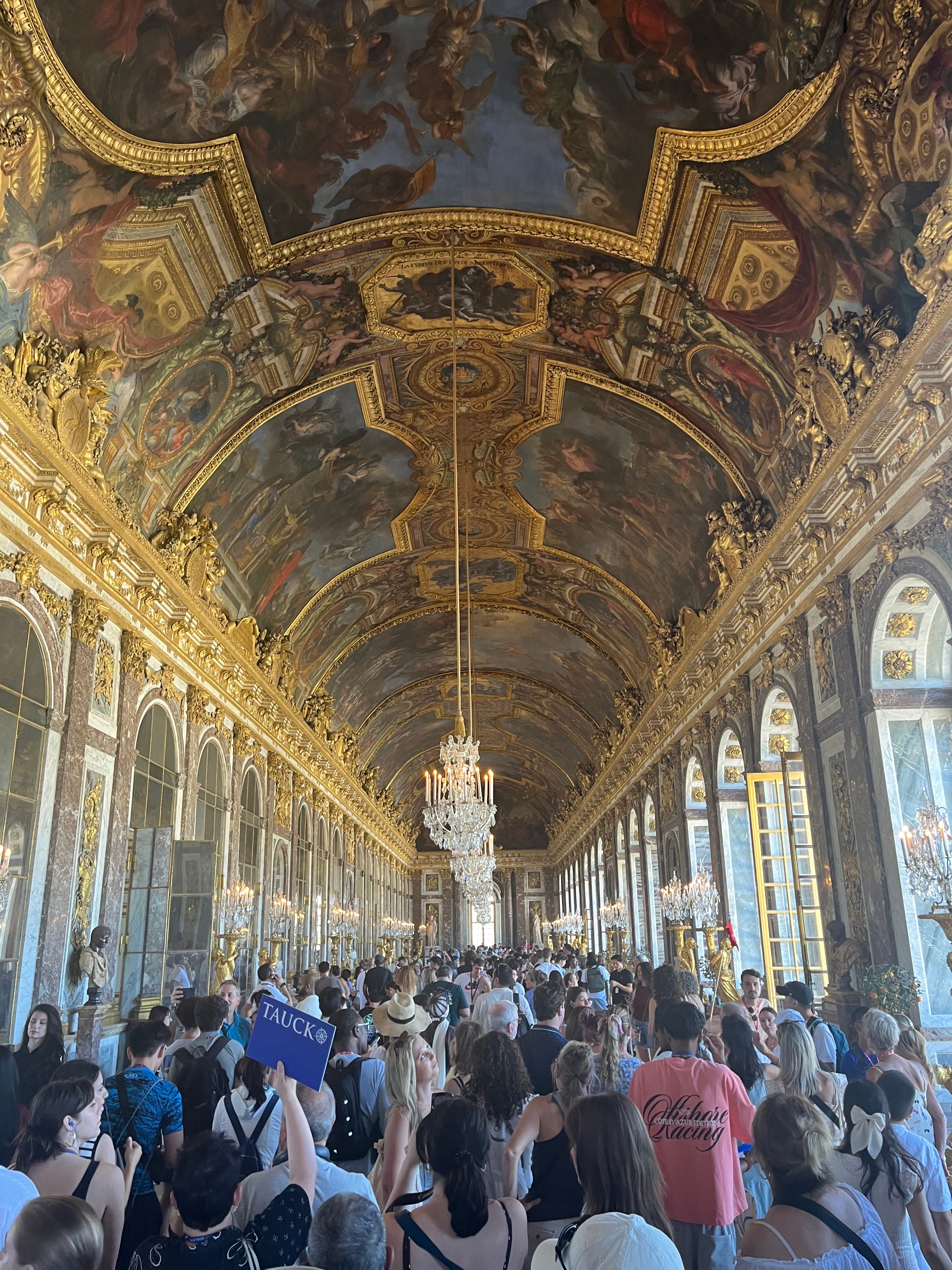
The Galerie des Glaces is an obvious exception. It covers the extent of the garden front, and astonished guests with tapestries, sculpture, fine furnishings, and the great mirrors that gave the hall its familiar name.
The ceiling is a masterpiece. Le Brun elevated it with paintings symbolizing the martial triumphs of Louis’s reign, some of which never occurred.
As Lenôtre was unleashed on the landscape, Le Brun had license to adorn Versailles’s interior with visual art. Like the palace, his contributions are more impressive by their profusion than their excellence.
A flood of Baroque ornamentation tends to drown the classical essence of each piece. But collectively, the two dozen frescos over the Grand Gallery and in the adjacent Halls of War and Peace are inspiring exaltations of the king who defined his time.
The château inspired imitation around Europe. At Vienna, Dresden, Stockholm, and St. Petersburg, rival princes wanted similar palaces of their own. Even Washington, DC was planned by a Frenchman, with long avenues, grand boulevards, and geometric design that emulated the new village at Versailles.
This pleasure dome had a political purpose. It was large and appealing enough to house the nobility of France, and to intimidate representatives from other realms.
Away from the ancient power their own estates provided, these dukes and princes became subservient to the king rather than his rivals. And the sovereign provided an assembly line of food, wine, music, and ladies to keep ministers under his thumb.
As should’ve been expected, the expense, arrogance, and optics of this bacchanalic indulgence was a recipe for revolution. Fortunately for the Sun King, popular temper took a century to boil.
The Chute
I was last in Versailles at the turn of the century. That was during Spring, when temperatures were cooler and crowds thinner.
Nôtre-Dame, Sacré-Cœur, the Louvre, and Eiffel Tower are the most popular sites in Paris. Versailles is on their heels, welcoming almost eight million annual visitors.
I think all of them were with us in the Hall of Mirrors. Subways in Tokyo have more space. After a private tour of the king’s rooms, a public viewing of the Queen’s quarters, and funneling thru State apartments like herds of buffalo in a Dakota canyon, we decided to escape the chute and go outside.
Under the monarchy, the exquisite park was open to the public. Fortunately for us, it still is.
The gardens of Versailles encapsulate the essence of style from late-seventeenth century France. The scale overwhelms, reminding guests where (and with whom) real power resided.
A Different Pit
Many walls at Versailles were honeycombed with corridors to prevent servants being seen as they served their masters. In 1789, those passages became fleeting lifelines when an unruly mob sought Marie Antoinette.
Across the realm, the earth had been stingy, with weak harvests yielding meager output. Centuries of government imperialism and royal extravagance had wrecked the currency and emptied coffers. Hunger and tempers began to rise.
Peasants packed into Paris, filling Medieval streets and alleys to live in filthy, violent, overcrowded slums. On the Rive Droit, districts like the Cours des Miracles became seedbeds of resentment and revolt.
Finance Minister Jacques Necker faced the impossible task of balancing the state budget. The nobility resisted incurring taxes to fill the hole, so the king dug a different pit.
He convened the Estates General at Versailles. This body hadn’t met since the early 17th century. Louis XVI would regret calling them now. The Third Estate decided they wanted more change than Louis was willing to make.
To get it, they created the first National Assembly, which met an indoor tennis court in the palace of Versailles. Attendees pledged not to dissolve till France had a new constitution.
Louis had other ideas. He tried to disband the Assembly on July 12, 1789. Camille Desmoulins climbed a table and urged Parisians to take action.
They did. Two days later, they stormed the Bastille. Royal officers were killed and the governor’s head was paraded on a pike. Only seven prisoners were freed from the fortress.
But the real prize was the ammunition stored inside, and the realization that Royal authority wasn’t invincible. The French Revolution was underway.
Three months later, working class women led a mob from Paris to Versailles to confront the king. To reach her husband’s chamber, Marie Antoinette fled thru the secret passages within the palace.
It didn’t work. The Royal family was imprisoned in Paris. Within four years, the king and queen would both be killed.
After furniture was confiscated, royal fleur-de-lys removed, and all art removed to the Louvre, Versailles was relatively quiet. After the restoration, Louis XVIII considered reviving it as a royal residence. Louis-Philippe made it a museum, which would also serve as stage for grand ceremonies.
Like a Guillotine
Eight decades after the Revolution, beneath the hagiographic frescoes in the Galerie des Glacé, Prussians would humiliate the defeated French, only to be subjected 48 years later to a revanche that imposed a fleeting “peace” on a weary world.
In the last year of the First World War, German guns bombed Paris. Fortunately, they missed the Louvre, which was an intended target. But they hit Saint-Gervais church during Good Friday service, and frayed nerves around the city. Otherwise, these explosions around Paris didn’t affect the war. Yet they encouraged France to harden the peace.
After losing Alsace and Lorraine in the Prussian War, the French were in a foul mood. The First World War made them destructively vindictive.
The process that produced the Treaty of Versailles became more about punishment than peace. The whole world would feel the lash.
Unlike when the Congress of Vienna included the defeated French as part of the settlement, delegates at Versailles didn’t invite the hated Germans until terms were announced.
The treaty was actually finalized at the Quai d’Orsay. Memories of the Prussian War and the Commune prompted Clemenceau to shift to Versailles for fear of uprising should Germans enter Paris.
But the notion of humbling Germans who’d humiliated France there half a century earlier was doubtless a major motivation.
The Germans didn’t come to the conference simply to receive conditions for peace. They were invited to Versailles to be vanquished - to unequivocally accept the accusation that they alone caused the war.
The terms of the treaty would wreck the country. It was less an armistice than a forced capitulation. It was something the Germans couldn’t sign. But under the circumstances, they had no choice.
The Galerie des Glaces was ornamented with a horseshoe table, before which, “like a guillotine”, sat a small table to receive German signatures. Twenty-one years later, at Compiègne where Foch signed the Armistice, Hitler would ostensibly dance a jig on the Versailles decree.
Foch himself saw it coming. He prophetically declared Versailles “not a peace, but a twenty year truce… The next time, the Germans will make no mistake. They will break through into northern France and seize the channel ports”.
In coming days we’ll move down the Seine and twenty-five years into the future, to see somber proof that Foch was right.
JD
Merci beaucoup de nous faire partager vos voyages en famille !!! 👍👍👍
Narcissists in power, former and current, are a curse indeed ...