


Le Havre, France
July 14, 2026
The most consequential events of modern history began 237 years ago, on the streets of Paris and the road to Versailles. The stone cast in 1789 splashed in the Seine, soaked all of Europe, and sent ripples every direction.
The waves watered St. Petersburg in 1917, wet Shanghai in 1949, and washed over Cambodia in 1975. More and more, the puddles pour onto our own sidewalks.
The French Revolution is sometimes considered a transatlantic extension of the American one. No doubt the flame of 1776 helped spark the conflagration of 1789.
But the two events were fundamentally different in origin, nature, and ramifications.
Off the Train
What we colloquially call the “American Revolution” wasn’t really a revolution at all. It was a parting of the ways, albeit an acrimonious one.
As in the War Between the States, a contested divorce, or a South Chicago mugging, it was a matter of one side wanting to leave and the other not willing to let go.
The War for Independence was a secession of thirteen states trying to take their place among (yet apart from) the powers of the earth.
But, unlike French revolutionaries, American separatists didn’t want to displace the Crown. Nor was there a wholesale destruction of tradition, or an attempt to eradicate the past.
Many Loyalists were forced to flee, and Patriots did re-name Kings College and pull down statues of George III. But they had no desire to dissolve parliament or overthrow the monarchy.
For the most part, American states saw themselves as true inheritors and perpetuators of English liberty. They followed tracks from the Magna Carta to the English Bill of Rights… to the Declaration of Independence.
It was the British government that went off the rails. The colonists simply wanted off the train. Their secession was a revolution not made, but prevented. Betsy Ross, not Madame Defarge, did their knitting.
A true revolution is different, and more dangerous. It’s a disruption rather than a continuation. An overturning, not a fulfillment.
Valid grievances become insane demands. Traditions are scrapped, language is overhauled, and sides are taken… or assigned. Revolutions are akin to playing Russian Roulette… but with a bullet in every chamber, just to be sure.
Like a bubble stock market, a revolutionary society takes the stairs up… and the elevator down. In recent years, we’ve felt as if we’re on the edge of the shaft, staring into the abyss. La Marseillaise rises in the distance and rings in our ears.
The Front Burner
The Marquis de Lafayette famously connected American independence to the French convulsion. In less conspicuous fashion, so did Axel von Fersen. A count of Sweden at the Court of Louis XVI, he was a (reputedly very) close friend of Marie Antoinette.
Von Fersen left France to join Rochambeau at Newport, and eventually Washington at Hartford. After the war, the victorious states signed a treaty of commerce with Sweden.
Washington awarded von Fersen the Order of Cincinnatus, which King Gustavus forbade him to wear because he earned it fighting for republican principles. When he returned to Europe, von Fersen resumed fighting for monarchical ones.
The King of Sweden was itching for war with Denmark, and returned von Fersen to Paris to help forge an alliance with France. Aside from a stint in Finland helping the Swedes ward off the Russians, von Fersen remained a fixture at the Court of Versailles.
As favorite of the Queen (hostile historians suspect he fathered her children) and a special envoy to the Crown, von Fersen was on the front burner as the pot boiled. He was in the hall when the Estates-General met, and heard Louis read his opening speech.
It didn’t have the desired effect.
The Third Estate soon rebranded itself as the National Assembly. By the end of June, the King reinforced regiments around the capital. A couple weeks later, the Bastille was stormed and Les Invalides was taken.
Von Fersen convened with the King at Versailles to decide how to quell the riots. Louis decided to go to Paris. Von Fersen joined him, and watched the king acquiesce to the revolt.
But royal accommodation fueled rebel fire. Within a month, most aspects of the monarchy were abolished. Mayhem spread, the royal army disintegrated, and revolution consumed the Eldest Daughter of the Church.
Cancelled Flight
The mob soon made its way to Versailles. The French guards had mutinied, and were replaced by a regiment from Flanders. They were more like doormen (or doormats) than deterrents. The horde rushed the royal apartments, and Louis agreed to return with them to Paris.
For two years, conditions deteriorated, and the erstwhile royals grew desperate. Von Fersen agreed to get them out. He arranged for a carriage, which he timed to arrive at a changing of the guard.
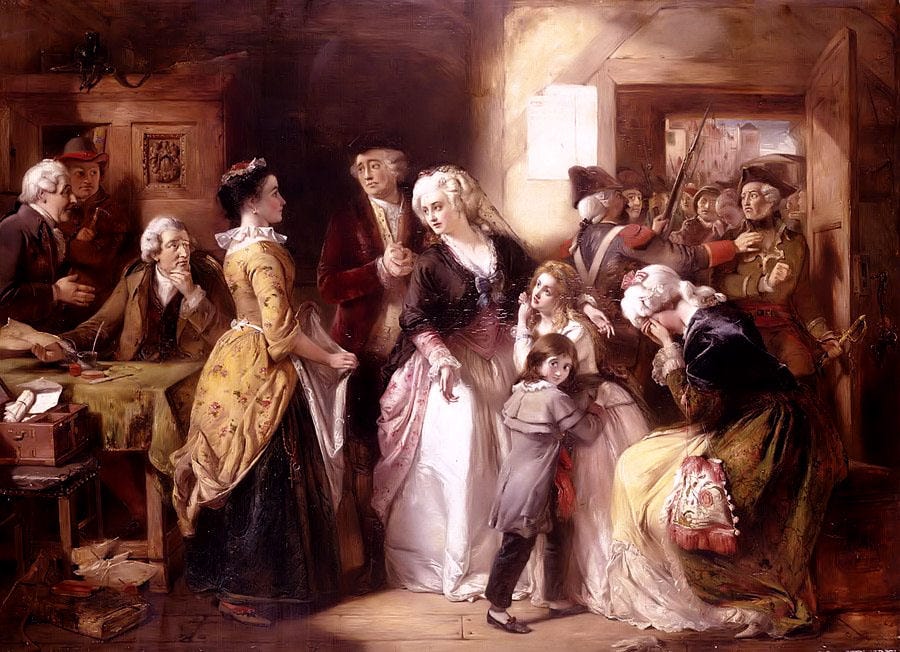
The children, king, and queen boarded separately. Von Fersen drove the carriage, beginning a futile flight that would end in Varennes. There, the royal family was recognized, captured, and returned to Paris.
Their Swedish chauffeur had left the carriage when it stopped to change horses, planning to reconvene up the road to complete the escape. The rendezvous never took place.
Fugitive from France
But von Fersen was identified as an accomplice to the “crime.” A warrant was issued for his immediate arrest. He fled France, finding refuge with Antionette’s brother in Vienna.
Toward the end of the year, he went back to Paris camouflaged as minister plenipotentiary to the Queen of Portugal. He snuck into the Tuileries, and met with Marie-Antoinette.
He’d hatched a new escape plan, but the king seemed resigned to their fate and doubted it would work. As Louis put it, “I lost the opportunity, and it has not come again.”
It was the last time Von Fersen would see the royal family. He left Paris, barely clearing capture at a check-point by feigning sleep. A few weeks later, King Gustav was mortally shot at the Opera House in Stockholm.
In January of the following year, Louis was guillotined in the Place de la Révolution (now de la Concorde). Von Fersen was distraught, and knew the queen was in trouble.
By August, she was moved to the Conciergerie to await her “trial.” The verdict and sentence were forgone conclusions. By the middle of October, so was her life.
Von Fersen had returned to Sweden, where he watched the French Revolution devolve from afar. After the turn of the century, he was appointed Marshal of the Realm, the highest office in the Swedish Court.
A Lamb to Wolves
Ten years later, he was enmeshed in a heated war of royal succession. Von Fersen was accused of poisoning a rival claimant to the one he supported. During the funeral procession, vengeful mobs he’d dodged in France denounced him in Sweden.
His coach was attacked, first by coins, then by stones, and ultimately by fists. The throng crashed into the carriage and dragged its passenger to the ground. The arrival of reinforcements only enraged the crowd.
It needn’t have worried. The ostensible saviors did nothing, willing to throw a sacrificial lamb to the pack of wolves.
Axel von Fersen succumbed that day to the ravages of the rabble. He died of wounds suffered on the streets of Stockholm.
But the greatest he sustained were from convulsions in France, a rupture that continues to afflict us today.
JD
Thanks for your today's post about Axel von Fersen the Younger.
Foreign interference, even intimate, at the highest levels of power seems to be an intrinsic part of politics throughout the ages ... 🤣🤣🤣
What an exotic life this man, Axel von Fersen, led.
A Swede fluent in French who participated in not one but three calamitous revolutions -- events which historians still study today -- who was given a prestigious award by George Washington; reputed father of Marie Antoinette's children; arranged an escape from the Bastille during the French Revolution; evaded capture by Revolutionaries only to lose his extraordinary life when a mob attacked his carriage after he returned to Sweden.
Sad ending for a man who was a participant in the dramatic changes by which democracy replaced monarchy.