


Reims, France
July 7, 2026
[NB: Previous installments are linked here and here]
Three centuries after Christ, the Roman Empire was coming apart. But fourth century Gaul was among the more materially prosperous, intellectually advanced provinces of the western realm.
The rising Franks had arrived from the east, pressed west by encroaching Huns. They were a hardy race that reveled in being free. That’s (ostensibly) what their name meant. They were enfranchised after liberating themselves by repelling Roman rule.
Though they could be fearsome fighters, they waged war less often than our own enlightened leaders. The Franks also left legislation that preserved relative prosperity and general peace.
These prescriptions were inscribed in the Salic Law. Though wide-ranging, its most consequential code proscribed Salic land being inherited into female hands.
A millennium later, this clause kept English King Edward III from capturing the French crown thru his French mother. That slight launched the Hundred Years’ War.
In the fifth century, a possibly apocryphal Frankish ruler called Merovech spawned a dynasty, and had a grandson who essentially founded France.
Clovis (a Merovingian version of “Louis”, the origin of eighteen French monarchs of that name) was fifteen when he took the throne as the “first” Merovingian, and consolidated his kingdom by grabbing northwestern Gaul. A few years after his death, the Burgundians abandoned Arianism for Catholicism, and succumbed to the Franks.
Clovis’s conquests reached Brittany and the Loire. They also included Clothilde, a Christian woman who became his queen… and converted him to the Faith.
Baptized by St Remi at Reims, Clovis set a precedent for his successors. After 1027, most French kings were crowned in that city’s cathedral.
For some, it took a while, which undermined their legitimacy. During the third phase of the Hundred Years’ War, the English invasion precluded Charles VII from receiving his crown at Reims.
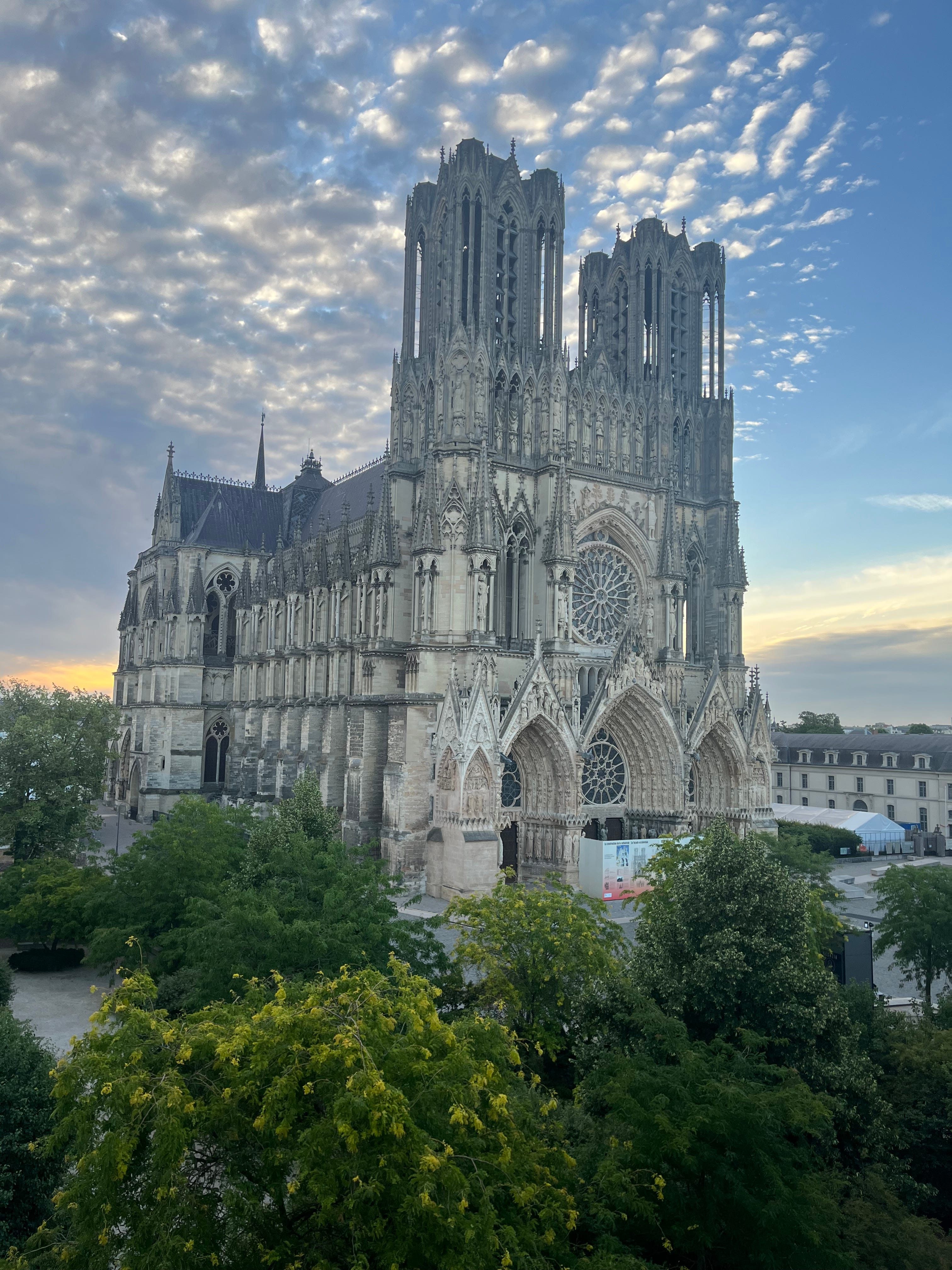
After lifting the siege of Orléans, Joan of Arc led Charles to Reims to legitimize his reign. The tide of war turned, the English were ousted, and Reims retained a soft spot in French hearts. As does its cathedral, which has been our companion and guide since we arrived.
From the window and balcony of our hotel room, it fills the scene and awes the senses. From a distance, it’s a benchmark and compass: its eastern orientation provides direction; the twin towers become looming beacons that bring us home.
Style and Structure
Like the Scholastic summae of the Middle Ages, Gothic architecture synthesizes preceding traditions rather than exclusively adopting or rejecting previous forms. It represented systematic construction, creating overall coherence from individual components.
The cathedral often dominated Medieval cities. In Reims, which is now home to almost 200,000 people, it still does. After visiting it, we can see why.
With counterparts at Amiens and Chartres, Notre Dame de Reims is one of three major Marian cathedrals from the 13th century. The cathedral that preceded the current masterpiece burned down in 1210, when building began on the Gothic gem for which the city is now known.
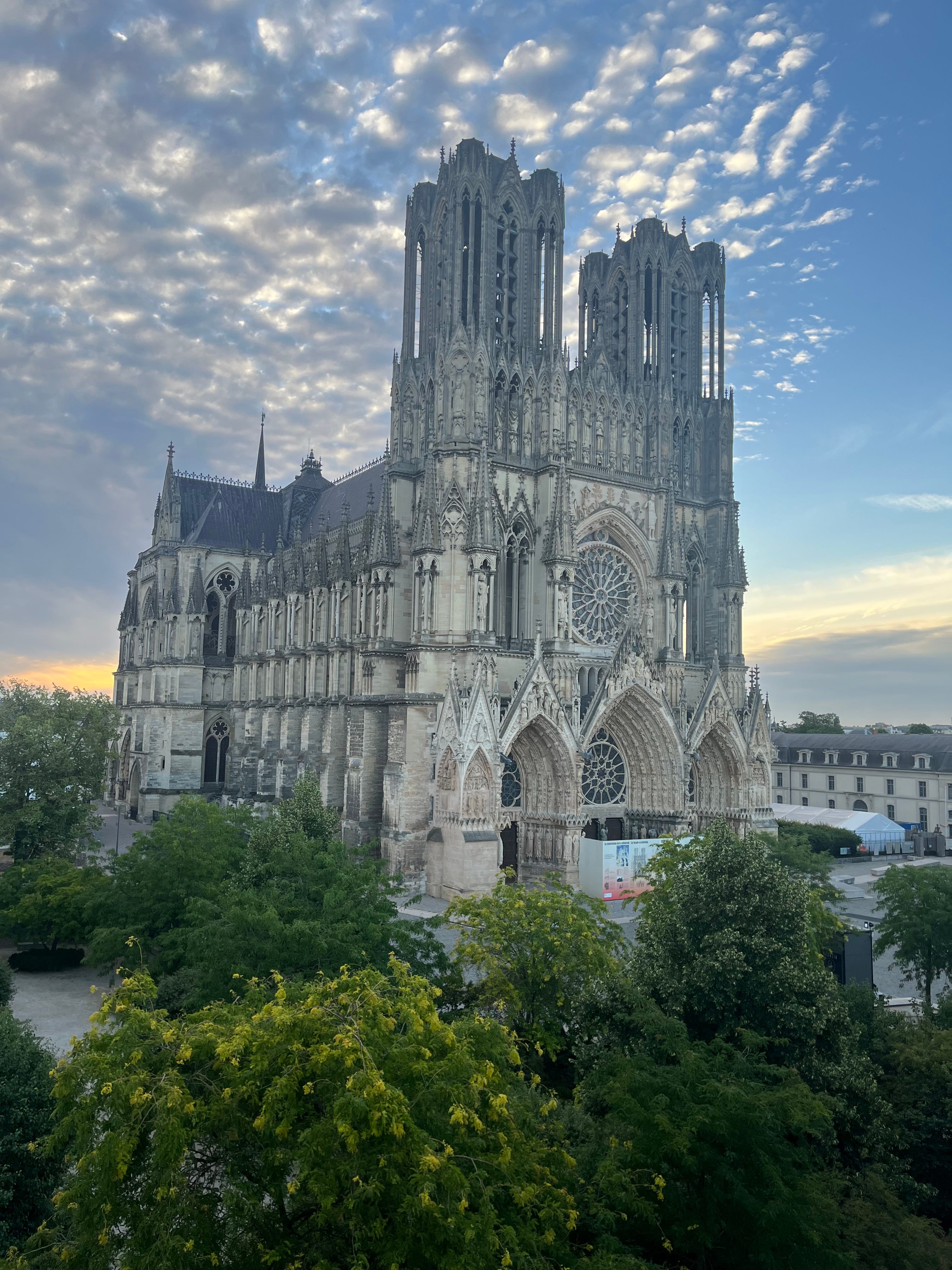
Twin towers (which originally featured spires) entice the pilgrim as he approaches from the west. The front tympana boast rose windows that let evening light flood the nave. Though these heavenly filters replace sculpture that often adorns space above doors, statuary abounds around the façade.
More statues grace Reims cathedral than any other church in France. Thousands of saints, angels, prophets, demons, bishops, and kings fill archivolts and pediments, surmount columns, and consume space between the towers and beside the doors.
I’ve not seen flying buttresses as systematic and dramatic as they are at Reims. That’s because architectural ingenuity makes them hard to see at all. Their bases are capped with ornate spires that grace engineering with the gift of art, becoming decorative turrets that strengthen the structure.
Gothic vaults push outward against the walls. Flying buttresses redirect that lateral thrust into vertical piers on the exterior. But horizontal thrust combines with the weight of the pier to create a diagonal force. If that force’s vector tilts too far from vertical, it exits the base of the buttress, tempting it to topple outward.
The heavy stone spires atop the piers steepen the force vector, pulling it vertical so it stays within the middle of the buttress’s footprint. Because masonry is excellent in compression but very weak in tension, keeping the thrust-line centered prevents the joints from opening on the outer face.
The pinnacles atop Reims buttresses are unusually tall and elaborate. Many house tabernacles with statues of angels. That extra mass isn’t merely an ornamental flourish.
The added weight permits slimmer, more daring buttresses while still resisting wind loads and the thrust from the high vaults. In a partnership that was once an aspiration of architecture, style and structure perform supplemental functions.
The roof superstructure is a concrete copy of the wooden original destroyed in the First World War. To supply flexibility, oak pegs secure the reinforced concrete beams.
With the new roof being more structurally stable and less susceptible to fire, visitors are allowed to wander under the rafters - a space resembling an overturned hull of a concrete ship. We were proud to learn that American donations made this restoration possible.
A proliferation of immaculate stonework reflects admirable attention to detail. These craftsmen were indifferent to our inability to detect defects from the distant ground. Sculptures are everywhere. Angels, demons, gargoyles, beasts, and anonymous men make an appearance in stone.
Uncredentialed Expertise
Interiors of Medieval cathedrals are typically distinguished by a light choir and darker nave. But Reims offers the opposite effect, primarily because the stained glass windows were removed from the nave yet remain in the choir.
Reims features a three-part elevation of aisle, triforium, and clerestory windows. Verticality defines the nave, with bay pillars topped by intricate capitals.
Looking up, standard four-part vaults support a distant ceiling that recedes toward the sky. The triforium arches are sharply pointed, consistent with those connecting the aisle to the nave. Elaborate capitals enhance the columns, and epitomize the uncredentialed expertise that created these gems.
In most cathedrals, a wall separates the altar from the ambulatory. Reims does too. But the wall is low enough to permit a view thru the candelabra toward the west entrance. It’s astonishing. A pair of stained glass rose windows represent the interior of the tympana over the central doors.
About fifty statues surround the lower rose, including depictions of John the Baptist, Old Testament prophets, and the story of Melchizedek giving bread and wine to Abraham, with the patriarch dressed as a Medieval knight.
The choir windows are original, and the stained glass is a remarkable arrangement reflecting apostolic succession. The apostles grace the upper tiers, with assorted bishops (including the Archbishop of Reims and his subsidiaries) featured below. Reims cathedral itself is also shown, emphasizing its perceived primacy in the annals of France.
Ravages of War
Leaving the church, we glance again at the jamb statues around the central west entrance. Most notable are depictions of Mary and Elizabeth during the Visitation. Their graceful disposition differs from most stiff Medieval sculpture. The facial expressions and garment folds betray familiarity with the ease and flow of Roman forms and Greek art.
The “smiling angel” Gabriel has for six centuries greeted visitors at the west front portal. But he was forced from his post for a dozen years. The statue was decapitated during the First World War. The Germans had taken the town, and converted the cathedral into a hospital.
When the occupiers abandoned the city, the church received their heaviest artillery. Some of it hit the rear of the building, igniting pine scaffolding that was emplaced around the edifice.
Flames consumed Medieval rafters and beams supporting the roof. The heat caused some of the stones to crack, and severed the head from the neck of the smiling angel.
At the time there wasn’t much to smile about. By the end of the Great War, over 90% of Reims was in ruins.
Of a population of 115,000 that heard the guns of August, fewer than 2,000 remained to appreciate the Armistice. Many had hidden in Champagne cellars honeycombed beneath the city.
A sizable post-war sentiment wanted to leave Reims in wreckage as a memorial to the ravages of war (much as Oradour-sur-Glane was embalmed after the next world war). Fortunately, that inclination didn’t last.
Reconstruction commenced, and though the cathedral didn’t re-open till 1935, the smiling angel retrieved his head almost a decade earlier. Around the façade, other saints and angels attest the horror of war with their missing limbs.
What Matters Most
Before the First World War, Reims rivaled Chartres in the glory of its stained glass. Most of it succumbed to German shelling in the first months of fighting. The transparent panes are bandages on war wounds that never healed.
An exception is in the apse behind the altar, a set of 20th century stained glass in intense deep-blue: a deliberate nod to the lapis hue that’s common to Gothic glass.
But the images depicted in the panels… the Tree of Jesse, a mingling of the story of Abraham with the life of Christ, and the coronation of French kings… intentionally reflect modern influence, to remind viewers what was lost.
When we learned these panes were by Marc Chagall, a favorite artist of my wife’s late father, we were consoled that what matters most will always be with us.
JD
😵😵😵 💥💥💥 ❣❣❣ 👍👍👍 !!!
And engineering feats way back when!