


Verdun, France
July 8, 2026
[NB: Previous installments are linked here, here, and here]
“But here in this graveyard that’s still No Man’s Land
The countless white crosses in mute witness stand
To man’s blind indifference to his fellow man,
And a whole generation who were butchered and damned.”
- Eric Bogle, “The Green Fields of France” (1976)
Every village in France has a monument to the dead… morts pour la patrie. About a million and a half French soldiers went to early graves between the Guns of August and the Treaty of Versailles.
This death toll exceeds what America suffered in the War Between the States and both World Wars… combined. Of eight million men France mobilized during the Great War, almost six million became casualties.
Traversing the green fields of northeastern France, the traveler can’t imagine that beneath sunflowers swaying under gentle breezes were pestilential pits resembling waiting rooms in Hell.
The ruts were deep enough to stand, but precluded their captives seeing over the top. Drudgery, disease, lice, fleas, flies, rats, excrement, flooding, and filth were the daily lot for millions of young men who’d barely escaped being boys. Many others never would.
With much of the front below sea level, trench depth assured soldiers’ shoes (assuming they had any) were always in mud. Water oozed from the walls. For more than half the year it fell from the sky.
Excepting seasons when it froze, bailing the seepage was a full-time job. During battle, emptying the trench wasn’t possible.
Even without rain (which was often relentless and torrential), the pits became open sewers that submerged torsos enduring enemy fire.
Along the front, battlefield mud was almost alive, with an insatiable appetite that consumed any man, machine, weapon, or horse that had the misfortune to step or fall into the hungry mire. Accounts relay that whatever did rarely got out.
The typical British, French, and German soldiers weighed less than 150 pounds. The average American may have contained 10-20 more.
But they wore, carried, or bore clothes, packs, and guns that could add another 100 pounds of soaked gear thru mud up to their knees and water over their waist. Trench foot joined shell shock as maladies indelibly linked to the First World War.
Ubiquitous Death
Incoming artillery often arrived in a deluge akin to drops of rain in a summer storm. Some might’ve welcomed the barrage of bullets, to provide eternal release from this abhorrent existence.
When fighting occurred, the troughs became muddy medical units and makeshift morgues. Stacked corpses reinforced sodden walls that otherwise caved at the slightest touch. As they became desensitized to ubiquitous death, soldiers used dead bodies as stepping stones, supporting props, or temporary tables within the trench.
This nightmarish existence persisted for years amid armed conflict at a scale no soldiers had ever endured. Artillery barrages were relentless in persistence and scope, with many shells emitting the yellow pall of poison gas.
The carnage was unfathomable. France suffered almost 300,000 casualties in the two-week massacre known as the Battle of the Marne, including about ten percent of her officers. And this was a French victory… still referred to in France as the “Miracle on the Marne” for how it was “won”.
In the first five months of fighting, France mourned three quarters as many dead as the Britain buried during the entire Second World War. Almost 30,000 Frenchmen fell on the first day of the Battle of the Frontiers.
It got worse. The British army suffered 60,000 casualties (20,000 dead) on the first day along the Somme… a battle that lasted four more months. That single offensive would claim more than a million casualties.
Numb Disbelief
We spent the day in and around the village of Verdun. Few places are as simultaneously solemn, harrowing, lovely, and revolting.
Between the first Battle of the Marne and Ludendorff’s last assault before the Americans arrived, Verdun joined Ypres as the sites of the only German offensives on the Western Front. The focus of fighting was the fortress of Douaumont on the right bank of the Meuse.
Verdun was the longest battle in modern history, and among the deadliest of all time. Vegetation has reconquered what was once a moonscape of mud, masonry, and human remains in which whole companies were buried alive.
Four hundred thousand Frenchmen were killed or wounded at Verdun, of which about 160,000 went under the earth. At Verdun, forty times more lives were lost in the battle than lived in the town.
The tower and crosses of the Douaumont ossuary guard the remains of 130,000 unknown soldiers in shared granite tombs. Down the road, we walked thru tunnels under the fortress French and Germans fought over for most of a year. After the fighting, the only upshot was destroyed towns, scorched terrain, and hundreds of thousands dead.
On the site of Fleury-devant-Douaumont, a village that vanished under the Battle of Verdun, the façade of a memorial chapel is graced by a Madonna. The Chapelle Notre-Dame-de-l’Europe mourns the town that died for France.
For France, the “victory” was “glorious”… yet Pyrrhic. Its devastating losses essentially assured defeat a generation later.
The Western Front carved these peaceful fields like a seismic fault that kept slipping. Within northeast France, the devastation and death were so extensive that they still evoke numb disbelief.
The Second Battle of the Aisne cost France 180,000 casualties. Unsurprisingly, within weeks of that slaughter (and after three years of senseless butchery), men began to mutiny.
They attacked their officers, decoupled engines from trains, and implored entire divisions to refuse to fight. Within a month, the insurrection afflicted half the French army.
General Pétain restored order before the Germans found out. He reassured his forces by letting them wait “for the Americans and the tanks.” U.S. intervention would tip the balance of this war, and press the scale to assure another.
The collapse of Russia relieved German forces in the east. Ludendorff made a final push to crush the Allies before more American doughboys arrived. This “Spring Offensive” claimed another 1.5 million casualties.
Pea Gravel
That summer, the Spanish Flu made its appearance, ultimately claiming more lives than the entire war. Through the infection, the fighting persisted.
German forces came within sixty miles of Paris before being repelled in the Hundred Days Offensive. This final campaign carried the war to its conclusion, with another two million killed, wounded, or unaccounted for by the time the Armistice ended the carnage.
Or did it?
East of the Rhine, communism was ascendant, revolution was in the wind, and ancient animosities erupted among ethnic tribes fighting over the carcasses of fallen empires.
To the West as well, “peace” was a passing illusion… a pause in a gruesome Thirty Years War. But France welcomed the respite to lick its wounds.
The catastrophe cost the country seven percent of its population. As with the British and Italians, more French were killed in the First World War than in the Second.
Even the late-arriving Americans, who (aside from the usual financial interests and munitions makers) had no stake in the outcome of the slaughter, lost men at a faster clip than in the War Between the States.
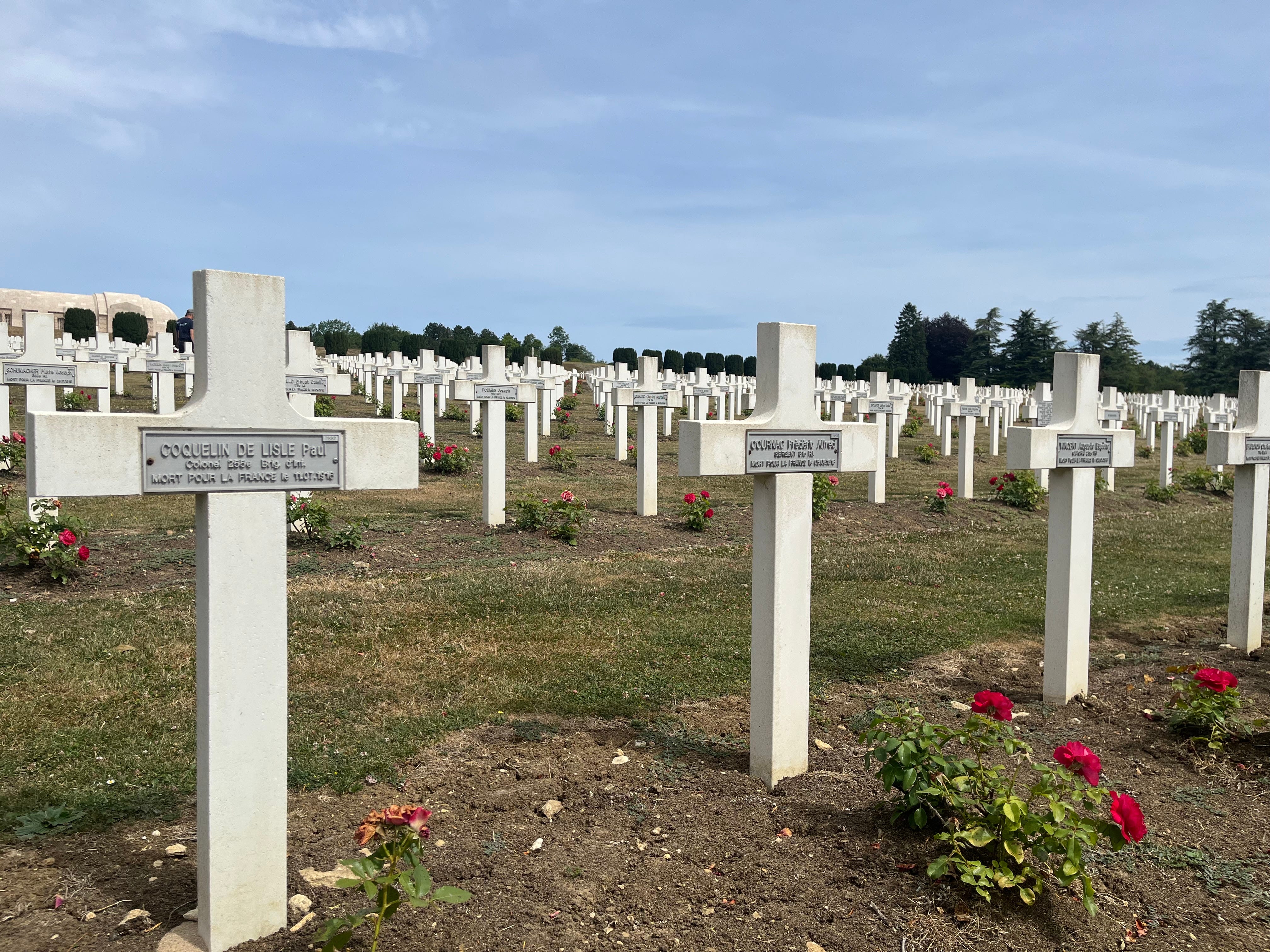
This afternoon, we paid respects to some of the dead. It’s almost impossible to see each of the thousands of cemeteries bearing bones of soldiers sacrificed in that worthless war.
We chose the French National Cemetery around Douaumont Ossuary, the tower of which depicts an artillery shell. Over 16,000 French soldiers lie here, plus those of a couple thousand Muslim colonists. Within the nearby fort, hundreds of German soldiers are also entombed.
Like pea gravel on a park path, tombstones and crosses pack together across northeastern France. After four years of incessant carnage, ten million men quietly screamed beneath the earth.
But while wreaths on their graves were still green, leaders in countless countries above the ground had already discarded what they had to say.
JD
PS - One of the best songs about this worthless war was written by Eric Bogle, and the Dropkick Murphys gave one of its most poignant performances (which, I grant, is not how Dropkick Murphys performances are usually described):
You provided a very poignant and moving ballad to conclude your Verdun battlefield tour.
The ballad's words, all visualized, sung at a dirge pace, were made especially impactful with the 100 year old film snippets of ghostly carnage.
The ballad made me sad, and sadder still due to the film snippets accompanying it.
Both proved that WWI was never the War To End All Wars; it was just a more vicious one in the enduring ones that mankind has waged unceasingly since recorded history.
This one really hit, JD. My grandfather fought at Gallipoli and in France. (Luckily?) he was gassed and invalided out of the war.
That is some song.
Thank you for this. Hopefully this crap will never happen again.