


Reims, France
July 5, 2026
Atlanta boasts having the “World’s Busiest Airport”, as if that’s something to brag about. Why not remind everyone how awful the traffic is too?
Friday afternoon, we made it thru both, onto our flight, across the ocean… and into France the morning of the Fourth.
The airport at Charles de Gaulle isn’t great either. It’s busy, hectic, and (as we were reminded) can be quite disorganized. But at least it’s easy to escape.
Or so we’d assumed.
French trains are comfortable, fast, and frequent, and radiate from Paris like traffic from L’Etoile. But not all of them take us where we need to go. We had to board one to find that out.
Plane, Trains, and Automobile
As expected in summer, Parisian stations are packed… particularly at Charles de Gaulle. Around the atrium chairs were full. Walls propped the backs of prospective passengers, while luggage and floors supported their butts.
Overhead screens flipped train schedules like a hyper-caffeinated croupier. Yet the one to Reims never appeared. Within thirty minutes of departure I began to worry.
But then my SNCF app gave the signal. Our train would depart from platform 6. Relieved, we grabbed our bags and went toward the gate.
We weren’t the only ones. The mob moving out of the atrium resembled the evacuation from Dunkirk. The train to Champagne remained disconcertingly absent from the smorgasbord of cities blurring the board. But I trusted our app, and led my wife into the crowd.
We found our gate, and showed our tickets to the first agent we saw. With an indifferent smile she waved us forward.
Still uncertain as we inched toward an escalator that supposedly descended to our train, I asked another person wearing official colors. Then another. And another. Each assured us we were where we should be. But none could explain why schedules revealed no train to Reims.
“It’s OK”, the last one lied. “Ça viendra à voie B.” Well, if “it will come to track B”… then off to track B we’d go!
Once again, we hauled our bags thru the throngs, and wound our way to the appointed spot. Assured we were finally in the right place, we grabbed a seat, caught our breath, and began to relax as we awaited our ride.
A few minutes later, a train arrived. Because it was bound for Montpellier, we stayed put. Almost everyone else climbed aboard. But like giving financial assistance to a Nigerian prince, what we’d done didn’t make sense.
The platform was empty, our train was already supposed to have arrived, and our destination was still AWOL from any announcements. Something was off… almost eerie. I decided to ask another agent. When I did, his eyes widened and his voice rose.
“This is it!”, he insisted, pointing at the Montpellier train which had been sitting idle several minutes. “Get on! Get on! Now! It’s about to leave!”
I ran back to my wife, and told her (in what I’m sure was a very calm, composed tone) “LET’S GO! WE HAVE TO BOARD!!”
As we hustled, I wondered what I was doing. I knew where Montpellier was. That it was about 500 miles in the wrong direction should’ve fazed me. Yet I’d followed orders like an idiot, assuming a stranger in a uniform could’ve cared less where we were trying to go.
For all I knew, he and friends were buckled over laughing at making a moron of an American. But this one needs no help.
We clambered aboard, and the train started moving. Once it did, I again felt like I’d left the iron on. Going to Languedoc to get to Champagne didn’t seem right.
On a whim, fatigued and frustrated, I showed our tickets to another attendant.
“Oh no”, she gasped.
Uh oh.
“We’re on the wrong train?”, I sighed.
“No”, she said. “You’re in the wrong car.”
“But it’s the right train?”, I pleaded… enlisting hope as my only strategy.
“Oui”, she promised. “But you need to take another one.”
(What?)
“Get off at the next stop and go to platform 3. Take the train to Strasbourg. It will stop at Reims.”
At that moment it hit me what happened. Our tickets included our departure time, assigned seats, and final destination. Yet they kept an important step a secret. We were supposed to change trains at Marne-la-Vallée Chessy. It was like booking a flight from Pittsburgh to Paris and not being told about the connection in Atlanta.
At the next station, we hopped off, hauled our bags, and hurried to the Reims train. Assured we were on the right one, we sought our seats… which two people were in.
I showed them our tickets. They showed me theirs… which looked just like mine. They were in the right seats. A helpful passenger took a glance, and pointed out a familiar mistake.
“You’re in the wrong car.”
I started looking for Alan Funt.
But then I realized he was right. I’d been looking at our return ticket. For this trip, we needed to be one car up. There we found (our) two empty seats, and enjoyed a comfortable ride the rest of the way to Reims.
From the station we took an Uber to the hotel.
War Room
The Hotel Caserne Chanzy is centrally located, part of the modern façade of an ancient city.
The suicide of the West known as the First World War destroyed most of Reims. German bombs turned almost 90% of it to rubble and ash.
Because the damage during the Great War was so extensive, Reims was a fortuitous site for Allies to receive the German surrender after the sequel.
This was a common pattern since the Prussian war, after which the victorious Teutons proclaimed a unified Germany in the hall of Versailles. The French demanded the same spot to exact vengeance after World War I, which had ended with an Armistice at Foch’s rail car in Compiègne. Two decades later, Hitler chose Foch’s car in Compiègne for the French to submit when the Occupation began.
We wanted to see where this pattern persisted. After checking into our hotel and dispatching our bags, we decided to walk. Under warm skies of unblemished blue, we strolled toward a nondescript structure across the river from the center of the city.
The brick building once housed the Collège Moderne et Technique, but that purpose was paused when Eisenhower used the logistical advantages of Reims to make the school the regional base for the Supreme Headquarters Allied Expeditionary Force (SHAEF).
For several minutes, my wife and I stood alone in the place where the war in Europe came to an end.
In a dark room below Ike’s old office, large maps fill each wall, depicting the Allied stranglehold on the Reich. These were irrefutable arguments to anyone in the room, and surrounded a long rectangular table hosting sixteen chairs.
Three are isolated on one side. In them sat delegates of the defeated regime, who asked that German officials and citizens be treated with respect. From the other side of the table, the request was met with the silence of disdain.
The Allies wanted unconditional surrender. When the document demanding it slid under his pen, Alfred Jodl had no choice but to sign. The next day in Berlin, Wilhelm Keitel ratified the capitulation.
Eisenhower was too contemptuous of the Nazis to share the room with their three representatives, so he let Bedell Smith procure their signatures. When the Germans left, Eisenhower met Jodl on his way out.
He had only two questions. Did Jodl understand the conditions, and was he prepared to carry them out? Jodl said “ya”, accompanied by a submissive bow.
Eisenhower warned Jodl he’d be held personally responsible if terms were violated. Then the General walked away, and never shook the German’s hand.
Works of Fire
War has always afflicted Reims. The Remi tribe arrived a few decades before the Romans. They were still settling in when Caesar showed up. When he did, his new subjects secured his favor by helping suppress restless Gauls.
Originally called Durocortorum to denote its configuration as a “rounded fortress”, the settlement soon adopted the name of its tribe.
The city is delightful. Elegant edifices mingle with Roman ruins and Gothic influences. Beneath modern Reims the second-century Porte de Mars (the widest surviving Roman arch in the world) and the half-buried cryptoporticus at the Place du Forum are relics of Durocortorum.
Notre-Dame Cathedral and St Remi Basilica are the most obvious Medieval mementos. Around them are blocks of Art Deco decor with classical flair, reflecting the era when the city was rebuilt: after bombardment of the First World War, but before the architectural assault inflicted after the Second.
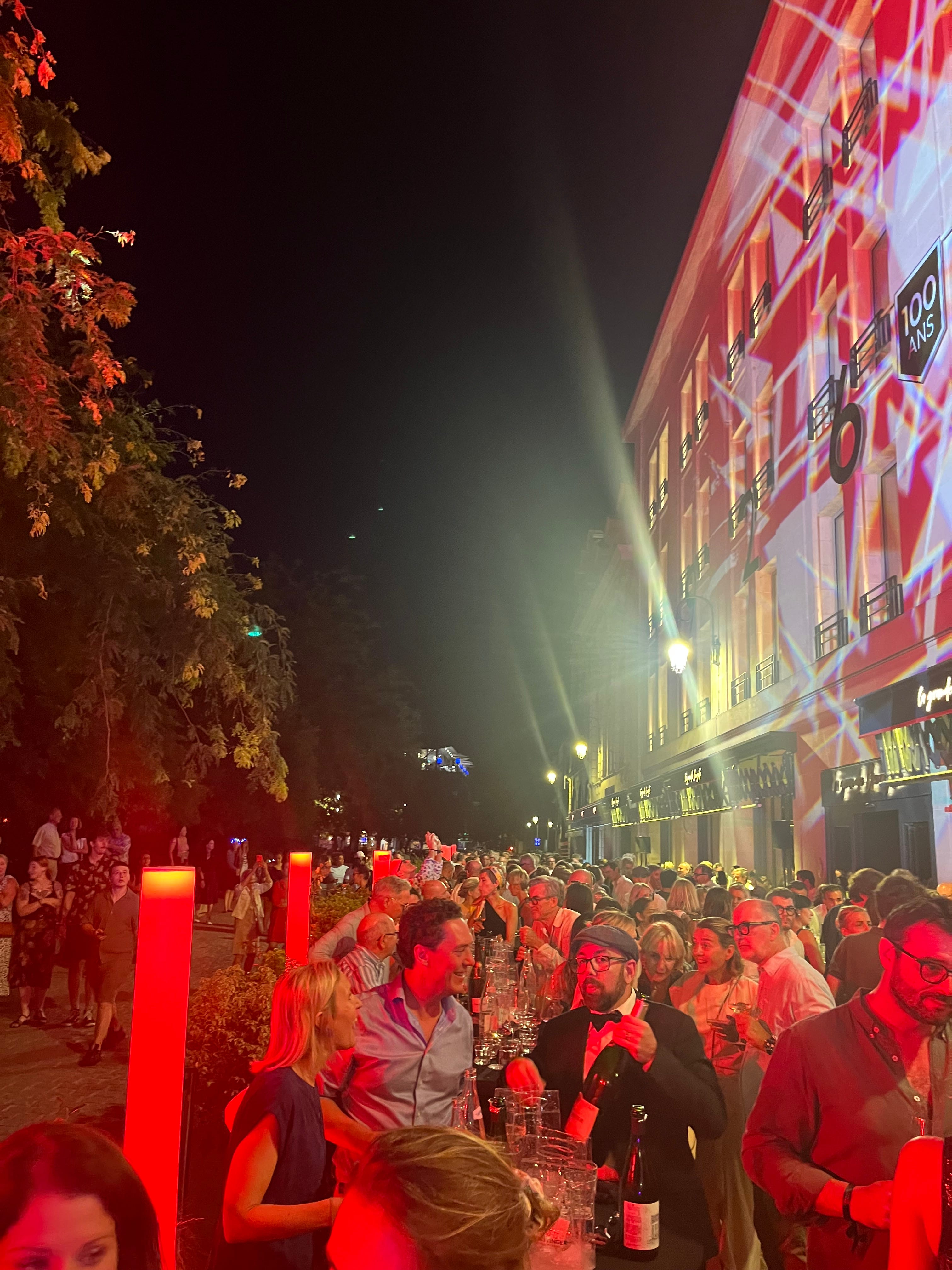
The Art Deco building in which our hotel is housed celebrated its hundredth anniversary Saturday night. Red carpets, Jazz Age ornaments, and ladies adorned in period dress welcomed singers, musicians, and dancers to a champagne party along the cobblestone block.
Our Fourth finished with lots of music, plenty of light, and genuine fire works. A fire-eating flame twirler dazzled attendees as they swigged champagne.
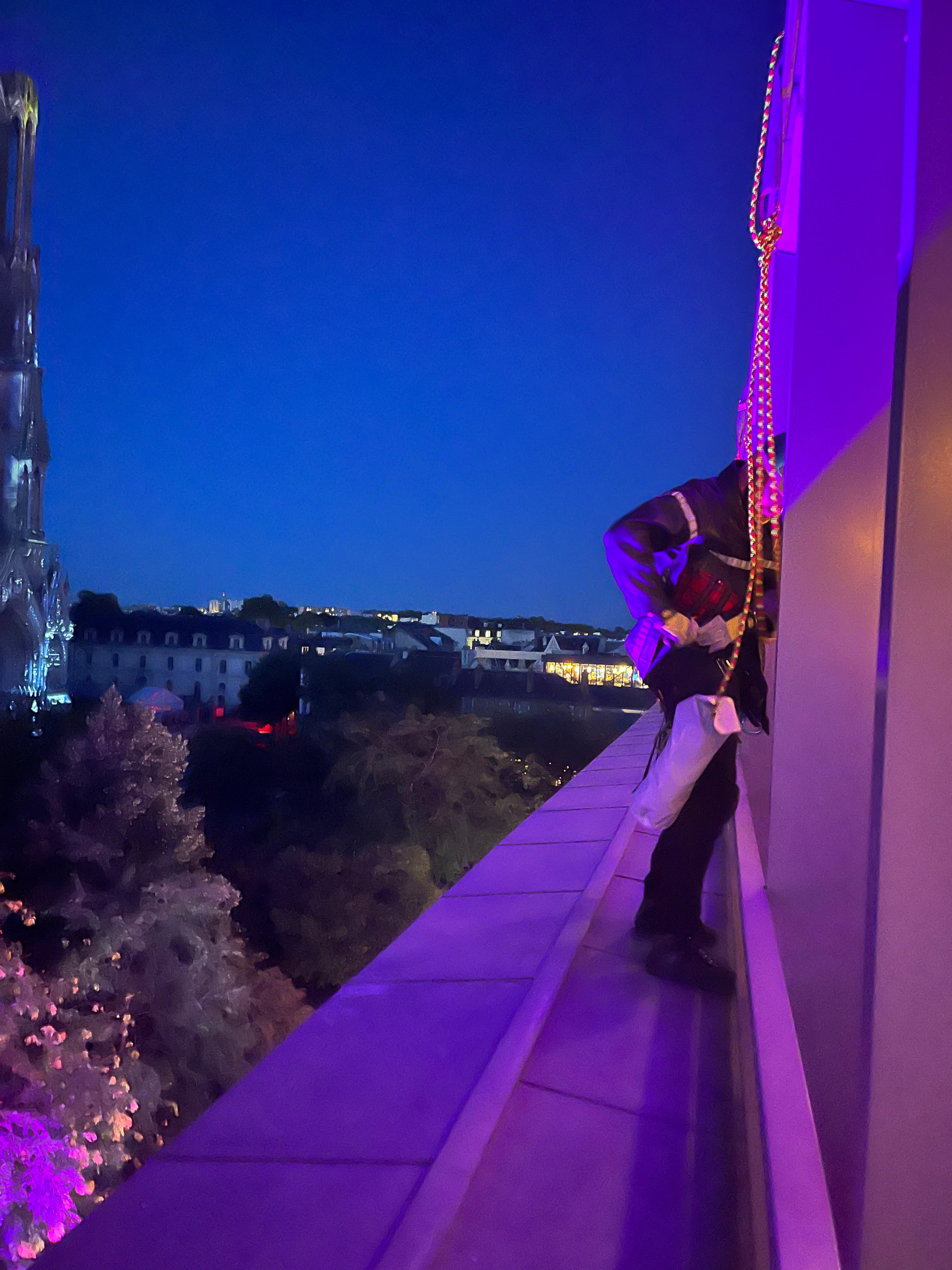
Les sapeurs-pompiers were honored as saviors of the city, with a few of these firefighters using our hotel balcony to descend to the street. By the time they did so, the works of fire were doused, the music ceased, and the cathedral bells tolled a new day.
JD
PS - a firefighter preparing to leap from our balcony ledge, as your correspondent snaps a photo while sipping champagne:
This is great writing, JD. The train sequence had me laughing out loud - "You're in the wrong car" becoming a recurring theme is the kind of thing you can't make up. Welcome to the European side of things, I guess. Enjoy Reims!
Your visit to SHAPE Hdqs and the momentous event that occurred there in 1945 -- one of two that defined the apex of the Greatest Generation -- reminds me that our species is innately vicious.
Not all that many years later, there was a UK + France confrontation with Egypt then a nasty Turkey v Greece squabble over Cyprus followed by Christian v Muslim religious war in the Balkans (in which the USAF destroyed inadvertently the Chinese Embassy).
And now we're witnessing Russia's inane invasion of Ukraine -- now longer than WW II -- and, potentially, Trump's armed theft of Greenland.
I can't help but wonder what contretemps will trigger the next armed confrontation between Europeans.