


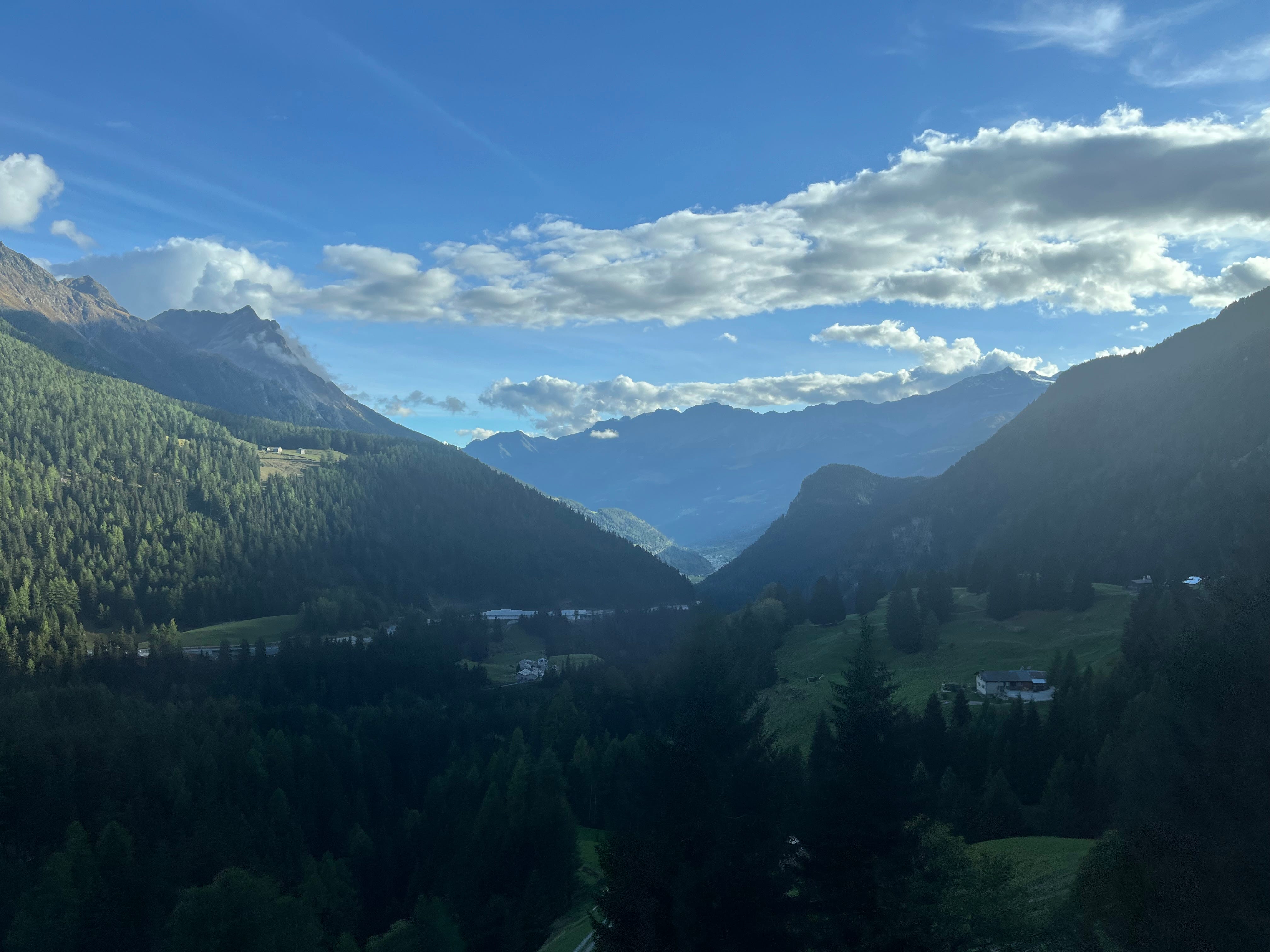
Bormio, Italy
October 12, 2026
[NB: Previous installments in this series are here, here, here, here, and here]
Years ago at dinner, my grandfather recalled his time in the Second World War. We were at my mother’s house, with several family members and some of their friends I didn’t know.
One of them was a woman who interrupted my grandfather as he told us some of his experiences. He recalled being sent to Africa and invading Italy. At that point the woman piped up, as if she hadn’t been listening to what he was saying:
“Oh! Don’t you just love Italy?”
This elicited a look like that of a gourmet chef watching someone put ketchup on a ribeye. In fairness, my grandfather did love Italy, even if he wasn’t fond of that particular trip. Few people don’t adore this country. But it’s seen its share of conflict.
Greeks, Sabines, Romans, Carthaginians, Celts, Gauls, Lombards, Frenchmen, Muslims, Normans, Spaniards, and assorted Italian kingdoms, duchies, and republics have connived and contested to rule this peninsula.
Nestled in the Valtellina valley, we’re in a place that saw some of the fiercest fighting Italy has ever seen. This was among many vicious theaters of the Thirty Years’ War, where France, the Hapsburgs, and local lords fought for the passes linking Spanish Milan to Hapsburg Tyrol.
Three hundred years later, along the slopes and crevices of the surrounding Alps, Italian troops froze to death after Antonio Salandra foisted this country into the First World War.
Beneath the confluence of Italy, Switzerland, and Austria at the Stelvio Pass, Bormio was on the front lines of the “White War” of World War I.
Like other belligerents who belatedly cast themselves into that cauldron, Italy was opportunistic in choosing the side it thought would win. As with earlier entrants, it eventually realized no one really would.
The Alpine theater of the First World War was probably the least suited to fighting, particularly between such ill-equipped armies. Four-fifths of the four-hundred-mile front was mountainous, with some peaks exceeding 12,000 feet.
Against howling winds and blinding blizzards, with packs on their backs, rifles on their shoulders, and skis on their feet, combatants climbed sheer rock to fight a vertical war along a frontier that became a front.
The outnumbered Austrians dug into the high ground on the Ortler massif, from which they hurled hand grenades at the exhausted Italians on the ridge below.
Two miles above sea level, the Italians hung on. In a sort of elevated trench warfare with each side burrowed into the mountains, they spent two years trying to dislodge the enemy.
Soldiers subsisted in frigid caves within the rock. Men rotated through endless shifts boring tunnels in hopes of reaching the opponent’s position, to blast the mountain beneath their feet.
Combined with cold, hunger, and sleep deprivation, the sound of enemy drills (real or imagined) drove men mad. Avalanches, whether natural or triggered by shellfire, were another hazard of this appalling theater of a ghastly war.
The frontier leveled out along the Isonzo River, where Italy launched four assaults in 1915 alone. These forays failed, with extensive loss of life, including 54,000 Italian dead.
But General Luigi Cadorna ordered seven more attacks, condemning hundreds of thousands more men to die for nothing. His troops never reached the Port of Trieste, which had been the “point” of this futile endeavor.
Three decades later, during the waning days of the Second World War, Mussolini wanted to make a last stand in the Valtellina. But his regime was in disarray.
When the Allies advanced, Valtellina wasn’t ready. Mussolini took to his heels. Literally.
Grapes and Grief
In this sublime setting such atrocious scenes are hard to imagine. Between soaring peaks… on verdant slopes and fertile fields… are serene vines, bucolic orchards, rustic villages, and quaint inns that sustain and promote the Valtellina Valley.
Family farms and terraced vineyards dot the floor and slopes of this slender vale. We’re never in danger of dying of thirst. Regional wines are everywhere, mostly the Chiavennasca version of the Nebbiolo varietal.
Valtellina grapes are handpicked in a “heroic harvest,” plucked from almost vertical vineyards on steep slopes, then hauled in weighty baskets on workers’ backs.
We start most days with sips and samplings of local sustenance. A neighboring farm welcomes us for lunch and local wineries treat us to tastings.
At Contadi Gasparotti, we toured subterranean caves before tasting. During the Second World War, these tunnels reportedly served as secret conduits to Switzerland for anti-fascist partisans.
This winery is in Tirano, beside the Adda between the Rhaetian and Orobic Alps. Like many Italian towns, Tirano is lovely… with its narrow streets, charming façades, and piazzas, ruins, and churches, any one of which would attract hordes of tourists to most American cities.
Above it all, clinging to a cliff overlooking the village, is the Church of Santa Perpetua. At the base is the cupola and campanile of the Basilica della Madonna di Tirano, a masterpiece of Renaissance architecture in the Valtellina valley.
We walked the length of the Via Italia to admire the edifice, but instead received a potent reminder why such sanctuaries were built.
These marvels weren’t intended as religious museums for curious tourists, but to preserve and nurture the Faith. This church honored an Apparition of the Blessed Virgin, who in 1504 anointed this spot for a shrine. But this afternoon we couldn’t go in.
The sanctuary was full and the piazza was packed. Tirano is home to 9,000 people, many of whom are in mourning. A couple weeks ago, one of their 18-year-olds was tragically killed in an accident involving his scooter, an oncoming car, and a passing train.
The funeral Mass was piped across the plaza. As was to be expected, the crowd included many teenagers and young adults, most of whom bowed heads, shed tears, and wondered how something so horrible could’ve happened.
Not knowing the answer, we offered supplications to God to tend the soul of the dead, that He succor survivors in their unfathomable grief.
Lap of the Alps
About thirty miles up the Adda, Bormio sits at the head of this long glacial valley. The village is mostly known for skiing, spas, and thermal baths, many of which were used by the Romans.
Leisure remains a major lure. Not far from town in the lap of the Alps, we spent a few hours playing golf amid some of the most spectacular scenery I’ve ever seen.
Situated on the Via Roma along the ancient trading route from Venice to Switzerland, central Bormio retains its medieval charm, enriched a bit by this year’s Olympics.
Despite being a magnet for tourists, the town feels natural, like a real place. Locals shop markets, frequent cafes, and walk their dogs along the cobblestone streets. While boutiques and bistros line the Via Roma from San Vitale to Piazza Cavour, we saw no fudge shops, few souvenir stands, and almost no menus written in English.
We could’ve spent a few nights in Bormio. But time beckoned us back into the valley. An impressive array of tunnels bores the Valtellina mountains. One five-mile system connects to a series of shorter segments that carried us toward Tirano.
Unlike the frozen burrows of the Great War, these tunnels serve a productive purpose. Where men once climbed these mountains to kill each other, travelers now pass quickly on their way to dinner, reminded why they love Italy.
JD