


Milan, Italy
October 2, 2026
My mother, stepfather, and I rented a car, left the airport, and drove to the station to meet my brother.
Brett had spent his last college semester “studying” in London. From there, he made occasional excursions onto the continent: France, Prague, Austria… and Italy.
But his pockets were empty when he crossed the Alps. He’d reached Milan a few days before we did, and needed to fill his belly and rest his head while he waited for us to arrive.
With what little cash he had, he bought a ticket and boarded a train. It took him to Apulia on the heel of Italy. The return trip would put him in Milan about the time our flight landed.
It was a creative, even ingenious, plan. The train would provide a place for Brett to rest his head and close his eyes. But it also offered an unexpected surprise.
An Italian family joined him in his rail car. The clan was stereotypically wonderful: large, cheerful, and welcoming to the bedraggled American in their midst.
The mother (naturally) brought baskets of food, and insisted my brother join the feast. Ample calories, good company, and a few winks sustained Brett till he returned to Milan.
When he did, he made his way outside the station where we’d planned to meet. As my stepfather circled the depot seeking my brother, he was taken aback by something he saw.
“Oh, my God…”, Jerry muttered.
“What?”, my mother asked.
“Is that him?”
“Where?”, I asked, scanning the sidewalk from the back seat. “Behind that hobo?”
“Oh no”, my mother gasped. “It is the hobo!”
Scraggly, disheveled, un-showered, sleep-deprived, with a mangy duffle flung over his shoulder, Brett waved and staggered toward us like a member of Napoleon’s army stumbling out of Russia. Because he loved my mother and wanted to stay married, Jerry pulled over and let him in.
That was thirty-three years ago. I’ve not been to Milan since. I was hardly here then. All we did was land, pick up our vagrant, and make our way to other parts of Italy.
I always wondered what I’d missed in Milan. As many armies as have fought for this city, it must have something going for it. Today we returned, and started seeing what it is.
Like eating at a restaurant called “Queasy” or boarding a ship christened “Capsize”, it’s disconcerting to fly into an airport named “Bad Thoughts”. But that’s what thirty million people do each year. This morning we joined them!
Milan’s main airport took its name from Cascina Malpensa, a farmstead that once stood where our plane landed. Where the farm got its name is a mystery.
One story is that trying to cultivate such barren land was a bad idea. Another has it that it was linked to a place where travelers were regularly robbed.
Neither of these explanations is encouraging, or seem like good reasons to call an airport “Malpensa”. But having arrived safely and avoided being mugged, we let it go, and hopped a cab to the middle of Milan. While waiting for our room, we left our luggage, and went for a walk.
The Renaissance usually evokes images of Medicean Florence, republican Venice, or papal Rome. Milan often gets short shrift. That makes some sense.
With its skyscrapers, commercial bustle, and northern European efficiency, Milan is often portrayed as less relaxed, artistic, and historic than its popular rivals on the peninsula.
This is probably unfair, stemming from the city’s reputation as a modern (and historic) hub of fashion, business, and finance. With almost seven million people sprawling from its center, Milan is the fourth largest metropolitan area in western Europe, the most populous in Italy, and produces about a fifth of this country’s economic output.
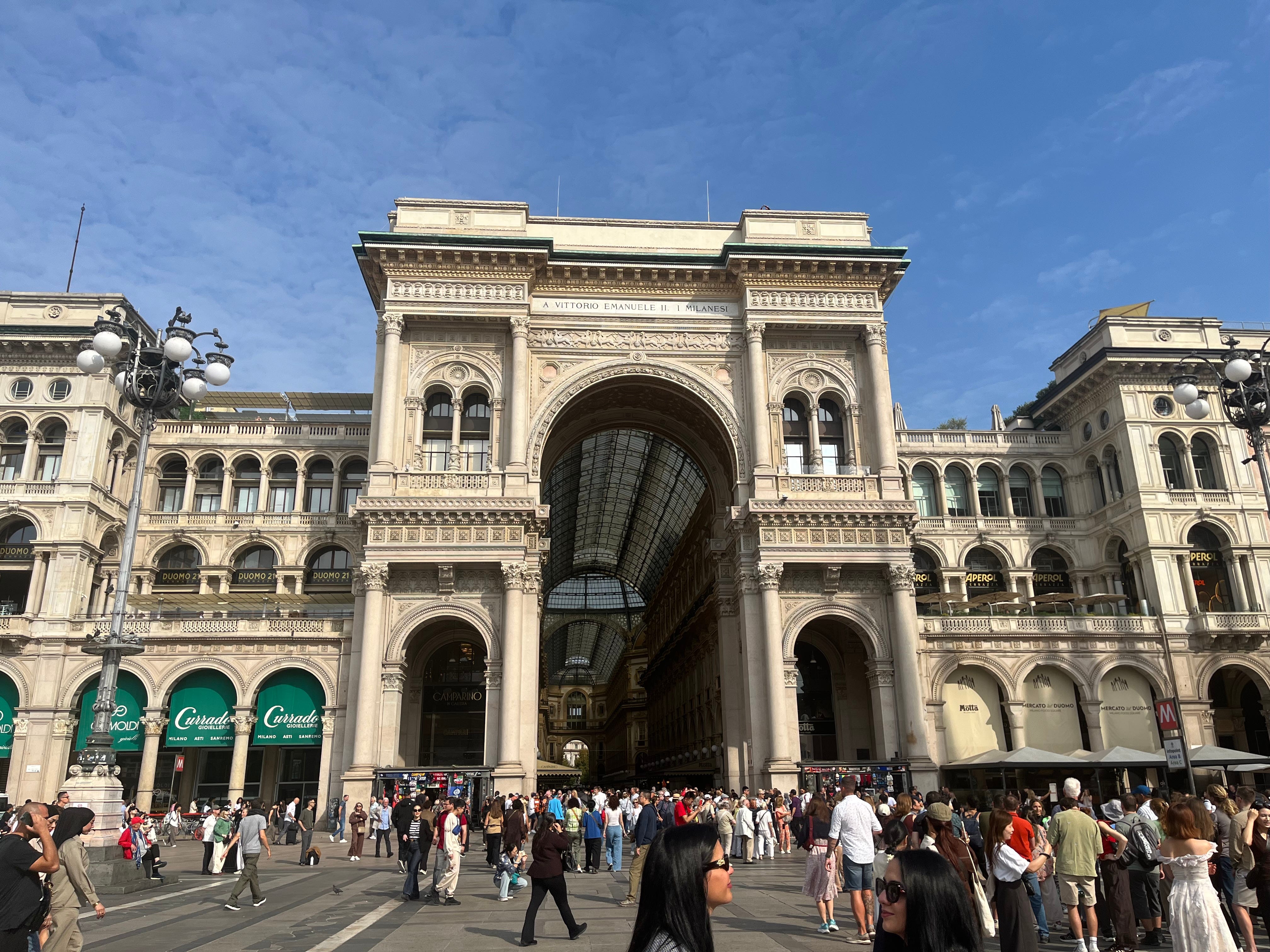
From our hotel beside the Piazza del Duomo, we wandered through the swanky Galleria Vittorio Emanuele on our way to the Brera quarter, something like a Marais or Montmartre of Milan. Artsy bohemians, narrow streets, boutique shops, hidden courtyards, quaint cafes, and Milan’s most prestigious museum adorn the district.
Like many Renaissance rulers, Milan’s domestic dukes and foreign kings ornamented violence with art, an impressive collection of which is housed in the Pinacoteca di Brera.
The palazzo was built in the 17th century, initially as a Jesuit college and later as an Academy of Fine Arts founded by Austrian Empress Maria Theresa. To accommodate paintings pilfered from his Italian conquests, Napoleon converted it to a museum in the first decade of the 19th century.
A neoclassical portal provides an elegant entry to the original building of Lombard Baroque. A graceful courtyard, a perfect square bound by two-story arcades on paired columns of Tuscan stone, lends rhythm and restraint to the heavy appearance of prevailing Baroque.
Around the plaza perimeter Doric pillars lift Ionic columns along the upper loggia, soothing the transition from the busy street, and offering a refined welcome to the Brera galleries.
We initially walked into the Library, which was almost a mistake… because I didn’t want to leave. Seeing her husband luxuriating in dark paneling, wall-to-wall leather-bindings, large globes, and chandeliers dangling from soaring ceilings, my wife started nudging him to go. The museum is what they’d come to see.
I’m glad we did. The Brera isn’t as vast, nor its collection as comprehensive, as the Uffizi or (certainly) the Louvre. But the viewing experience feels more spacious and relaxed than most renowned museums.
Renaissance and Baroque masterpieces—mostly from Lombardy and Venice—line parlors of coordinated color under high ceilings, with rooms arranged to not make you feel cramped or rushed.
Among the bounty are Caravaggio’s Supper at Emmaus, the haunting Discovery of the Body of St Mark by Tintoretto, Mantegna’s Lamentation over the Dead Christ, and Raphael’s Marriage of the Virgin, with perspective that pulls the viewer past the wedding and into the temple, tempting him to wonder where the last opening leads.
Under Napoleon, suppressed churches were major sources of loot. Monumental altarpieces, confiscated paintings, and other large-scale ecclesiastical art are a prominent part of the Brera haul.
It’s an impressive collection in an appealing place. But the volume is still overwhelming, especially when jet lag kicks in. As we retraced our steps thru the Brera, legs and eyelids were getting heavy. Under clear skies and a descending dusk, we returned to the hotel, where our room was ready.
That’s good. After a red-eye flight over the Atlantic, we weren’t eager to take an overnight train to Apulia.
JD
Grazie mille per farci partecipare al Vostro interessante giro in Centro Milanese !!!
GodeteVi il soggiorno in Bella Italia !!!
Siamo curiosi di leggere il Vs. prossimo rapporto viaggi ...
E buon rientro negli Stati Uniti.