


St. Moritz, Switzerland
October 9, 2026
[NB: Previous installments in this series are here, here, here, and here]
“In Italy for 30 years under the Borgias they had warfare, terror, murder, and bloodshed, but they produced Michelangelo, Leonardo da Vinci, and the Renaissance. In Switzerland they had brotherly love - they had 500 years of democracy and peace, and what did that produce? The cuckoo clock.”
-Harry Lime, The Third Man
The Valtellina Valley touts itself as the birthplace of mainline electric rail. Designed by Hungarian engineer Kálmán Kandó in 1902, the first line exceeded 45 mph.
What’s now known as the Rhaetian Railway started about a dozen years earlier, by a Dutchman who owned a hotel in nearby Davos. Tight mountains necessitated a narrow gauge, which soon carried trains between Landquart and Davos.
As the network expanded, the canton of Graubünden acquired it. In 1903 it opened the Albula Line serving St. Moritz. Routes proliferated, extending across the border to northern Italy, providing access to hydroelectric plants south of the pass and bringing tourists north into the mountains.
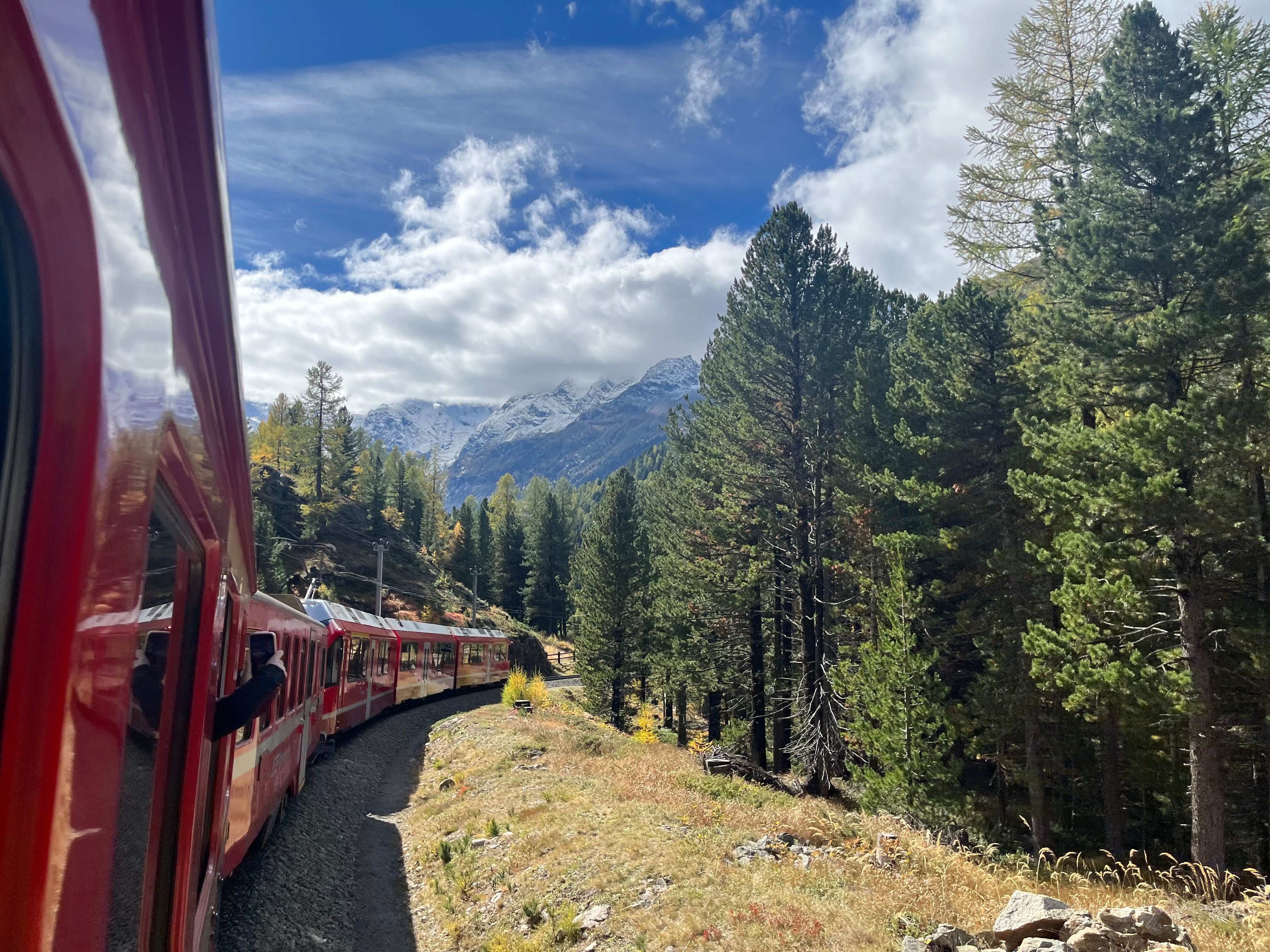
We arrived on the Bernina Red Train from Tirano. Steep ascent and spectacular scenery carried us over the Alps toward St. Moritz. After popping a bottle of Prosecco (wouldn’t want to get parched in the dry Alpine air), we entered Switzerland at Campocologno in Graubünden.
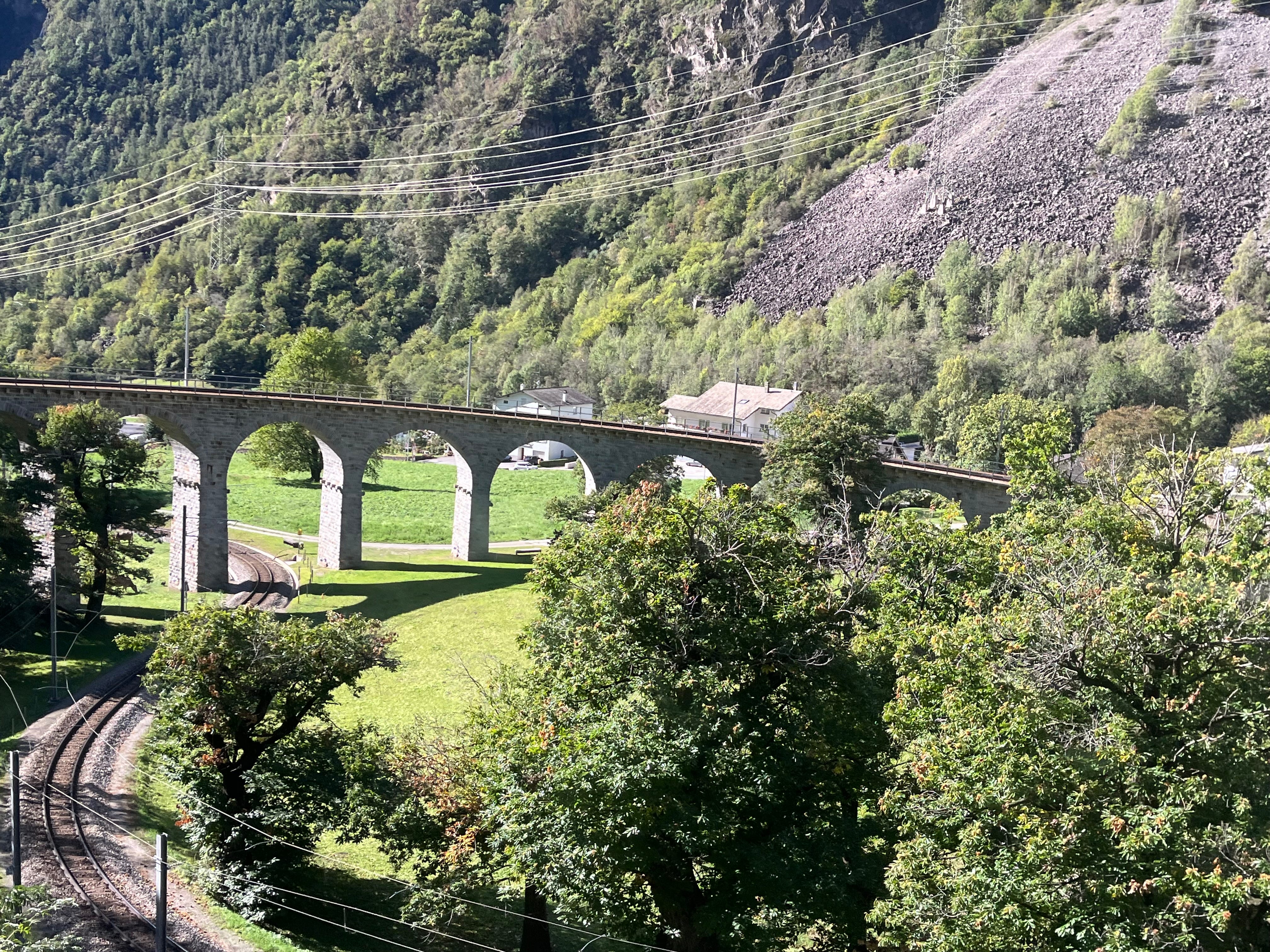
To serve an inclined valley, accommodate natural terrain, and scale the steep slope of the surrounding Alps, the Brusio spiral viaduct opened in 1908.
When unstable geology precluded initial plans to construct a tunnel, engineers opted to route the rail in a rising circle on a nine-span viaduct of locally-sourced stone. The novel corkscrew configuration loops the track over itself, lifting the rail as we headed uphill.
This ingenious design avoids inconvenient switchbacks while reaching the 7% gradient at which standard steel wheels start to slip. It’s a clever (and fun) way to overcome the steep slope, and conquer the 5,500 foot incline from Tirano toward the summit.
To ease connections within the Swiss network, accommodate heavy freight as well as passengers, and navigate slick ice on mountain terrain, the Bernina train shunned rack railway for adhesion, supplemented with magnetic brakes to increase grip and enhance friction.
From the spiral we kept climbing, clinging to cliffs on the way to Poschiavo. As an engineer I appreciated the feats we’d seen. As a humble human, I marveled at what the Ultimate Architect served up next.
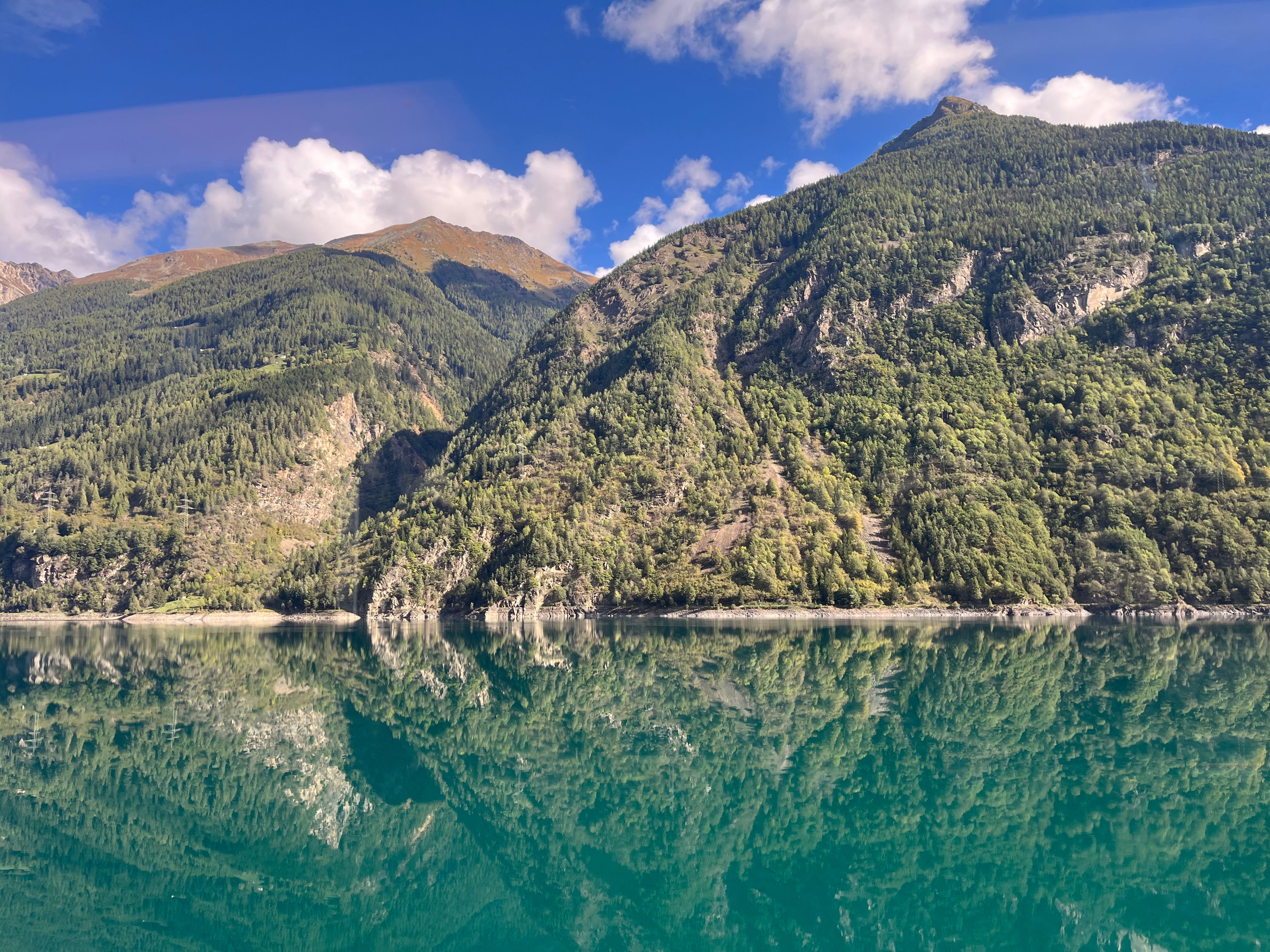
Like a topaz pendant hanging beneath Bernina Massif, Lago di Poschiavo sits about 3,100 feet above the sea it eventually feeds. Soaring above 11,000 feet, the Piz Varuna reflects off the surface as it stares defiantly at the Livigno Alps. We skirted the west side of the lake between Miralago and Le Prese, to the Italian-speaking village of Poschiavo.
Swiss Mix
Italian is one of four official languages spoken in Switzerland, but is used by less than ten percent of the population… mostly in Ticino and this part of Graubünden.
Romansh is a regional Rhaeto-Romance language spoken in this canton, but in few others around Switzerland. French is spoken by just over a fifth of the Swiss. Most speak German, the mother tongue of more than half the country.
As in most of Europe and (fortunately for us) much of the world, many Swiss speak English as a second language… with almost 7% doing so as their first. About 10% of Switzerland’s people communicate in Spanish, Albanian, or Portuguese.
The country comprises 26 cantons, each with its own constitution and tax system. It’s a confederation reminiscent of what the United States originally were. Most governance derives from local decisions.
This federalism works. Decentralized Swiss society is stable, civilized, and prosperous, even if popularly derided as producing only watches, chocolate, and the cuckoo clock.
Graubünden is the only officially tri-lingual canton in the country, recognizing German, Italian, and Romansh. We can recognize a couple of those (Romansh remains elusive), but can’t speak any, relying instead on the kindness and pity of English-speaking locals to make our way around.
This canton is the most geographically spacious and least densely populated of any in Switzerland. From what we’ve seen, that’s not surprising. It’s an ideal place for the upper crust to escape the hoi polloi, and worth the effort to get here.
Eternal Snow
From Lago di Poschiavo we ascended a couple thousand feet to the village of Cavaglia. Below us was the Valposchiavo valley, an Eden of orchards, pastures, and arable plots. Apparently, more than 80% of these fertile fields are organic farmland.
From above, the glacial trough is stunning… a 25 mile north-south gorge that keeps the Livigno Alps no more than ten miles from the Bernina Range.
Escarpments shoot skyward on either side of the wedge, grasping snowcapped peaks five thousand feet above the floor. The Bernina barrier at the head of the valley shields the temperate Valposchiavo from the colder Upper Engadine on the other side.
That’s where we went next. But it took a few hairpin turns to get there. On the way we were rewarded with the panoramic splendor of Alp Grüm, and the peak of the line at Lago Bianco. At over 7,000 feet, Ospizio Bernina is the most elevated station at which any European adhesion railway stops.
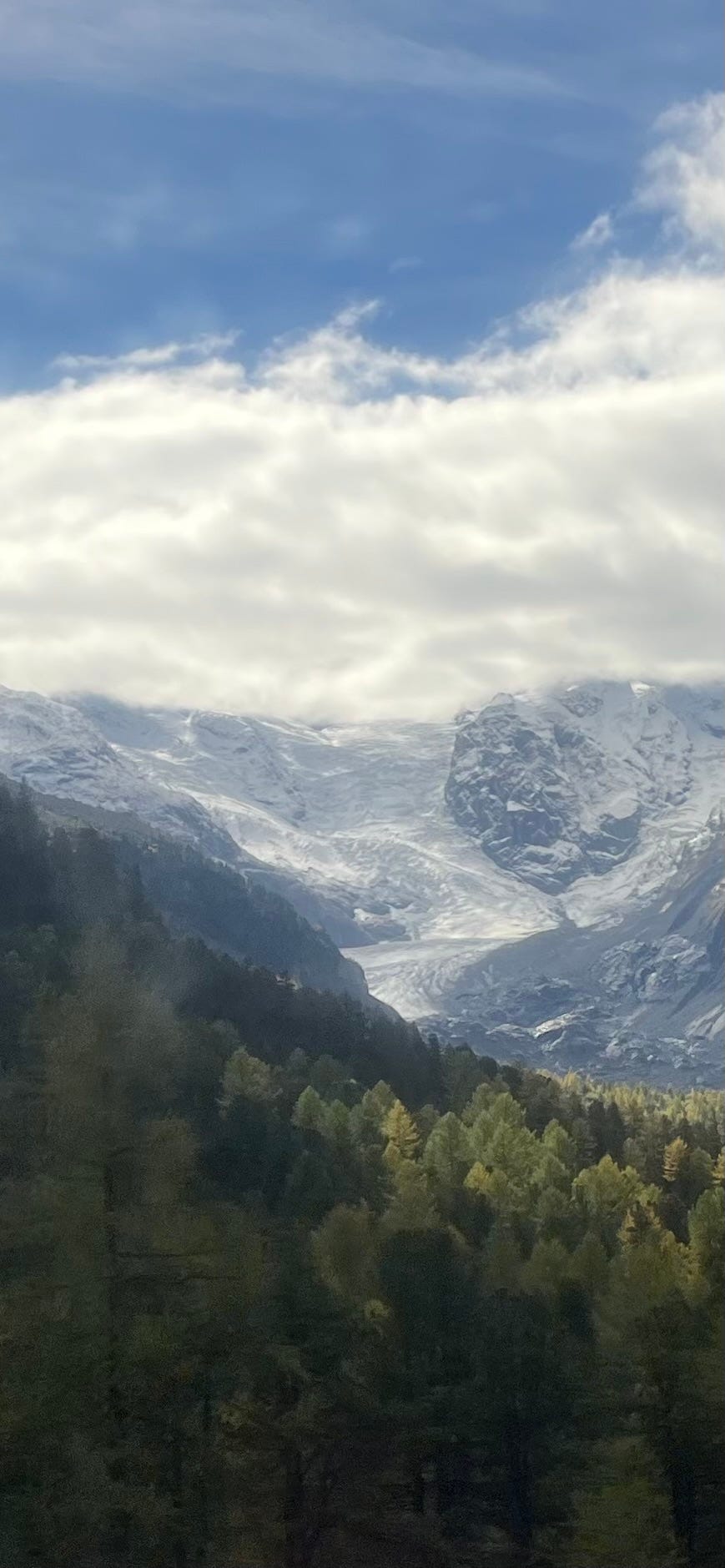
Thru the eternal snow of the Bernina mountains, around the Montebello Curve, past Morteratsch Glacier and the highest point in the eastern Alps at Piz Bernina, we descended thru Val Bernina into Morteratsch. After lunch at a lodge beneath the glacier, we continued on to St Moritz.
Off-Season
At almost 6,000 feet up in the Alps, this high-end hamlet features mineral springs, an eponymous alpine lake, and luxury boutiques lining the Via Serlas, and has twice hosted the Winter Olympics.
Autumn is well along in St Moritz. The town is quiet between the summer season and the winter rush. This is a period when some five star hotels close and roads receive periodic repairs.
A proliferation of chocolatiers and luxury shops remain open. None of them seem to sell a cuckoo clock. And if they do, we probably can’t afford it.
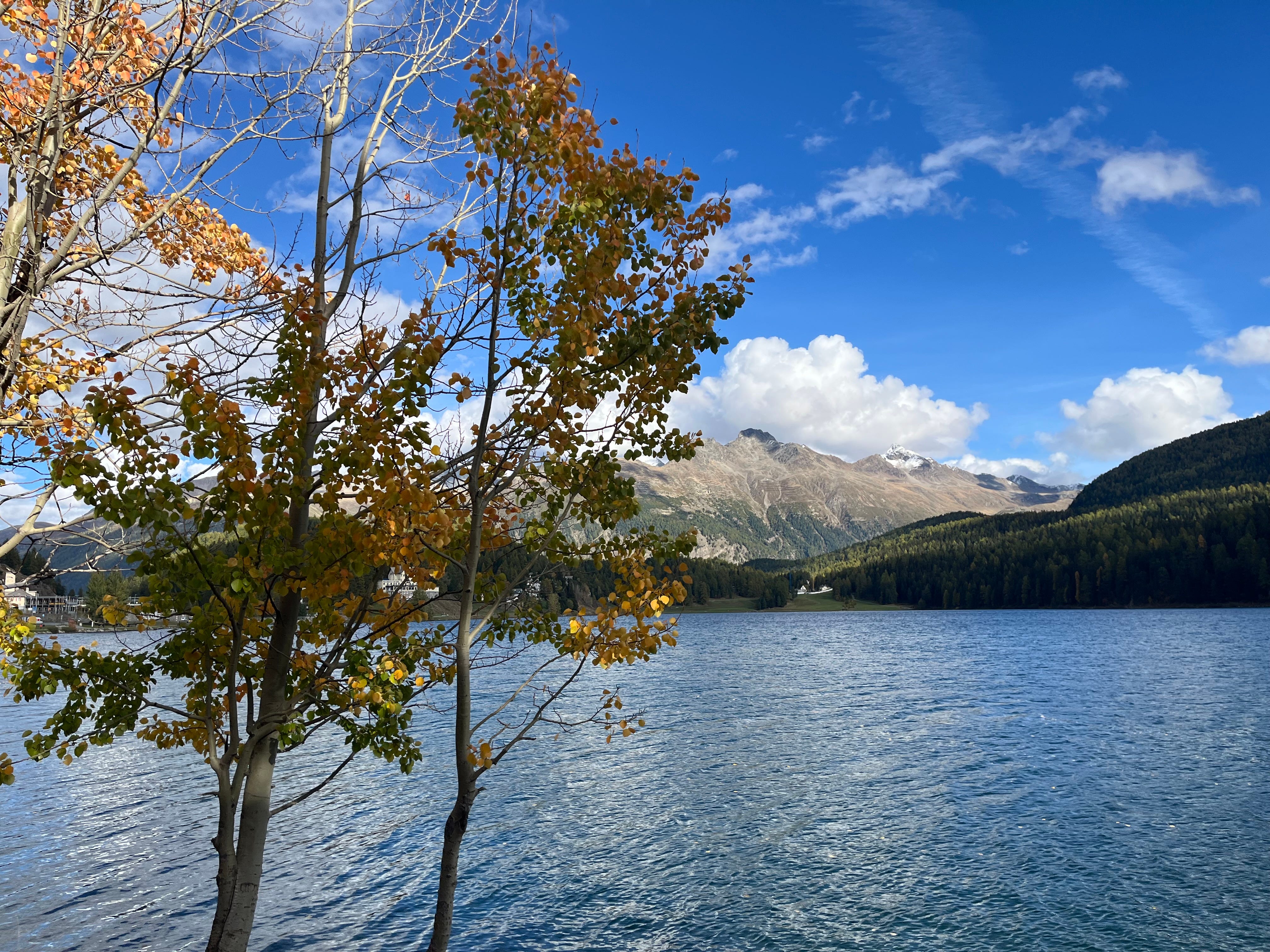
We instead wandered away from town toward Lake St Moritz, where a brisk breeze reminded us winter approaches, and that we’ll need to retreat back over the Alps.
JD
Glad You mentioned the "local" form of government . Just read a book on this , the Swiss governments. I tend to agree with this form of government , albeit not all of it . Thanks !