


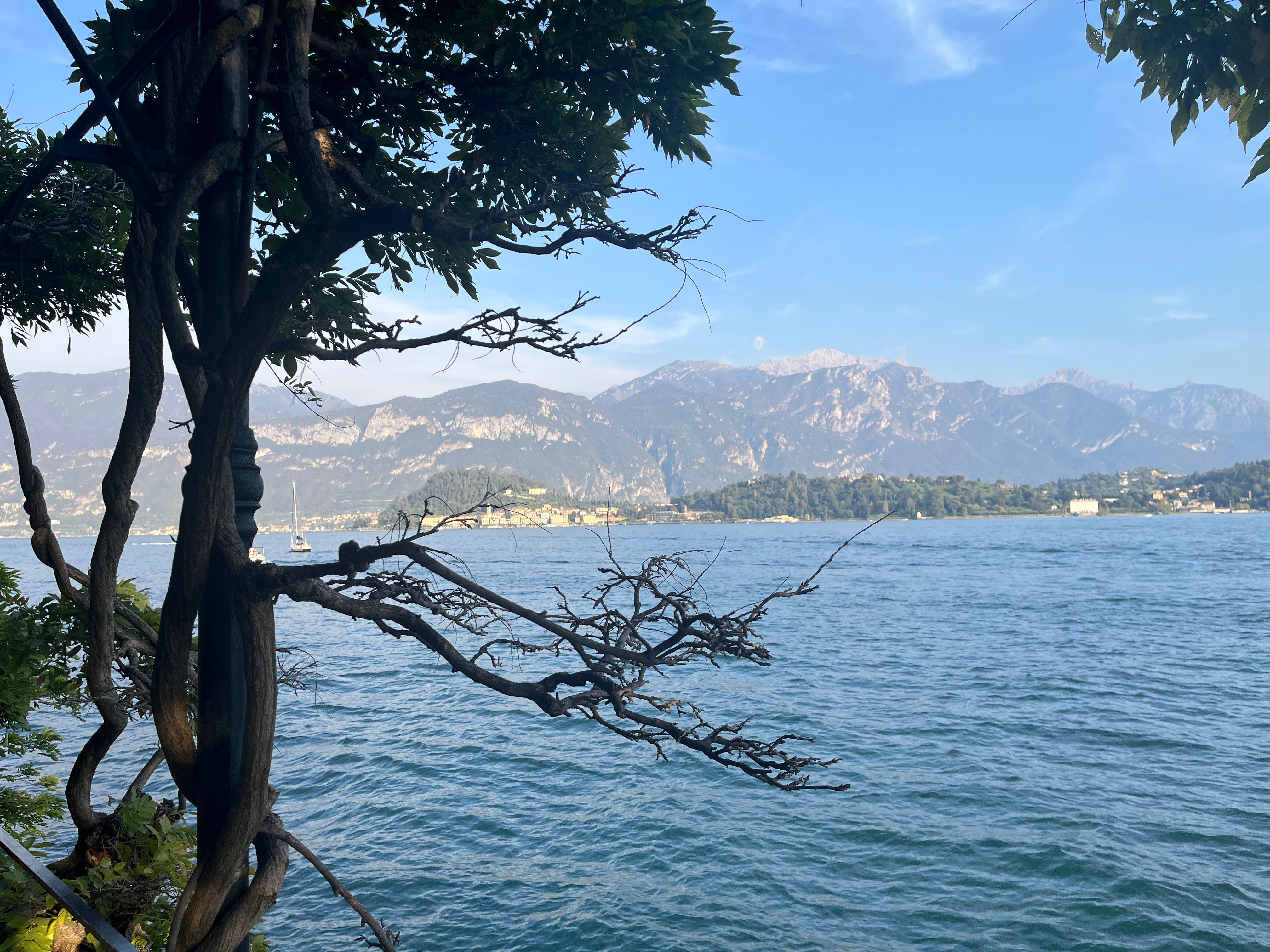
Tremezzo, Italy
October 7, 2026
[NB: Previous installments in this series are here, here, and here]
During the Alpide orogeny of the Cenozoic Era, Africa and Europe collided along the Periadriatic Seam, lifting the Southern Alps from the Lombardy Basin.
Mesozoic rifting, grinding ice, and glacial retreat gouged a steep basin, and left Lake Como as an aquatic wishbone in the Italian Alps. Meltwater filled the trough after the last Ice Age a hundred centuries ago, confined by moraines left by receding glaciers.
Excavation was extensive, creating a lake more than 1,200 feet deep, with a floor about 600 feet below the surface of the sea. Lovely villages, secluded bays, stately villas, and exotic gardens grace the banks of this exquisite pond.
For centuries the Milanese, Austrians, Spanish, and French laid claim to Lake Como. In 1861, it became part of consolidated Italy.
At the end of the Second World War, Milanese fled here to escape Allied bombings. Italian manufacturers moved offices to the Grand Hotel Tremezzo, and the Villa Carlotta sheltered works of art from the Brera Academy.
The war reached Lake Como in April 1945, when Mussolini and his mistress were captured at Dongo trying to flee to Switzerland. They were put against a wall at Villa Belmonte, about a mile from where I’m writing this. Their bodies were subsequently hauled to Milan to be hung by their heels.
The day Mussolini was killed, sixteen people were buried beneath the rubble when the Hotel Bazzoni was destroyed by bombs. The last three nights, this is where we’ve stayed.
It doesn’t look like there’s been much renovation since the air raid ended. The “decor” is dated, the perks (such luxuries as towels, shampoo, soap, hot water, cool air) are limited or nonexistent, and the service is spotty. Overnight traffic and trash trucks sound as if bombers are still making runs.
Our accommodations were arranged by someone else, and ended up being a bit more “budget” than we’d bargained for. But the staff are nice, the coffee is excellent, and the scenery is astounding.
Room With a View
The ride from Milan was relatively quick. Within an hour we’d reached the lake, then followed the narrow (and occasionally harrowing) road that clung to the coast till it reached the hotel.
Tremezzo is billed as “one of the most beautiful villages of Italy.” I can believe it, if only for the spectacular views.
This setting is stunning. North from our balcony Lake Como reaches its greatest width. Verdant escarpments shoot from each side of its three legs. Small boats flit like whirligigs across the water, riding the wake of commercial ferries that connect strands of hamlets that hug the shore.
The warm lake nourishes thick foliage and colorful gardens that feature a thousand species of various plants. Medieval towers and church spires poke above pastel towns and ochre villas. Sunlight glistens on gentle waves as the Grigne encases the sublime scene.
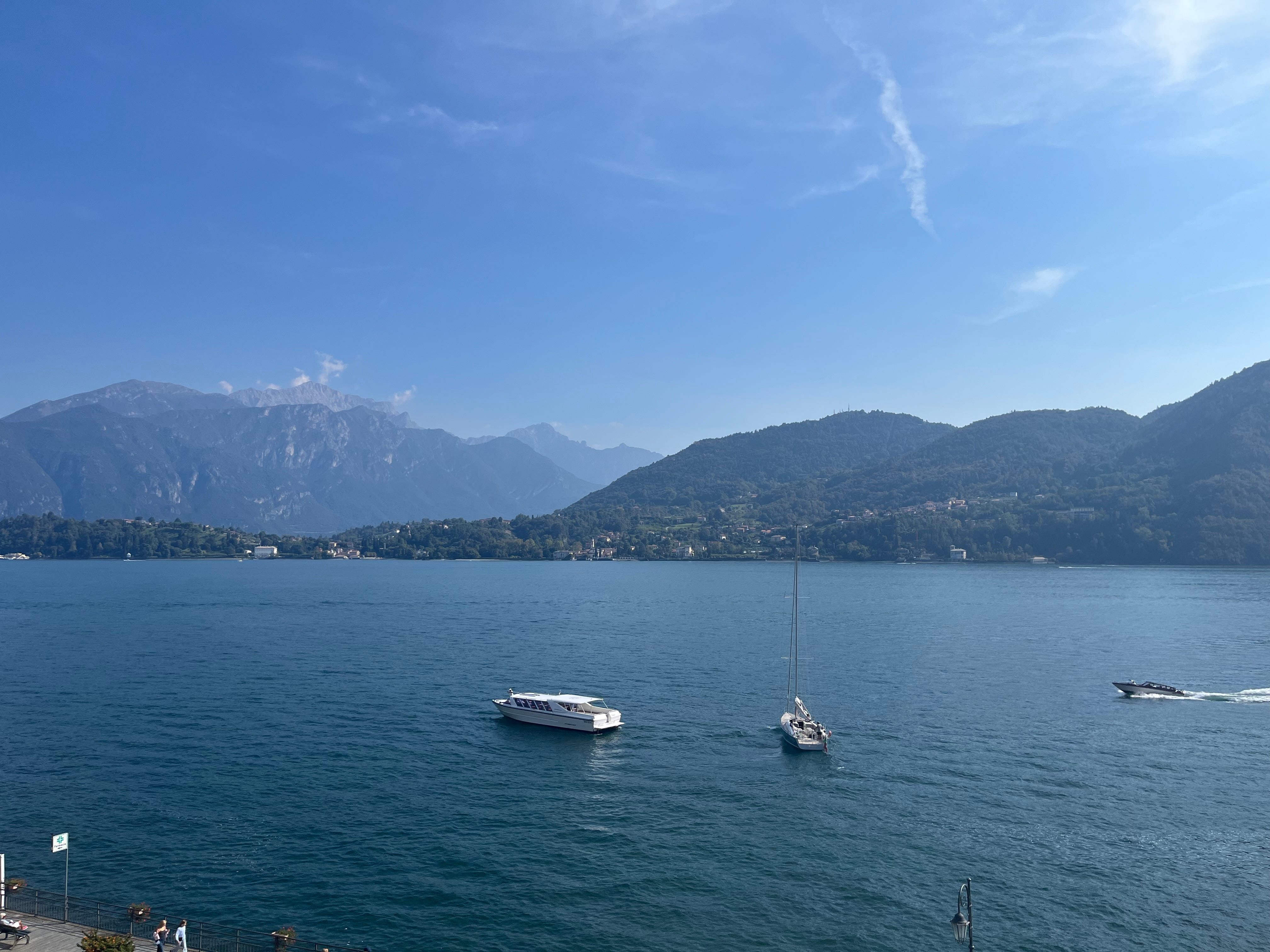
We’re not sure we’ve seen anything more beautiful, and can only imagine the magnificence when these peaks are coated in winter white. After spending time being hypnotized by the view, we decided to become a part of it.
Occupying the promontory created where the ice split to form Como’s fork, Bellagio earns its moniker as the “place between two lakes.” Perched on the prow of its peninsula, Bellagio is beautiful.
Quaint cafes line narrow cobblestone streets ascending steep hills overlooking the lake. Gorgeous as it is, it’s the most “touristy” of the places we’ve seen. It almost feels contrived, like Disney invented an Italian village.
Businesses primarily sell high-end leather, jewelry, and gelato. Most locals cater to guests, whose phones are perpetually hoisted in the air. You’d never catch me being so tacky or gauche.
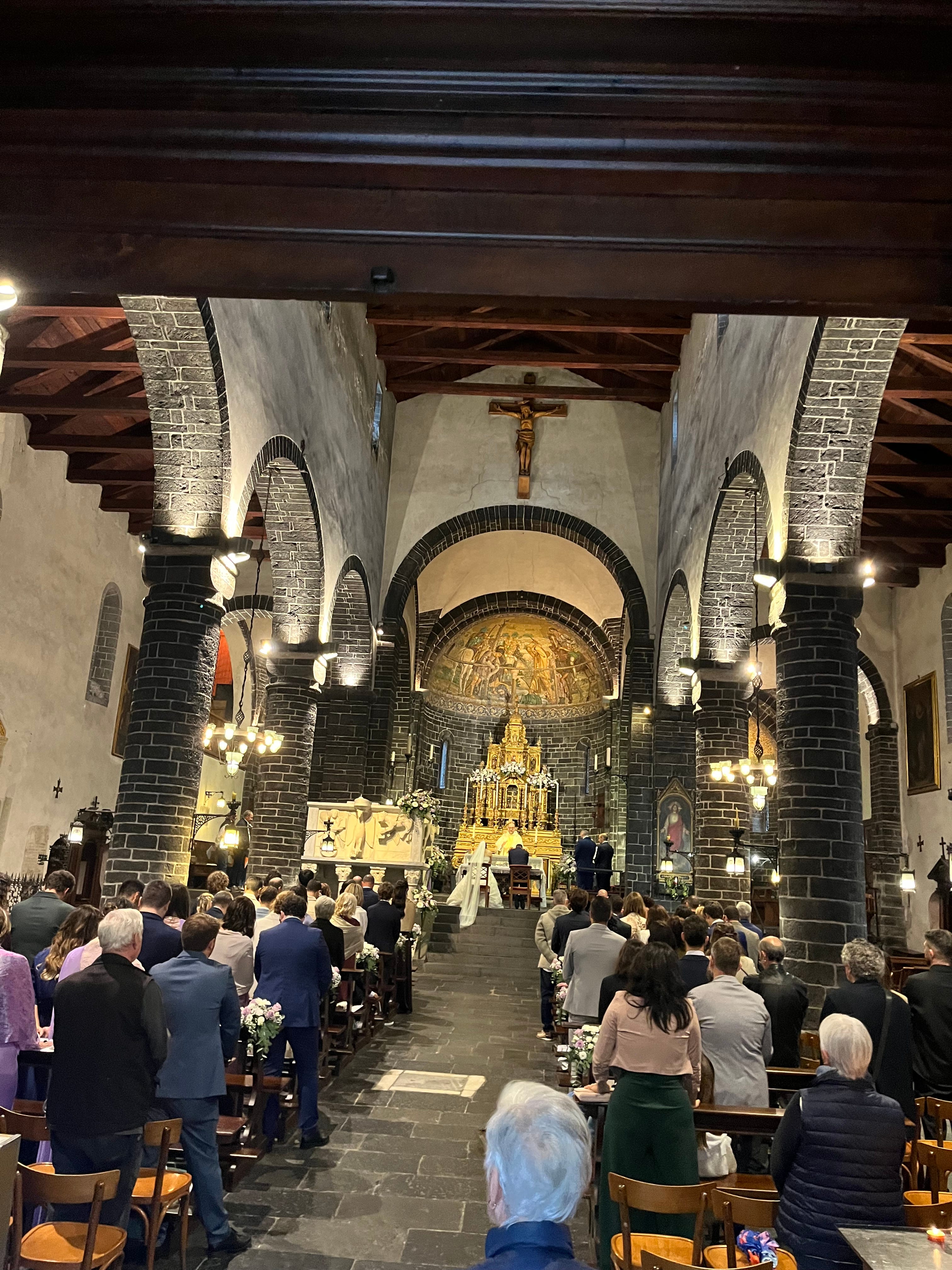
Incidentally, here’s the inside of Bellagio’s San Giacomo Basilica, during a wedding we crashed:
Tremezzo sits at the mouth of the western arm opposite Bellagio. On its northern edge is Villa Carlotta, perched atop a terraced garden overlooking the lake.
The current edifice was erected in 1690, but later passed to German owners (including the family of the princess for whom it’s now named) until World War I. When Italy entered on the side of the Entente, it confiscated the villa as property of the state.
Housing a museum featuring paintings by Appiani, Migliara, and Hayez, with sculptures by Canova, Thorvaldsen, and Acquisti, the villa is a Baroque building with a neoclassical blend. It’s surrounded by a twenty acre botanical garden that’s the most robust of its kind along the lake, featuring 800 specimens imported from as far as South America and East Asia.
Farther north, across from Varenna, is the hamlet of Menaggio, where I think we may be moving. My wife has rarely been so captivated by a place.
I can’t blame her. The promenade offers enchanting vistas in every direction. Pleasant piazzas, cobblestone streets, and al fresco cafes complete the postcard.
We selected a table for two beside the lake, over a long lunch we never wanted to end. When it did, we made our way back to Tremezzo.
A Nice Reminder
I’d arranged a private boat tour around the lake. Our captain contacted me the day before and asked if we could delay departure by one hour. I was concerned we might not finish before dark, but trusted his judgment as someone who’d done this before.
We agreed to meet at a dock outside the Bazzoni. At the appointed hour, our skipper wasn’t there. He sent a text that he was at the Grand Tremezzo. We took a ten minute walk to the new location… where he also wasn’t.
After searching several docks we finally found the small boat bobbing in the water, albeit a bit annoyed at receiving vague directions rather than specific locations.
For Americans who prize precision and punctuality, this is the frustration and pleasure of Italian life. Or, rather, of life. It’s great to be easy going, unless you value detail or need something done.
With a shock of disheveled hair and a cigarette dangling from his lips, a man waved at us from the boat as he took a swig from a flask.
“Oh great,” my wife exclaimed. “He’s drinking.”
“It’s water,” I assured her as a way of reassuring myself. “But if you want to bail on this we can.” Unwilling to let me off the hook, she said nothing. We kept going.
“Are you Matteo?” I asked, assuming this was the same person with whom I made the reservation.
“I am Giorgio,” he said in his thick Italian accent.
Uh oh.
“You are John and Margarita?”
OK. He knew us, so that was encouraging. We decided to hop aboard.
I suppose we could’ve ended up like Fredo at the end of the second Godfather. But to some extent, we take that chance anytime we do anything.
Instead, Giorgio was terrific. With his knowledge, wit, and humor, he won us over immediately. The bottle of Prosecco didn’t hurt.
Like his passengers, Giorgio had been an engineer. After thirty years, he gave it up because he was unhappy with what he was doing, and realized time was something he couldn’t buy.
He now spends his summers carrying people like us around Lake Como and winters sailing others among Caribbean islands. To commute between his two “offices” he once sailed solo across the Atlantic.
From the dock we sped down the west arm of the lake, past the Villa del Balbianello where Star Wars was filmed, to the Villa la Cassinella Richard Branson bought, and around Isola Comacina —the only island in Lake Como—dotted with Roman ruins and (according to Giorgio) imported kangaroos.
The story is true, but Giorgio got the wrong island. The Australian critters were placed on Isola dei Cipressi in nearby Lake Pusiano.
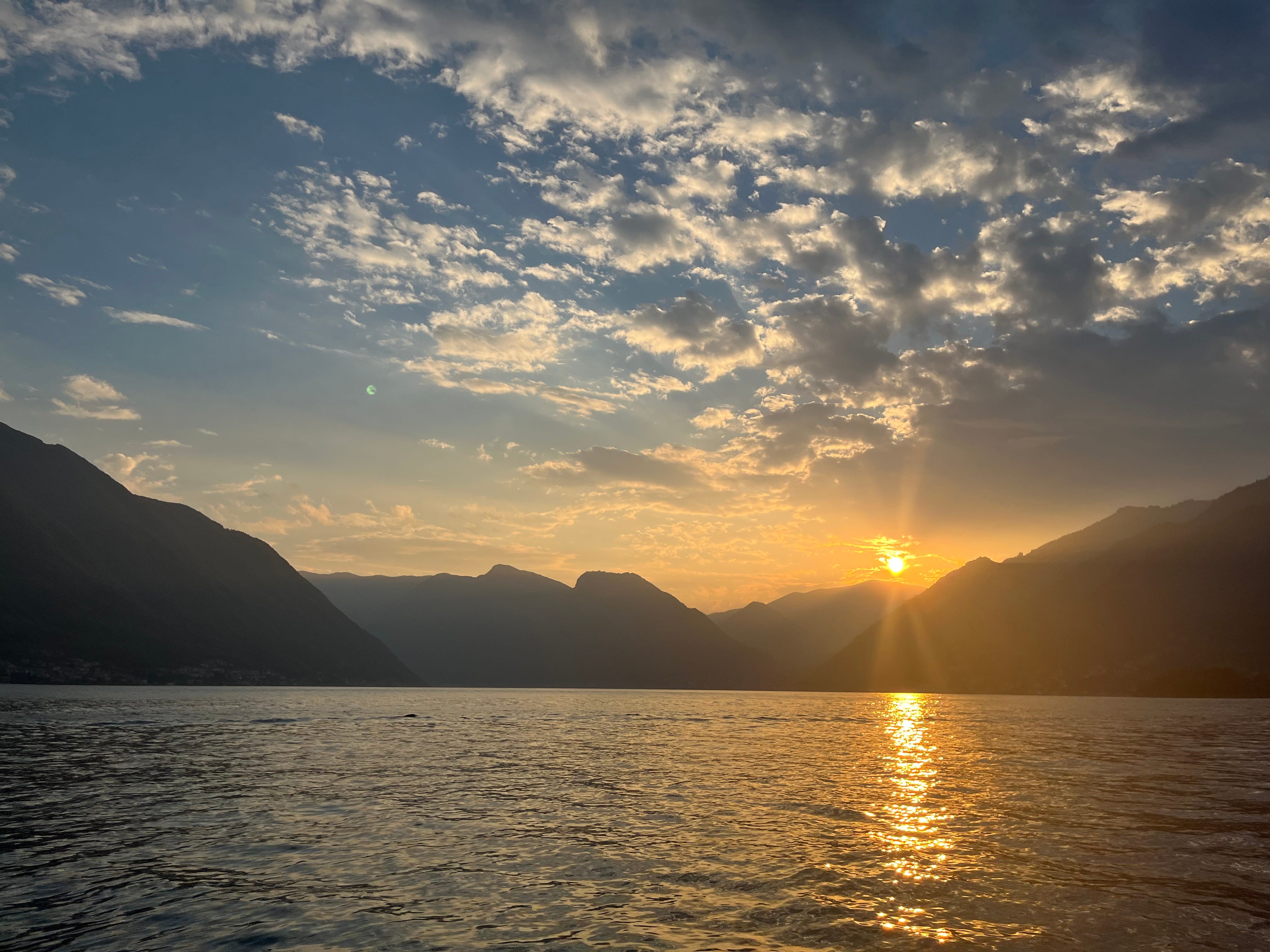
This is where we opened the Prosecco. Returning toward Bellagio, we eased under the Villa Lucertola, tucked at the base of a steep slope at the edge of the lake and now owned by the Guinness family.
Legend (perhaps invented by captains giving boat tours) has it that a previous owner sympathized with the Nazis. At the end of the war, she tossed her diamond ring in the lake rather than yield it to her captors.
There’s a similar tale that replaces the Nazi sympathizer with a Brazilian woman distraught at having to sell the place. Regardless the tale, the place has since become popular with divers futilely seeking a fabled gem.
Next door is the Ponte del Diavolo, the “Devil’s Bridge” of lake lore. Built over a canyon near Lezzeno, the arched span was apparently completed in a deal with the devil.
He agreed to finish it overnight in exchange for the soul of the first to cross it. The builder and a local priest tricked the devil by sending a dog. Defeated and furious, the devil hurled himself into the river below.
As dusk descended, we approached Bellagio, passed the fork in the lake, and drifted past the lovely village of Varenna. Under enveloping darkness, Giorgio brought us back to Tremezzo, and said goodbye. But not before we exchanged numbers so we can stay in touch.
It was a pleasant surprise and a nice reminder. Sometimes no matter how apprehensive we may be, we simply need to get in the boat.
JD