


Milan, Italy
October 4, 2026
[NB: Previous installments in this series are here and here]
We started our Sunday with a sunrise stroll, Mass at the Duomo, breakfast overlooking the cathedral, and reflections on something I didn’t reference in yesterday’s missive.
Under Francesco Sforza, Dominican friars began building Santa Maria delle Grazie to honor the Virgin Mary, and to be the site of the Sforza mausoleum.
Lodovico Sforza later commissioned Bramante to add the apse, a cupola, and cloister porticos that fell victim to the Second World War. These overlaid Renaissance influence on Lombard Gothic.
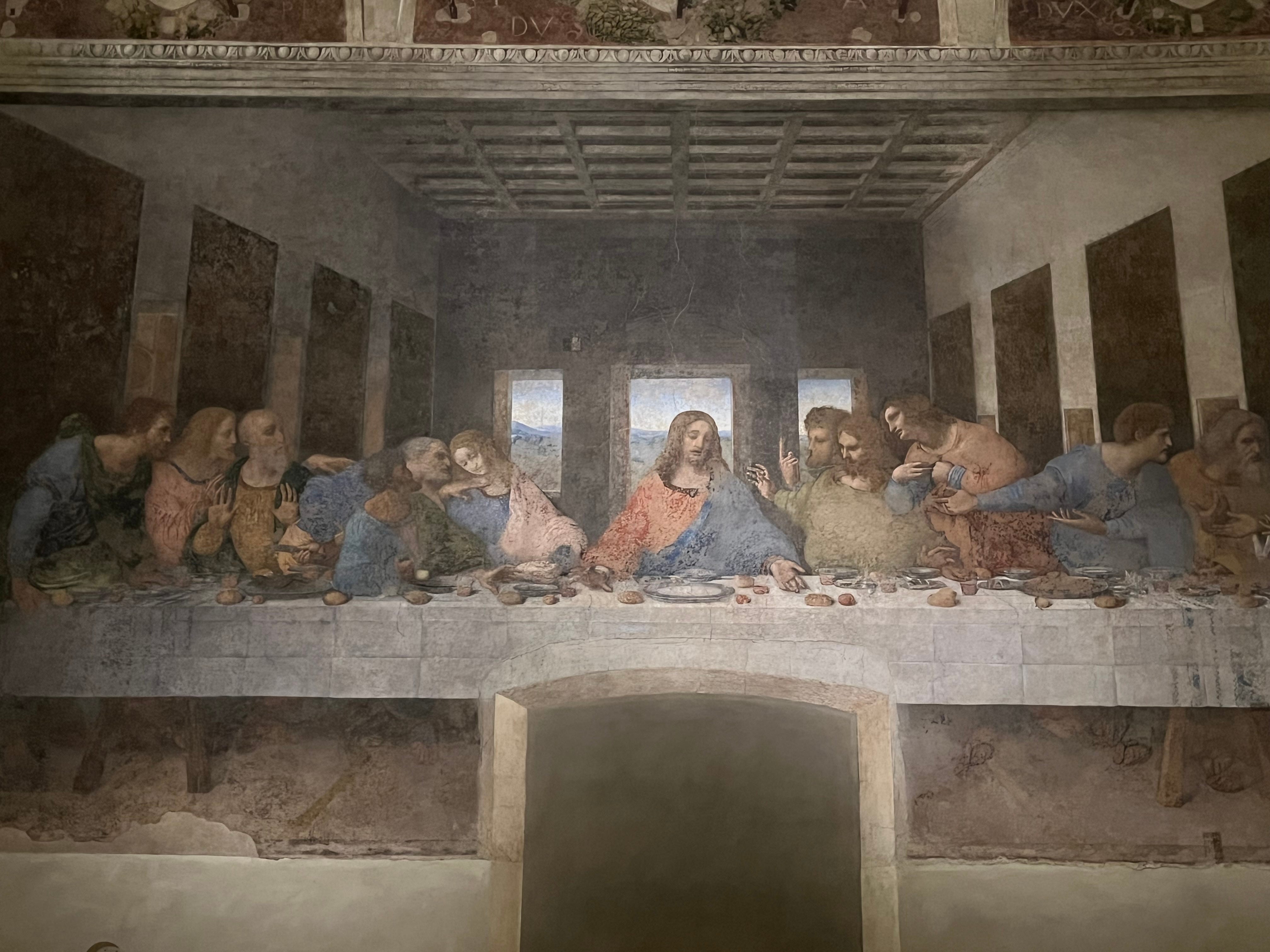
In the refectory the Dominican friars took their meals. On the far wall of this rectangular room, Leonardo da Vinci left the culminating work of the 15th century. It’s one of the two most famous paintings in the world. The other is also his — the Mona Lisa that hangs in the Louvre.
Hundreds of artists have painted Last Suppers. But only one created The Last Supper. Whenever that image is referenced, it’s Leonardo’s version that comes to mind.
Yesterday we had an opportunity to see it. Entry is allotted to small groups in fifteen minute increments. Like entering a gun range, we passed thru one door that had to be closed before the next could open.
We waited in this holding pen till previous visitors left the refectory. When they did, we entered the hall, and looked to our right.
Testing the patience of his patron and the prior, da Vinci took his time completing the painting we’d come to see. Leonardo apparently explained that conception is more important than execution. “Men of genius”, as Vasari said, “do most when they work least.”
Around Milan Leonardo found models for the Apostles, each remarkably individualized in the painting. But his main challenges were depicting Christ’s features and Judas’s face.
Legend has it he picked the convent’s prior as Judas, but that may be a myth. Struggling to portray Jesus, Leonardo seems to have taken the advice of a friend to leave His visage unfinished.
So sublime were the faces of James the Greater and James the Less, his friend observed, that whatever Christ da Vinci completed couldn’t be their Master.
Leonardo made a preliminary sketch of Jesus’s head, which we saw the day before in the Brera Museum. It conveys resignation of One who knows His fate, and Who must share it with those He loves. At that moment, even Christ was unable to look His apostles in the eye.
Unfortunately, The Last Supper started dying the moment it was born. Leonardo shunned fresco because wet plaster required his work to be rushed.
He instead combined tempera and oil on dry plaster, hoping the layers of oil would supply the sealing qualities of wet plaster, and that these two sets of pigments would allow him to paint at his preferred pace while retaining his work’s resilience on the wall.
It didn’t work.
The tempera he preferred resisted adherence and was prone to flake. On a dry wall between a damp refectory and a hot kitchen, that happened almost immediately. Inconceivably, friars later accelerated decay by cutting a doorway thru Christ’s feet.
We’re lucky that any of The Last Supper still survives. Restoration has persisted over the centuries (often doing more harm than good), and ongoing preservation requires small crowds and short visits.
Unsurprisingly, French Revolutionaries took a whack at it. When they invaded Milan in 1796, they used the refectory as an armory. To defile a work of Catholic art, the soldiers threw rocks at the wall, or climbed it to scratch the eyes from apostles’ faces.
A couple decades later, efforts were made to move the mural to a safer environment. But central chunks collapsed during removal, and had to be pasted back into place.
The greatest threat came in 1943, when an Allied bomb destroyed much of the convent. Miraculously, The Last Supper survived, because caretakers had stacked sandbags against and across the extent of the wall.
After centuries of suffering, the mural that has been called “the keystone of Western art” was in trouble. About fifty years ago, an extensive renovation effort was undertaken.
During two decades of meticulous effort, layers of varnish, grime, glue, filth and extraneous paint were removed to unveil what Leonardo left us. More than a quarter century after the revival was complete, the restoration retains the vivid brightness the artist intended.
About twenty people joined us for our fifteen minute viewing. Not being sardined into a space made it easier to appreciate the painting.
It wasn’t difficult. The refectory is long, narrow, and dimly lit. The painting is enormous, and feels like an extension of the room. Monks in the refectory must’ve felt as if the Last Supper was occurring while they ate.
The painting was elevated so diners could see it from the far reaches of the long hall. From a distance, the perspectival effect is even more pronounced, making it seem like the Last Supper is occurring in an annex of the refectory, with the Apostles appearing even more animated than they appear up close.
The lines of the picture extend the horizontal layout of the sidewall cornices, pulling the friars of the refectory into the scene. Leonardo knew light was limited, supplied only by seasonal sun thru elevated windows, or by flickering candles when darkness fell.
He captured the dusk by illuminating the apostles on Christ’s left, who’d receive setting sunlight thru actual windows along the west wall of the refectory.
Even damaged and redone, The Last Supper is remarkable, capturing the shock of the Apostles around the calm center of Christ. The action is in their anxiety, and its reflection of ours.
The compositional choices are almost perfect. The design is naturally balanced around the figure of Christ, who occupies the center of the frame in both directions.
The Apostles are grouped in four clusters of three, in individualistic poses that distinguish each from the others. They recoil from the accusation Christ asserts. Almost reflexively, the viewer does too.
Within each group of three apostles, the emotion increases from surprise… to disbelief… to shock… to horror… in a crescendo from left to right along the table. But Jesus sits serene at the eye of the storm.
Many Medieval Last Suppers depicted Apostles as stiff and static, often with Judas on the opposite side of the table like a witness at a Senate hearing. Leonardo removes the halos, brings the Apostles to life by making them human, and puts Judas among them as an enemy within.
This painting depicts or evokes several crucial events in a single scene. Christ institutes the Eucharist and announces his betrayal. By grasping with one hand and reaching with the other, Judas confesses to everyone at the table and to all of us in the room.
Anticipating his action later that evening, Peter wields a knife behind Judas as he and John seek clarification of what Christ has said. Thomas lifts the finger that will inspect the wound of the resurrected Christ.
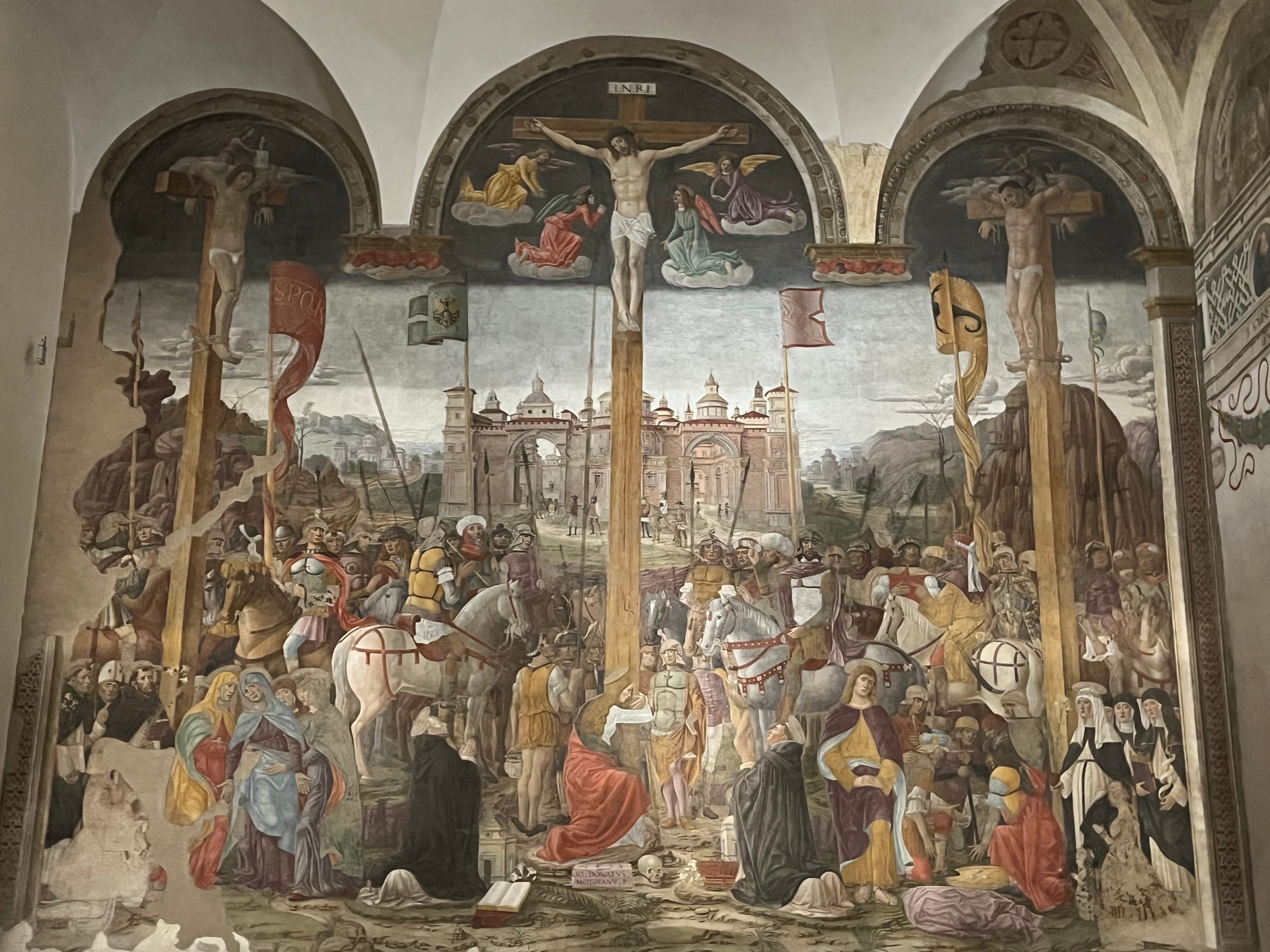
Leonardo packs most of the Passion into a mural he knew his educated audience would understand. The obvious omission is reference to the crucifixion itself, which perhaps explains its portrayal on the opposite wall.
With Last Suppers, Crucifixion scenes were common in monastic refectories. Santa Maria delle Grazie features an interpretation by Donato Montorfano, who must’ve felt like he was performing across the street from the Beatles.
But Montorfano got the last laugh. Unlike Leonardo’s tempera, his fresco transmitted thru time, and it has basked under almost as many eyes as its more popular counterpart. It’s the last thing we see when we leave the room.
JD