


Milan, Italy
October 3, 2026
As with many cities, geography facilitated Milan’s fate. It’s always been a hinge between the Italian peninsula and transalpine Europe. This was partly due to the Romans, who moved their capital here in the late third century.
The Celts founded Milan almost six centuries before Christ. The Romans arrived a few hundred years later, conquering and expanding the settlement, and rechristening it Mediolanum for its position in the “middle of the plain”.
Under Diocletian, Maximian made Milan seat of the Western Empire. Thirty years later, Constantine came here to issue his edict giving Christians freedom to worship. Later that century, St Ambrose brought added prestige as bishop of a city that was firmly Catholic.
A Magnificent Fusion
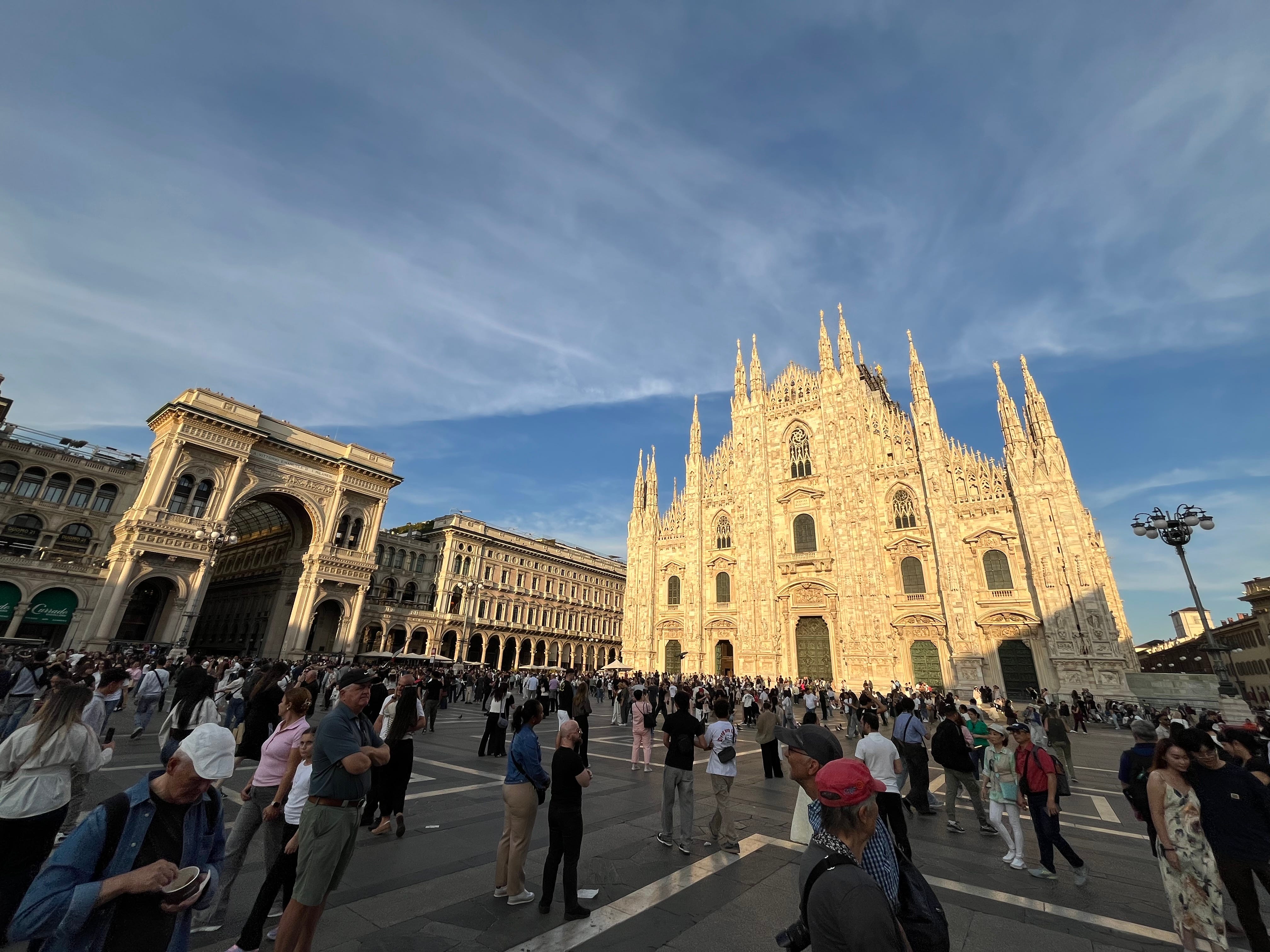
Milan’s cathedral is the largest church in Italy, occupying what had been the central site of Roman Mediolanum, and the spot from or about which the modern city still radiates.
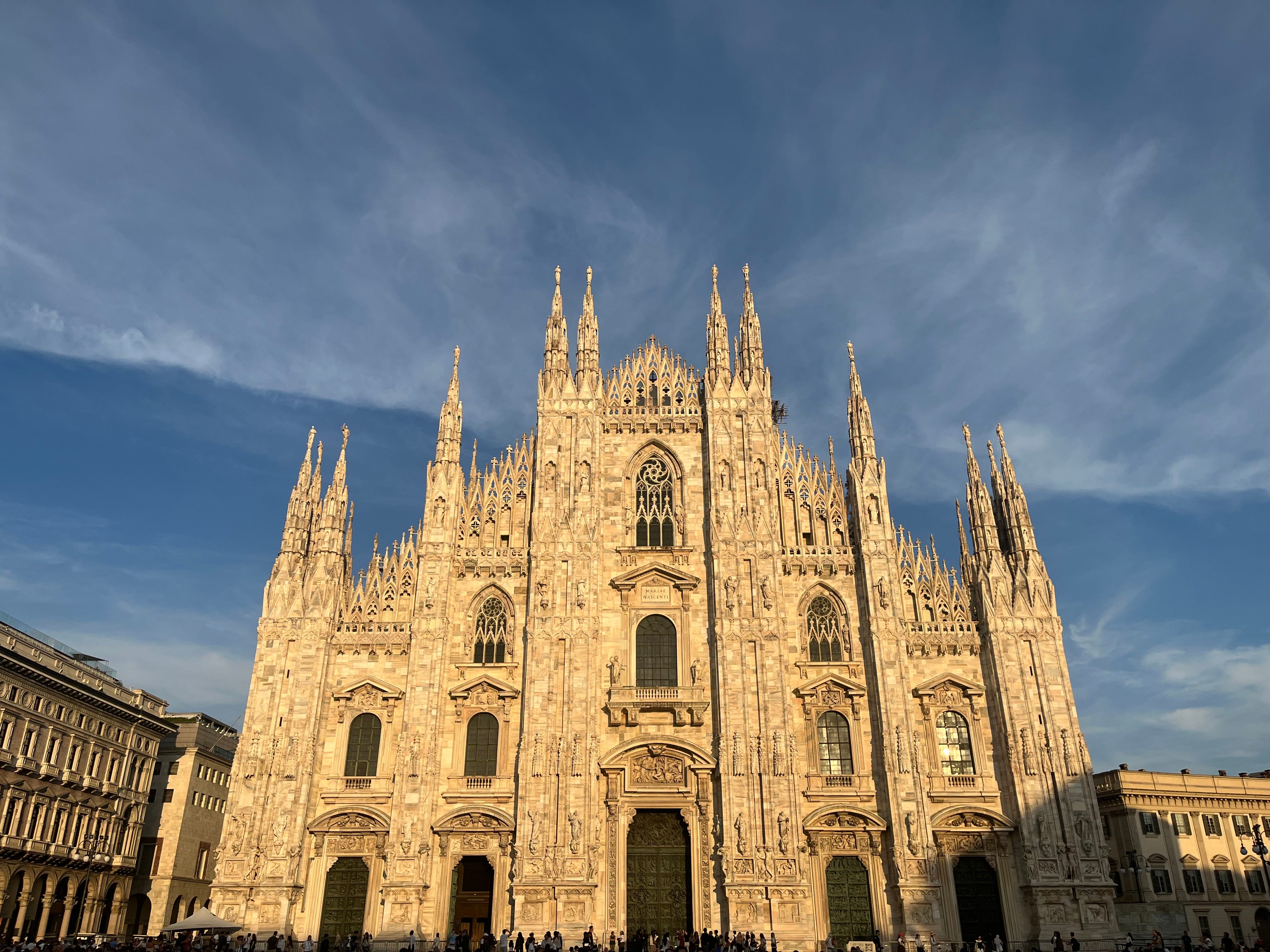
The Duomo is a magnificent fusion of florid Gothic, Renaissance ornament, and Baroque flair. Intricate, elaborate, solemn, and vast, the cathedral is a six century amalgamation of competing preferences and evolving styles.
It rose in the late 14th century when Gian Galeazzo Visconti started construction of the chevet. Delay intervened. When building resumed decades later, a host of sculptors ensured no speck of surface remained unadorned. Among others, Leonardo and Bramante were asked to design a cupola, which wasn’t completed till 1759.
The façade didn’t start till 1616, and wasn’t finished till Napoleon commanded its completion two centuries later. The final details were added sixty years ago, when the Duomo was finally done.
In the interim, a succession of Italian, French, and German builders crafted the white Candoglia marble into an ethereal assemblage of belfries, pinnacles, gables, and statues, including sculpted saints standing sentry atop processions of spires that sprout from the roof. Above them on the Tiburio is the gilded Madonnina, honoring the Nativity of Our Lady to whom the basilica is dedicated.
Delicate bays of counter-curved tracery, ornate rose windows glorifying the east face, and the elegance of more than a hundred pinnacles and three thousand statues offer misleading impressions of the scene inside.
Unlike the airy fragility of the external architecture, the cathedral interior is severe, imposing, heavy, and dim. Enormous columns line the nave, bounding it from two aisles on either side.
The apse stained glass is astounding. In chronological imagery from lower left to upper right, panels depict respective events of the Old Testament, the Apocalypse, and the Gospel of Christ.
The edifice is almost overwhelming, inspiring awe among even the most devout disbelievers. To capture its majesty, we orbited the structure a couple times, ascended the roof, and slowly absorbed the array of vaults, arches, sculptures, reliefs, altars, and spires that compete for space.
A Medley
Fortunately, our hotel is just off the Piazza del Duomo, so we’re easily able to explore on foot. Today we strolled past La Scala, and lamented missing last night’s opening of La Traviata.
At least where we’ve wandered, the city is remarkably clean. As are its people, who (by modern standards) are generally well-dressed.
Not that they’re formal. Most are casual. But they’re not slovenly or unkempt. We’ve seen little litter and few beggars. Unlike other European cities we’ve visited recently, we don’t notice an inordinate number of migrants, many of whom enter Europe thru Italy.
But as in Spain, Greece, or other southern gateways, many move on after they arrive, attracted to the richer welfare of wealthier states, or of countries that once colonized their homeland and offer comfort of language or family.
Regarding pick-pockets, we haven’t noticed any. But we recall Paul Newman’s reply to Robert Redford when Redford reassured him in The Sting that he hadn’t seen anyone following him: “you never do, kid.”
Central Milan is a medley of architectural styles — Gothic, neoclassical, Baroque, Novecento, and an unfortunate smattering of post-war junk. But nineteenth century Italian Art Nouveau predominates.
Behind many façades, whether sober or ornate, are hidden courtyards or peaceful gardens that provide respite from bustling narrow streets.
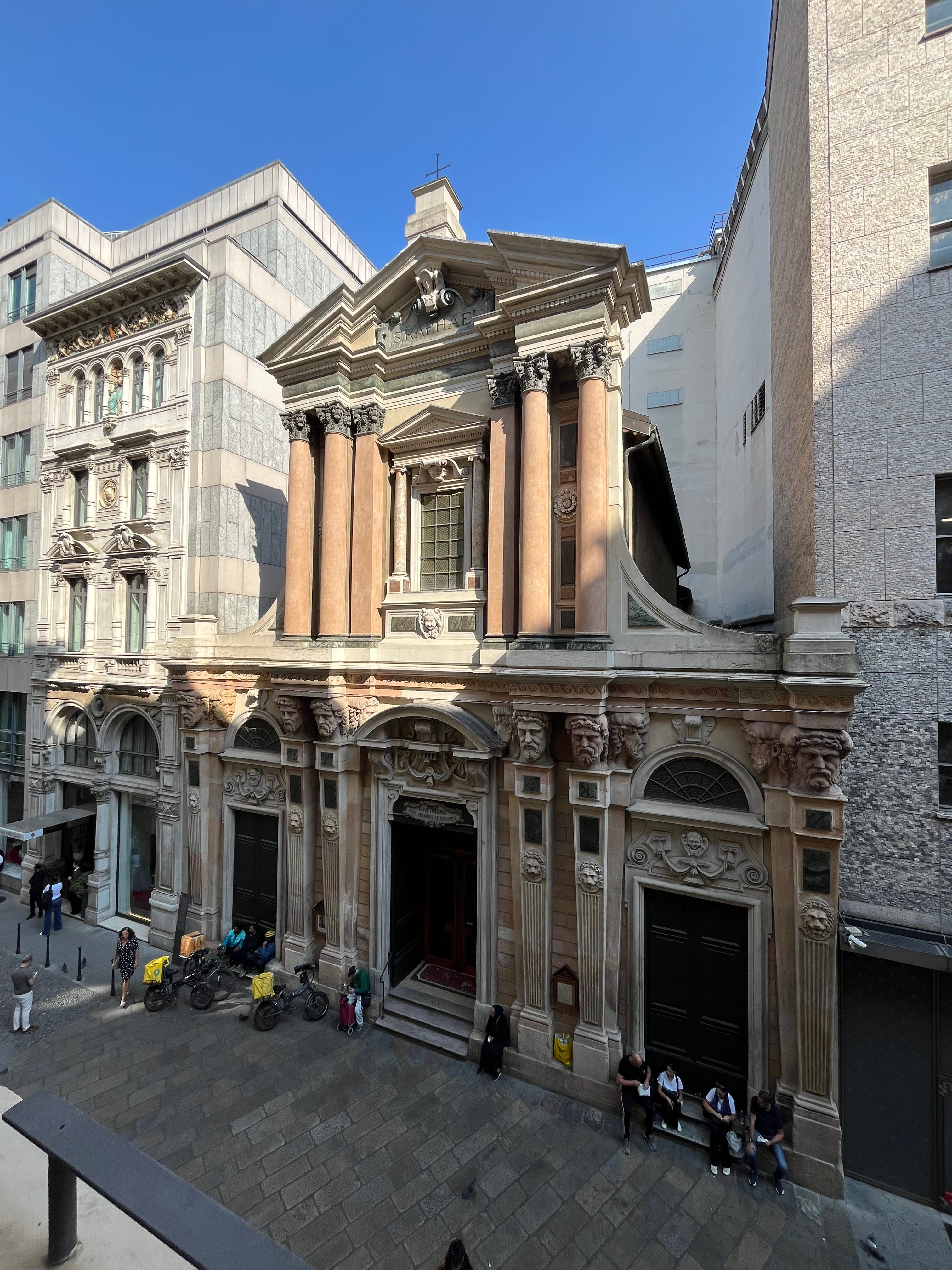
Directly across from our hotel balcony, the Church of San Raffaele encapsulates Milan’s architectural mix. Medieval in origin, it was reconstructed in Counter-Reformation style by Pellegrino Tibaldi, who contributed work on the Duomo in the late 16th century.
The split-level façade is of two orders: a Mannerist style of classical columns, niches, and pediments that’s heavier and more sculpted than earlier Renaissance work. The front wasn’t finished till the late 19th century, pulling influences from that period into the design.
Literature, Learning, and Art
Having seen some Churches, we checked in on the State. At the outset of the Renaissance, Gian Galeazzo Visconti consolidated most of northern Italy under his rule.
But when he died in 1402, his descendants became increasingly degenerate. Two sons… one perfidious, the other paranoid… ruled into the middle of the century. Both died without male heirs.
One left an illegitimate daughter, who’d married the condottiero Francesco Sforza. Sforza embellished the Castello Sforzesco as his seat of power and monument to himself.
On the edge of the Parco Sempione in the middle of Milan, this quadrilateral citadel of impregnable walls protected the signore from his own people and foreign foes, while offering a secure setting to patronize literature, learning, and art.
Francesco Sforza resumed the beautification of Milan. He enlarged the Piazza del Duomo into a space worthy of the majestic cathedral that had begun to be built. But the plaza took its familiar form hundreds of years later.
Small Details
On the north side of the plaza a triumphal arch provides passage to the 19th century Galleria Vittorio Emanuele, a shopping arcade beneath a glass canopy connecting the Duomo to La Scala.
The complex is a cross-shaped arcade ornamented with stucco, stairs, and frescoes. The central axis features mosaics honoring Italian capitals of Florence, Milan, Turin, and Rome.
Beneath the dome are frescoes representing America, Asia, Africa, and Europe, each of which welcomes wallets to (or warns husbands from) an array of shops, cafes, bistros, and boutiques that line the axes of this deluxe gallery.
Up the cloister is the Rinascente, which contains a larger assortment of similar stores at (somewhat) more affordable prices. It also has a rooftop bar that overlooks the Duomo, which offers a seat where a husband can write while his wife shops.
Milan has history, museums, churches, and charms. But it’s these small details that matter most.
JD
Aaahhh, what a beautiful day to roam and wander around these places !!!
You, as an engineer and architecture pundit, how come, you did not yet purchase a tilt-shift lens that works according to the Scheimpflug principle, thus avoiding any distortion of vertical surfaces, even when taking the picture from the ground ??? ... 🤔🤔🤔
You simply can't always book a hotel room as you did for the Chiesa di San Raffaele ... can't you ???
Enjoy your stay to the fullest !!!
Your follow-on article about your recent visit to Milan was suburb. Richly worded and educational.
I'd like to return, but given my age, I need to visit other cities and countries which have always tantalized me but in which I've never set foot.
Eastern Germany, Chile and equatorial Africa foremost