


Milan, Italy
October 13, 2026
[NB: Previous installments in this series are here, here, here, here, here, and here]
Italy is full of surprises, most of them pleasant. But many are inconvenient, and predictability should never be expected.
Yesterday started as planned. Our driver arrived on time, and carried us uneventfully from Tirano to Malpensa.
After depositing bags at our airport hotel, we enjoyed a smooth train ride to the middle of Milan. The weather was perfect. No clouds, slight breeze, and temperatures that suggested a sweater, yet didn’t demand one.
From Cadorna station we started walking. The arboreal canopy over Via Vincenzo Monti connects the Piazza Virgilio to Corso Magenta, and funneled us to lunch.
Along the way we received several welcome surprises: quiet courtyards, quaint shops, the exuberant façade and classical pediment of Santa Maria della Porta, and a magnificent archeological museum that unearths the ruins and artifacts of Etruscan, Roman, and Medieval Milan. Even the passing melody of pedestrians speaking Italian was welcome music to our American ears.
Pleasant Surprises
When time is limited, we tend not to spend much of it eating, preferring to explore places we haven’t seen. Yesterday we did both. I’m glad we did.
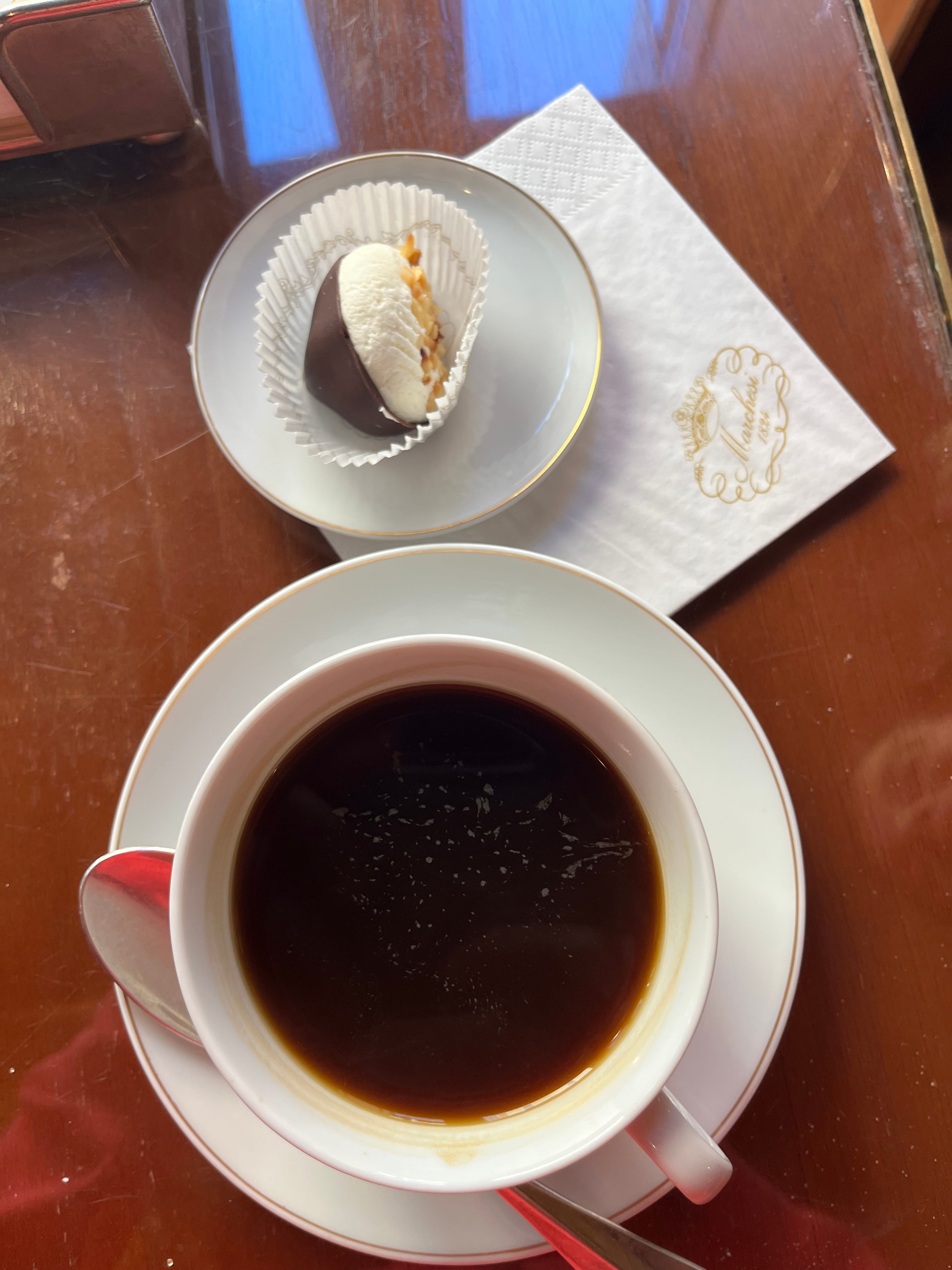
I promised my wife a day to do what she wanted. We spent it seeing the city on foot, passing Pasticceria Marchesi, established when the Habsburgs ruled Milan, almost four decades before Italy was founded.
We felt compelled to go in. From a window table we absorbed the passing scene. My wife ordered one of the best pastries she’s ever eaten, washed down with another in a series of excellent espressos. After lunch next door, we spent a few hours exploring the area.
Some friends invited us to join them for dinner. After my wife supplied herself with Italian shoes, we made our way to the restaurant. As we did, we found another pleasant surprise.
Through an open door of a massive edifice on Via Torino, we saw a sculpted Pietà made of Carrara marble. On the busy shopping street, few noticed the imposing structure that houses the statue.
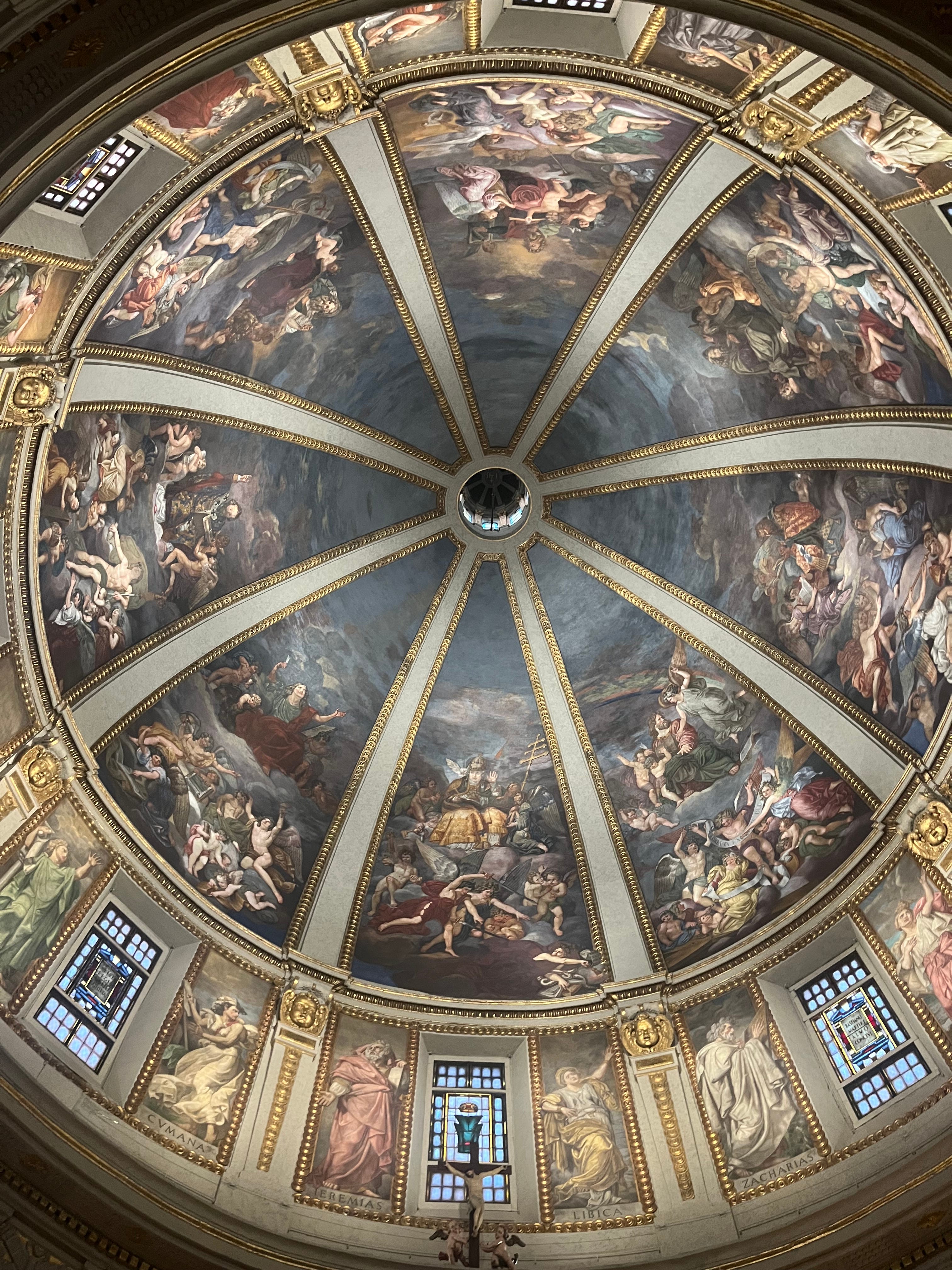
The Civic Temple of San Sebastiano was commissioned the decade after the Council of Trent, in an octagonal configuration unusual in Tridentine churches.
Constructed in a Mannerist style to mimic the Pantheon, the interior includes four radial chapels honoring St Sebastian (patron saint of the Milan police force), the Pietà, the Annunciation, and St Eligius.
The interior dome is filled with 19th century frescoes depicting the four evangelists and the Doctors of the Church (Saints Augustine, Jerome, Ambrose, and Gregory the Great) under depictions of Old Testament prophets adorning the drum of the dome.
My wife lit a couple candles at the small shrine to St Rita, and requested prayers from her patron before we resumed walking toward the restaurant. Skirting south of the Duomo, we passed the Piazza Santo Stefano and approached the University of Milan.
Upscale Speakeasy
In its shadow was a leafy patio that looked ideal for an al fresco dinner. Our friends had chosen a lovely restaurant… that was about to offer an even nicer surprise.
The hostess led us to the side of the building. Thru a nondescript door we went down some steps, into a cavern of vaulted brick, art deco decor, and the elegant ambience of an exclusive cellar or upscale speakeasy.
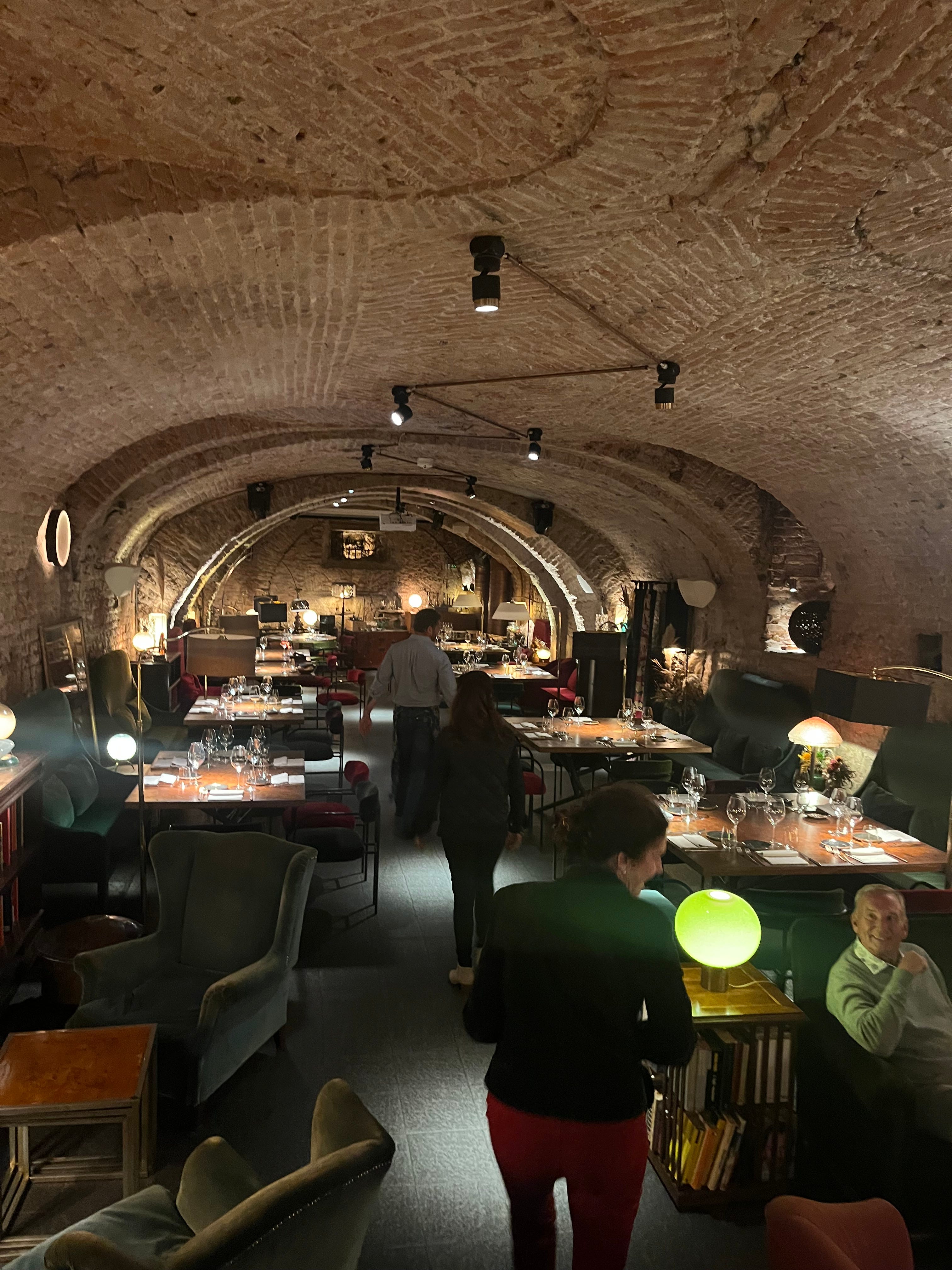
The Cantina Piemontese has operated under its current name for eighty years, but started four decades earlier as an old world tavern. Located on the Via Laghetto (“little pond”), the building originally accommodated coal deposits brought to Milan on the Navigli canals.
These waterways were constructed in the 14th century to transport Candoglia marble that built the Duomo. Our waiter explained that during the Great Plague of the 17th century, coal dust within the barrel-vaulted basement apparently kept workers from getting sick.
A couple hundred years later, sanitation concerns caused the canals to be filled. Docks converted to streets, and the vaulted basement became a bar. Following the Second World War, the current restaurant took root.
After dinner Rita and I enjoyed a delightful stroll past the Duomo, toward the Castello, and back to Cadorna. Our hotel concierge told us the last train was scheduled at 11:30, which I’d also confirmed online. We arrived a little after 10:00, bought our tickets, approached the platform, and received another surprise.
“No train to Malpensa,” an officer informed us. “Today they stop at nine-thirty, to work on the track.”
“But we just bought our tickets.”
“Is OK. We have a bus. Is outside. Same ticket. The bus… it take you to Malpensa. Go outside, turn left, and bus is there.”
Several buses were there. But none were bound for Malpensa. One of the drivers told us no buses went from Cadorna to Malpensa.
“You must take the Metro to Stazione Centrale. There, a bus goes to Malpensa.”
It was after 10:30, and we were tired. We cut our losses, and caught a cab to our airport hotel.
Labors of Hercules
When we flew to Italy a couple weeks ago, we wondered why Malpensa was named for “bad thinking”. This morning, the inspiration seemed obvious.
I was surprised to learn there’s no Delta lounge in Milan. Now we know why. No one would ever have time to use it.
While we’ve been in Italy, we’ve been repeatedly warned that lines at Malpensa are often interminable. We’d received official messages admonishing us to arrive extra early. Several locals gave the same advice.
From our hotel, we took a shuttle to the international terminal, and followed signs to check-in for our flight. A corridor took us behind the far wall, and led us to a checkpoint manned by a couple women.
“You are too early,” one of them informed us. “Come back in one hour.”
After spending days telling passengers to come four hours before departure, airport personnel wondered why we were there. Only within three hours of departure could anyone check-in for flights.
We weren’t the only ones taken by surprise. After spending days insisting travelers arrive extra early to the airport, the delay converted the terminal into a holding pen, with departing passengers packing the narrow hall like chickens in a processing plant.
We soon realized that passengers bound for the U.S. or Israel (I guess the two countries are now considered synonymous) were being corralled into their own kennel in a separate corner of the airport. This confinement was ostensibly to provide “extra security.”
At the appointed hour we were let thru, and made the long march to the Delta desk. Clearing the check-in hurdle, the Labors of Hercules continued. Next came the theatrical drudgery of “security”, followed by a Duty Free bonanza of luxury stores.
Unbeknownst to most passengers, Passport Control is on the far side of these opulent shops. Agents warned that those lines were eternal, so it was essential that ladies lash themselves to the mast, and resist the lure of deluxe sirens.
Most travelers apparently got the message and applied their wax. Almost every store… Gucci, Bulgari, Louis Vuitton, Hermès, Dior, Armani, whatever… was completely empty, which can’t please these high-rent tenants.
Beyond these abandoned boutiques were the serpentine queues of Passport Control. Malpensa recently installed “self service” screening kiosks, many of which don’t recognize the faces or documents they’re supposed to mine for data.
These machines were among the main reasons for the long lines. Passengers were routinely denied passage and had to ask one of the too-few human assistants to approve their documents.
The scanner rejected mine twice, but let me thru on the third attempt. Another lengthy walk finally brought us to the gate.
Omitted Details
I wanted a cup of coffee before boarding, but no cafes were in the area. The gate agent said the nearest was back toward the cattle chutes at Passport Control. About a ten minute walk.
I thought about going, but quickly reconsidered. Italian surprises often stem from what isn’t said… the omitted details that make a big difference.
“The lines are long, so get to the airport early (but you won’t be able to get in).”
“The last train is at 11:30 (but not tonight).”
“But don’t worry: the bus will take you (from another station several miles away).”
What was this agent not telling me? What barrier would I cross that would keep me from returning to the gate? What unspoken construction was underway that would divert me someplace I couldn’t escape?
A few minutes from departure, the last thing I needed was another shock. Best to stay near the plane. I’d had enough surprises.
JD
Thank you for the lovely description.
It brought to mind Daniel Kahneman's research. How people perceive an unpleasant experience is determined by how bad the experience was at the conclusion rather than the average of the entire experience.
This psychological phenomenon is known as the Peak-End Rule, discovered and formalized in the 1990s by Daniel Kahneman, Donald Redelmeier, and Barbara Fredrickson.
The core finding is that retrospective evaluations of an unpleasant experience are not an integral (mathematical sum or average) of pain over time. Instead, the retrospective evaluation is almost entirely predicted by a simple heuristic: the average of the peak intensity of pain and the pain level at the very end. Furthermore, the actual duration of the episode has virtually no impact on retrospective memory—a finding Kahneman termed duration neglect.
(I asked my trusty assistant Gemini to help me with this comment.)