


Atlanta, GA
April 26, 2026
The “developed world” lives in historically unprecedented opulence.
Few fear famine. Many diseases that had always been fatal are mostly manageable. Shelter is widely accessible, indoor plumbing is ubiquitous, communication is instantaneous, and we can be almost anywhere on earth within a day.
We take it as a given that the lights go on, the car will start, our phones work, and supermarket shelves are full of food. We enjoy these blessings because our ancestors deferred consumption, accumulated capital, and converted raw energy into reliable power.
After fifty years of fake money, insatiable debt, and relentless wars, their descendants have consumed much of the seed corn they inherited, and are about to learn what happens when they clog the pipes of prosperity they take for granted.
The Real Riddle
The Strait of Hormuz is the neck of earth’s most important hourglass. For eight weeks, it’s been strangled. Like a body deprived of a third of its oxygen, economic hypoxia seems inevitable even if the chokehold were released today.
A fifth to a third of global crude oil, refined petroleum, liquified natural gas, distillates, jet fuel, helium, sulfur, urea, and ammonia come thru this gullet. After two months of asphyxiation, global depression appears unavoidable. Destruction of energy infrastructure in the region and around the world makes matters worse.
These lost resources cripple the transportation, communication, medical care, fresh water, reliable food, and every other convenience and requirement the modern world expects to materialize without caring where they come from.
Meddlers, hand-wringers, and world-improvers often wonder what causes poverty. That’s the wrong question. Poverty is the default condition in a state of nature. The real riddle is what produces wealth.
Sound money, free markets, and the accumulation and compounding of capital are essential ingredients. Each of these has dissipated in the half century since Nixon severed the dollar from gold.
This chart reveals another prerequisite for continued prosperity:
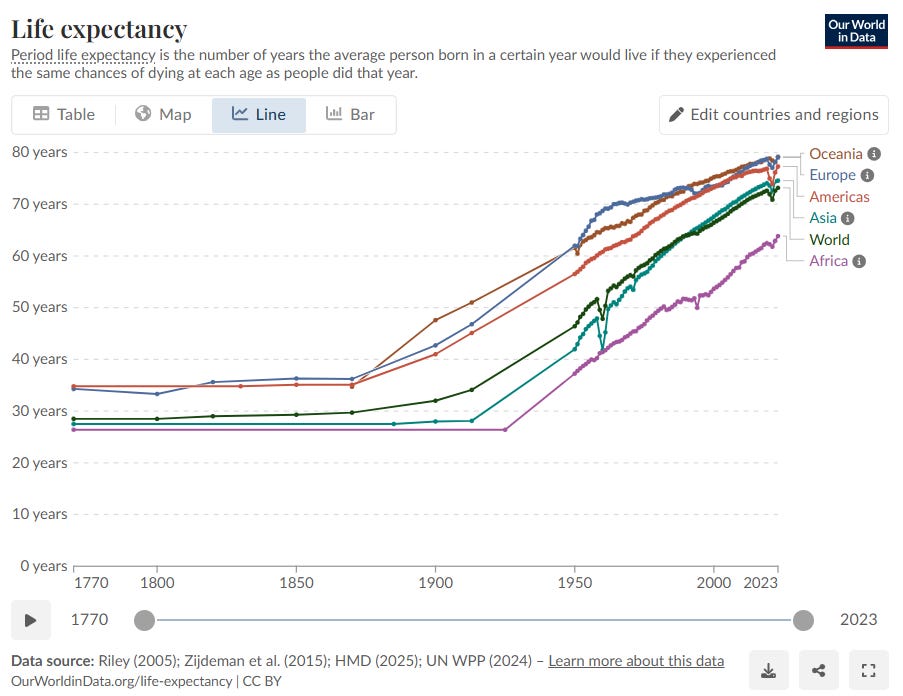
Around the world, the lift in life expectancy coincided with the advent of oil. Aside from the large drop in Asia during Communist atrocities of the late 1950s (from 1957-1960, the Great Leap Forward lopped 15 years off Chinese life expectancy), and a smaller dip during the covid response, the climb has continued since oil came into widespread use.
The disruptions in the Persian Gulf have removed almost 15% of this life-sustaining elixir from the market, and the deficit compounds with each passing day.
In How the World Really Works, Vaclav Smil identified cement, steel, plastics, and ammonia (for artificial fertilizer) as the four pillars of modern civilization. Each is contingent on unhindered availability of hydrocarbons, which is why “decarbonization” is so detrimental. His thesis may soon be put to the test.
Contingency Plans
Since war throttled the Strait of Hormuz, I’ve warned of global depression, travel lockdowns, widespread shortages, and potential famine as shockwaves ripple from the epicenter of the debacle. At this point, I’m not sure how they can be stopped.
Most Americans have no inkling what’s coming. The International Energy Agency (IEA) has called this the “worst energy crisis ever faced by the world”, worse than those of “1973, 1979, and 2022 combined.”
They’re not alone. Christine Lagarde, president of the European Central Bank and personification of the Establishment, warned this week that food rationing is coming and that supply disruptions could rival deprivation world “leaders” (like her) inflicted during covid. If nothing else, this sounds like psychological preparation for what’s likely to occur.
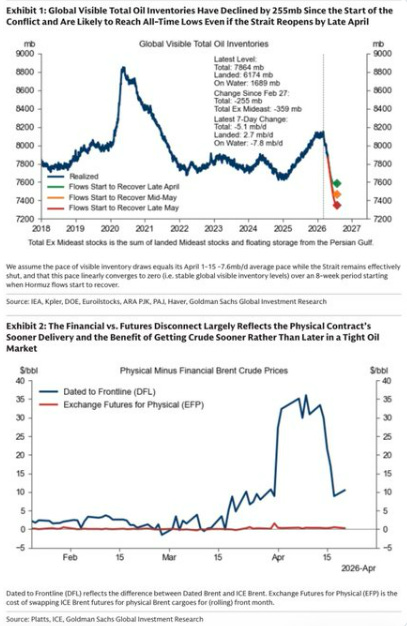
The world is currently consuming last year’s harvest. With fertilizer unavailable or uneconomic, much of this year’s crop (at least at the margins) won’t go in the ground. Oil inventories are projected to plumb all-time lows, with prices for near-term delivery reflecting extreme backwardation:
Europe receives about 40% its jet fuel imports thru the Strait of Hormuz. With only about six weeks of jet fuel remaining, European airlines are already cancelling flights. This should accelerate by summer, with warnings to have contingency plans in place for when flights are grounded.
Most Americans remain oblivious, with higher gas prices being their only inconvenience. So far.
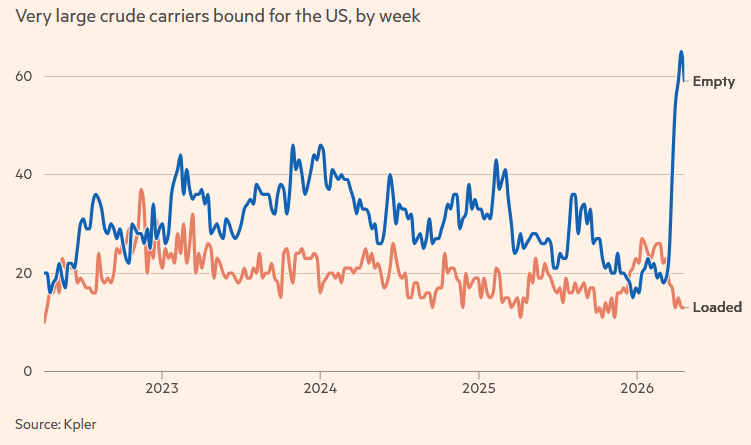
The US doesn’t import much Persian Gulf crude, but they import the global oil price… through diesel, freight, fertilizer, plastics, insurance, utilities, and food distribution. This mess takes time to manifest, and longer to fix.
Reopening the strait won’t refill inventories, reposition tankers, normalize insurance, repair infrastructure, rebuild workover capacity, or restore flow rates of shut-in wells. Months (or years) will be needed to restore capacity to pre-war levels.
Goldman Sachs projects that only 70% of lost Gulf production would be recovered within three months of the strait re-opening, and 88% after six. Almost 14.5 million barrels per day were lost in April, implying 4.35 mb/d would remain offline after three months, and 1.5 mb/d after six. This seems like an optimistic scenario.
Sales of oil, petroleum, and LNG from the US will offset some of the shortage. But America doesn’t have capacity (or the type oil) to supply the global deficit. US Gulf coast refineries are configured for heavy/sour crude that’s in short supply. The US may be a net exporter of petroleum products, but it remains a net importer of the crude needed to refine the exports it sells.
On the Beach
I recently analogized this calamity to the 1906 San Francisco earthquake. Having been a seismic engineer, I’ll reach for another tectonic comparison.
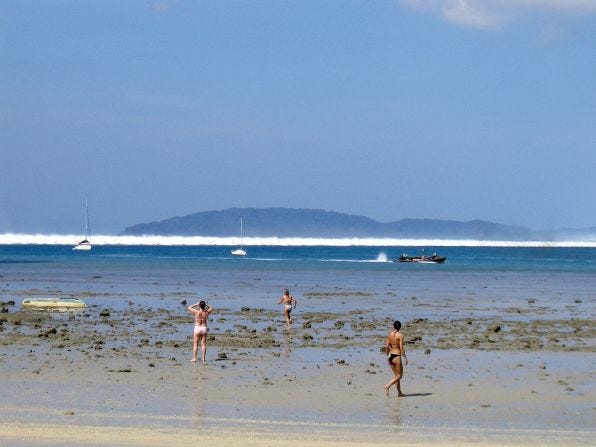
The Sumatra Andaman temblor of 2004 struck under the ocean the day after Christmas, after a rupture along the fault separating the Burmese and Indian plates. Registering 9.3 on the Richter scale with Mercalli intensity reaching IX, the earthquake was the most powerful ever recorded in Asia. It caused the entire planet to vibrate almost half an inch.
The sudden burst displaced enormous volumes of ocean water. Out at sea, low deep-water waves were almost imperceptible. But as they approached the coast, their speed slowed and size increased.
Waves that were only a couple feet high in the middle of the ocean crested up to a hundred feet when they reached the shore. In some places, the surge took up to seven hours to arrive, swallowing unsuspecting victims who assumed they were immune from the distant shock.
Far from Hormuz, much of the world is still lounging on the beach.
JD
Excellent SitRep (Situation Report).
The world is not prepared for the consequences of what Trump and his puppet master, Netenyahu, have wrought.
I am not surprised by Trump's obliviousness of the consequences. His poor judgement is well known, documented and adjudicated (e. g., multiple bankruptcies, divorces, lawsuits, convictions and fines).
Nor am I surprised by Netenyahu.
After all, his country has masterfully exploited our laws and regulations to the point that, through its America champions, it can lawfully remove any elected official who criticizes Israel or who might want to reduce the flow of our USD's -- whether in cash and kind -- that it receives.
What astounds me is the failure of Trump's advisors, especially the SecDef and SecState. These two organizations have studied copiously for years an array of scenarios pertaining the Straits of Hormutz.
But, to my knowledge, no one among his advisors addressed the array of possible consequences.
Books galore will be written about this colossal mistake. None will be kind to either protagonist.
One (Trump) has already been convicted for fraud and investigated (partially) for instigating the overthrow of the US government; the other (his puppet master) is subject to an international arrest warrant for perpetuating genocide.
Many thanks for your thoughtful description of how the basic foundations for the WEF's & WHO's Great Reset are being laid out before our very eyes ... 🎯🎯🎯 👍👍👍
This "step" is need, because the clot-jabs and wars everywhere still do not show the desired quantitative results in the chosen time-frame; mass-famine is cheaper and definitively works !!!
Here on SS, I follow quite a few writers who touch the topic currently unfolding in the Persian Gulf, but virtually none of them calls it as I mentioned above ... 🤔🤔🤔
Therefore, I just keep asking myself: WHY !?!?!?