


Atlanta, GA
August 10, 2026
Two years ago, “conservative” pundits rightly ridiculed the Biden Administration for suggesting inflation was fine while blaming its poor approval ratings on Americans’ ignorance of how little they were spending. Now, under the Trump Administration, the same “influencers” mock young people for noticing how much things cost.
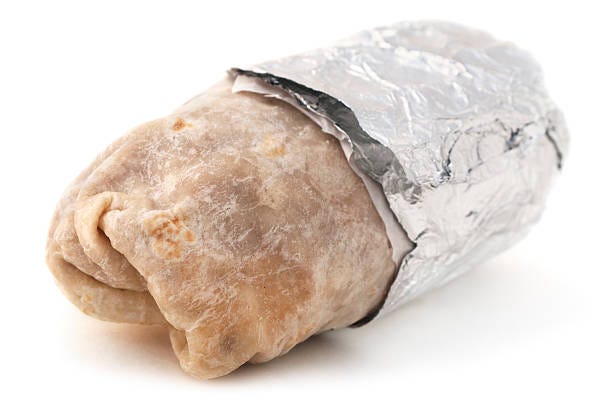
Last week a “burrito debate” erupted when a college student said burritos shouldn’t cost twenty bucks. Many respondents promptly missed the point, explaining that most burritos don’t cost that much, and that these entitled whiners shouldn’t be eating out anyway. They should cook at home and subsist on ramen and beans, just like those critics (claim they) did.
But the student’s observation was less about burritos being expensive than the undeniable fact that the cost of many essentials keeps going up, to the detriment of those born too late to acquire assets before they soared in price.
Whittled Away
The tone-deaf response to a legitimate complaint isn’t just wrong. It’s economically, politically, and culturally idiotic. This isn’t about pulling up bootstraps, driving a beater, or walking uphill both ways.
Telling people that things they buy don’t cost what they’re paying probably isn’t going to change minds or win votes. Nor is advising them to eat beans because a degraded dollar has boosted the price of beef.
General price increases started decades ago, deriving from government spending, unlimited credit, and State meddling in essential industries. It’s no coincidence that housing, medical care, and education… sectors near the money spigot and with the most government subsidies, restrictions, and mandates… are among the least affordable, and whose customers incur the most debt.
That these increases accelerated after the 1970s… with the proliferation of student loans, expansion of Medicare, and advent of the “Greenspan Put”… also isn’t a coincidence. Nor is the “Nixon Shock” in 1971.
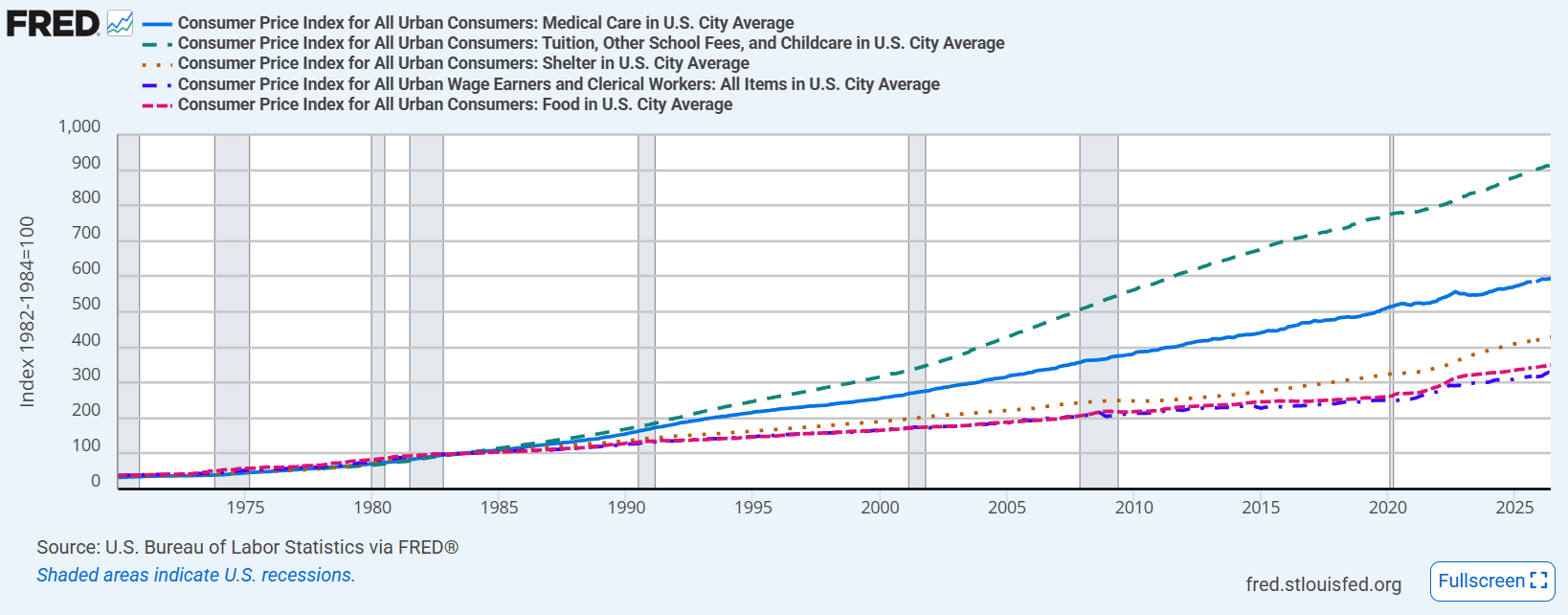
Wages have also risen, though not enough to compensate these costs. Even the yardstick is being whittled away. The dollar has lost about a fifth of its purchasing power this decade, almost half this century, and nearly 90% since it was divorced from gold in 1971. From the founding of the Fed in 1913, it’s almost entirely gone:
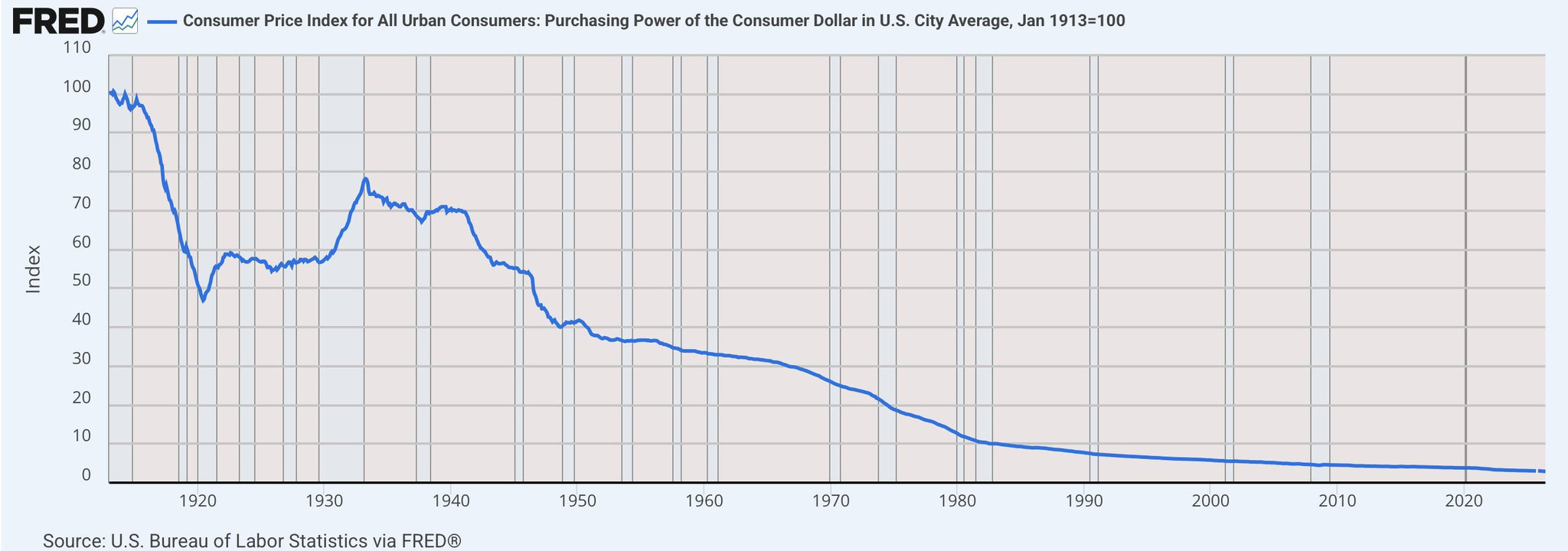
During this time, fiat money has fueled the financial system. Fiat currency creation instills distortions, depending on where the “printers” decide to distribute the loot. Connected insiders control the pump, and receive the first infusions when new cash is created.
This is how counterfeiting rings work, to quickly enrich initial recipients while slyly ripping off those forced to fill up last. Among the laggards are wage-earners, who tend to receive more pay after prices of assets (that young people own less of) and consumer goods (which they must buy) have already risen.
Instead of sound money that encourages investment and savings, we get banker bailouts, entitlement boondoggles, non-stop wars, and less affordable stuff. Under inflation, even items with falling nominal prices (software, televisions, mobile phones) cost more than they otherwise would.
A Separate Argument
Millennials and Zoomers didn’t cause this problem, and their wasteful spending habits don’t make it worse (though many of their proposed “solutions” will). For them to be scolded for financial irresponsibility by generations that compiled over $100T in public and private debt isn’t a good look.
The debate isn’t about burritos. Those are symbolic. The point is that U.S. “leaders” have wrecked the currency to pay for foreign wars and domestic boondoggles at the expense of Americans who resent being ripped off. Many are young people who were pilfered before they were born, and inherited the mess bequeathed by the people berating them.
Why must we act like their animosity isn’t understandable? Instead, youngsters are told to grab their bootstraps, get roommates, and eat ramen (all of which most of them already do) so that being robbed wouldn’t hurt so much.
Spending beyond one’s means is a valid point when discussing personal finance. But it’s a separate argument. A college student with a low-paying job shouldn’t expect to afford an $80,000 truck or a half million dollar house. Fine.
But that’s obvious… and a distraction. No one is arguing otherwise. How people spend money is a budgeting discussion, and a worthy one. Yet the topic at hand is the declining value of what’s being spent.
Baby Boomers didn’t sit meekly when “guns and butter” ravaged their paychecks. Nor should they have.
Why should generations that came of age this century not be angry that their elders eroded the dollar, incurred debt, and rigged industries to fund wars, support the stock market, keep house prices high, and make food, fuel, education, transportation, and medical care unnecessarily expensive?
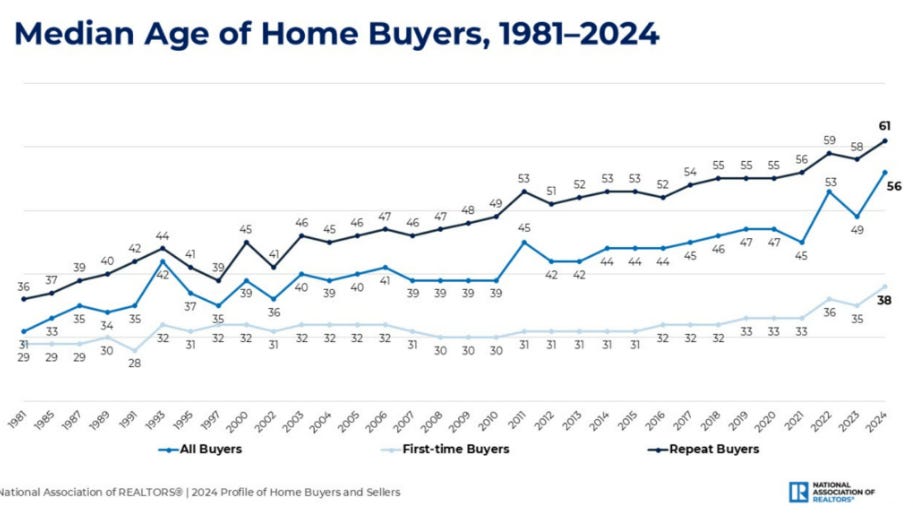
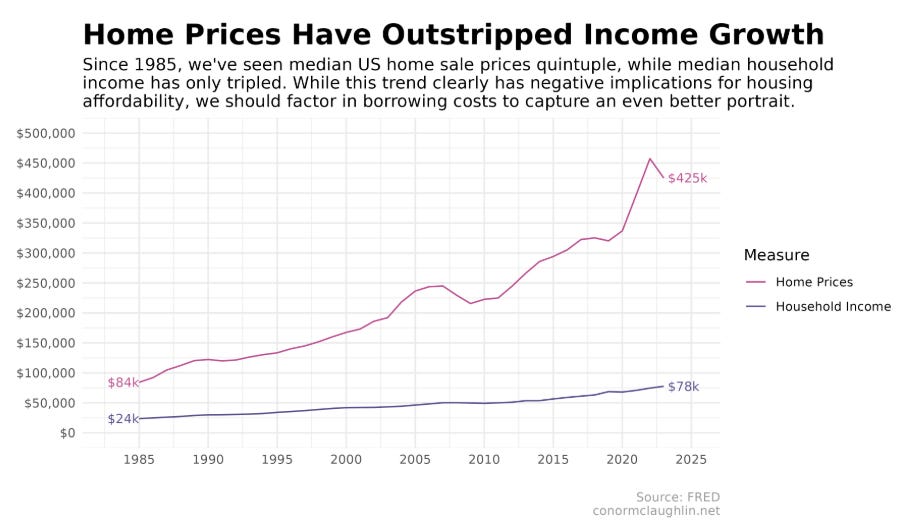
Buying burritos and lattes isn’t what’s keeping young buyers out of the housing market. Till this decade, the median first-time home buyer was in his early thirties. Fifty years ago, he was in his twenties. He’s now almost forty, with the typical homeowner pushing sixty.
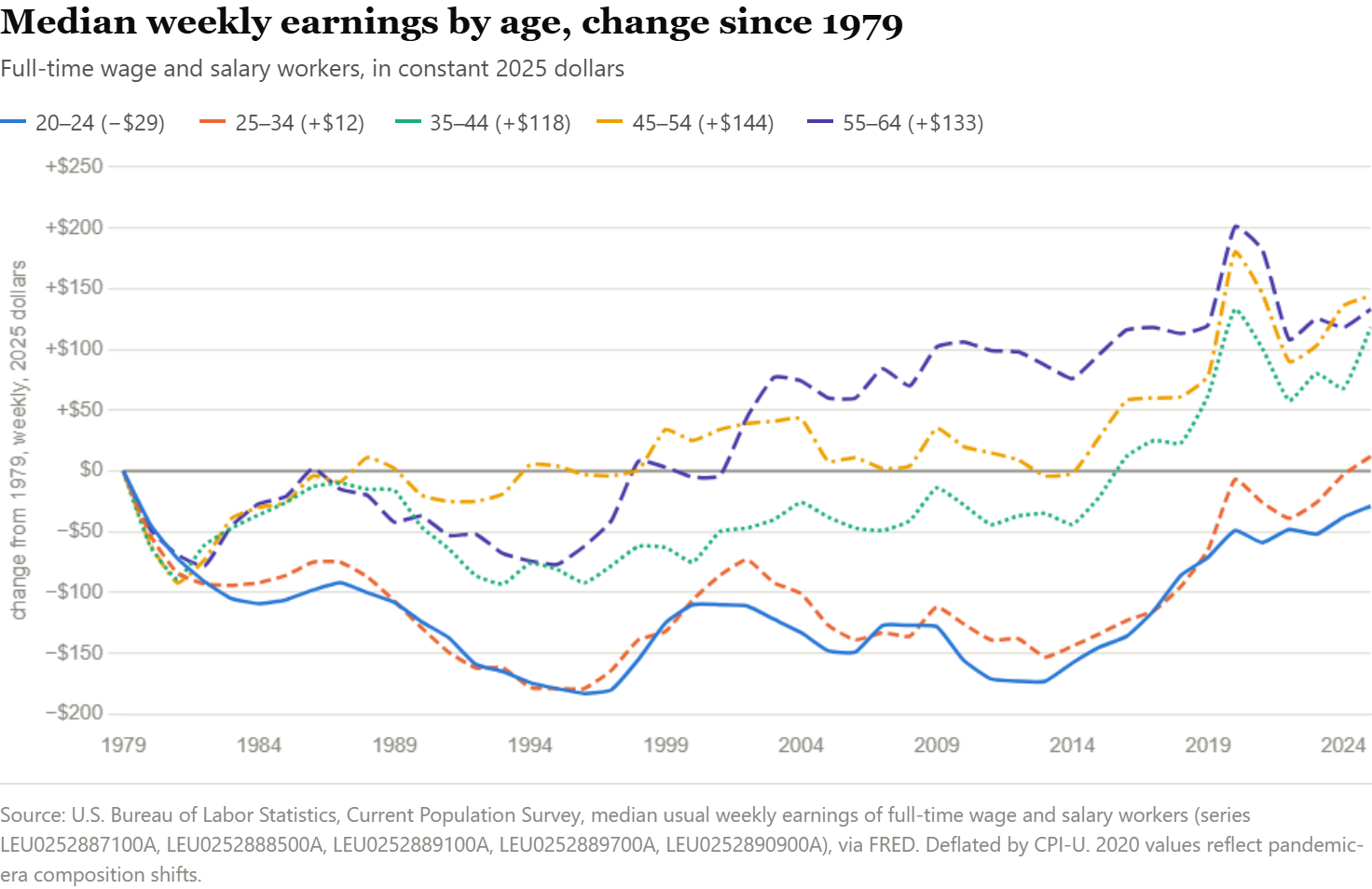
Home prices are outrunning wages, which are generally lower for younger workers. According to the Bureau of Labor Statistics, a 20–24 year-old working full-time earns about $796 a week in 2025 dollars, down from $825 in 1979.
While real wages for all age cohorts are now rising, this is the only group still paid less than it was when Carter was president. The 25-34 bracket just recently slipped ahead. Others did so at least a decade ago.
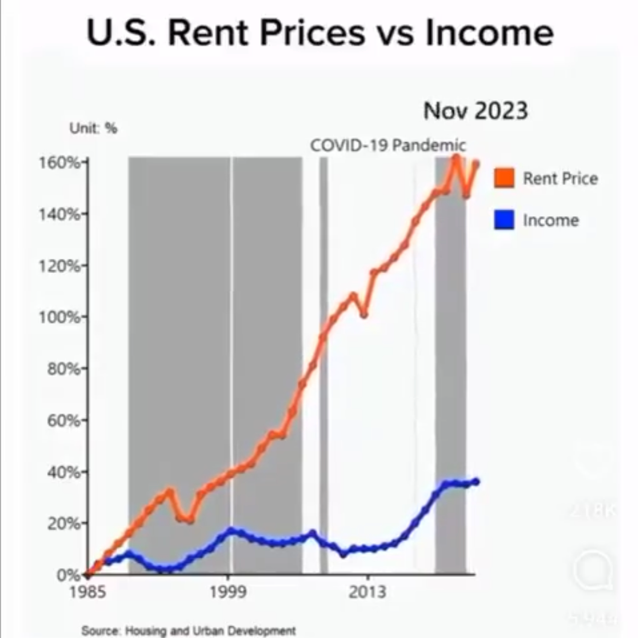
Renting is an option, but not a great one:
Bipartisan Larceny
Eating burritos didn’t cause this problem, which isn’t a function of who’s in office. More than 20% of all U.S. government debt (in constant 2026 dollars) accumulated while Donald Trump has been president.
But he’s not alone. In real terms, Ronald Reagan doubled the debt. About 70% (85% nominally) was compiled this century, during which purchasing power was sliced in half. That’s not an accident, or because entitled brats bought iPhones.
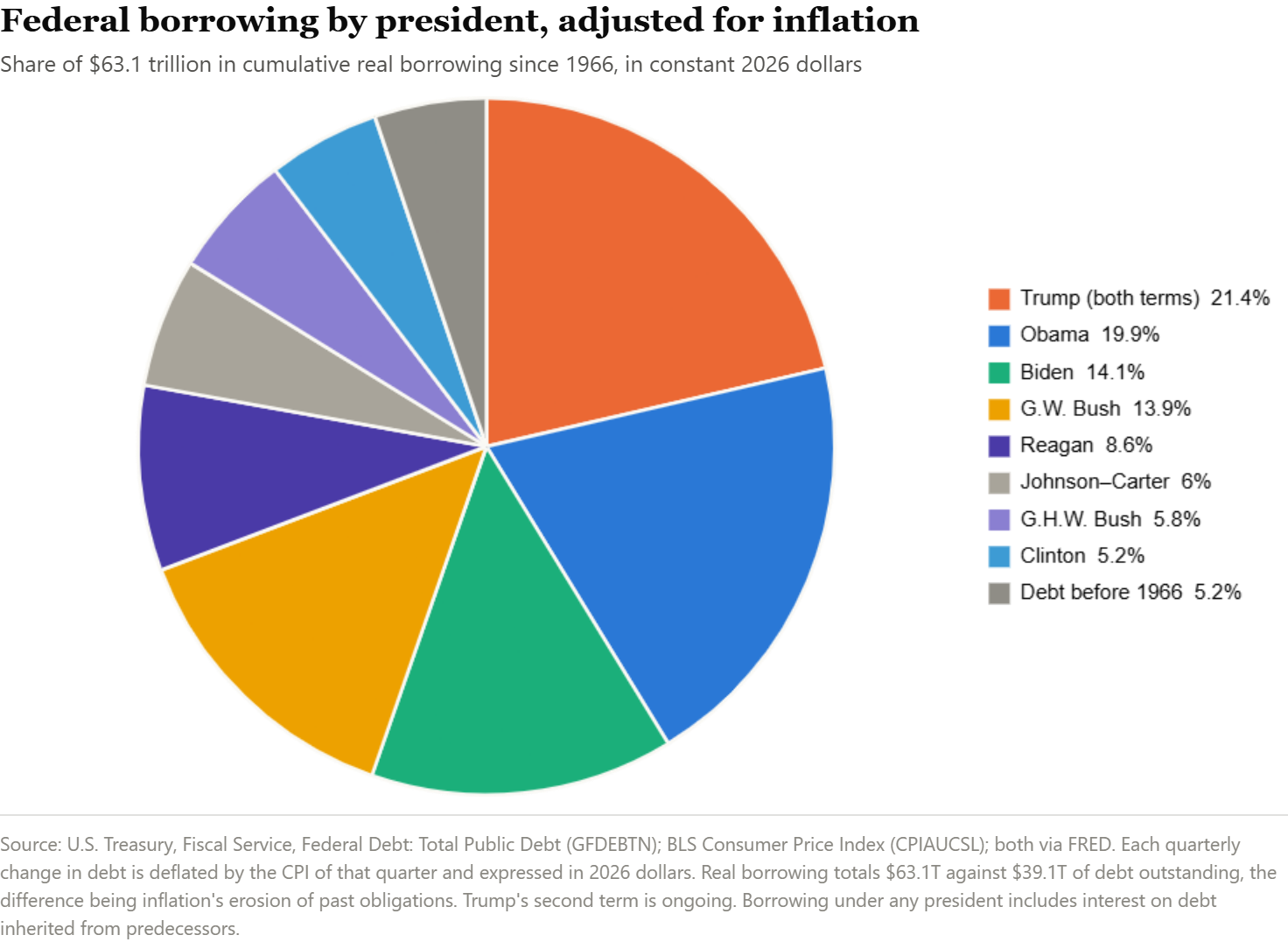
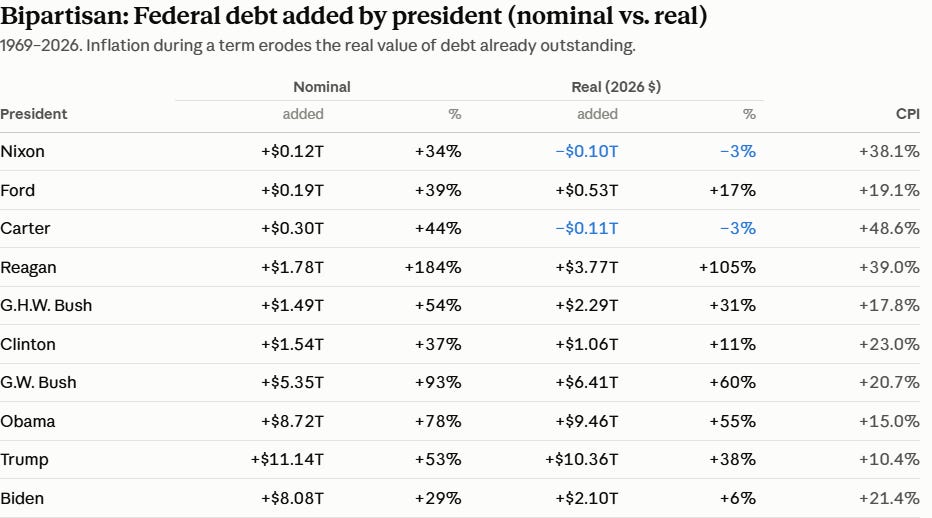

Cumulative real (2026 dollars) borrowing is more than $63T, against almost $40T of nominal debt. Inflation has erased nearly 40% of the real value of what was pledged. Two-fifths of the obligations DC compiled have been surreptitiously discharged by devaluing the money it’s denominated in.
The government, fixed-rate mortgage holders, and other debtors benefited. Creditors, savers, and anyone who held dollars absorbed the loss.
Age-Based Antagonism
The “Burrito Debate” has exacerbated age-based antagonism that is unfortunate and crippling. Inter-generational cooperation is among the greatest attributes thriving societies possess.
We often learn more from other generations than our own, many members of which are competitors for status, positions, or mates. The young imbibe wisdom from elders, who receive energy from youth.
But a proliferation of memes about out-of-touch Boomers and slacker Zoomers breeds reflexive conflict that foments fragmentation, stagnation, and rot (which is why it’s probably partially contrived and intentionally stoked).
Young people do have a lot of advantages their elders didn’t enjoy. As is often reiterated, their lives would be science fiction to any human being who died more than two decades ago, much less throughout human history.
But that doesn’t mean they’re wrong about this. Because Medieval peasants lived in huts amid perpetual plague on the edge of famine doesn’t mean today’s youth should accept being afflicted with inflation.
Many of the youngsters’ “remedies” may be warped (as were most of their predecessors’ when they confronted earlier challenges and caused our current ones). But the problem is real. If the idea is to dissuade twenty-five year-olds from embracing socialism, it’s unwise to insist they tighten their belts while their elders get fat taking the meat from their plates.
At some point, the kids are gonna get fed up and want in on the racket. If their parents can print money and incur debt to sustain stock prices, preserve pensions, and wage wars, why not grab some loot for themselves, to make groceries “cheap”, healthcare “free”, and rent “affordable”?
As Much Right
These prescriptions are imbecilic. But from the perspective of the perpetually fleeced who receive self-righteous lectures, they’re not irrational. They’re also politically potent, which is why it’s foolish to encourage revolutionary anger by treating reasonable gripes with arrogant condescension.
The people “helping the communists” aren’t the kids being attracted to it. It’s the beneficiaries of Fed counterfeiting, government debt, and protective regulation who keep denying the existence of a problem they caused.
Decades ago when the debt started accelerating, real conservatives warned that their grandchildren would be forced to pay for their profligacy. Now the grandkids are here, and they aren’t thrilled being stuck with the bill after those who ran up the tab left the table.
The “Greatest Generation” complained about their predecessors causing the Depression and a couple catastrophic World Wars. The Boomers protested when their parents gave them Seventies stagflation and Vietnam.
They were both right. So are Millennials and Gen-Z when they begrudge the idiotic wars, debt, and incessant inflation they’re saddled with.
Like their predecessors, they’ll persevere. But they have as much right to resent their ancestors’ malfeasance as their ancestors did.
JD
Just as darkness is simply an absence of light, the hard economic realities facing We the People are due to the lack of our elected to actually represent our interests and values. Evil prevails when good people do nothing about the march of marxism. Turning a blind eye to years of open borders, H1B, leftist indoctrination in school curriculum, attacks on female spaces, and degrading the integrity of elections have all come home to roost both culturally and economically. Mustering the principle to renew our nation and continue reducing the size and scope of our government must be the goal. Let's refocus on its reason for being in protecting rights and providing for the national defense instead of being a funding mechanism for wasteful tax and spend policies, and tolerating them!
There's a lot to go at here on both sides of the equation.
In opposition to "Gen Z" and the Millennials: people today overwhelmingly make ridiculously imprudent decisions when spending their money. Look around any large urban area and count how many of Millennial or "Gen Z" age are covered in tattoos nowadays, for example. Look also at the number of frequent consumers of narcotics among the same generations. The majority of these two generations does not exactly exemplify the traits of prudence and sound judgement when it comes to budgeting.
Then again, to be blunt: the Baby Boomers are uniquely abhorrent in that they are the first generation en masse to live completely and utterly for themselves, with total disregard in many cases for future generations' well-being. Speak to nearly all Boomers, and they'll insist that they earned off their own backs with no outside influences whatsoever their cushy retirement with a mortgage-free abode now worth ten times in fiat currency units what it was when they first got onto the property ladder. That same ignorant smugness is what allows them to justify spending their retirement provision on cruises around the Med or Caribbean four times a year and eating out four days a week - this, on top of having a state pension paid for out of the taxes of income of those still working, even though these Boomers still insist their state pension is owed to them by the taxes they paid in throughout the years.
Essentially, it boils down to the world now being the domain of Modern Mass Man, with no spiritual enlightenment and no regard for traditional virtue of any sort. There will be a reckoning one day.