


Atlanta, GA
July 1, 2026
Even the best allocators make mistakes. What made Warren Buffett unique was that he made so few. Until he suddenly started making so many.
Shareholders didn’t buy Berkshire Hathaway for quarterly payments. They bought it because of Warren Buffett, and assumed he’d multiply their money better than anyone else.
For several decades, they were right. From the late Sixties to the turn of the century, Berkshire Hathaway was among the greatest capital compounders the world had ever seen. Warren Buffett was the reason.
Changed Temperament
No investor has been as glorified, lionized… even deified… as Warren Buffett. With good reason.
But it’s not primarily because of the stocks he picked. The impetus for his success was the model he established, the leverage he used, and the structure and discipline that let him sustain these processes.
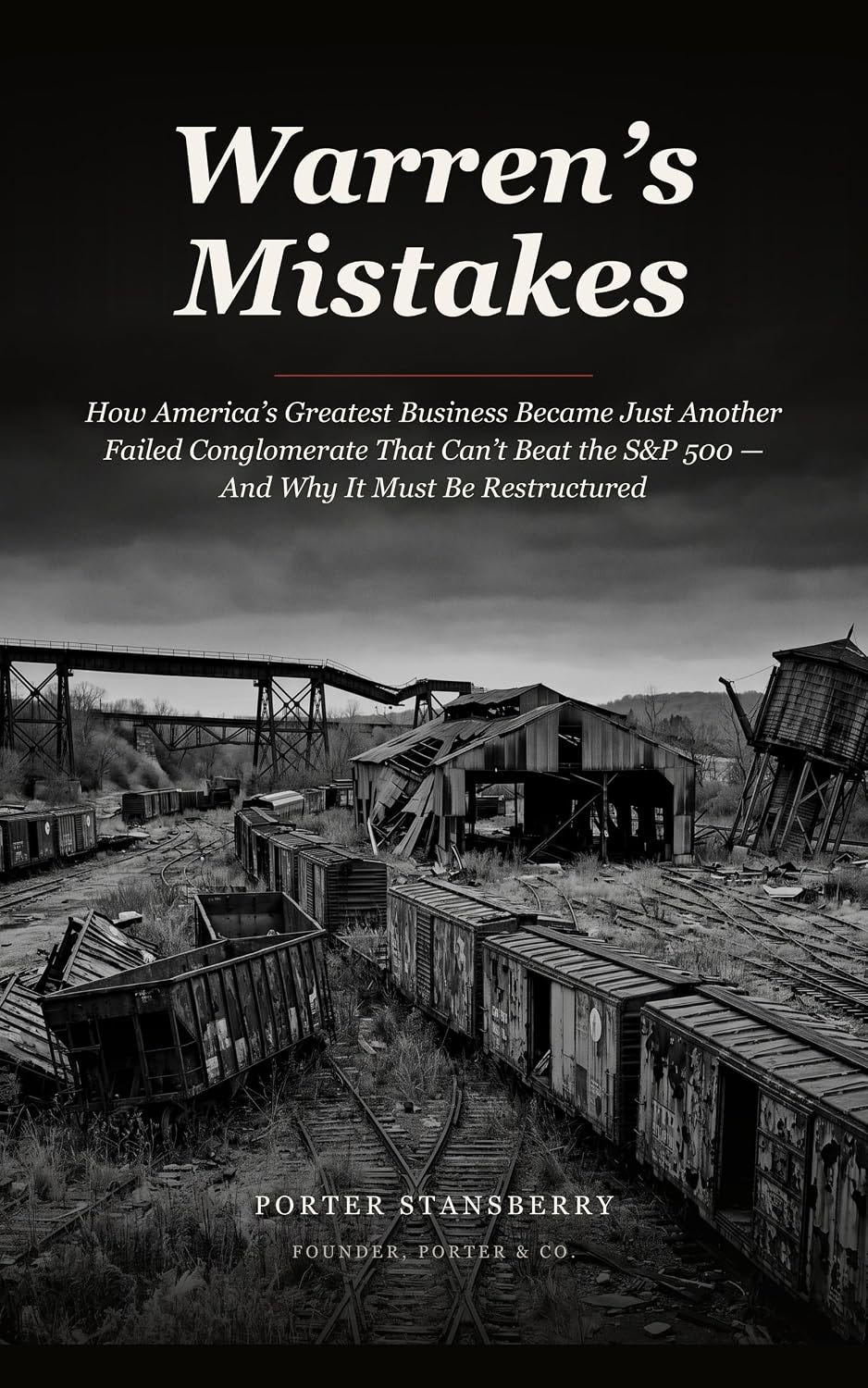
As Porter Stansberry asserts in Warren’s Mistakes, Warren Buffett had an undeniable genius. However,
“the genius wasn’t the stock picking…. The returns of the last 60 years can be replicated. You do not need to be Warren Buffett. You need the low-cost float, you need the institutional resiliency, and you need the investment discipline to only invest in the world’s best, lowest volatility stocks when they’re cheap - and hold forever. The problem is, Buffett lost that discipline about 25 years ago…”
How he did so is the lesson of the book. Using verified data and peer-reviewed research from half a century of Berkshire results, Stansberry makes a compelling case for when and why Buffett went awry, and how Berkshire can replicate its previous outperformance.
With his acumen as entrepreneur and equity analyst, Stansberry is a great storyteller. He also has a reputation for being brash and arrogant. I can see why, but don’t agree with that superficial assessment.
He is forthright and assertive, which I find refreshing. But I’d describe him less as conceited than confident. Why wouldn’t he be?
During two decades becoming one of the more prominent voices in the financial publishing space, Stansberry built a large fortune, lost most of it (or had it taken), then made much of it back within a few years. And his investing record has been stellar.
But who is Porter Stansberry to question Warren Buffett? As this book makes clear, for a quarter century, someone needed to. Yet almost no one did.
About a decade ago, Porter Stansberry started doing so. He didn’t question the model Berkshire had used to become the greatest wealth compounder in public markets. He extolled it, and still does.
As Stansberry observed, Buffett “was not running a model. He was running a temperament.” But just before the turn of the century, the temperament changed. As did what Berkshire bought.
Buffett’s framework relied on leverage from disciplined underwriting and insurance float to provide “free” funds to buy public stocks. The businesses he bought were moated, market dominant, capital efficient, low-Beta, shareholder friendly, underpriced “Inevitables” that would compound for generations.
The formula worked. Spectacularly. It still does. But for some reason, Berkshire Hathaway abandoned it during the 21st century.
Till then, shares in public companies comprised about three quarters of its investment portfolio. Now, the proportion is reversed, with wholly-owned subsidiaries comprising most of Berkshire’s book.
This has trapped cash in inefficient, low-growth businesses that consistently lag performances of public market analogs. Berkshire has become the type of “empire-building” conglomerate Buffett used to lambast.
Ominous Harbingers
Stansberry provides countless examples of this degenerative bloat. Berkshire purchased General Re and NetJets in 1998 with Berkshire shares Buffett considered undervalued, in bizarre defiance of Gresham’s Law. About the same time, Buffett acknowledged his mistake selling shares of McDonald’s to buy Dairy Queen outright… acquisition also partially made with Berkshire stock.
When these acquisitions happened, these seemed more like odd deviations than ominous harbingers. But Buffett still deserved the benefit of the doubt, and General Re at least kept feeding the float. Besides, anyone… even Warren Buffett… can make a mistake. In the case of McDonald’s, at least he acknowledged it and would learn from it.
Except he didn’t. He began compounding it. Buffett adopted a habit he’d rightly condemned… of avoiding public market “Inevitables” to acquire wholly-owned albatrosses.
Stansberry describes a quarter century of these errors, how they were made, the (substantial) opportunity cost they imposed, and how the fawning media looked the other way. In isolation, none of these mishaps was fatal, but all were crippling.
But few ailments are more destructive than a flawed philosophy. Based on his actions around the turn of the century, Warren Buffett’s changed. After thirty years of unparalleled prosperity using float to buy “Inevitable” stocks, he decided to become what he’d rightly despised.
Like any investor worth his salt, Porter Stansberry is a longtime admirer of Warren Buffett. But as a critical thinker, he’s not a sycophant. Stansberry respects his subject enough to hold him to account, just as Warren Buffett once did with executives who led the businesses he trusted them to run. As Stansberry relays from Berkshire’s 1984 Annual Letter:
“Managers of high-return businesses who consistently employ much of the cash thrown off by those businesses in other ventures with low returns should be held to account for those allocation decisions, regardless of how profitable the overall enterprise is.”
In the same publication a couple years earlier, Buffett reiterated one of his core principles:
“We will not issue shares unless we receive as much intrinsic business value as we give. Such a policy might seem axiomatic. Why, you might ask, would anyone issue dollar bills in exchange for fifty-cent pieces? Unfortunately, many corporate managers have been willing to do just that.”
With the acquisitions of NetJets, General Re, Berkshire Hathaway Energy, Precision Castparts and BNSF, Buffett became one of them.
The problem with these subsidiaries isn’t that they lose money (they usually don’t). It’s that they entailed punishing opportunity costs, incarcerated capital, accrued excessive debt, and were partially acquired with undervalued stock.
Perhaps Buffett assumed whole-business acquisitions were the only outlet big enough for his ocean-sized balance sheet? Maybe.
But for each of these purchases, Stansberry provides obvious public market stocks that easily outperformed… the type businesses Buffett always advocated (and often owned)… without the expense and hassle of running a business.
An Expensive Boast
Buffett’s biggest mistake may have been one of omission. It didn’t derive from a 21st century change in philosophy, but from one he weirdly cultivated during his initial decades running Berkshire Hathaway.
Homespun “simplicity” is part of Buffett’s (carefully orchestrated) brand. For whatever reason, he decided his image should include an ignorance of technology, a self-deprecation that for half a century has helped define his reputation… and cost his shareholders a lot of money.
Among Buffett’s wise aphorisms is to not invest in what he doesn’t understand. That makes sense. But that doesn’t mean he shouldn’t try to understand, especially about the most indispensable component of a successful business. As much as any other investor, Warren Buffett was well-positioned to do so.
Yet for half a century, every world-changing company of the computer age and Internet era eluded his investment. Most of them probably should have. But all of them?
It’s as if Buffett’s image as a “tech” novice was more important than his performance as a steward of capital. His folksy reputation became an excuse to completely ignore the most energetic part of the market. Being ignorant became something of a boast.
A very expensive one, which Buffett himself belatedly acknowledged. He eventually made Apple his largest holding, purchased shares of Google, and admitted it was “stupidity” that kept him from buying Microsoft.
Proven Track Records
This book isn’t just Stansberry spouting off. Assertions are cited and documented throughout the text or in the appendix. The book doesn’t merely describe; he prescribes.
After chronicling a quarter century of blunders that turned Berkshire into the type business Buffett once censured, it concludes with remedies to reverse the decline. These recommendations are based on proven track records, especially that of Berkshire itself.
If Warren Buffett can screw up, the rest of us certainly will. Among the best ways for investors to minimize mistakes is to understand the many things Buffett did right, and to see what happens when that discipline is abandoned.
Stansberry wrote this book to give us a look. Anyone with money in the market should be glad he did.
JD
To error is human, that comes with the territory of being human. And as always , it is easy to see what the past has brought. But good writing on Yours and Porter's work.