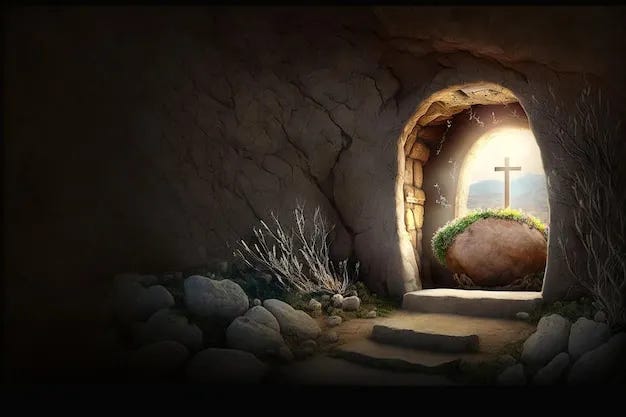
Atlanta, GA
April 5, 2026
What is Truth?
It can be hard to know.
Not because it doesn’t exist, but because it’s usually too distant, vast, and complicated to comprehend. Or… like an ocean to a fish or a forest to a tree… it’s too close, and all-encompassing. As Chesterton said, it’s easy to be blind to a thing, so long as it’s big enough.
What we think we see is often a consoling mirage, a portrayal we create to validate our assumptions. It’s tempting (and often reasonable) to base unequivocal conclusions on preconceived notions.
And why not? In some sense, that’s what preconceived notions are for: handy guides to keep us from wandering in the desert. But we tend to rend our garments whenever they’re refuted.
We all have biases that beg to be affirmed. Most are harmless, some are helpful, many are dangerous.
To keep from being singed, we sometimes hide our candle under a bushel, to curtail controversial opinions so that we keep receiving our pieces of silver. When suspected of holding unapproved perspectives, it’s easiest to deny three times we ever deviated.
It’s convenient to follow the crowd and go with the flow. To preserve professional status or personal clout, we’d best join the chorus… and choose Barabbas over Christ.
That’s human nature. When given a choice, most of us opt not to carry a cross. I’m no different.
Their Own Reward
I’ve spent most of my life on the prescribed path. College… graduate school… corporate career… leafy suburbs. For most of that time, aside from intimate family and close friends, I’d kept my opinions private.
For two decades, my writing was mostly personal diaries, family stories, and travel journals. Only in recent years did more controversial topics enter these essays, tenuously transported on the ignorance of an ass.
Regarding religion and politics… which converge on Good Friday as on no other day… my opinions are occasionally welcomed with waving palms. But they’re usually met with rhetorical scourging.
That’s fine, and to be expected. These are acrimonious subjects we’re not supposed to discuss, except to repeat approved pronouncements from our appointed priests.
It’s understandable that “respectable” society avoids contentious themes. We don’t want relationships ruined over political disputes that are often irrelevant, and typically beyond our control.
Regardless the intensity of our concern for some distant war, domestic policy, or religious dogma, there’s usually little we can do about it.
But deliberation and discussion can be their own reward. Philosophical topics would be less interesting if they weren’t controversial. And they’re engaging because they matter, whether for the wisdom they instill, the damage they do…
or the hope they provide.
Spreading the Word
On the holiest day of the year, we dispense with Good Friday gloom, and exult in Easter optimism. Let’s wash our hands of rancor, to focus inward on family and upward to God.
From the Resurrection to the Ascension, the followers of Christ were reacquainted with the Redeemer, humbling themselves before the Conqueror of death. Having been confined to the Chosen People for two thousand years, it was time for the Word of God to be transmitted to the world.
When Christ was crucified, the Roman Empire was nascent. Like the US after the Second World War, it was energetic, expansive, and unrivaled. Its money was good, its military strong, its competitors subdued. For another century it continued to expand, till decadence and hubris slowly withered it away.
It’s said that with God there are no coincidences. In the time of Christ, Rome approached its apogee. Maybe He came when he did because His path had been paved.
Literally.
Roman roads and the Augustinian peace permitted Word to spread. Never before had the known world been so seamlessly connected. After the Resurrection, Christ’s disciples could multiply adherents by traveling vast distances with (relatively) few internal hindrances or foreign threats.
And they did. From Jerusalem, they scattered far afield.
We know Peter and Paul ultimately went to Rome. Andrew evangelized what’s now the Ukraine, and probably Greece. James went west to Spain. Thomas traveled east, to Parthia and India. Bartholomew may also have gone to India, but almost certainly arrived in Arabia.
A Church established, the message was magnified. After a couple centuries of periodic persecution, it seeped into the crannies and crevices of the declining empire. In the 4th century, Constantine adopted and adapted Christianity to Rome.
Net and Sieve
In large measure, Gibbon ascribed the fall of Rome to the rise of Christianity. Perhaps.
But many factors precipitate an imperial collapse. Sometimes, as Nietzsche said, that which is bound to fall deserves a push. If the Church gave Rome a shove, it also served as a net, and a sieve… retaining seeds of revival as it let degraded soil wash away.
Regeneration was tedious. It began when the Church embedded belief in the sanctity of all human life. This was based on a worldview rooted in reason, that acknowledged an orderly universe created by God, with each person crafted in His image.
Unlike some random creation subject to arbitrary whims, such a rational system was susceptible to observation, experiment, and study. This formed the basis for modern science, of which Church scholars were at the forefront.
Their efforts laid the foundations of Canon Law, from which emerged Western notions of human rights and the rule of law. Five centuries before Adam Smith, Catholic priests developed precepts of free-market economics. To facilitate scientific exploration and philosophic inquiry, the Church invented the university.
Today these achievements are mostly forgotten, attributed elsewhere, or overtly denigrated. The Catholic Church (and Christianity itself) is routinely ridiculed as anachronistic and oppressive. It hasn’t helped that since the Second Vatican Council, the Church has engaged in what seem to be concerted efforts to undermine itself.
Ostensibly “opening its windows” to welcome the world, the Church instead stooped to its level. Sacramental reverence and ecclesiastical credibility have collapsed as earthly concerns superseded the salvation of souls.
But even with the Church in shambles or consigned to catacombs, we’re certain it’ll survive. Christ affirmed the Gates of Hell wouldn’t prevail against it, and that He’d be with us till the end of time, as the Way and the Life.
And the Truth.
Happy Easter.
JD


Your opening comment captivated me:
"What is Truth? It can be hard to know. Not because it doesn’t exist, but because it’s usually too distant, vast and complicated to comprehend."
So too did I admire your eloquent explanation of your faith.
I've always been intrigued by our species innate disposition to believe in a munificent, all knowing, ever compassionate, supreme being.
And to accept the written explanations made my mortal men how to placate this entity.
Some learned person realized they all these faiths had at their core a unifying theme which has been titled the Golden Rule: "Do unto other as you would have them do unto you."
How wonderful it would be if humanity would consistently abide by this simple admonition.
Happy Easter, JD! I prayed this morning to understand why God permits such evil and hubris to occupy political power so utterly. The answer was given, “so that you will see earthly authority for what it is, and not be tempted.” I was comforted.