


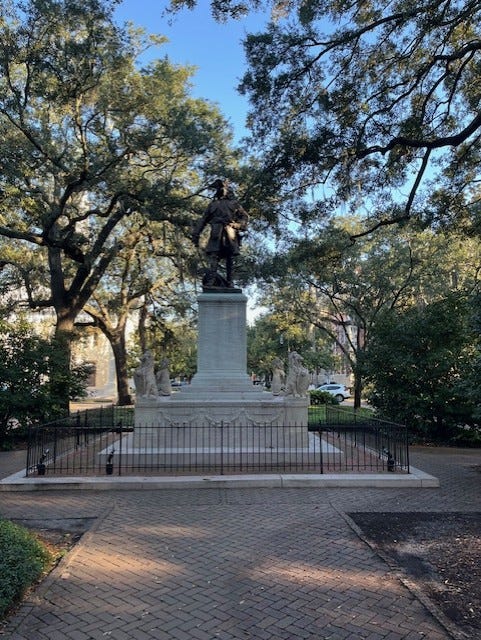
Savannah, GA
November 19, 2025
Like a chessboard beside its namesake river, Savannah was first settled by James Oglethorpe in 1733. Crossing the Atlantic on the Anne, Oglethorpe established the city and created the urban plan that remains an ornament of this town and the envy of others.
We came from the other direction… tho’ an ocean voyage probably offers a greater variety of views, and about as many places to stop.
Flat and effervescent as a bad glass of Champagne, the road from Macon to Savannah is a dull drive. This is the approximate path Sherman took, but his pillaging armies found more places to eat.
The terrain between the fall line and the ocean is coastal plain featuring Cenozoic sediment… and little else. For food or fuel, the town of Dublin is the only oasis in this alluvial desert.
That’s OK.
My wife and I were ready for the ride. We had a full tank, a cooler of food, and a couple hours to catch up. A beautiful woman makes time pass fast. Before I knew it, we were in Savannah.
Strategic Port
As the southernmost colonial port and a cornerstone of the Confederacy, the city was captured by both obstinate British and invading Yankees.
The Americans and French attempted a siege of the city to oust the English. It didn’t work. John Bull held the town till Cornwallis capitulated.
Eight decades later, Savannah was the object of Sherman’s March to the Sea. Some say Savannah’s beauty convinced Sherman to spare it. It’s a nice thought. But a naive one.
His “mercy” had little to do with the alluring layout of a charming city. It was a strategic decision, not a sentimental one. But we’re glad he made it.
Savannah is lovely. Arranged on an Enlightenment plan inspired by Vitruvius and Locke, Oglethorpe’s city is composed of landscaped squares surrounded by fetching blends of businesses and homes.
The squares anchor twelve-acre wards comprising eight city blocks. Within each ward are “tythe” and “trust” lots dedicated, respectively, to family homes and civic structures.
Churches dot these districts, with steeples and spires piercing the sky. For farming, gardens, and military training, tracts were provided to each tything just outside town.
As Savannah expanded, its distinctive pattern repeated. The original six wards quadrupled, creating an attractive network of walkable streets, appealing parks, and inviting structures at a comfortable scale.
Like silk scarves draping an elegant lady, Spanish moss adorns stately oaks, and cloaks Savannah under an enchanting aesthetic.
Oglethorpe meant to replicate his city plan throughout the colony. Regrettably, aside from a couple cities along the coast, it didn’t spread beyond Savannah.
First and Last
The Oglethorpe Plan let ordered beauty buttress the practical purposes for which his colony was founded. As Chair of the Gaols Committee in Parliament, Oglethorpe saw Georgia as a relief valve for the abused poor in debtors prisons. The territory would also be a military buffer between the prosperous Carolinas and Spanish Florida.
Under Oglethorpe, Georgia was the first American colony to ban slavery. A couple decades later, it became the last to allow it.
The state again prohibited importation of slaves in 1798, but the institution continues… and Savannah remained a hub for human trafficking. Among its more infamous episodes was the “Weeping Time” auction of 1859 (about which I elaborated here), when more than 400 slaves were sold to settle gambling obligations of Pierce Butler.
Savannah emerged impoverished from the war. Industry languished and shortages abounded. As with Charleston, our silver lining is Savannah was too broke to rebuild. Poverty forced it to keep the character that makes it attractive.
Vibrant Fabric
When Oglethorpe proscribed slavery, he outlawed lawyers. He also prohibited booze and Catholics. Given the abundance of pubs and that I somehow snuck into the city, I assume those statutes have been rescinded.
If not, River Street is one of the loudest speakeasies I’ve ever seen. I opted to shield my ears and walk the other way.
Along cobblestone streets, past elegant edifices, and around exquisite squares, Savannah spills south from the river. I spent the morning soaking it in.
We’re here at the right time of year. Summer - which lasts about seven months - is like breathing thru a wet sponge. But mid-November couldn’t be nicer.
Days dawn cool and crisp. As shadows shorten, sweaters come off. Gentle breezes soothe steps of those who stroll Savannah. Plenty of people do. Why wouldn’t they?
Most cities are indistinguishable hodgepodges of wide highways, vast parking lots, and bland buildings with blank walls that repel people.
Savannah is welcoming once you reach her. With most buildings being fewer than five floors, heights are of human scale. Façades front sidewalks, which line streets of reasonable width.
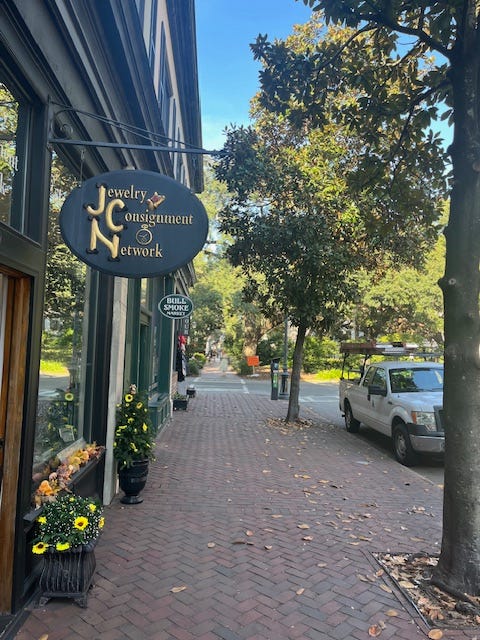
Oaks and palms provide shelter from the sun and shield pedestrians (physically and psychologically) from passing traffic. Parking is mostly parallel, underground, or behind buildings.
An array of Greek Revival, neo-Gothic, and Victorian styles, the city is a reminder that architecture needn’t be ugly. It also shouldn’t strive to show off, or to reflect condescending disgust for the general public.
Before function vanquished form after the Second World War, beauty was an essential component of public space. Not only individual structures, but the way they threaded a cohesive whole… where residential, retail, and religious edifices weaved with streets and plazas to form a vibrant fabric.
In many municipalities, zoning ordinances make such arrangements illegal. Commercial and residential areas are rigidly defined and strictly separated. Minimum numbers of parking spaces and absurd offsets encourage acres of asphalt over relentless sprawl. Cars are needed to get anywhere.
Savannah isn’t immune to this scourge. After all, cars come here too. But they accommodate the city, not the other way around.
As Vin Scully said of Fenway Park, Savannah is what it is and where it is, and those who want to reach it will find a way. Most things worth having play hard to get.
But Savannah can be more elusive than most.
Low Hanging Fruit
In San Francisco, a statue of Benjamin Franklin adorns Washington Square, while General Washington graces Franklin Square. Savannah plays the same games.
Johnson Square is the oldest plaza in city, anchored by an obelisk honoring (who else?) Nathaniel Greene. The Jasper Monument adorns Madison Square. James Oglethorpe stands in Chippewa Square. Monterey Square honors Casimir Pulaski. Wright Square features Washington Gordon.
And a Confederate Monument somehow survives in Forsyth Park.
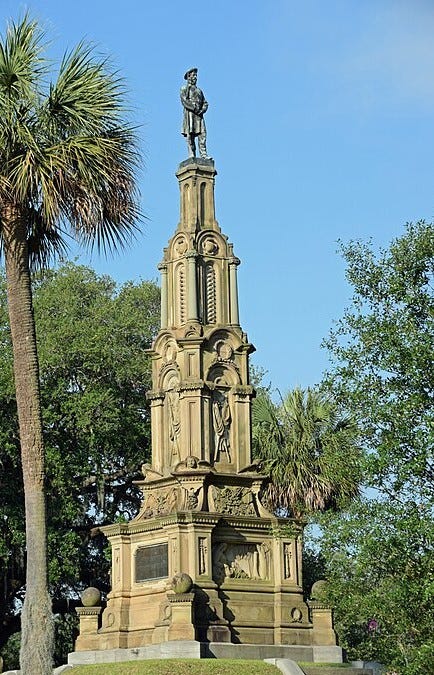
I’m not sure how this happened, but am relieved it did. Throughout the South, from Texas to the Potomac, sculptures of heroes have been defaced or destroyed, to browbeat Southerners (and other traditional Americans) into being ashamed of their ancestors... and of themselves.
Confederate monuments are low-hanging fruit. Cultural vandalism doesn’t end when those are picked. That’s when it starts, as we’ve seen the last five years.
Fitting Perpetuation
I wrote most of the preceding beside the fountain in Lafayette Square. Caddy-corner across the street is a High Victorian Gothic basilica incorporating French influences.
The prohibition of Catholics faded (yet didn’t disappear) after Independence. French immigrants arrived in the wake of the Revolution and after slave uprisings in Haiti.
The congregation of St John the Baptist became their home. Their cathedral was the first structure in Georgia built with brick. Repairs were recently completed to replace girders that had rusted away and risked collapse.
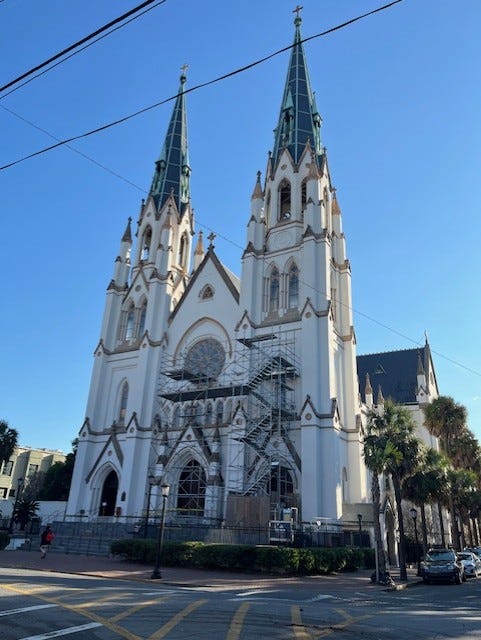
I was greeted by the grand organ as I entered the nave. Side aisles guide parishioners and petitioners toward separate chapels to the Virgin Mary. Stained glass and vaulted ceiling surround the high altar, which was regrettably repositioned after Vatican II.
Beside the Basilica is the Greek Revival Academy of St Vincent, where Jefferson Davis’s children were students during the War Between the States. It opened a couple decades earlier as an orphanage, boarding house, and free school. The Sisters of Mercy tended to wounded during the war, and secretly taught the children of slaves.
Up the block, the Daughters of the American Revolution erected a memorial arch as gateway to Colonial Park. This was the second cemetery in Savannah, and cradles the graves of Georgia luminaries before and during the secession from Britain.
Burials were permitted for a century preceding 1853. It became a city park forty years later, a fitting perpetuation of Oglethorpe’s plan.
JD
👍👍👍 !!!
After reading and absorbing your beautiful description, I'm definitely destined to move to Savannah !!!
Thanks very much for your today's post !!! 🔥🔥🔥 💯💯💯