


Bath, Maine
November 14, 2025
[NB: Previous installments in this series are here, here, here, here, here, here, here, and here]
“Life can only be understood backwards; but it must be lived forwards.”
- Søren Kierkegaard
Last week, Archimedes came to class. This week, Pythagoras popped in. Today, so did Socrates.
In building, as in many pursuits, the best place to start is at the beginning: in our heads.
The Shelter Institute slogan is “Think. Build. Live.” The first step before doing anything is to establish what we’re trying to accomplish; how, where, and when we want it; and (most important) why we should.
Then we pick up a pencil and put those answers on paper. That happened last week, when we drew our plans… and started working our way up the edifice. A couple days ago, we reached the roof. To get there, we considered ways to install stairs.
Using trigonometry, the Pythagorean theorem, and a speed square, we identified rises and runs that let us measure, cut, lift, and install a series of rafters on our emerging structure. We had them up before lunch.
After eating, we learned about insulated walls and installed a window. Thursday we re-convened in the classroom, with a warning that that morning would entail the most math of the entire course. It did.
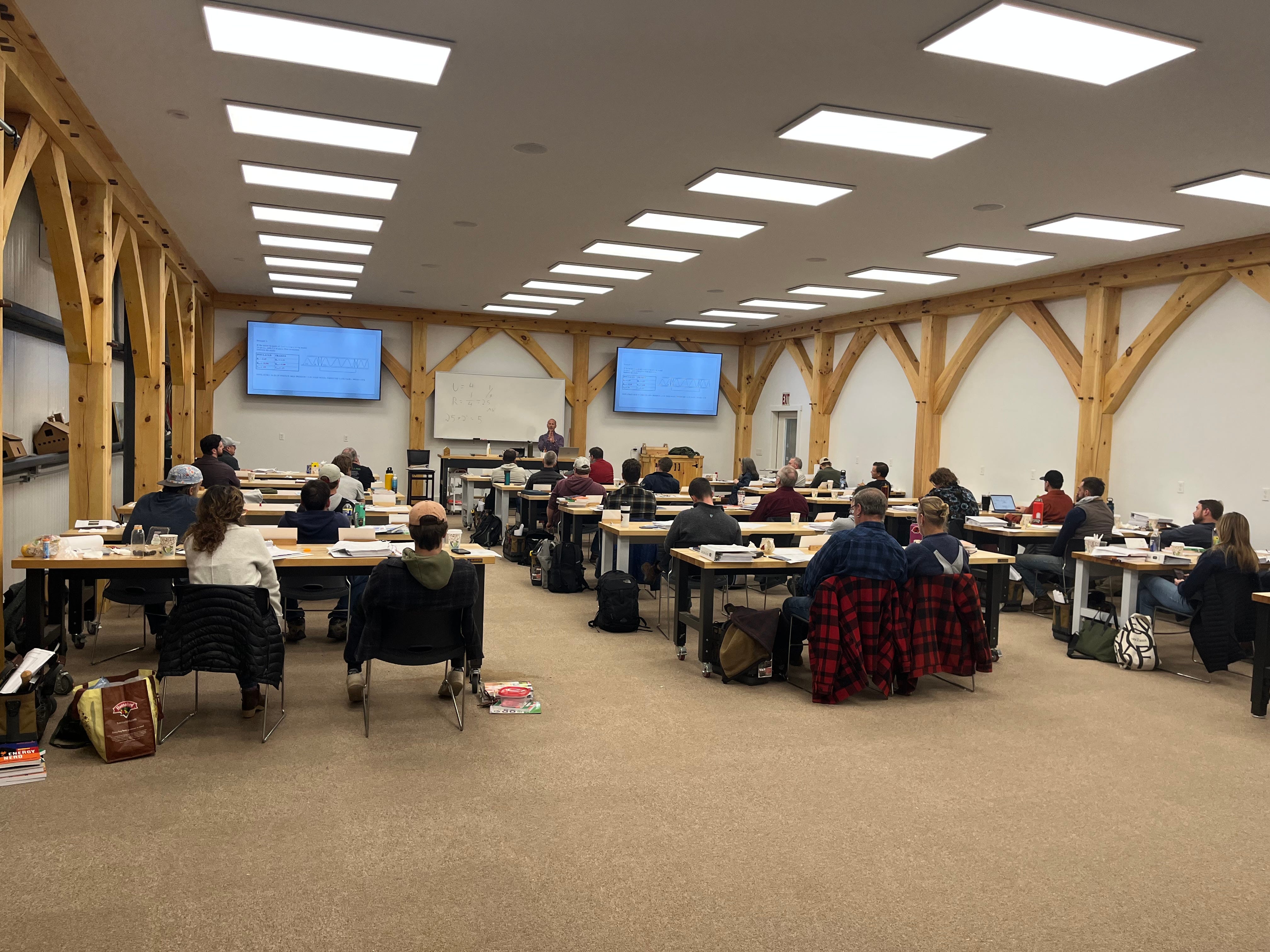
We covered convection and radiation, and calculated heat loss thru conduction and resistance. In the afternoon we transferred load to the other side of our mind, creating cardboard models of what we’d previously drawn.
This morning we conveyed them to the computer, assessing several options for digital design. We finished with financing, to be sure we can pay for everything we’ve learned to do.
Tuck-In Acquisitions
Yesterday we saw the sort of structures we’d studied for two weeks. But these were ones our instructors built to shelter themselves.
The Shelter Institute is a family business that treats employees and students like part of its clan. Last night, the Hennins welcomed these unruly “relatives” to their homes.
Matt Smith describes Doug Casey as “the most interesting man in the world.” That description fits.
It suits Pat Hennin too. Pat is a Renaissance Man… learned, well-read, sociable, self-sufficient.
Pat doesn’t always acquire everything he comes across. But when he does, it’s usually worn down, left for dead, and incredibly cheap. The seller wants to be rid of it.
He purchased his farm almost fifty years ago. Like a series of “tuck-in acquisitions”, he kept buying adjacent plots over the years. That’s not all he bought… or built.
At the time, this was a dairy farm owned by someone who wanted out. That’s the way Pat lands most of what he owns. He bought an excavator when the previous owner said it was “shot”.
“Nothing is ever ‘shot’”, he assured us when recounting the purchase. “Anything can be fixed. You can do it too.”
Several barns sit beside his house. Pat built all of them, most within a week. The shelters house an ecosystem of cars, crafts, and tools assembled over the years.
The barns serve as sheds, hangars, garages and stables. They contain a few boats, several horses, and stunning cars of notable vintage… including a ‘34 Citroën, ‘33 Studebaker, and a ‘48 Packard (often considered the first “single-frame” car).
It’s an astonishing array. Pat picked up most of these treasures on a whim, and on the cheap. As we dug into the chest, Pat held court and fielded questions. It was like touring Troy with Heinrich Schliemann.
These weren’t showpieces or vanity projects. The purchases had a point. Pat hates waste, and likes reviving “broken” things. That’s what he planned to do with what we saw in his self-built barns.
But he wasn’t able to… yet.
Family Business
Down what’s now a gravel path on the far end of the property, he and his wife constructed a second home along the water. They never moved in.
Having seen many friends succumb to cancer, Pat and Patsy Hennin helped establish Mid Coast Hospital in nearby Brunswick. The day it opened, Patsy was diagnosed with that dreadful disease.
Their kids moved home. Pat devoted the next five years of his life… and the rest of Patsy’s… to tending to his wife. Their three children helped care for their parents. Two of them, Gaius and Blueberry, joined the business.
Across the road from Pat’s farmhouse, Gaius built his own home. Blueberry moved into the riverside house down the path. Both their families have lived there since. In the United States, this sort of set-up is regrettably abnormal.
Within the last century, the cultural current pulled high school graduates away from home (I was one of the ones carried off).
As I relayed several years ago (here), by the time an average American turns eighteen, 90% of the minutes he’ll spend with his parents have already elapsed.
Pat knows this, and laments it. He’s ecstatic to have his kids and grandkids so close, but doesn’t take their proximity for granted. “I’m very lucky”, he acknowledges.
Like most of what Pat does, he made much of that “luck” himself.
His kids are talented, personable, and accomplished, and would be successful anywhere (and have been). But Pat told me he and his wife bought this property to live there the rest of their lives, because he wanted their children to not only know they had a place to go, but to always know where it was.
Gaius and Blueberry have erected barns of their own, which provided educational cover for our visit. With the course winding down, the Hennins offered us an opportunity to see a few examples of what we’ve studied.
The siblings each built sizable timber frame structures. Atop hers is a 24x24 apartment that makes magnificent use of tight space under the rafters.
His has a cathedral aspect, with soaring ceiling over the center and a couple “aisles” hosting chapels of workspace on either side. A concrete slab serves as sole foundation, with cross-bracing stiffening the ceiling against lateral force.
They highlighted materials, construction methods, and creative architectural quirks within each edifice. These structures contrasted with what Pat called “drywall palaces” benumbing most of America.
Those banalities share the same skeletons of stick-frames and gypsum, with phony “features” fostering an illusion of elegance. Many are adorned with “accessories” like decorative “dormers” and artificial “shutters” that accentuate fakery.
The Best Blessings
Throughout our course, Gaius stressed that in building as on streets it’s often intersections that create problems. Whether foundations to footings, walls to floors, windows to walls, or fittings to pipes, where things connect causes trouble.
But that’s also where strangers cross paths, and (can) become friends. But we often must force ourselves into the crosswalks.
As with most things that are worthwhile, the best blessings at Shelter are the people I’ve met. The instructors are as conscientious and kind as they are knowledgeable and diligent. They treat every student with respect, and demand reciprocity. As I hope these essays have expressed, I admire all of them.
Students descend on Shelter from around the world. Many are from Maine, with several others from the Northeast. But some came from Canada, a few from the Midwest, two from Atlanta, and others from places like Nevada, Montana, and Dublin, Ireland. We’ve created a community, and intend to stay in touch.
We all came to Maine with common notions but different intentions. We all felt we needed to know more about building, for various reasons.
Some wanted to buy land and sprout a house. Others hoped to remodel an existing edifice. Many wanted to be able to question a contractor without sounding like an idiot. I gave some of my inspiration here.
Building a house requires an assortment of skills. The most important of which is knowing that, with patience and persistence, they can be acquired.
For two weeks, Pat noted that a house should free you, not only by providing a reliable place to live… but by instilling confidence that comes from building it.
It’s important to have what Hennin calls “accident-consciousness” with a “safety frame of mind”. We should be careful, but not afraid.
Pat isn’t reckless; there’s a fire extinguisher in every room of his house. But he has common sense. Anything we do entails risk, even (or especially) doing nothing. We mustn’t be frozen by fear.
The Real Question
The Hennins teach people to build homes. But Pat’s passion is assuring students they can be self-sufficient.
In his inimitable style, Pat concluded our course yesterday afternoon. After two weeks determining how to dig, scale, frame, plumb, wire, draft, heat, cool, and calculate, he left us with the real question we all must ask.
If someone builds himself a house… who is it for?
An honest answer is the key not only to whatever house we want to build, but to the life we want to live. Pat forged a few follow-ups for us, which made me wonder if he’d read the book that inspired me to be here (he hasn’t).
He suggested we subpoena ourselves, and cross-examine the witness:
Who do we think we are? Who do our friends think we are? Our parents? Our children?
Each question should elicit several responses, many of which will be contradictory (and perhaps disturbing) depending on who we imagine provides the answers.
Like Socrates, Pat urged us to keep pondering:
Time has made us who we are. Who is that? In our mirror is a person molded by every moment up to this minute. When we recognize (or perhaps meet) whoever that is, we must ask him the most important question:
“Who do you want to be?”
As class was dismissed, we were reminded that the most essential tool in our kit is one no course can provide.
JD
Along with learning to build things with one's hands, one learns to look at one's self. Good lesson about life. A double score for the same monetary price!