


Atlanta, GA
September 10, 2024
Bright red blood that covers towns and plains
Of Kampuchea, our motherland,
Sublime blood of workers and peasants,
Sublime blood of revolutionary men and women fighters!
The blood, changing into unrelenting hatred
And resolution struggle
On 17 April, under the flag of revolution,
Frees us from slavery!
- from the national anthem of the Khmer Rouge
"For the dead and the living, we must bear witness."
- Elie Wiesel
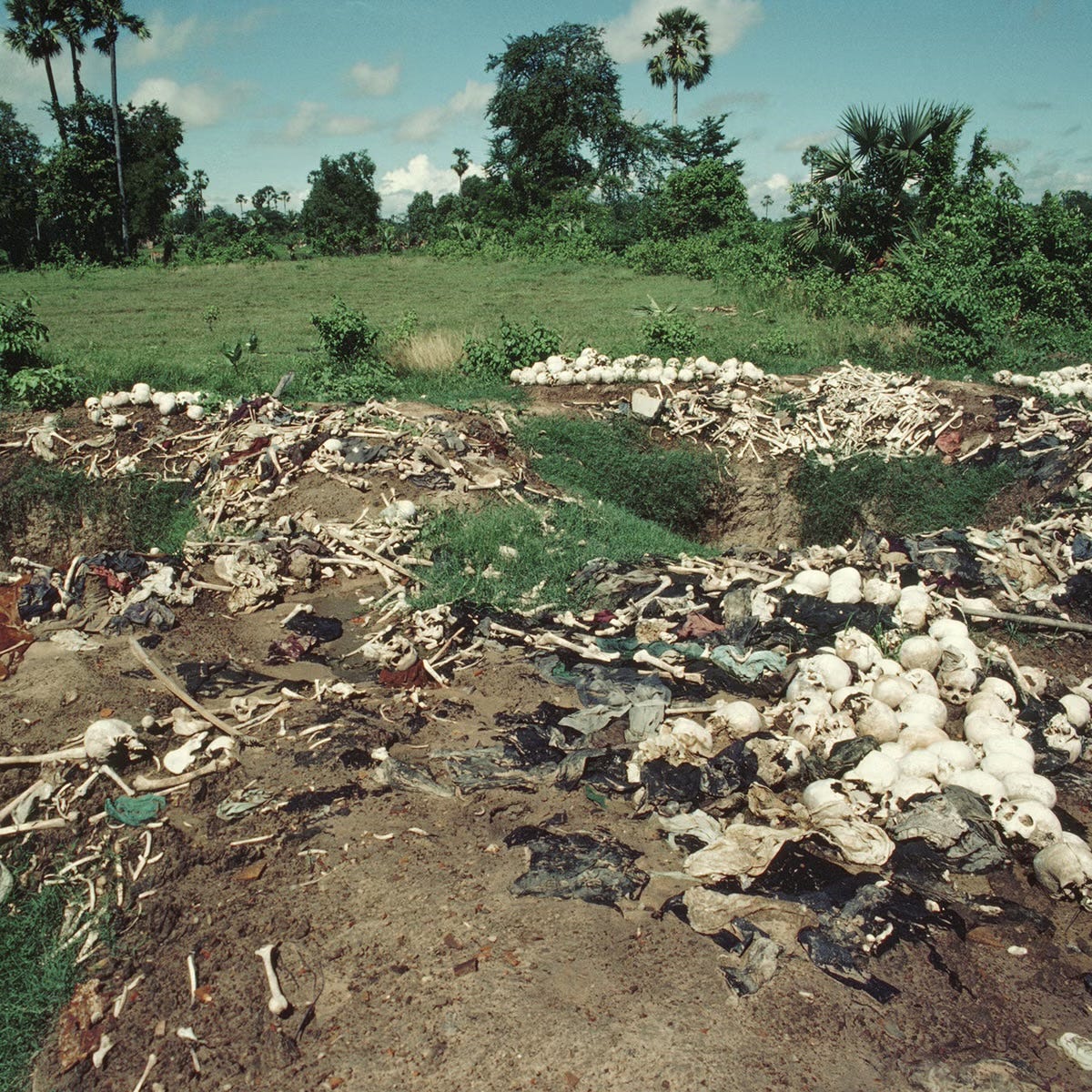
Forty years ago I saw a remarkable movie. At the time I couldn’t comprehend the story it tried to tell.
I still can’t. Nor can anyone who wasn’t there, or who hasn’t survived similar horrors.
Unfortunately, the 20th Century featured far too many. Yet this one was unique, tho’ representative. How the hell could it happen?
I watched The Killing Fields again last night, which prompted me to write this essay today.
As Hillsdale professor Brad Birzer put it in a wonderful review, the (true) story “made the horrors of communism palpable in ways even the greatest books could not.”
Overture
The French Revolution was the modern impetus for these unspeakable barbarities, which were replicated with sadistic depravity in Soviet Russia, Eastern Europe, Castro’s Cuba, Mao’s China, and throughout East Asia, Latin America and the continent of Africa. But they were particularly pronounced in Cambodia.
By 1970, the Vietnam War seeped across the western frontier. Cambodia was officially neutral in the neighboring conflict.
But it was deeply engulfed in its own civil war. This made it an attractive base for the Viet Cong to launch attacks over the border (and within Cambodia itself).
Richard Nixon wanted out of Vietnam. His plan was to strengthen South Vietnamese forces so they could take up the fighting borne by American troops. But to do so, the cross-border threat had to be eliminated.
Cambodia had begun to unravel. With the blessing (if not active participation) of the CIA, Prince Sihanouk was deposed. Rival gangs began hacking each other to pieces, and slaughtering anyone who happened to be in the way.
Pogroms were unleashed against the Vietnamese minority. And the North Vietnamese began arming the Khmer Rouge.
Unbeknownst to the American public…and, like the entire war, in defiance of the Constitution…the Nixon Administration began bombing the bejesus out of eastern Cambodia.
The U.S. dropped more than half a million tons of explosives, which slowed martial progress of the Khmer Rouge. But it accelerated its recruitment.
Its leaders asserted they’d “rather kill ten friends than allow one enemy to live.” They got their wish. In the late 70’s, their entire country became a gulag…and a morgue.
The Khmer Rouge thought Stalin too subtle and Mao too moderate. The carnage those savages inflicted over years and decades, the Khmer Rouge unleashed in days and weeks.
Slicing, Strangling, Shooting, and Hanging
Barely a hundred hours after the US Embassy was abandoned, the Khmer Rouge entered Phnom Penh. The atrocities began immediately.
Hordes of ruthless peasant soldiers emptied the cities. Over three million people were literally pushed into the countryside.
Or else.
Unlike the Nazis, the Khmer Rouge didn’t use gas chambers. They opted instead for slicing, strangling, shooting, and hanging.
Many victims were evicted from hospitals. Those who remained were stabbed, shot, or clubbed in their beds.
Beyond infirmary walls, invalids, teachers, and students were massacred with the indifference of exterminators eradicating cockroaches from a room.
Any who resisted (or merely appeared befuddled or frightened) were shot dead in the street. Bazookas fired at businesses and houses where human presence was seen or suspected. Before long, there wouldn’t be any.
The Khmer Rouge cut off the water supply its first day in Phnom Penh. After a week, money was abolished and all currency incinerated. Identities were stripped and private property prohibited. Total collectivization was complete in less than two years.
Historian Paul Johnson noted married couples being killed merely for conversing. Orphans and the elderly were abandoned to the whims of famine and disease. Relatives were forced to watch their children, siblings, and parents decapitated, bludgeoned, garroted, or axed in endless orgies of public executions, which were often preceded by horrific mutilation.
Johnson recalled a colonel having his eyes gouged, nose removed, and ears cut off before spending three days dying while crucified to a tree. A teacher who taught unapproved ideas was ordered hanged and hacked, with his eight year-old students forced to carry-out the sentence.
Birzer elaborates on the scope of the depravity:
“The Khmer Rouge probably murdered 86% of the Buddhist monks, half of Cambodian Muslims, half of Cambodian Catholics, 89% of the medical doctors, and 75% of the teachers. Anyone who had any pre-revolutionary education, especially in French and English, was systematically murdered, and the Catholics and Muslims were both seen as anti-Khmer.”
But the worst, as Birzer said, must remain unstated.
“The Khmer Rouge especially hated pregnant women, doing things to them and their fetuses that should not enter our soulful utterances and imaginings at all.”
Many Khmer Rouge soldiers were pre-teens who’d been ordered to brutalize animals to desensitize them to killing. Unfortunately, it worked.
Fanatical Intellectuals
As was common under twentieth century Communism, these sickening cruelties were orchestrated by fanatical intellectuals who were “educated” in the West.
Pol Pot was no exception. Like many deranged ideologues of Cambodia’s Angka Loeu, he had a bourgeois background.
These revolutionary leaders were teachers, professors, economists, and bureaucrats. All were schooled in France and influenced by Satre. As Johnson noted, they detested cities, yet never sullied their hands with manual labor or the creation of wealth.
By 1976, the Angka Loeu controlled Cambodia, and implemented their plans to remake the world. In just over a year, they “liquidated” about twenty percent of the country’s population. Many who survived probably envied those who died.
As agents of social engineering and radical disruption, the Khmer Rouge made the Cultural Revolution and Great Leap Forward look like a Sunday stroll. In a matter of weeks, said Jean-Louis Margolin, “the country was razed to the ground and plunged back into a prehistoric era.”
Like the French Revolutionaries, the Khmer Rouge discarded the conventional calendar and centered a new one around themselves. They were now living in “Year Zero”.
“Re-education” camps were established. Memories were to be erased. Under threat of execution, parents and children were ordered to forget each other. Prior education or acquaintances could get you killed. Knowledge of foreign languages was a death sentence.
Everyone who wasn’t a corpse, as RJ Rummel relayed, “was a prisoner or a slave.” Birzer quotes a Cambodian witness:
“There was no spare moment in the twenty-four-hour day. Daily life was divided up as follows: twelve hours for physical labor, two hours for eating, three hours for rest and education, and seven hours for sleep. We all lived in an enormous concentration camp. There was no justice. The Angkar [meaning simply “The Organization”; this was the name the Khmer Rouge took for themselves] regulated every moment of our lives.”
As happened in Revolutionary France and the Soviet Union, many of the insurgents turned on each other. Purges proliferated, and the uprising eventually ate its own.
By mid-1978, half the high officials and most regional secretaries had been executed. These purges grew hungrier as they ate. Eventually, wives and kids of victims and targets were added to the menu.
The Khmer Rouge ultimately murdered up to one in two Cambodians. This was undoubtedly part of an intentional effort to be rid of “useless mouths.” And many who remained (especially including most of the kids) were coldly programmed to kill.
The carnage continued into 1979, when the Vietnamese invaded. To outsiders, these “saviors” seemed like cool comfort. But relative to the current regime, they were warm relief.
By the time the liberators arrived, bones filled the Mekong, flesh fertilized Cambodian fields, and cannibalism sustained many who’d managed to survive. Common decency, human dignity, and Buddhist compassion had long since disappeared.
The Khmer Rouge seeded the Thai border with landmines to discourage escape. Revealing how horrible Cambodia was, escapees fled to hostile Vietnam. And hundreds of thousands endured horrific conditions as “boat people” trying to reach saner shores.
Those who did were eager to share their stories. Like survivors of the Holocaust or the gulags, they made it their mission to tell the tales of terror under the Khmer Rouge.
Our role is to hear what they said, and to remember a menace that modern sentiment is inclined to forget.
Or, more frequently, to romanticize.
JD
Sobering stuff, JD. I have been in Cambodia many times but have yet to see the killing fields. A friend told me how you can go there and hire an AK47 and shoot chickens.
That said, the Cambodian people are among the nicest I have met anywhere in Asia. They call Cambodia "The land of real smiles." (Not to be confused with Thailand).
I do remember some of that...