


Atlanta, GA
February 28, 2025
He opted for an ivory grip on his new revolver, thinking it would look better in the museum after he’d done the deed.
It did, but not for long. The weapon was given to the Smithsonian, where it was eventually “lost”.
But the mind of Charles Guiteau was already gone, and it was convinced James Garfield had to go. Guiteau had written and distributed campaign speeches endorsing Garfield’s presidential bid, and gave himself credit for securing the victory.
Disgruntled at not receiving a post in Paris after helping Garfield get elected, Guiteau decided God had given him a new mission.
Stalwarts and Half-Breeds
The Stalwart wing of the Republican Party were remnants of the radicals who wielded power in the wake of the war. Opposed to them were the “Half-Breeds”, an epithet implying (like the “RINO” acronym today) inadequate devotion to party “principles” and political patronage.
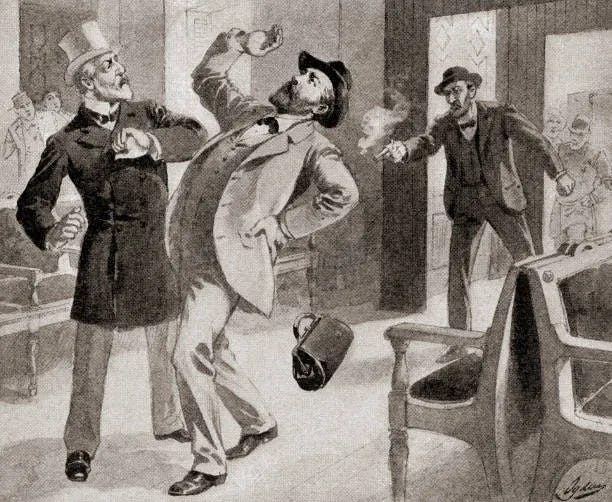
The Stalwarts advocated for the “spoils system”, and considered reciprocal favors their just reward. Guiteau agreed. When Garfield didn’t give him any, Guiteau put two bullets in his back.
From unsanitary efforts to extract the slugs, the president died of infection two months later. Chester Arthur took his place. Guiteau was charged with murder, and became the first defendant to plead temporary insanity in a high-profile case.
If not for the “temporary” part, he may have had a point. During the trial Guiteau berated the judge, jury, prosecution, witnesses, and his own defense team. He solicited legal advice from random spectators in the courtroom, and delivered his testimony as epic poems.
In a clever plea, he argued that President Arthur should pardon him because Guiteau had increased Arthur’s salary by giving him a promotion. It didn’t work.
Charles Guiteau was convicted of his crime. He dangled from a rope nine months after Garfield died, giving him the honor of being the presidential assassin who lived longest after pulling the trigger.
To Guiteau’s posthumous chagrin, six months later the spoils system also died. Sort of.
Kudzu over Georgia
As after any traumatic event, hyperbole ran rampant. The spoils system was blamed for killing the president. Those who cast this aspersion didn’t let the crisis go to waste.
Throughout the nineteenth century, proponents of patronage had resisted reform. But when Guiteau assassinated Garfield, he killed the practice of using political appointments as overt payoffs for loyal promises or previous favors.
Sixteen months after Garfield’s death, the president’s Stalwart successor signed the Pendleton Act.
This ostensibly replaced patronage with merit when assessing government workers. Immediately after the law took effect, ten percent of federal positions were filled based on competitive exams rather than political privilege. And these “civil servants” couldn’t be fired for political reasons.
Within a few years, this applied to almost half the federal workforce. By the turn of the century, ninety percent of employees were covered by the Act.
Many of the initial changes were cosmetic. So long as candidates passed the exam, politicians still appointed whoever they wished. And the terms during which employees couldn’t be fired were suspiciously coincident with those of the officials who nominated them.
But like kudzu over Georgia, as time passed the effects of the Act began to take root. Especially during the New Deal and in the wake of the Second World War, the “civil service” proliferated, and no executive could stunt the growth.
The Civil Service Reform Act of 1978 added fertilizer, creating the Office of Personnel Management, the Merit Systems Protection Board, and the Federal Labor Relations Authority. It also established the right of civil servants to unionize and arbitrate (which seems inappropriate for people employed by the taxpayers).
The administrative state became entrenched. Fear of unions, the corporate media, connected corporations, and the intelligence apparatus kept “the people’s representatives” in their place.
As Jeffrey Tucker put it last week,
“most people in politics have simply surrendered, like homeowners who know there are rats in the basement and bats in the attic but long ago gave up trying to fix the issue….
The American people have felt themselves ever more oppressed, weighed upon, taxed and regulated, spied upon, brow beaten, and otherwise overwhelmed. Voting never made any difference because the politicians no longer controlled the system. The bureaucracies ruled all.
“The Biden years underscored the point. We didn’t even need a conscious and present executive. We only needed a figurehead to pretend to be president, just like the Soviet premiers in the old days. The institutions ran everything and the people controlled nothing.”
Toward the end of President Trump’s first term, he signed an Executive Order creating Schedule F classifications that would allow the president to more easily dismiss these permanent employees. Joe Biden reversed that order a couple months later, in one of his first acts upon taking office.
Trump’s original directive was a shot across the bow. He fired it again when he returned to power. Only this time he seems determined to hit the target.
Eternal Punchline
Within hours of taking the oath a second time, Trump signed an Executive Order titled "Restoring Accountability To Policy-Influencing Positions Within the Federal Workforce".
This is ostensibly why DOGE has been digging the last few weeks. The administration knows it doesn’t have much time to get this done. As Tucker continued,
“they are profoundly aware that they MUST act fast and with some degree of ferocity, even recklessness, else we will default back to the status quo of leaders who pretend to be in charge while the embedded system runs things behind the scenes.”
Who knows if they’ll succeed, or if they really want to? I certainly wouldn’t trust Trump to do (or mean) what he says. After the last fifty years… and especially the last ten… why would I?
But for as long as I’ve been alive, almost everyone has complained about corrupt “governance”, bureaucratic incompetence, and reckless spending (if on behalf of other people).
Government malfeasance is an eternal punchline, and the idea of controlling it has always been a joke. Yet when anyone tries (or even pretends) to do so, the laughter stops.
It remains to be seen whether the weeds are trimmed, or ripped out by the roots. Those tentacles dive almost a century and a half deep, into soil contaminated by two blasts from a British Bulldog revolver.
We’re all familiar with the shooting of Lincoln, and fascinated by the killing of Kennedy. Even the murder of McKinley receives an occasional remark.
But as surgeons still struggle to remove the bullets, the most consequential shots in US history might be the ones that assassinated a president few Americans remember.
JD
The Civil Service is way too large but the way to pare it down is not indiscriminate and disruptive dismissals; it's mission reduction, aka "privatization."
Frankly, the way Trump, Musk and their minions are going about it has never been justified.
Why the rush? Surely firing National Park Rangers -- getting ready for summer tourists -- are not going to save the nation from a looming debt default. But canceling major programs might.
Or how about stopping the Federal government from financing private sector ventures? After all, governments don't create wealth; they consume it.
Or, instead of tariffs which make products with foreign content more -- not less expensive for US consumers -- give some attractive benefit to foreign firms that establish production facilities here?
This tactic worked with Japanese auto companies which, collectively, now employ tens of thousands of US citizens and produce millions of tax revenue for local, state and the Federal government.
Or close some of the 800 facilities abroad at which the US has a military presence?
Trump and team are Ready, Fire, Aim.