The Happiness of Pursuit
Recent years have evoked apprehension and fear. Today we abandon anxiety and consider contentment.
Adairsville, GA
May 1, 2026
What makes us happy?
The question has animated philosophy since systemic thought sprouted on Aegean shores. For twenty-five centuries, the hunt for happiness has followed countless routes of reflective contemplation and empirical inquisition.
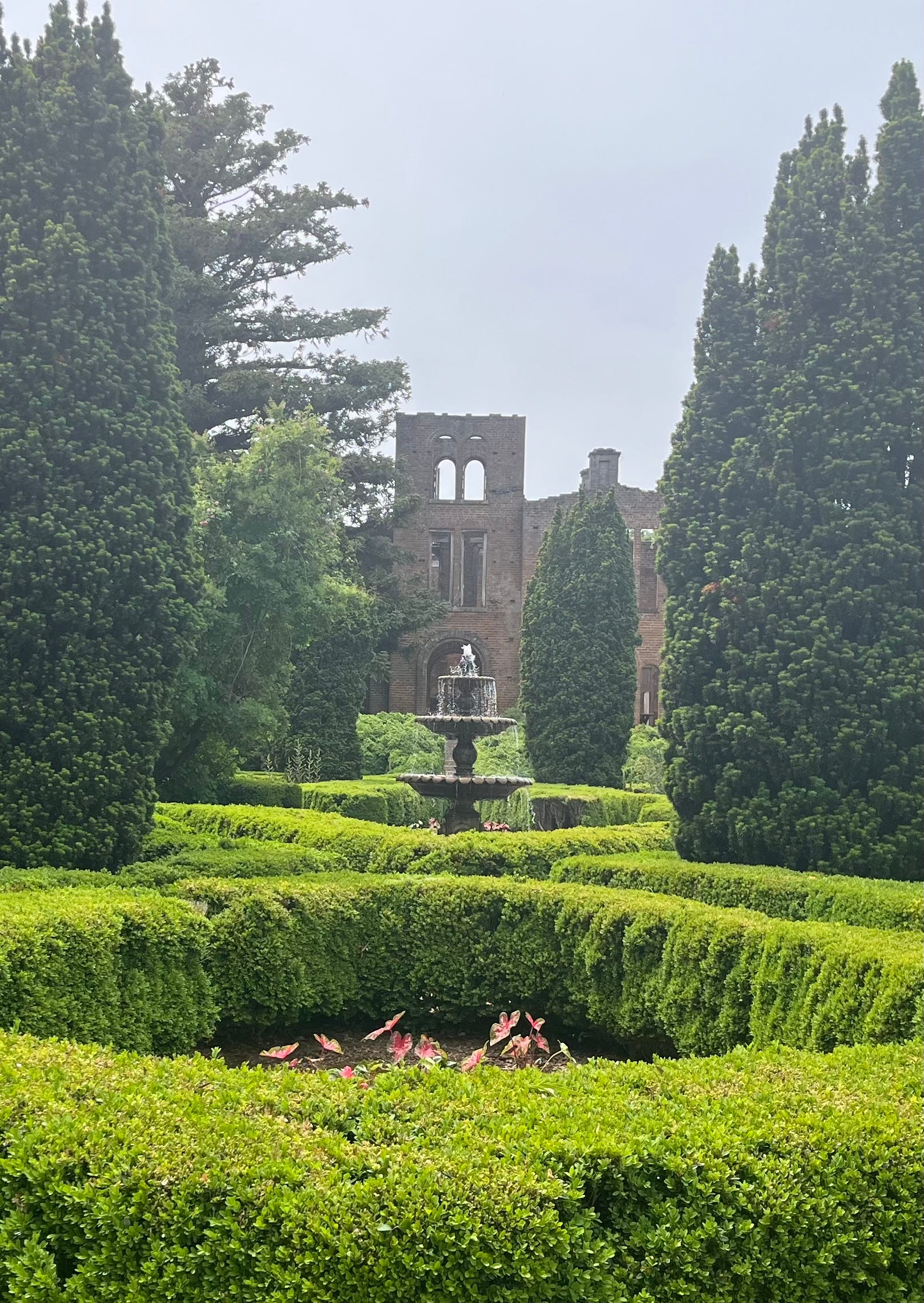
Today, under a cool dawn at Barnsley Gardens, we pick up the scent. Around the preserved ruins of an antebellum estate, the serene scene offers a tranquil trail.
Neo-Gothic Testimony
Ten years after the US army pushed the Cherokee from Georgia, and two decades before blue-bellied soldiers poured in, Godfrey Barnsley constructed for his wife an ornate Italianate villa in the Appalachian foothills northwest of Atlanta.
Andrew Jackson Downing inspired the original gardens around a manor completed in 1848, ravaged by Sherman in 1864, and that (after 1910) descended into the ruins which now offer neo-Gothic testimony to the love of an English gentleman for a bride who died too young.
Much as the Levy family saved Monticello from deterioration and potential oblivion, Bavarian Prince Hubertus Fugger purchased the Barnsley property in 1988, rescuing the estate and grounds from a prolonged dilapidation.
After reviving the gardens, stabilizing the ruins, and converting the surrounding acreage into a high-end resort, Fugger in 2004 sold the land to Julian Saul, a retired carpet executive and Georgia Tech graduate who’s made improving this property his top priority.
It shows.
The Ultimate Goal
Amid the rustic charm, the scenery is idyllic. A few horses trot before me as a local dog frolics in the distance. On a soft breeze, an orchestral aviary emits a symphony of song. In the verdant lap of the north Georgia piedmont, a floral palette completes the canvas.
Roused by hot coffee and morning dew, we pick up our brush and apply some paint. Let’s try to sketch what elicits joy.
From Ionia to Attica, competing philosophers applied opposing force on the Greek mind. But they tended to tug in the same direction.
The ultimate goal was the good life. But what is that? Socrates didn’t offer an answer. He rarely did. Like a good lawyer or a bad balance sheet, he was more adept at raising questions.
Happiness, like beauty, is in the eye of the beholder. But that doesn’t mean there aren’t essential elements, or eternal ones. The Romans emphasized virtue, the Greeks sought truth. These aren’t mutually exclusive, though each can be evasive.
We think of “truth” as a quality; the Athenians thought it a process. Like the fruit of Tantalus, it was a receding horizon on a sea of ignorance… a noble destination that’s rarely reached.
Not that ancient thinkers didn’t try. But after Socrates and his immediate successors, the search shifted. Metaphysics subsided, and ethics came to the fore.
A Banquet
To center stage came a couple schools distorted by popular caricature. In the final centuries of the pre-Christian era, Stoics and Epicureans took the torch.
They both emphasized the power of perception. How should we react to what our senses perceive?
Many people regret yesterday and are nervous about tomorrow. But they’re fine right now, which is the only moment we have. Both schools suggested we seize it, to fulfill our potential by living as well as possible.
But how? To the Stoics it meant removing distractions, to live with virtue and control what you can.
Like the serenity prayer, we should focus only on what’s in our power. Radical responsibility entails changing what we can, recognizing what we can’t, and knowing the difference. This is the path from frustration to fulfillment.
To the Stoic, something outside our control is intrinsically neither “bad” nor “good.” It just “is.” Only our reaction makes uncontrollable events positive or negative. Calling unavoidable events “terrible” or “terrific” is a judgment, and it may be correct.
But it isn’t stoic.
And, often as not, time reveals our interpretation to have been wrong. With increasing frequency, what we think matters ultimately doesn’t.
When we’re young, we’re drawn to material possessions and fleeting superficialities. As we age, these become what Stoics might call “preferred indifferences.” It’s fine to enjoy them. But possessing them shouldn’t define our life.
According to Epictetus, life is like a banquet. We should sample and savor it. If a plate is passed, we should take from it…but modestly. And we mustn’t whine if we’re deprived of a portion.
Epicureans identified happiness as simple pleasures and avoiding pain, and concentrated on ethics more than even the Stoics did. To Epicurus, fundamental truth is found through perceptions, preconceptions, and passions. Even reason is derivative of the senses. If the latter are wrong, the former will be false, and satisfaction suffers.
A Push or a Tow
When Christ came, he overturned prior precepts as if they were tables in the Temple. But he etched others like stones from Sinai. Such synthesis made a new map, and challenged travelers to follow a new path.
The trick lies in avoiding diversion, and abiding the trail. True happiness often relies less on attaining fulfillment than in seeking it.
In his book, The Happiness of Pursuit, Chris Guillebeau surmised (as the title implies) that general happiness is found in particular pursuits. Persistent pleasure depends on having a purpose. Whether earning a degree, writing a book, or running a marathon, having objectives is what gives life meaning.
Whether grand or granular, deep down we desire goals, and yearn to pursue them. But most of us neglect to determine what they are, so we don’t know where to go.
As such, we end up all over the place. And when you’re everywhere, you’re nowhere. Wheels spin, mud flies, and the rut deepens. To get out we need a push, or a tow.
Where to find the motor to pull us from the mire? A good start is to supplant degradation, distortion, lies, and repugnance with truth, harmony, balance, and beauty.
That can be difficult, because we often refuse to make it easy. Matthew Kelly wrote a book about our tendency to resist happiness. We may know what it takes to get what we want. Yet we engage in corrosive conduct that sabotages our success.
Gandhi thought we were happy only when what we think and do are in harmony. The test is deciphering what we really think. Where do we want to be? And who? And why?
Many of us have never really known, or even thought to ask. But a place to start might be to understand what brings us joy, and strive to attain more of that. Sounds simple; almost simplistic.
Yet happiness is more often a pursuit than a place. It’s not so much the final score that matters as what we do when we have the ball. The destination is important. But it’s usually the journey that means the most.
Real joy comes along the way…from simple pleasures, and when those we love are truly happy. My wife’s smile. Our children’s success. A bed, a book, a candle…and a kiss.
What more do we really need?
JD


