


Atlanta, GA
April 18, 2026
Bully ruins, brick and wall, through the night I’ve heard you call
Sort of sorry for each other ‘cause you had to burn and fall.
From the Ferry to Van Ness you’re a God-forsaken mess
But you’re the damnedest finest ruins, nothing more and nothing less
- From The Damnedest Finest Ruins, by Laurence Harris
It’s been said that if a cow lies down somewhere in California, a seismologist will know it. Such is the density and sensitivity of the more than 700 seismographs scattered across that quivering state.
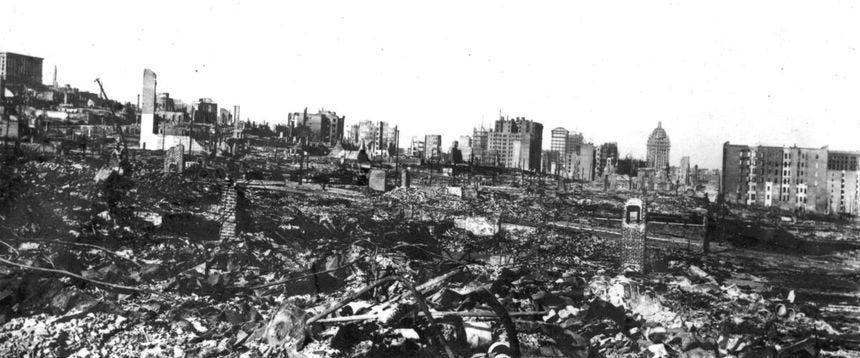
One hundred twenty years ago, at 5:12a on April 18, 1906, the cows didn’t so much lie down as fall flat. But the seismographs were capturing bigger game.
The ground at the head of Tomales Bay in Marin County shifted twenty feet that morning. The Crystal Springs Dam, situated south of the City directly atop the offending San Andreas Fault, slid eight feet… yet it held, as it would again during the far weaker 1989 temblor.
The City it served wouldn’t be so lucky, and would rue the ruptured pipes that precluded Crystal Springs water from dousing the flames of its burning buildings.
Excepting the Flood Building, the St Francis Hotel, Old St Mary’s Church, and a smattering of Telegraph Hill homes sheathed in Chianti-coated towels, few buildings east of the firewall at Van Ness would survive the inferno.
That firewall saved the elaborate Victorians and Edwardian homes that had more recently adorned the Western Addition and Pacific Heights. Tent cities in Golden Gate Park would house refugees from charred areas till the heart of the city could be re-built.
Aside from rent control, single-use zoning, and “urban renewal” programs, the “Great Fire” (insurance companies and the civic boosters shuddered to call it a quake) remains the most extensive and expensive (in real terms) urban disaster in American history. More than 80% of The City was destroyed.
City Beautiful
A helpful San Francisco heuristic is to avoid flat terrain near the waterfront… or to grab a helmet and handrail if you don’t. When the earth skips a beat, these areas of artificial fill are the ones that start dancing.
Debris from the 1906 cataclysm helped fill the remainder of the natural marsh between the Presidio and Ft Mason, becoming the level land we now know as the Marina District. Like a prairie dog in Wyoming, this detritus poked thru the liquified ground during the 1989 quake, even as more modern structures collapsed upon it.
A glorious Greco-Roman artifact of the 1915 Panama-Pacific International Exhibition survived the ‘89 temblor unscathed. The Palace of the Fine Arts helped signal the City’s renaissance after 1906. Its classical dome and Corinthian colonnade now embrace a small pond and wildlife preserve that are the peaceful remnant of an erstwhile lagoon.
The exposition honored the opening of the Panama Canal, and was part of the Beaux-Arts City Beautiful movement that blessed San Francisco as it rose from the rubble.
Like an Amway pitch at a Vegas bachelor party, the devastation of 1906 cleared the ground of prior occupants, and cleaned the slate on which Daniel Burnham could carve his plan for wide boulevards, noble buildings, and grand public spaces.
Burnham rubbed his hands in anticipation, eager to apply his plan to revive the City. But the magnitude of destruction and the urgency to rebuild repelled novel notions, prompting reconstruction to proceed quickly, within the lines of the prior layout.
Only the new Civic Center, with its monumental assemblage of opera venues, concert halls, theaters, libraries, and museums orbiting City Hall, would conform to Burnham’s grand vision.
City Hall was worth it. The dome recalls that of Les Invalides in Paris. In a small victory for local government, it eclipses the height, if not the imperial reach, of the US Capitol in Washington, DC.
Arthur Brown, a graduate of L’École des Beaux-Arts in Paris, designed the building, which burnishes credentials that also include the War Memorial Opera House across the street and Coit Tower across town.
Telamones by Henri Crenier support the west entrance of City Hall, while Doric columns and colonnades along the porticoes, façades, and dome reinforce the structure and theme of this magnificent building.
The Pre-Quake City
But the pre-quake City was also fabulous…and notorious.
Today’s antique shops, fine furniture boutiques, and upscale lofts of Jackson Square were once the Barbary Coast bordellos, bars, and boarding houses from which Shanghai Kelly drugged and dragooned unsuspecting conscripts on arduous expeditions to the far corners of the world.
South of the seedy shows along Pacific Avenue, the descendants of which now occupy the Broadway blocks between Columbus and Kearny, entertainment from a higher brow carried the day… and the nights.
Edwin Booth had his start in Sacramento, but gained traction in San Francisco… overcoming association with his tyrannicide brother to become the most famous actor of his time.
Enrico Caruso brought down the curtain on the old City. The greatest tenor of that (and perhaps of any) age sang Carmen at the Mission Opera House one Tuesday night.
Early Wednesday morning, the undulating floor of his Palace Hotel room woke him, sent him scrambling to the window, and then to the street so he could witness adjacent buildings tumbling to the ground in a procession his hotel would soon join.
The Palace Hotel was rebuilt within a couple years, hosting statesmen and dignitaries from that day to this…including Warren Harding, whose final act was to assume the ambient temperature of its Presidential Suite.
Lotta’s Fountain
Ten years ago, Bill Del Monte died - a week shy of his 110th birthday.
Three years earlier, he was the lone attendee at an annual reunion at Lotta’s Fountain. Since he was a kid, a dwindling group of survivors gathered at the same time each year, to recall the event that defined their lives.
Named for entertainer Lotta Crabtree, the fountain was originally erected to water horses on Market Street. But in the aftermath of April 18, 1906, it became the place to post notes to find or inform scattered loved ones in the wake of the quake.
One morning 34 years ago, I awoke early to witness the commemoration. But I paid respects by keeping my distance, watching the ceremony from across Kearny Street. In the pre-dawn darkness, firefighters and city officials encircled the fountain, honoring the few frail survivors who shared knowing nods and heartfelt hugs.
A wreath was affixed to the fountain at the minute the San Andreas slipped. After a moment of silence to recall the devastation and honor the dead, attendees sang San Francisco to praise the City and recognize resilience tragedy can inspire.
No witnesses remain from the Great Quake. But a crowd still gathers to pay respects. They’re there the minute this note is sent, hanging a wreath on Lotta’s Fountain.
JD
Many thanks for your beautiful writing on memorial-day for a devastating event !!! 👍👍👍
Poignant remarks about a destroyed city rebuilt but likely to be destroyed anew.
Until recently, my brother lived in a two story home on Market Street. Great view; off street parking.
Despite the occasional shake, rattle and roll events that beset the city over the years -- including a bridge collapse -- he stubbornly stayed aging in place.
No longer. He sold his townhouse and moved to Texas not for tax reasons, but to age near family.
We all felt a measure of relief. The north-south geographic fault that traverses most of California is a sleeping catastrophe