


Woolwich, Maine
November 7, 2025
Yesterday Archimedes came to class. After finishing the previous day’s discussion of site selection, we started working with rigging.
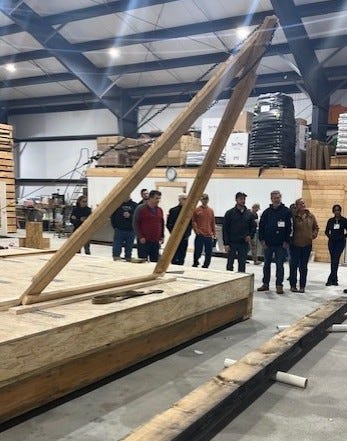
Having framed the floors and laid the boards, our next task was to erect the walls. Given a set of plans and our own bag of tools, we measured, cut, and arranged the wood.
But first we learned efficient ways to move it around. Skeletal studs aren’t difficult to lift. A finished frame is fairly light.
Yet big beams must be maneuvered, large posts positioned, and the occasional tree uprooted. How can small crews accomplish such feats?
They invite Archimedes to assist!
Back to Statics
The third century BC Greek mathematician famously said he could move the earth with only a place to stand.
Our instructor christened this principle the “Art of Persuasion” - a means of coaxing movement using minimal muscle. On a nearby board were equations I recalled from Statics class:
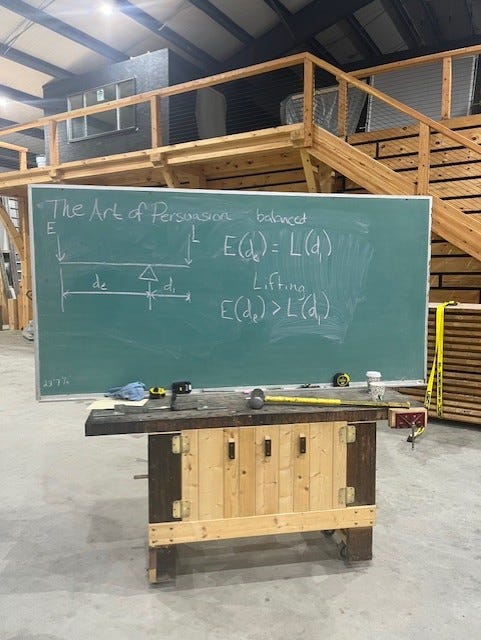
To lift a load, the effort applied at a given distance from a fulcrum must exceed the weight of what we want to raise. As the length of our lever increases, the force required recedes.
This point was proven when one of our female classmates easily elevated the floor and foundation we’d built the day before. She did the same to affirm similar principles using pulleys.
The comealong is the lever Archimedes would’ve loved. It’s simple, compact, and convenient. And it hoists a ton (literally), especially when combined with a pivot point.
A makeshift steeple can redirect the force of the comealong to a vertical element. Its purpose is to redirect a chain upward so it pulls the bent off the ground.
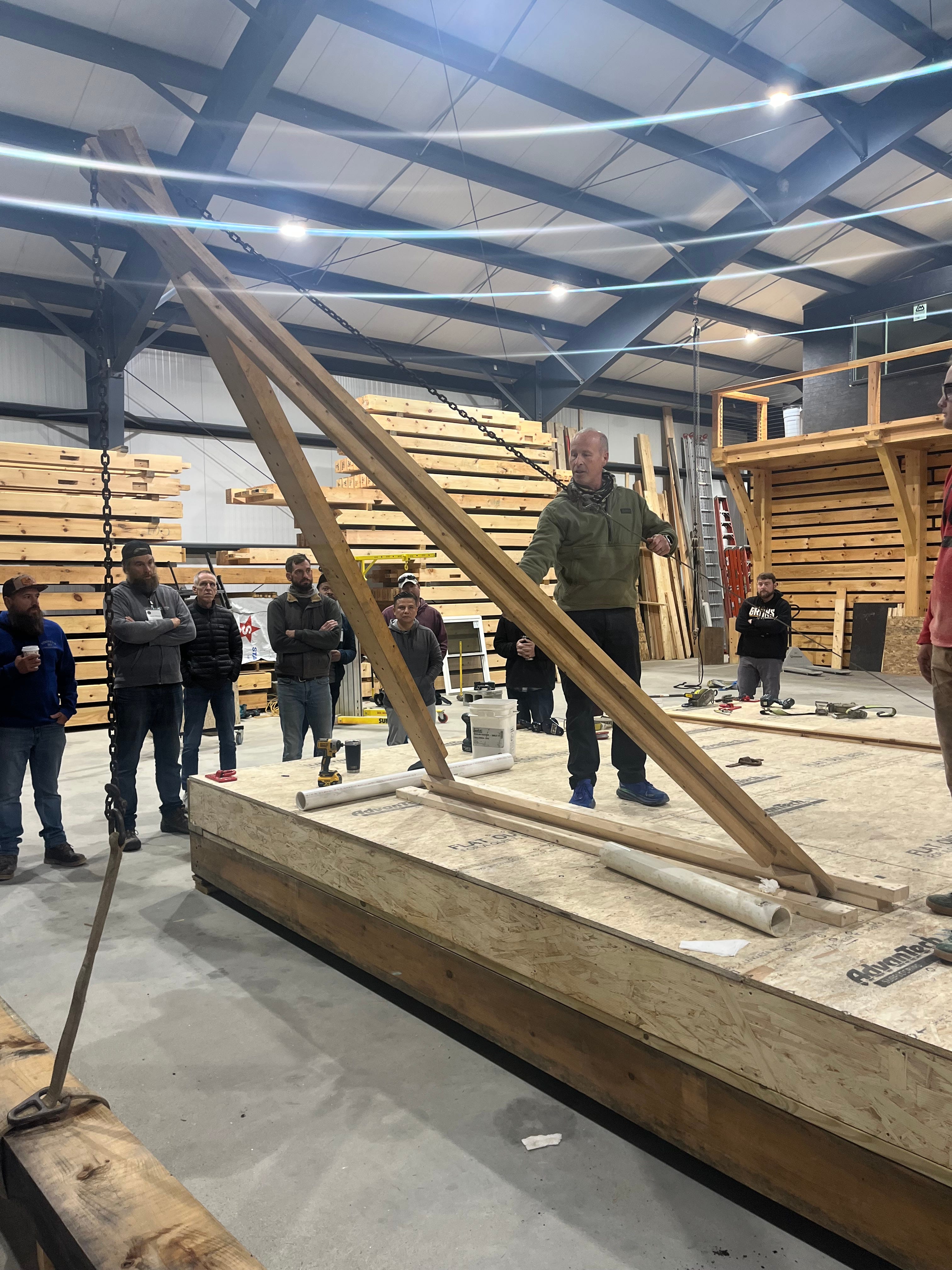
The beauty of the technique is its simplicity, and that it doesn’t require expensive tools. It’s particularly helpful lifting timber frames for which Shelter Institute is famous.
But that’s not all they’re known for. They offer engineering and insights to enable independence. Yet liberty is more than being left alone. It’s essentially the ability to fend for yourself.
Common Sense
That’s what this place preaches. Yesterday a student asked founder Pat Hennin whether an ingenious building method he’d used decades ago would still work.
“Of course it does”, Pat replied. “Why wouldn’t it?”
Before the student could respond, Pat continued: “It’s only problem is the inspector won’t approve.”
The student raised his arms in mock exasperation, as if that were his point. Pat knew that, yet he used the question to repeat a point of his own:
“I teach common sense. I’m not concerned with what bureaucrats think. They’re all about compliance. And I hate complying with anything (which doesn’t mean he won’t). Our staff here will ensure you know how to comply. Then you can choose to do so if you want.”
I like this guy more and more every day. His entire family and team is a delight. They offer guiding principles, engineering insights, and practical knowledge novices can understand. And they do so with patience and smiles… and common sense.
The course is billed as a deep-dive into design and construction of framed structures. And it is.
But it’s also a class about perspective and philosophy. They teach how to think, which (after all) is the first word in their motto. This pertains less to what you do than what you want. And (most importantly) why you want it. When you know that, there isn’t much you can’t accomplish.
The One Lesson
Yesterday afternoon, Pat displayed and described how he’d built an elaborate fireplace. He’d never erected a chimney before.
After walking us thru what he’d done, Pat fielded questions from the class. Among those posed was whether he did much research before beginning risky projects he’d never attempted.
“That fireplace is so elaborate, I’d be too paralyzed by fear of messing up a project where so many things could go wrong. Do you do much reading or research before starting something like this?”
“Yes, all the time.” Pat replied. “But I didn’t for this one.”
The class chuckled as he continued.
“I read and research all the time. My sixth grade teacher told us that we weren’t real men. She said you can’t be a real man if you don’t read a book every week. So since then, I’ve read a book every week.
“That’s how you learn not to get rattled by whatever’s going on. It’s all happened before. I’d built a lot. And others had built fireplaces. If they could do it, so could I.”
As important as books are, ability is acquired thru experience and practice. After all, that’s why we’ve come to this class. And Pat concluded with the one lesson we must all retain.
“There’s nothing you can’t do”, he assured us. “You just have to know you can figure it out… whatever it is.”
JD
Thinking, that thing that is not taught in schools these days. But all is not lost as You and I are thinkers!