


Bath, Maine
November 2, 2025
Thomas Jefferson called it the “knell of the Union”… a “fire bell in the night” that “awakened and filled [him] with terror.”
Several decades later, his apprehension proved prophetic. Seventeen years earlier, he’d emplaced the clapper that caused the noise.
Louisiana Purchase
Upon independence, the Treaty of Paris transferred TransAppalachia to the American states. The territory between the Atlantic and the Mississippi…from the Great Lakes to south Georgia… became fertile ground for westward expansion.
But the path was blocked. With the Spanish holding New Orleans, the Gulf of Mexico remained out of reach. Jefferson considered foreign powers that held the city to be the “natural and habitual enemy” of the United States.
As a relatively impotent empire, Spain could be managed. But Jefferson fretted when Louisiana was retroceded to imperial France. The president ordered his envoys in Paris to purchase New Orleans.
Napoleon had his hands full in Haiti, and was busy battling everyone else almost everywhere. He was ready to be rid of Louisiana, and offered the Americans the entire territory.
Time was short, so the diplomats accepted the offer before the emperor could rescind it. Overcoming Constitutional scruples, Jefferson convinced Congress to approve the deal.
With the Crescent City came a vast expanse extending to the front range of the Rockies. But rare is the bounty unaccompanied by burden.
The new territory became a pivot in an ever-shifting balance of power. Sectional animosity had always existed, as had secessionist sentiment (that, after all, is what the Declaration of Independence expressed). But Louisiana agitated it.
The Missouri Problem
After the Louisiana Purchase, the Embargo of 1807, and the War of 1812, New England felt marginalized. At the Hartford Convention in 1814, those “Deep North” states considered secession. Although (or because) they decided to stay, tension continued to simmer.
By 1819, it came to a boil.
Spain and France had sanctioned slavery in Upper Louisiana. When Jefferson acquired the territory, slaves represented about a quarter of the population around St. Louis. Within a few years, Congress hinted at restrictions. But local opposition preserved the practice in Missouri.
The region became a territory the month the War of 1812 began. As the decade ended, it petitioned to become a state. During relatively routine debate regarding admission, an amendment was submitted requiring Missouri to prohibit slavery as a condition of statehood.
Representatives in northern Massachusetts agreed. While acrimony roiled the west, these Mainers wanted out of Massachusetts.
The Maine “Solution”
Europeans first found Maine about thousand years ago, as Vikings ventured southwest from Iceland or Greenland. But the French founded the first confirmed settlements in the early seventeenth century.
They fought with the English and Indians for more than a hundred years. American Mainers battled the British during the War for Independence, and were recognized as part of Massachusetts when it ended.
The War of 1812 incited secessionist desire in the district, which pro-British merchants in Massachusetts refused to defend. By 1819, Massachusetts relented, and let Maine go. But would the new state be allowed into the union?
Missouri would be the price. Five Maine representatives voted not to pay. They preferred remaining part of Massachusetts to accompanying an additional slave state into the US.
But not for long.
When Missouri requested admission, eleven states lay on either side of the Mason-Dixon line, which (with the Ohio River) became the approximate basis for the Missouri Compromise.
Alabama had recently been admitted as a slave state, which brought the scales into balance. Maine was the chip to keep accounts aligned. If Missouri entered, Maine could too.
The Compromise welcomed Maine as a free state, and excluded slavery from territory north of the southern Missouri border… excepting the new state of Missouri itself.
This was the ringing that kept Jefferson awake. It was
“a reprieve only, not a final sentence. A geographical line, coinciding with marked principle, moral and political, once conceived and held up to angry passions of men, will never be obliterated; and every new irritation will mark it deeper and deeper.”
That’s precisely what each “new irritation” did. And there were plenty of them. But for thirty years, the Missouri Compromise enabled an uneasy equilibrium.
Blessed Seclusion
Since that time, Maine has nestled in blessed seclusion in the far northeast. It remains the least densely populated state east of the Mississippi, and the most rural one in the union.
It’s also the oldest (about a third over 50) and whitest (95%) demographic in America…
so I should fit right in!
Bordering Québec, about four percent of Mainers speak French… slightly more than in Louisiana, and a greater proportion than in any other state.
Almost half of all residents live around Portland, which was the initial location of the state capital. Within a decade, the seat of government moved to Augusta… ensuring it remained in a place with a name now more associated with a city in another state than with a pleasant town in bucolic Maine.
Locals seem fine with that. The last thing inhabitants of this reclusive state want is recognition. I don’t blame them. Look what happened to Portland’s western namesake after it was overrun by outsiders who “discovered” it.
Pressing My Luck
I arrived in the Pine Tree State this afternoon, and made a pit stop in Portland before continuing up the coast (more on that later in the week).
I was last in Maine just over a decade ago, on a stop in Bar Harbor sailing south from Canada. My only other visit was sixteen years earlier for a wedding in Islesboro, about sixty miles from where I sit.
On each of those occasions… in late June and early September… the weather was wonderful and the scenery sublime. I feared returning in November might press my luck. The latest forecasts suggest it’ll hold.
As of now the next two weeks look like the meteorological equivalent of a blue chip stock: low volatility, little rain, and temperatures finding support at freezing and testing resistance just above fifty. Chilly, tho’ not bad.
But the weather is mostly irrelevant. With respect to quaint towns… and captivating cliffs, rocks, and inlets carved by glacial retreat… I’m not here to see sights or soak up scenery.
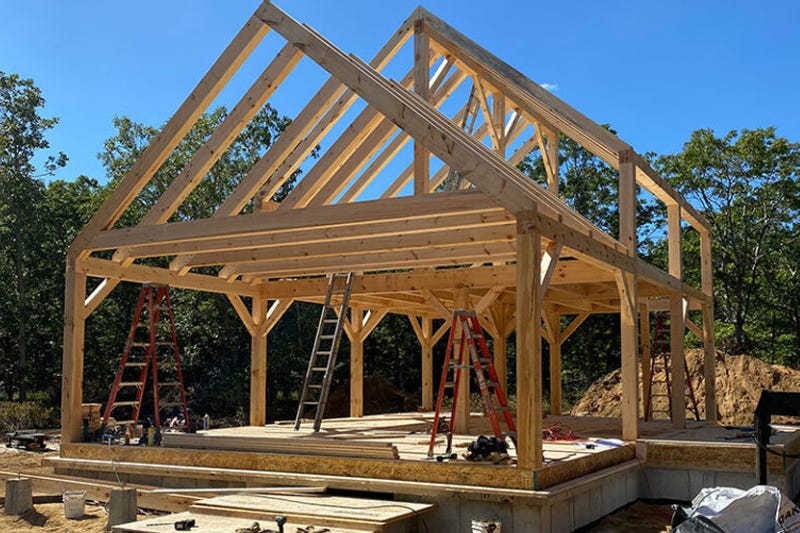
As I noted a few days ago, for two weeks I’ll be sawing, setting, wiring, and plumbing. From foundation to framing and pipes to beams, I hope to learn how to build a house.
I earned a degree in Civil Engineering from Georgia Tech, was licensed as Professional Engineer (PE) in three states, and designed numerous structures and roadways in Georgia, Pennsylvania, and Northern California. But I never built any of them.
My job was to approve the design, affirm the calculations, and sign off on projects others would construct. In essence, I was an egghead who understood theory while being ignorant of practice.
The Shelter Institute
I’m here to rectify that. Tomorrow is the first day of a two-week “Design-Build” course offering hands-on instruction erecting homes.
Fifty years ago, Pat and Patsy Hennin founded the Shelter Institute in Bath, Maine (not to be confused with “main bath”).
At the turn of the century, they opened the wooded waterfront campus in nearby Woolwich… an Arcadian enclave to impart their craft.
The second generation is actively involved in this family business, which conducts classes, builds homes, sells tools, and offers a wide assortment of real estate services.
I became aware of the Institute after reading The Preparation. It hosts the “anchor course” for the “Builder” cycle (one of sixteen in the “curriculum”) described in the book.
Courses are popular and space is limited. This session was full when I tried to register late last year. But I added my name to the wait list, and a few months ago, a spot opened. I quickly grabbed it and booked a flight.
With about thirty other students, I’ll (hopefully) acquire skills to sprout a shelter from the earth… including designing and drafting, understanding real estate regulations, manipulating materials, laying foundations, leveling, framing, rigging, sheathing, plumbing, wiring, insulating, roofing, installing windows, and applying wraps.
A fire bell may have brought Maine into the union. But a school bell brings me into Maine. Unlike the ringing that worried Thomas Jefferson, let’s hope this sound signals an ability to build a house that’ll stay standing.
JD
Good luck on the Shelter course! Really excited to follow along and hear what you take away from it. I can’t wait to see your reflections on the hands-on experience and how beneficial it is for you. Enjoy every moment of it!
I don't mean to rain on your parade but I fear you are acquiring a skill that you will never use, or not use enough to be proficient.
But if it's a hill you have to climb, so to speak, go for it!