



Atlanta, GA
March 28, 2026
Nobody knows how to make a pencil. But many probably think they could.
Just wrap wood around some lead, add a rubber eraser, a touch of metal, and a coat of lacquer…and voila!…you’re ready to take a standardized test or tackle The New York Times crossword puzzle.
But building a pencil is impossible for any one person to do. Even (or especially) the most ardent busybody has no idea how to make this superficially simplest of things.
Amazing Matrix
Creating a single pencil requires a complex lattice of financing, digging, drilling, growing, picking, pulling, packaging, shipping, trucking, buying, selling, and marketing among millions of people across every continent. Almost none of those engaged in these activities will ever meet one another or know each other’s names, and few are even aware of the thing they’re unwittingly helping to create.
This amazing matrix of seemingly uncoordinated activity was brilliantly described in the 1958 “autobiography” I, Pencil: My Family Tree, as Told to Leonard E. Read.
I first read this insightful essay in 1990, not long after I’d moved to San Francisco. The parable changed my life. It provided a valuable glimpse into how the world works, which is what economics (when done correctly) is supposed to do.
The origins of the commonplace pencil are extraordinarily complex, with components that are remarkably diverse. Were it applying to an Ivy League college, administrators could find ample grounds to admit or exclude it based on a wide array of assorted ancestry.
One of its fathers, as we all might guess, is a tree. But by what other parents was it conceived? What collection of saws, trucks, rope, and rubber were needed to commence the courtship, and plant the seed? And what mineral or material antecedents were conscripted and combined to create these essential ingredients?
As “the Pencil” put it, think of all the mining and metallurgy that went into making steel for the saws, how much growing and weaving was needed to make the rope, and what level of agricultural output was required to feed men in the logging camps when each day ended, and to wake them with coffee when the next one began.
Even the simple eraser is a marvel. It requires rapeseed oil from Indonesia, that it be reacted with sulfur chloride, and then combined with several vulcanizing and accelerating agents from around the world. Pumice from Italy enters the mix. Rubber is added for binding purposes, and cadmium sulfide provides the color.
No single manager, politician, or department secretary has any idea how to coordinate this complicated process for creating this one small part of a humble pencil.
But their presumptions go well beyond a mere eraser. To paraphrase Oscar Wilde, you’d have to have a heart of stone to hear their pretensions and not laugh.
Iron must be mined and smelted to build the ships that carry the requisite commodities. Oil needs to be drilled, extracted, and refined to fuel the vessels and trucks that haul those raw materials to far-away ports, or to take the pencil’s ancestral logs to distant mills.
And who builds and runs the millworks? What processes, materials, and manpower are brought to bear to construct any one of these indispensable facilities?
Then there’s the “lead”, which includes graphite mined in Sri Lanka, and that is placed in paper sacks and steel ships guided by harbor pilots and sophisticated navigation systems that are themselves the product of half a billion inputs from every corner of the world (and a few outside of it).
To bring these ingredients together so they can be formed into a pencil and brought to market, trucks and trains made of infinite inputs from countless countries must ride roads and rail that themselves derived from an inordinate web of engineering, financing, manpower, mining, and materials to eventually connect distant countries, great oceans, and domestic cities, towns, and villages where a vast array of intricate interactions combine to create a plain pencil.
The Least of Our Problems
You get the idea. A properly functioning economy and the supply chains that enable it are undeniable marvels. Yet they are incomprehensibly elaborate, and resist central control, political planning, and military misadventure.
It wouldn’t take much sand in the gears to shackle the whole shebang. How much of a Sahara could be caused by corking Hormuz? Dust storms are already swirling, impeding intricate systems on which markets rely.
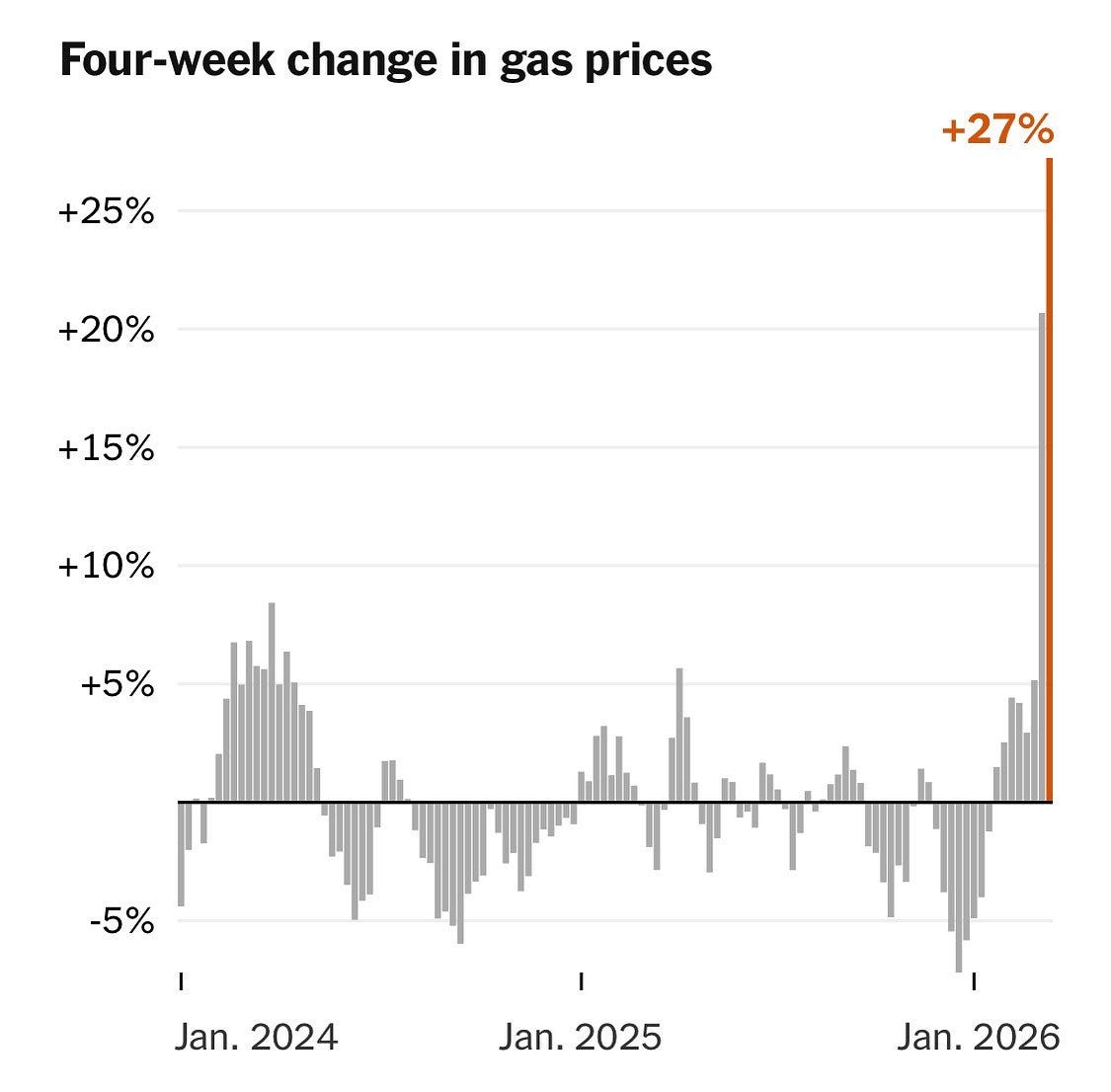
From Asia to Australia, fuel and food are running low, and rationing has begun. Europe receives about a third of its jet fuel and a fifth of its diesel from the Persian Gulf. How long before trucks sit and planes stay parked? In America, moving vehicles are also paying more:

Manufacturing may also idle. Helium is byproduct of natural gas processing, and is essential for cooling silicon to make chips. If a pencil is complicated, how complex is anything containing semiconductors? We may find out.
Qatar accounted for a third of global helium production. This was erased when the strait was shuttered, specialized containers were stranded, and the Ras Laffan gas complex was disabled by Iranian retaliation for US attacks. This supply can take years to replenish.
Up to half the urea, ammonia, nitrogen, phosphate, and sulfur for fertilizer come from the Middle East. North American farmers are running short, and are reluctant to plant. If they don’t soon, they won’t at all.
As too few asked in 1914, “how long can this continue, and how far could it spread?” The US is sending more Marines to the Middle East, and asking soldiers to get affairs in order.
Russia will ban gasoline exports as of April. What happens if aquatic arteries at Malacca, Panama, Denmark, Bab el-Mandeb, or Suez are suddenly sealed? When routes and resources are strangled, transit stops, the world chokes… and people starve.
Under the circumstances, ignorance of how pencils are made seems like the least of our problems. But indifference to it is how they’re caused.
JD
Many thanks for your deep-dive into pencilography and pencilhood; a realm that never knew any racism or artificial exclusion: all colors and shapes being equally OK and respected ...
{...and people starve...}
THAT's the whole point of the performance, NOT regime-change, gas, oil or transit-routes. FERTILIZER-shortage in the northern hemisphere and at worst possible time creating total panic on a world-wide scale. NOTHING else...
Well, a little additional plandemic with even more draconian lockdowns turning-up at everybody's porch for sure !!!
The Chosenites' entirely remote (kompromat)-controlled Judeo-Christian demolition team in full action.
Seems, the cough-era did not show the desired results in expected time-frame.
Welcome to the WEF's & WHO's depop-agenda which will lead straight into the NWO including all it's amenities that are soooo convenient ... 🤣🤣🤣
Just yee-haw and WOW !!!
Lo and behold, when my father's house (the place where I grew up) was redone after he sold it last year, the basement pictures showed the old crank-handle red pencil sharpener screwed to the post at the bottom of the basement steps. I was surprised to see it wasn't removed. She's from around 1964 but not used for decades. I maybe use a pencil once or twice a year. But today, most lies are typed on a keyboard.