


Paris, France
May 24, 2025
Within the last year, several friends about our age were diagnosed with terminal malignancies or other deadly ailments. One of them died yesterday. We heard the news on our way to Paris.
Mercifully, in the other cases, treatment seems effective. But it’s tenuous, and arduous. Cancer in remission can always recur. Within any of us, it’s liable to appear at some point.
And if it doesn’t, another killer will. It’s only a matter of when. No one gets out of life alive. The only question is when we go.
Most of us don’t know when that will be. But a fatal disease can narrow the window. With appropriate perspective, that can be a blessing. If we let it.
Extraordinary Grace
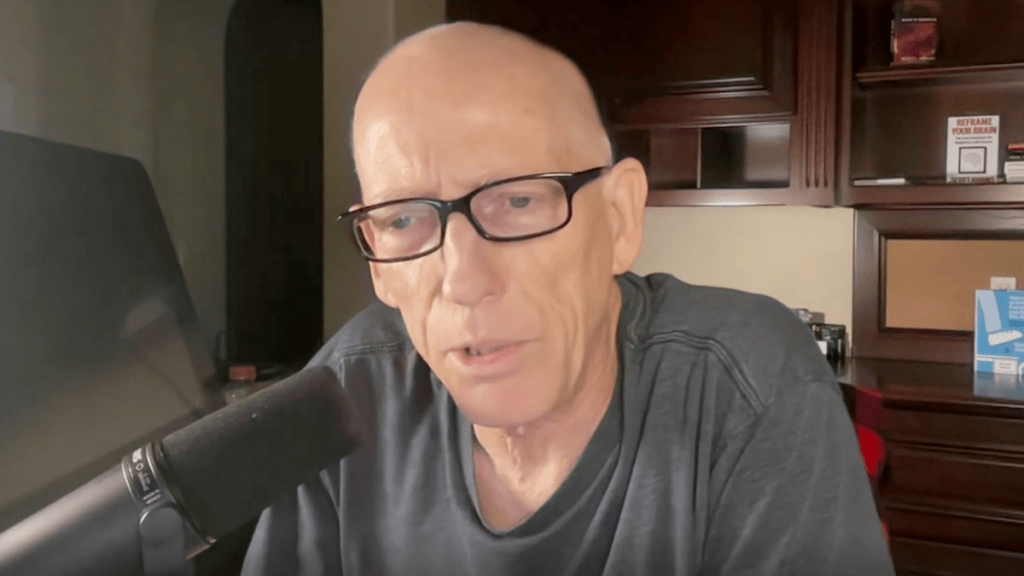
That’s what Scott Adams seems to have done.
This week, the creator of “Dilbert” divulged he’ll be leaving us sooner than he’d expected… or than any of us would want.
All our days are numbered. But Adams has known for a while that he has fewer than most. In an era devoid of dignity, he exhibited extraordinary grace announcing his impending death.
The day after Joe Biden’s prostate cancer became public, Adams shared that he suffers the same affliction. Like the ex-president, Adam’s malady spread to the bones. He expects to succumb sometime this summer.
But having had time to process what’s coming, Adams appreciates certain aspects of what he’s enduring. Knowing about how long he has allows him time to arrange affairs and say goodbyes.
He admitted his condition is excruciating, and that he has no good days. Each one is “a nightmare.”
But despite physical pain, he is at peace. By conveying his condition with calm courage, he gave a gift that will survive the grave.
“While this could be much worse… I’m handling it quite well. The pain is tough. I mean really tough. But the mental part, I got that under control. I know that some people are having a tough time with this. But remember, nothing lasts forever.”
That’s a helpful reminder, regardless how hard we try to resist.
Adams acknowledged trying several potential remedies to enable recovery. None worked. So now he’s reconciled to what’s next. And why not? Death is the unavoidable conclusion of every life.
It’s what’s supposed to happen. It happens to everyone. Adams isn’t whining or wondering “why me?” To Scott Adams, that question is silly.
It’s not him. It’s everyone. He recognizes he isn’t exempt from the human condition.
None of us are.
Not that we don’t hope to be mourned when we die. We do. For a little while.
But we don’t want our loved ones to mope. After they share some memories and shed a few tears, we expect them to honor our lives by making the most of their own.
Adams did that as long as he could. That’s one of the reasons he delayed admitting his ailment. He wanted to live as normally as possible, without being known as “the cancer guy.”
Adams isn’t kidding himself, or making futile pledges to “beat cancer.” He knows the game is already over. Cancer is merely milking the clock.
Dying Twice
As a Roman Catholic, I doubtless have religious differences with Scott Adams. But that’s not the point.
I simply appreciate the decorum with which he announced his malady and accepts his fate. It reminded me of a comforting way he once re-framed death.
All earthly entities come to an end. That includes our corporeal existence. No one is exempt. We’re all diagnosed with the terminal condition known as mortality.
Death isn’t merely inevitable; it’s necessary. Life is valuable because it’s limited. It has significance only because it ends. As Adams put it, “everything that has meaning comes from the fact that we don’t live forever.”
Yet he reassured us by acknowledging that, in a way, we do. We don’t so much die as transform. Our influence survives after we’re gone. How long is a function of how well we wielded it while we were here.
Dave Collum once said that we die twice. Once when life leaves our body. And again the last time anyone remembers our name.
We typically don’t determine when the first death occurs. But till it does, we strive to live in accordance with God’s will, to postpone the final passing as long as possible.
JD
After reading your excellent article, I am reminded of this gem, with a hint of Catholicism in it:
“He’s listed as day to day, but then again, aren’t we all?”
Vin Scully
If one wants to be remembered, then four steps must be taken:
1. A tombstone made of some material impervious to weather that …
2. conveys text certain to be provocative …
3. should ensure that future generations who understand the language used to convey your remarks will remember what a pistol you were …
4. As long as the graveyard in which you were interred isn’t given the King Richard III treatment.
After he was killed in battle for his crown, his remains were lost in the ensuing years
However, they were recently found nearly a thousand years later under a parking lot in northern England