


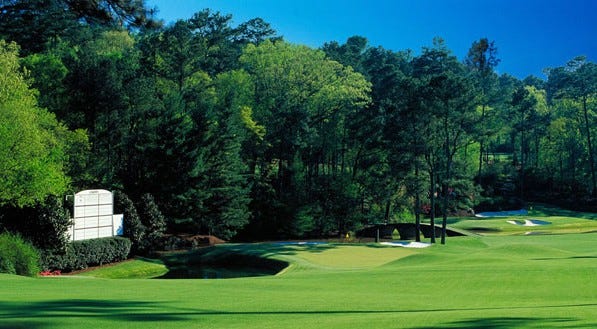
Augusta, GA
April 17, 2025
“It seemed as if this land had been lying here for years, waiting for someone to lay a golf course upon it.”
- Bobby Jones
My grandparents grew up in Augusta. As a kid, my grandfather lived down the street from Ty Cobb and became childhood friends with Cobb’s daughter, Shirley.
My grandfather’s older brother was a local businessman who was friends with Cliff Roberts. When Roberts and Bobby Jones converted the grounds of a commercial nursery into a golf course, Jerome Franklin became one of the club’s initial members.
Jerome is still known as “Member Number Three” at Augusta National. He was the last surviving founder, and is buried in a cemetery not far from the course. Along the way he accrued prominent friends:
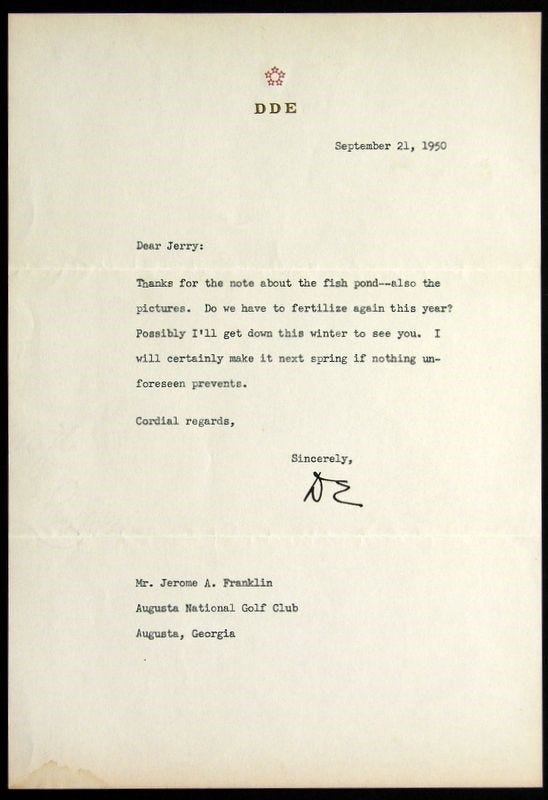
Last Saturday, for the second consecutive year, my wife had the privilege of attending The Masters. Almost forty years ago, my stepfather and uncle were honored to play the course. This week, I finally had a chance to follow their footsteps.
“We Need a Fourth”
The only major tournament I’ve not attended is the one held each year at the club my family helped found. I’ll need to wait at least another year to do so.
But this week, I received the consolation of playing the course. It’s said that success isn’t about what you know, but who you know.
That’s not true.
It’s about who knows you! This week, one of those acquaintances placed a call.
Not recognizing the number, I didn’t answer. Fortunately, he called back. I still didn’t pick up. Mercifully, he left a message.
“JD, I know this is short notice. But if you can get to Augusta tomorrow, we need a fourth. Let me know as soon as you can.”
I returned the call before I heard the last sentence. After The Masters, privileged members of the media can play the course. But one of them had a death in the family so couldn’t make it.
A few hours later, I was in Augusta. The next morning, I made my way to the club.
Eyesores Evaporate
Augusta is a beautiful town. But Washington Road isn’t indicative, and was a disconcerting contrast with what I was about to see.
This stretch emblemizes what’s wrong with urban “landscapes” in modern America. It’s littered with fast food, gas stations, strip malls, parking oases, unwalkable streets, and fluorescent signage that pollutes most cities in America.
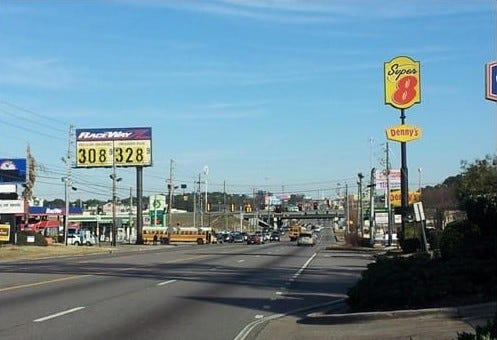
But the eyesores evaporate on Magnolia Lane, a narrow passage back in time. As expected, security greeted me at the gate. I considered the “do you know who I am?” move, but decided against dropping my great-uncle’s name.
I instead gave mine, and was allowed entry after the guard confirmed my host had already arrived.
The drive to the clubhouse is beautiful. In its way, it evoked memories of Plan-Tanes colonnades in Aix en Provence, or Palm Drive on the entrance to Stanford.
Only better. Because anyone could drive on those roads. But at this moment, I was the only one on this one.
Under the shaded canopy that gave the lane its name, cheap, crass, commercialism yielded to Southern serenity, elegance, and grace. I was directed where to park, and was met there by the man who was kind enough to grant me this honor.
After welcoming me to Augusta, he apologized for the commotion of grand stands and television towers being removed after The Masters.
I rejected his apology, told him I refused to play, and that I’d report his club to the Better Business Bureau.
Just kidding.
Instead, I thanked him profusely, and went to the trunk to remove my bag before he changed his mind. There I met another man dressed in familiar all-white attire.
Players and Caddies
“Good morning, sir. I’m Tommy.”
My caddie shook my hand, grabbed my clubs, and showed me to the clubhouse. It is as elegant and understated as Bobby Jones.
As we entered, I glanced at pictures along the walls, seeking photos of my great-uncle. I’m sure I saw some without knowing it.
I wanted a tour, but when one wasn’t offered I didn’t press my luck. I gladly settled for a brief lunch before we played.
After washing down our pimento sandwiches with iced tea and water, we made our way to the Par-3 course for a warm-up round. This was a nice way to ease in and become acquainted with my caddie, who wasn’t who most people might expect.
As club chairman, Cliff Roberts essentially created The Masters. Even the name was his idea. Bobby Jones thought it too pretentious. But Roberts leaked it to the press so it couldn’t be rescinded.
Roberts was also the man who controlled how Augusta National was presented. He signed one-year deals to keep networks on a leash. If anyone uttered the wrong word, that announcer was out.
Roberts came up with the idea of calling customers “patrons” rather than “fans”. I suppose that explains why he banned CBS broadcaster Jack Whitacker for calling 18th fairway fans (patrons) a “mob”.
Roberts reputedly proclaimed that as long as he was alive, “all the golfers will be white, and all the caddies will be black.”
My caddie’s melanin deficiency reminded me that Cliff Roberts is no longer alive. Prior to 1982 (Roberts killed himself in 1977), even Masters participants were assigned one of the club’s caddies.
They’ve since been able to bring their own. Today, Augusta National contracts with an outside company to manage its 120 or so caddies, about two-thirds of whom are white.
Endless Horizon
I was shaking as I approached the first hole. Twice the ball fell from the tee as my hand trembled.
I hadn’t played much in recent years.
A couple weeks ago I joined my son for his fraternity’s father-son tournament. Six months earlier, I’d been part of a “college-Am” scramble at East Lake. I played a wonderful weekend with an uncle, cousin and friend in Wisconsin last August. Otherwise, it’d been at least a year since I’d swung a club.
Sometimes, that works out well, especially when rust restrains bad habits. That’s what happened on the first hole. My drive was exquisite… landing softly in the center of the fairway.
I glided toward it as if walking on air. The course was like undulating felt rolling under our feet. Thru the pines, it seemed to grasp for an endless horizon.
A good opening drive eased some of the anxiety the setting inspired. My stroll became a strut. Confidence rose as I approached my ball. Not only was I playing this course; I planned to humble it.
I was soon reminded that the hardest shot to recover from is a great drive. Tommy handed me a six-iron for my next swing.
Standing over the ball like I knew what I was doing, I eyed the green, envisioned a perfect approach within a few feet of the pin… and chunked the ball into the fairway trap.
I escaped to a spot just short of the green. To be safe, I decided to putt. It was like trying to maneuver a marble on the hood of a car. With four attempts, I got plenty of practice. I headed to the second tee at three over par.
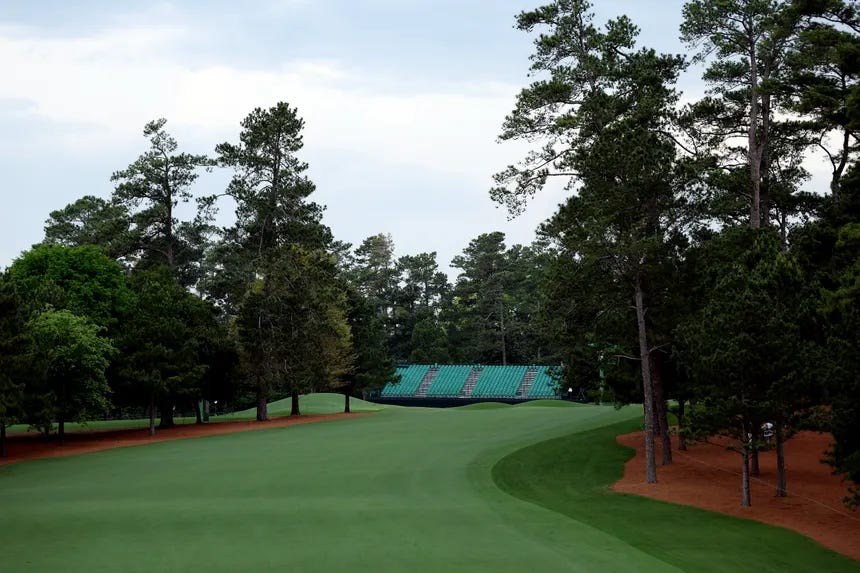
I finished the first nine shooting forty-nine.
“That’s OK”, Tommy consoled. “The second nine is where champions are made.”
Nod to a Champion
He told me the tenth hole was originally the first, and is traditionally the most difficult. Off the tee, my drive bisected the fairway, leaving an ideal line to the green. But I chose a different target.
When my step-father played here, he holed out from the fairway bunker. As his caddie exclaimed at that birdie from the beach, “even da big boys don’t do that”! (Left unsaid was that “the big boys” are rarely in that trap.)
In Jerry’s honor, I wanted a shot from the same spot. Tommy was right that this is where champions were made. It was time to honor one of them. From my perfect perch on the right side of the fairway, I took aim at the bunker.
The ball nestled into the soft sand. From there I took aim at the flag. I rolled past it and missed the putt.
After I tapped the next one in, I tipped my cap to Jerry. On this green he never needed a putter.
I took my putter and bogey to the most famous enclave on this fabled course.
Amen Corner
As we started Amen Corner, my prayers were answered with a perfect drive on 11. At the crest of the ridge, I took a moment to soak in the scene.
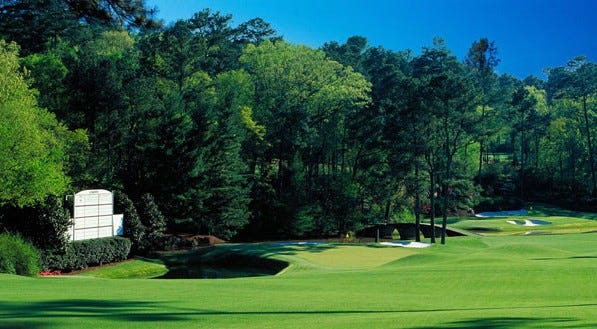
Looking up at the trees and out toward the green, Tommy suggested a six-iron. I asked for a seven. Shaking his head as if he’d seen this before, my caddie decided to teach me a lesson.
He gave me what I wanted. And I got what I deserved.
Ben Hogan once said “if you ever see me on the 11th green in two, you’ll know I missed my second shot.” I didn’t think I did.
I hit the ball well… but it ended up left of Nancy Pelosi. Tommy suppressed a smile as it landed short, and rolled lazily into the lake.
“Well, guess you can keep that seven-iron”, he smirked. “It’ll be handy pitching from the drop zone”.
It was. I then three-putted before stepping toward the ominous twelfth.
This is the most famous par-3 in golf. Bouquets of azalea bushes back a tiny green tilting treacherously toward Rae’s Creek.
Wind is the wildcard. It seemed calm as we approached the tee. Tommy again looked up. Then at the green. The flag pointed toward the eleventh pin, which waved back a knowing salute.
The banners were drawn to each other like opposing poles, revealing winds blowing different directions. Tho’ we were closer than I’d been on the previous hole, Tommy again handed me a six-iron.
This time, I shut up and I took it. I assumed I’d have no problem clearing the creek. My fear was that I’d carry the green. Behind it were traps from which it’d be easy to chip back into the water.
My well-hit shot soared toward the target, then drifted left, and came to rest just short of the trap. I chipped to within a dozen feet. Three putts later, I said goodbye to “Golden Bell”, and sulked toward the next tee.
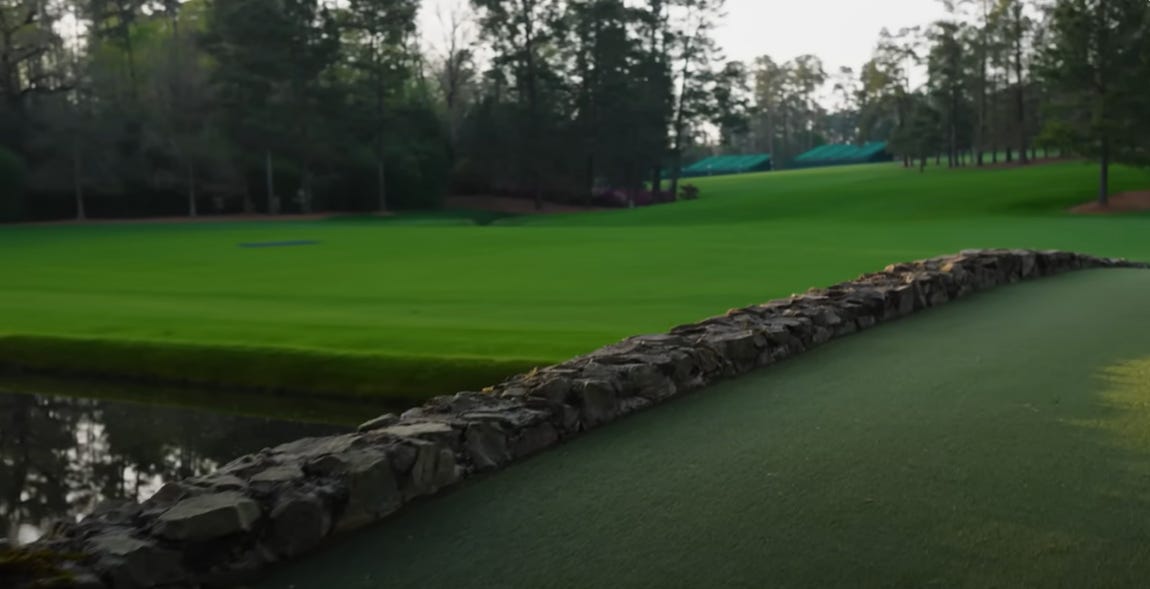
Tucked deep in the back pocket of Augusta National, the 13th is often called the greatest par-5 in golf. It’s certainly the most beautiful hole I’ve ever seen.
Like a protective father of a beautiful girl, a tributary to Rae’s Creek acts as a chaperone walking quietly to our left. It guides suitors toward the green it guards, daring them to see what happens if they try to get home in two.
The hole is called “Azalea” for good reason. Along the fairway and around tee and green is a resplendent array of 1,600 eponymous bushes. I had ample opportunity to enjoy each one.
My drive was fine, tho’ not great. I sauntered over the Nelson Bridge, found my ball, and decided to go for the green. Why not? What else would do? Give it a shot the next time I was here?
No. I had to go for it. Worst case, I’d find the creek, just like countless professionals have done before. I grabbed a three-wood, and swung as hard as I could in case I hit it.
I did. Barely. My dribbler bounced left toward the stream. Fortunately, it came up short. From “the second cut”, I could still reach the green in regulation.
I did. For a few seconds… till the ball retreated into the water.
Having seen so many players suffer this fate, I took solace being in good company. Unfortunately, my companions and I then parted ways.
From the creek, the pros usually take their bogey and move along. I opted for a second swim. After holding my third attempt on the surface, I comforted myself with my first one-putt of the day.
Having saved triple-bogey, I bid adieu to Azalea, and a fond farewell to Amen Corner.
Indians and Arrows
Stumbling toward the 14th tee like Napoleon’s Army on its way out of Russia, I ceased caring about my score. With five holes remaining, I decided to savor every step.
My contrived indifference revived my game. I managed to par the next two holes. On 15, a bad drive gave me a break, saving me from myself by keeping me from trying to reach the par-5 in two.
A few steps from the 15th green, I found myself on another hallowed plot. Were it not for the 12th hole at Augusta, the 16th might be the most recognizable par-3 on the planet.
It was on this green beside Ike’s Pond that Jack Nicklaus sank a putt that won the ‘75 Masters. Thirty years later, Tiger Woods did the same with what might (along with Gene Sarazen’s 1935 albatross on 15) be the most famous shot in the history of golf.
I just wanted to be on the green. Or, at the very least, not in the water. I asked Tommy what he thought. He handed me the six-iron.
“Really?”, I joked. “You sure it’s not a five?”
He handed me the club as if he didn’t get the jest.
The hole wasn’t in its traditional back left location. Thank goodness.
To honor the golden anniversary of the Golden Bear’s putt for birdie on this green, the prior Nicklaus hole location was replicated. It was more toward the center of the green, which is where I aimed. Miraculously, that’s where the ball went.
Part of me thought it was going in. It didn’t.
But it stopped near enough to be annoying, and far enough to apply pressure. From four feet, I sank the putt… which let me brag of a birdie at Augusta National.
“See, told you that was the right club”, Tommy told me as we left the green.
“It’s not the arrow”, I clichéd. “It’s the Indian”.
Tommy’s eyes rolled us up to the 17th tee. Karma demanded I double-bogey that hole. After I did, we reluctantly arrived at the last link on this iconic course.
The Last Six-Iron
My tee shot thru the chute was perfect… middle of the fairway and about 170 yards from the hole. Once again… I looked to Tommy. For a final time, he handed me a six-iron. As always, he was right.
I hit it pure. The ball landed on the green, just past the hole. I started to smile as I began to walk.
“Wait”, Tommy said, with one hand holding me back.
I followed his eyes to the green. From the bank below the second tier, my ball started easing its way toward the hole. It gathered speed, hit the flag… and disappeared.
At that moment, I saw a light and heard a sound. Through the window, rays of light pierced the curtain. From my phone, the alarm went off.
The dream was over. It was time to wake up.
JD
PS - The dream started with the section titled “We Need a Fourth”. Everything before that is true.
I loved it. Hated the ending, though.
Beautiful sweet dreams 😊