


Atlanta, GA
October 27, 2025
“I’m a Ramblin’ Wreck from Georgia Tech, and a hell of an engineer--
A helluva, helluva, helluva, helluva, hell of an engineer.
Like all the jolly good fellows, I drink my whiskey clear.
I’m a Ramblin’ Wreck from Georgia Tech and a hell of an engineer.
Oh! If I had a daughter, sir, I’d dress her in White and Gold,
And put her on the campus to cheer the brave and bold!
But if I had a son, sir, I’ll tell you what he’d do--
He would yell, ‘To hell with Georgia!’ like his daddy used to do.
- “Ramblin’ Wreck from Georgia Tech”
This weekend we were back at Georgia Tech, joining a swarm of Yellow Jackets revisiting the hive for Homecoming.
This month marks the 140th anniversary of the Institute’s establishment. Originally the “Georgia School of Technology”, the college arose to spur Southern engineering, science, and industry after the War Between the States.
Its mission emphasized theory and “practice”, which entailed students producing consumer goods to help fund the venture. Derisively dubbed the “North Avenue Trade School” by its in-state adversaries at the “Athens Community College”, Tech defused the insult by embracing it.
Why not?
Among the best ways a college can distinguish itself from most universities is to ensure graduates can do something useful when they get out. And make no mistake… that’s the ultimate goal of every Tech student:
To “get out”.
The degree is great, but primarily because it represents release… like an honorable discharge from remnants of the Grand Armée that returned from Russia.
Outward and Upward
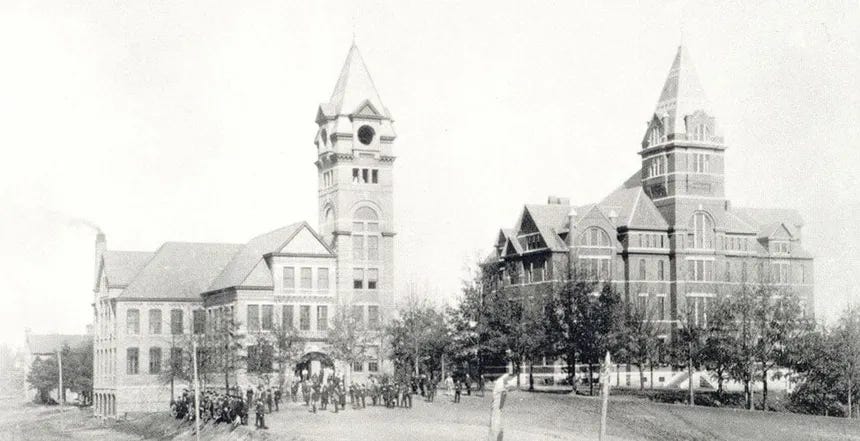
Upon completion, the Victorian Tech Tower prompted Atlanta Constitution editor Henry Grady to proclaim it “a light that will cast its beams over all the South. So lighted, we can move into the industrial future.”
The Tower reflected a style architectural firm Bruce and Morgan perpetuated at Auburn, Clemson, and Agnes Scott during the same decade.
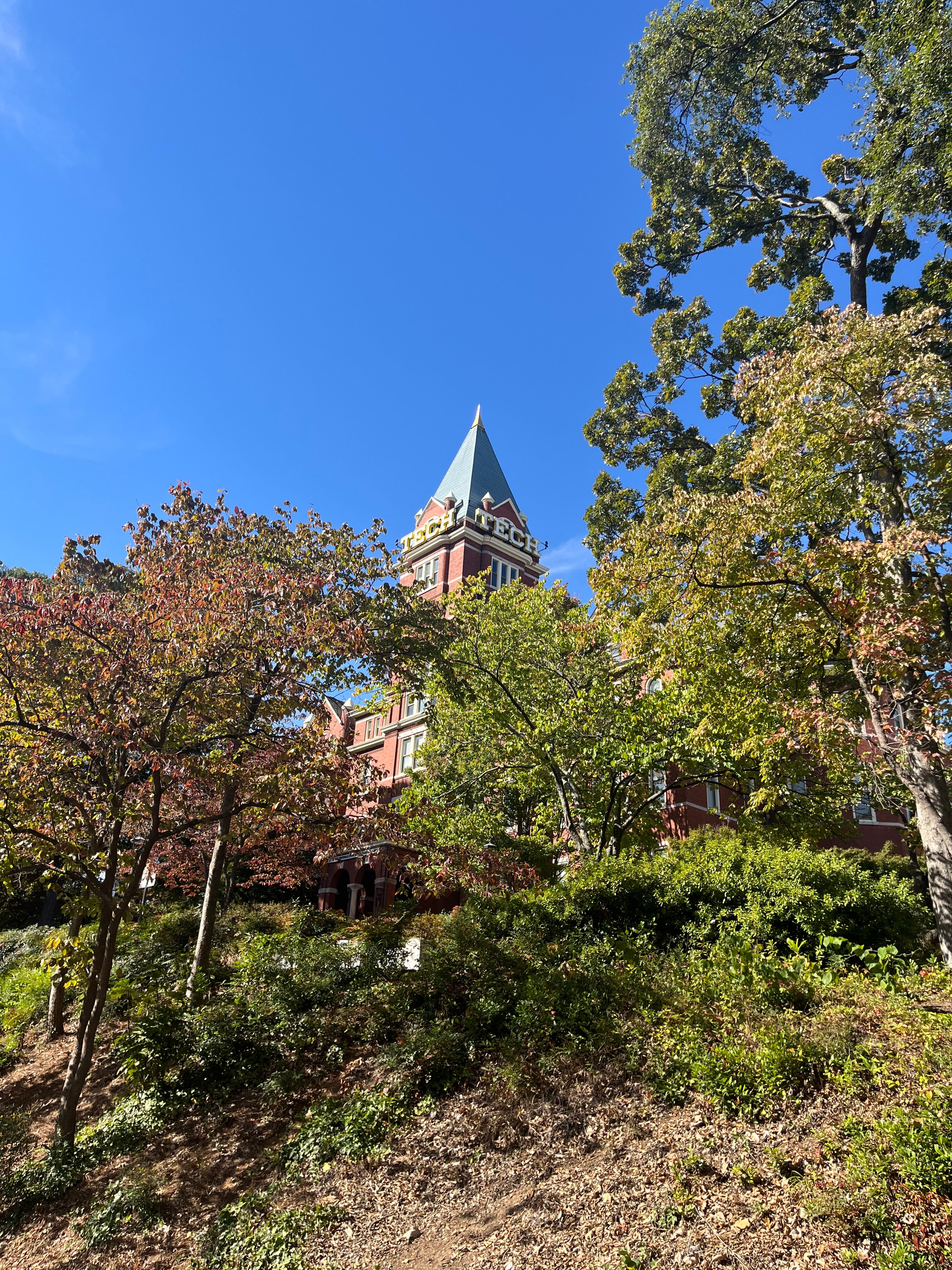
On the site of a stillborn suburb donated by Richard Peters, Georgia Tech originally occupied four acres along North Avenue, a street that denoted the northern limit of Atlanta. Confederate fortifications once lined the road, and on the site of the current campus the city surrendered to Sherman after those defenses failed to hold.
For six decades Tech continued to grow. In the wake of the Second World War, to reflect rapid expansion and enhanced emphasis on all aspects of engineering discipline and scientific research, the school was renamed The Georgia Institute of Technology in 1948… sixty years after it initially opened.
The campus spread northwest from Tech Tower, filling a footprint a hundred times larger than the original plot Peters provided. In recent decades it’s moved east, pouring further outward and upward… bursting its banks to nourish Atlanta like the Nile.
Recognized as among the three best engineering universities, a top ten research institution (the highest ranked without a medical school), and the greatest return on investment of any public college in America, Georgia Tech offers about forty undergraduate majors and more than 100 post-graduate programs.
At the turn of the 20th century, it featured only five. Degrees in civil, electrical, textile, and chemical engineering were added to the mechanical engineering major offered when the school opened.
A dozen years later, an Evening School of Commerce offered classes at an off-site location that would eventually become Georgia State University. In 1919, Anna Teitelbaum Wise received a degree from that college, becoming the first alumna from Georgia Tech.
Thirty-three years after Wise got her diploma, Diane Michel and Elizabeth Herndon enrolled as undergraduates, albeit restricted to programs not offered by other schools. Four years later, in 1956, Michel and Shirley Clements became the first female graduates from the Georgia Tech campus.
Tech Traditions
Like most institutions of higher learning, Georgia Tech boasts unique traditions.
Some… like inordinate stress leading to liver failure, or having girls from Agnes Scott wander campus to fool prospective students into thinking the female “Ratio” is reasonable… are overstated or flat-out false.
Others were true… like “Drownproofing”, stealing a “T” from atop Tech Tower, or telling incoming freshman to glance at students on either side because only one of the three would still be at Tech in four years.
These days, those customs are anachronistic. Drownproofing (binding ankles together and wrists behind the back, then tossing students into water and wishing them luck) was discontinued the year after I started (tho’ is still used to train Navy Seals), and “T” thieves are now slapped with expulsion rather than on the wrist.
And the “look to your left, look to your right” routine would no longer make sense. Almost every student (~95%) who enters Tech now “gets out” with a degree.
Not because it’s easier to get out. But because it’s harder to get in. Seeing the quality of current students, many of us who returned this weekend doubted we could do it.
We were like a meet-up of inmates who tricked a sympathetic parole board into setting us free. Now we couldn’t convince them to let us in.
Only about 5,000 spots are available for almost 70,000 applicants. Those who can’t make it thru are unlikely to be admitted at all.
Yet for almost a century, one student has made it every year.
George P. Burdell
First enrolled in 1927, illustrious alum George P. Burdell is purported by haters to be apocryphal. But that’s because, like Zelig or Forrest Gump, he’s been everywhere.
High school student Ed Smith was a student at Richmond Academy in Augusta (which my grandfather contemporaneously attended).
After receiving two applications to Georgia Tech, Smith submitted both… the second under the fictitious moniker of George P. Burdell. When Smith was accepted, Burdell came too.
Smith enrolled his phantom friend in every class he took. With assistance from accomplices, Smith completed duplicate assignments and exams for each of his courses, and Burdell earned a degree in 1930.
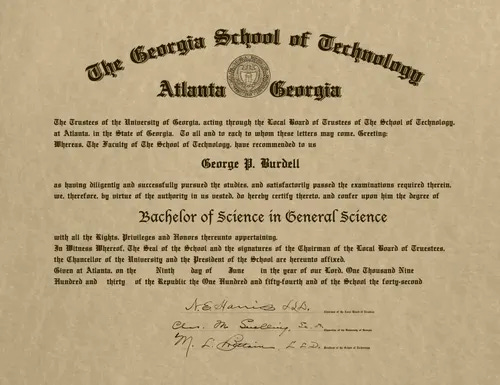
Burdell couldn’t get enough. He briefly studied at Harvard, and received a Master’s Degree from Tech. He’s earned several since.
He’s enrolled in every Tech class at least three times. In 1969, when the administration computerized enrollment to keep “Burdell” from registering, students hacked the system and signed him up for every class Tech offered.
Like Captain Tuttle in “MASH”, Burdell joined the military during the Second World War. Until an officer who’d graduated from Tech recognized the name, Burdell was on each log of a B-17 that’d flown twelve bombing missions over Europe.
The Georgia State Senate honored him in 2015 for being “an upstanding citizen”, recognized for his accomplishments and contributions to Georgia Tech and the state of Georgia.
From the late 1960s to early 1980s, Mad Magazine listed Burdell as being on their Board of Directors.
In 2001, with 57% of the vote, Burdell was leading candidate for Time magazine’s “Person of the Year”, till editors realized who he wasn’t and removed him from the running.
During the 1950s, The Atlanta Journal announced his engagement to “Anna Cartwright” of Agnes Scott College. In 2006, Garrison Keillor acknowledged their 50th wedding anniversary on Prairie Home Companion (at the 1:13:54 mark).

Ramblin’ Wreck
Tech is perhaps best known for its famous fight song. The “Ramblin’ Wreck” ostensibly referred to make-shift jalopies built by Georgia Tech engineers for use on projects in South American jungles.
It’s since become a 1930 Ford Model A coupe that (among other things) leads the team onto the gridiron as part of the pomp before each game.
Based on a Scottish drinking song, the lyrics were apparently written by a Tech football player while traveling to an 1893 game at Auburn. Other attributions are to a member of the original Tech graduating class or to a skirmish during an early baseball game against the University of Georgia.
Tech adopted the tune as its fight song in 1905. Three years later, it was published in The Blueprint yearbook. Under the headline “What Causes Whitlock to Blush”, the words “hell” and “helluva” were decorously omitted.
The Tech band played the song in the melody of “Son of a Gambolier”. By 1919, that version was embellished and copyrighted. It quickly caught on, and entered popular culture.
Tech graduate Arthur Murray opened his first dance studio a few blocks from campus, at the Georgian Terrace Hotel. As a student, Murray created the first “radio dance”, which featured the fight song.
The “Ramblin’ Wreck” received increasing prominence the next few decades, culminating in the Tech Glee Club singing it on the Ed Sullivan, Nixon allegedly playing it for Khrushchev at the “Kitchen Debate”, and Gregory Peck strumming it in The Man in the Gray Flannel Suit:
The song has been played a lot lately. The football team has won its first eight games, including the Homecoming victory a couple days ago.
Georgia Tech has exceeded this threshold only four times: in 1966 (9-0), and the Championship seasons of 1952 (12-0), 1928 (10-0) and 1917 (9-0). It matched it in 1916, when John Heisman coached the team that clobbered Cumberland State 222-0.
The most lopsided victory in college football history may seem vindictive and gratuitous. Because it was.
But that doesn’t mean it wasn’t warranted.
Cumberland had recently used professional players to put a 22-0 pasting on the Tech baseball team that Heisman also coached. Heisman wanted revenge and… like Alexander at Tyre… he wasn’t shy about exacting retribution.
Most Honorable Win
Despite boasting four National Championships (with legitimate claims on three more) and playing in the oldest on-campus stadium (which has witnessed the most home wins) in major college football, Georgia Tech’s team has finished unblemished by loss or tie only three times.
Among Tech’s more honorable victories was the 1956 Sugar Bowl. Not because the team won (it did, 7-0), but because it played.
Governor Marvin Griffin prohibited Tech from participating because Pittsburgh fielded a black player. Students revolted, marched to the Governor’s Mansion, and burned the Chief Executive in effigy.
Running on a segregationist platform, Griffin didn’t relent. But a reluctant Board of Regents (which initially supported Griffin) did. After Georgia Tech President Blake Van Leer appealed to them, they voted to overrule the governor, and send Tech to the Sugar Bowl.
Cynics may suggest racial solidarity wasn’t the main motive for Tech’s stance. The team wanted to play, the school wanted money, and students didn’t want to pass up a party.
Maybe.
But everything in Van Leer’s career suggests he was sincere. He even threatened to quit if the Regents didn’t override the governor:
“Either we’re going to the Sugar Bowl or you can find yourself another damn president of Georgia Tech.”
The Regents voted with Van Leer. Unfortunately, Tech would need a new president anyway. Van Leer died several weeks after the game he ensured everyone would win.
Four years later, students voted to admit qualified black applicants to Georgia Tech. In 1961, the Institute became the first Deep South university to desegregate without a court order when Ralph Long, Lawrence Williams, and Ford Greene enrolled.
Robert Yancey followed the next Fall. Four years later, he became the first black graduate from Georgia Tech. Eight years after the ‘56 Sugar Bowl, Dr Calvin Huey of the Naval Academy became the first black player at Grant Field. It’d be six more years before Eddie McAshan bestowed that honor on the home team.
Coming Home
Homecoming isn’t just about returning; it’s about acknowledging change and looking ahead. The place that once measured in slide rules now leads in satellites, software, and startups.
With its incessant evolution, Georgia Tech retains its essence: demanding, proud, perpetually in motion. Getting out is hard; coming home is easy.
JD
Thank you for this very lively and entertaining story. I spent three and a half years training as a Green-Beret nearby in Georgia, loved Atlanta and Georgia...