


Woolwich, Maine
November 12, 2025
[NB: Previous installments in this series are here, here, here, here, here, here, and here]
When I was at Georgia Tech, freshmen had to complete several “weed-out” courses (aside from “Drown Proofing”). Among them were three quarters of Physics classes.
The first covered Newtonian motion. The third related to optics. Neither were easy, but I did well in both. Electromagnetism (“E-Mag”) was another matter.
I never understood it. Midway thru the term, I dropped the course for fear of getting a C. When I took it again, I got a D… and was happy!
Throughout my time at Tech, Electrical Engineering courses would occasionally contaminate my civil engineering curriculum. I muddled thru, but always with a pessimistic mindset.
Those early scars convinced me principles of electricity would always be elusive. For that reason, they always have been. I knew I couldn’t understand it, so I didn’t try… and never did.
Until this week.
Path of Least Resistance
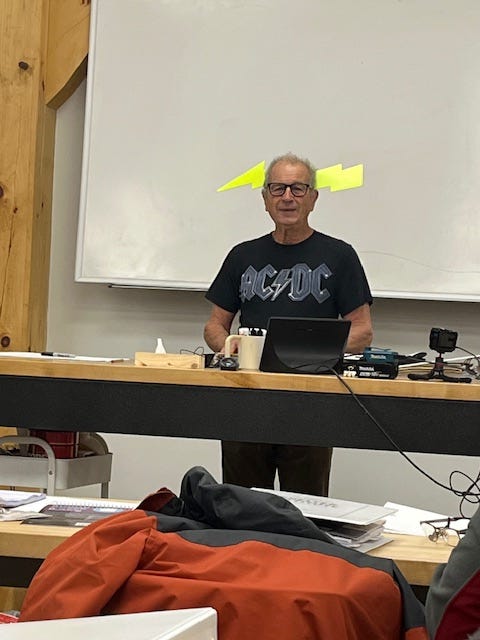
At Shelter Institute, the first day of our second week was all about wiring. With his usual spark, Pat Hennin explained the subject as if it were obvious. Because, as he insisted, it is.
He opened by asking what electricity is. When someone included the word “electrons” in response, Pat recoiled.
“No, no, no… it’s not that complicated”, he reassured us. “Think of electricity as power, which moves from where it is to where there’s less. That’s it.”
My simple civil engineering mind likes to see things. Pat’s explanation evoked the free body and internal force diagrams that made sense when I pursued my degree and obtained my licenses.
Plumbers probably feel the same way about corralling water. As with power… and like most people… it prefers the path of least resistance (so to speak).
We spent the morning following electricity’s flow… from powerplants thru transmission lines, to utility poles, thru transformers, and into exterior meters and internal panels. From there we walked each wire to its receptacle, switch, or appliance.
Pat also covered the electrical code, noting that over the decades it had expanded less to enhance safety than to thicken profits of connected corporations that manufactured electrical components.
Silly Shame
After lunch we got to work. We were given five scenarios to wire, with varying voltage, amperage, and sequence.
Several panels were filled with an assortment of parts. Our job was to sift thru them, find what we needed, and connect our assigned breakers, switches, and outlets.
The exercises exposed one of my (many) weaknesses: I loathe looking stupid… even if I’m the only one who thinks I do. I frequently remind myself how much better I’d sleep if only I knew how infrequently other people think about me.
None of them, particularly those I’ve just met, care what I know. But when they’re watching, I’m embarrassed to reveal any ignorance, even when that’s the shared reason all of us are in this class.
It’s silly, like feeling shame being unable to play the Moonlight Sonata when starting piano lessons. Fortunately, the Shelter Institute has a knack for puncturing pride and putting us at ease.
A Bowl of Broccoli
We worked with a classmate when we did our wiring. Mine had experience with electronics, so I instinctively deferred to him. Fortunately, he wouldn’t let me.
“You want to give it a shot?”, he asked, leaving me no option except to accept.
When I finished, he surveyed the scene like a dog eyes a bowl of broccoli after expecting a hunk of beef. Sensing I’d screwed up, I asked what was wrong.
“You won’t hurt my feelings”, I lied. He responded as if his wife had asked him how her dress looked.
He commended my effort, but implied there might be an even better way to connect the wires… that wouldn’t cause a conflagration.
What he suggested didn’t “look” right, because it entailed tying wires in ways I wouldn’t have expected. But why would it? I didn’t know anything.
I was focused more on appearance than effectiveness, which probably explains my interest in being an architect. I wasn’t thinking things thru. I’d tried to grasp electricity like someone learning a language by listening to sounds rather than understanding logic.
Pat provided an analogy that’s apparently common, but that I hadn’t heard. The amount of power delivered is a function of the size (amps) and speed (volts) of the “trucks” that transport it. Our job was to pick the best vehicle and right width of road.
Why couldn’t professors explain it to me like that when I was studying to be a civil engineer?
Fasteners, Sheathing, and Insulation
This morning, we learned how to hold things together, create openings we want, seal those we don’t, and control domestic traffic in vapor and air.
Gaius Henning guided us thru the variety and advantages of different nails, screws, metals, and wood. We delved into the details of wall assembly, how it’s evolved, and ways to permit or prohibit condensation, mold, heat, and cold.
As with power, heat and moisture move from where they are to where there’s less. After acknowledging this, we must determine the best materials and methods to protect our homes while preserving our comfort and defending our budget.
As we noted last week, there are no solutions… only trade-offs. There’s an ever-evolving balance among temperature, toxicity, cost, and rot. Depending on regional weather, mitigation differs around the country.
But wherever we are, as Gaius put it, our objective is to “build tight and ventilate right”. When possible, we want to seal our shelters, while retaining discretion over the flow of air.
We shouldn’t be at the weather’s mercy or our wall’s whims. Better for air and vapor to travel when, how, and where we want. It shouldn’t come under baseboards, thru windows, or thru cracks and crevices in frames or pipes.
We explored ways to accomplish this, and received several resources to refresh us when we inevitably forget. Then we were reminded why insulation is so important.
Round Robin
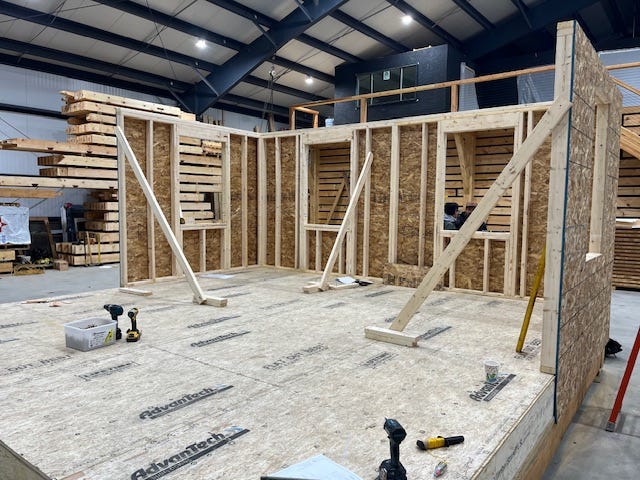
The afternoon was a round-robin of several activities. We started by erecting the walls we’d framed last week. We squared and sheathed them, raised them onto the foundation we’d formed, then created openings for windows we’ll install later this week. Then we grabbed our coats.
Yesterday I boasted to my family that I was warmer in Maine than they were in the South. The high temperature there was below what the low had been here. Today, Maine avenged my mockery.
Last week was mild. The weekend was warm. But this morning, winter arrived… and seems determined to stay. After lunch, snow fell. That was when we went outside.
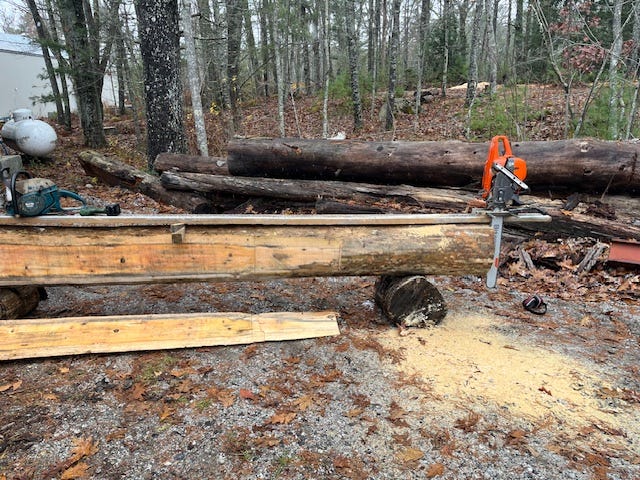
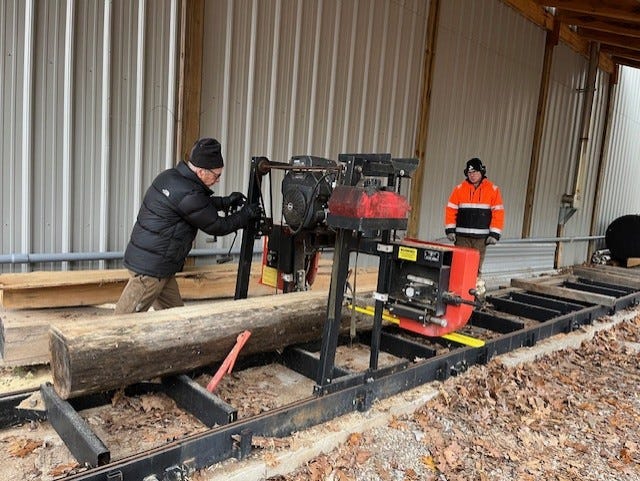
We trudged toward a pile of twenty-foot logs. Two of them (which had been here for two decades) were pulled aside, one to a mill, the other atop several stumps turned on their sides. George, one of Shelter’s timber framers, joined Pat to teach us how felled trees become structural timber.
Using hand ax, chainsaw, and a three-foot mill, Pat and George demonstrated ways to shave the logs into posts and beams. They explained how and when to use each piece of equipment, what to look for in the wood, and ways to acquire and fix each tool without spending a fortune.
We then moved “inside”, to a warehouse with a disabled door that couldn’t close. There we handled an assortment of power tools to drive nails, turn screws, and hammer drill concrete before learning to hang, seal, and patch drywall. Well into our second week, slippery concepts are starting to stick.
Whether power through a wire, air through a wall, or heat through a home, all move the same direction — from where they are to where there’s less.
Knowledge and competence flow the same way. Lighted candles fuel empty wicks, but without reducing the height of the original flames.
JD
Another great ‘stack, sir. Pat Hennin is definitely my kind of “prof”: wearing an AC⚡️DC t-shirt while teaching electricity is absolutely magnificent!
Construction can be complex...