


Sea Island, Georgia
November 14, 2026
The best way to see what’s happening is to take a look.
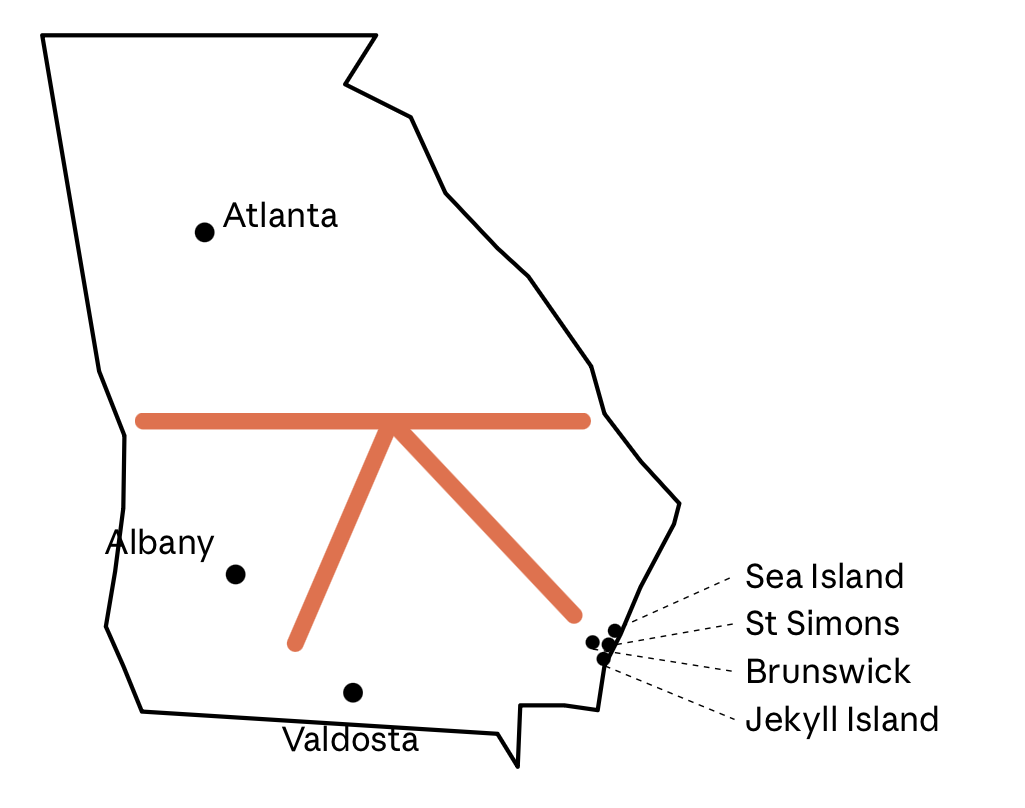
This week we toured south Georgia’s “K-shaped” economy. The upper arm stretches along the coast, reaching into St Simons and Sea Island. The lower leg runs inland, thru Brunswick to places like Valdosta and Albany.
Across the sound from St Simons, Jekyll Island is the cradle of the K, the point of departure for the fiat money system that’s afflicted America for more than a century.
Jekyll Island
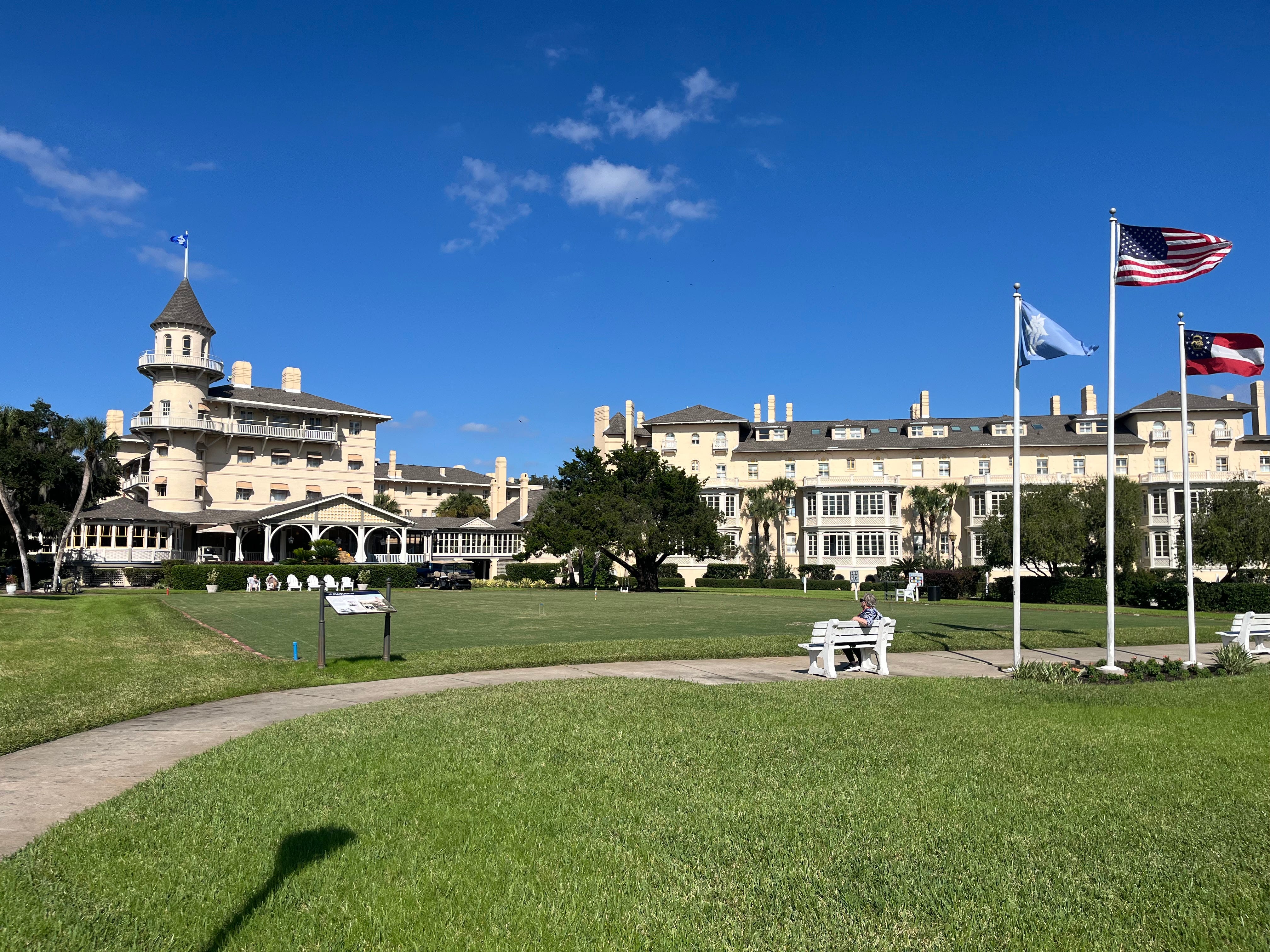
One hundred sixteen years ago this month, Nelson Aldrich’s railcar rolled south in the middle of the night. It carried Senators, bankers, and financiers who’d secretly lay the foundation for the Federal Reserve. They did so at the Jekyll Island Club, where I paid a visit earlier this week.
The Fed’s fake money scripts the K-shaped economy. It filches most Americans by funneling counterfeit currency to the favored few. Only after first recipients siphon purchasing power by spending the loot do the lower rungs get whatever leaks.
Fiat money fuels government suppliers, contractors, and the financial industry, inflating assets owned by people perched at the upper end of the K. But it hobbles those languishing on the lower leg, who suffer inflation in consumer goods without enjoying the rise in financial assets.
Yet ersatz cash isn’t all that splits the K; geography, weather, and history have also pried it apart. This week we took a trip in each direction.
St Simons and Brunswick
Saturday we made the six hour drive to St Simons, where we spent the weekend with several friends.
Aside from pre-colonial Indian settlements, the Spanish came here first… establishing a mission that various buccaneers burned. English raiders pushed the Spaniards out. To ward off Spanish incursions from Florida, James Oglethorpe built Fort Frederica… which now remains only in ruins.
Throughout the colonial and antebellum periods, cotton plantations dotted the island. After the war, freed blacks formed communities at Harrington and South End.
The Gullah Geechee (who I described more thoroughly in this essay, this one, and this one) are descendants of slaves who pulled rice and cotton from the marshy fields. As land values went up, the Gullah Geechee were pushed out.
In the 1920s, when a causeway connected the island to the mainland and The Cloister resort opened at Sea Island, the area became a luxury destination… and has remained one since.
St Simons is one of more than a dozen barrier islands dotting Georgia’s coast, and among only four with sizable population. About a quarter of inhabitants are here seasonally, with much of the island preserved as woods or marsh.
The Mackay River acts as a moat separating the upscale enclave from nearby Brunswick, which is being revitalized on the other side of the bridge. Under graceful canopies of moss and oak, beautiful 19th and early 20th century homes line streets and surround squares of a city that’s long suffered the scourges of poverty and crime.
Like the city and its economy, many of Brunswick’s stately structures are enjoying a revival. A good number have been renovated, with others undergoing restoration. This weekend, several of their stoops hosted musical acts that entertained roving crowds as part of the annual Porchfest of local bands.
In Brunswick, unemployment is relatively low (~3%), tho’ poverty (~30%) remains high. The Port of Brunswick is among the busiest in the U.S., accommodating more cars and heavy equipment than any American harbor (boosted by the widened Panama Canal and collapse of the Key Bridge in Baltimore).
Back on St Simons, the economy is bustling and prosperity is ubiquitous. Official unemployment is under 3%, yet only about half the population has a job... or needs one.
More than 40% of residents are retirees, many living on investments, pensions, or other accumulated wealth. As in many coastal communities, employment tends toward tourism, healthcare, and retail.
The town is pleasant and comfortable, but (unlike the gated Sea Island community next door) not exclusive. It feels upper middle class, as wealth statistics suggest it is. Ocean waves, sandy beaches, and mossy oaks are the obvious enticements.
Plenty of pedestrians stroll shaded sidewalks, patronizing an array of busy shops, restaurants, boutiques, and bars. The island is clean. We saw no homeless. Private golf courses proliferate, and permitted lots rarely wait for new construction.
Residents who once came mostly from Atlanta or other parts of the South now increasingly arrive from the Northeast and Midwest, pulling property prices in the predictable direction.
Valdosta
After a few days drinking, dining, and golfing with friends, my wife and I rode several hours west. We stopped first in Valdosta, a town we (like most travelers) usually approach from the north or south, when driving between Tampa and Atlanta.
We usually speed past on I-75, or stop for food or fuel without veering far from the freeway. But this week I decided to explore the city.
Named for the Val d’Osta plantation of former governor George Troup to honor the Aosta Valley in Italy, the settlement rose in 1860 around the new Atlantic and Gulf Railroad that linked Savannah to the Flint River.
The War Between the States started the next year, and ravaged Georgia. No fighting afflicted the village of Valdosta, but the loss of men to the Confederate Army and the destruction of the railroad by the Union one almost strangled the nascent outpost.
Construction ceased, the Confederate currency became worthless, and refugees poured in from points north (among them were the parents of Doc Holliday, who spent his teenage years here).
Like most of the South, Valdosta struggled under Reconstruction. Its economy languished for two decades, till Sea Island long-staple cotton was cultivated in Lowndes County.
Valdosta became the largest inland market for the crop. By 1910, it reputedly had the highest per capita income of any city in America.
It didn’t last. During the First World War, the economy turned to tobacco and timber when the boll weevil wrecked the cotton crop.
The next year, racial violence made things worse. A white mob murdered thirteen blacks after a black worker killed a white planter. Among the victims was a pregnant woman who protested her husband’s lynching.
The Depression decimated Valdosta. As across much of the country, federal funds poured into south Georgia to prop prices that tried to drop.
Make-work projects provided jobs to those precluded from work by high wages the government refused to let fall. Moody Air Force Base opened at the outset of the Second World War, and became Valdosta’s largest employer.
It still is. Other big ones are Valdosta State University, South Georgia Medical Center, and a Lowe’s distribution facility. Textile and apparel plants closed a few decades ago, as NAFTA and fiat money facilitated a shift of industry overseas.
Valdosta’s median household income of $46,000 is about 40% below that of Georgia. Only 40% of Valdostans own their own home. Few own rising stocks in public corporations, yet all pay higher prices for what those companies make.
Job growth is relatively flat, and heavily dependent on government spending. The poverty rate exceeds 25%, skewed somewhat by a large student population.
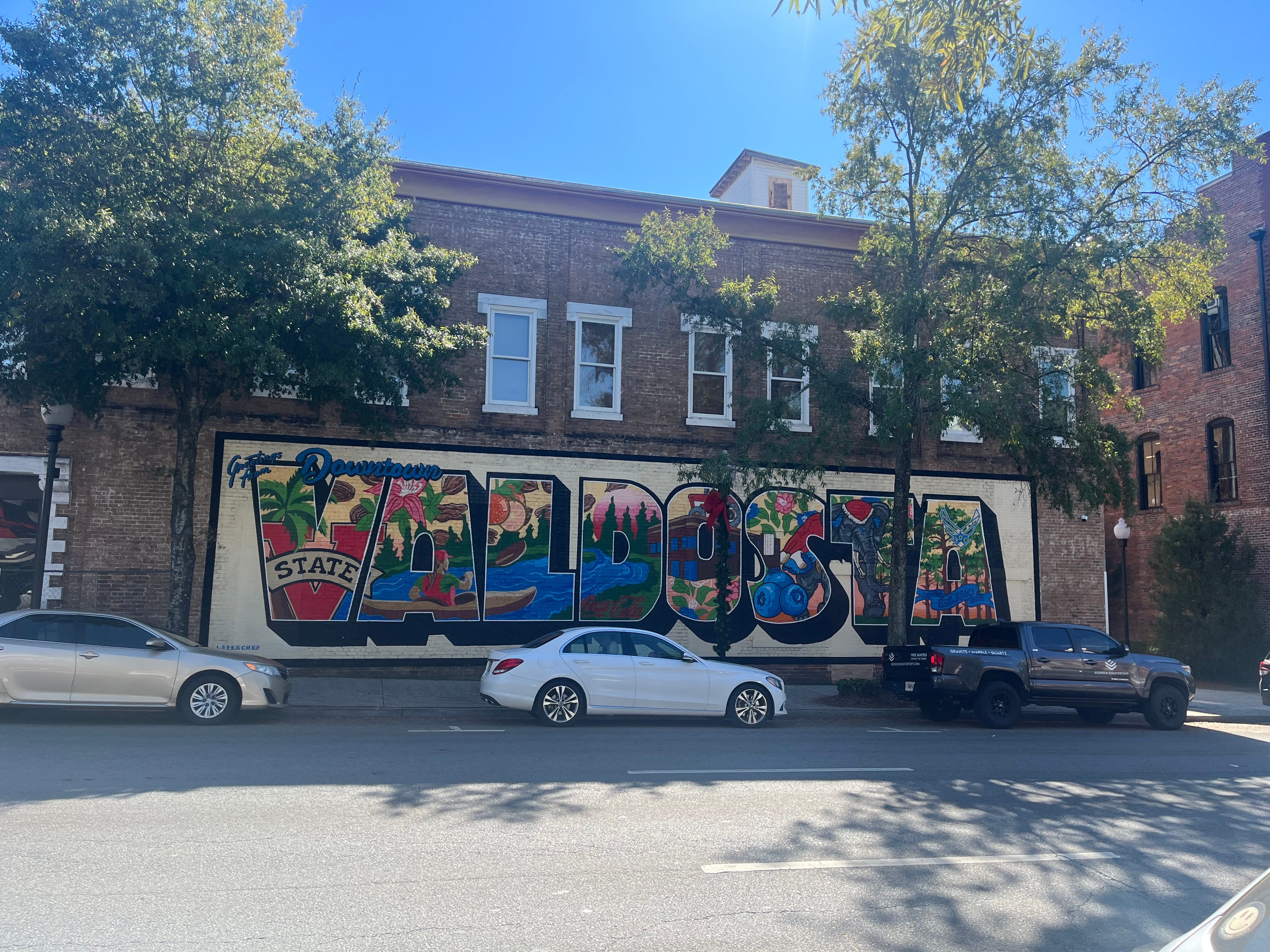
On a gorgeous Tuesday morning, I spent an hour or so wandering the central business district. It was relatively quiet. Even mid-morning, few establishments were open. Many buildings were vacant.
But I expected the town to look worse. While much of it is filled with the usual assortment of empty lots, gas stations, or fast food shacks, a couple square blocks show promise. With several restaurants, cafes, bars and a few home decor stores that keep afternoon hours, they’re probably busier later in the day.
Between strolls, I settled into the Red Door Cafe, a relaxing coffee shop where a wandering writer can relay his thoughts amid shelves of books.
As in most of the small town South, the Valdostans I met were as nice as they could be. Without exception, shopkeepers, servers, policemen, and passersby all offered pleasant smiles and warm wishes… which were welcome accompaniments as we went on our way.
Albany
Nelson Tift came from Connecticut to establish Albany after the Indians were evicted. “Awl-benny” was founded in 1836 as a steamboat port on the Flint River. Tift named the town for the capital of New York on the Hudson, whose prosperity he hoped his new city would emulate.
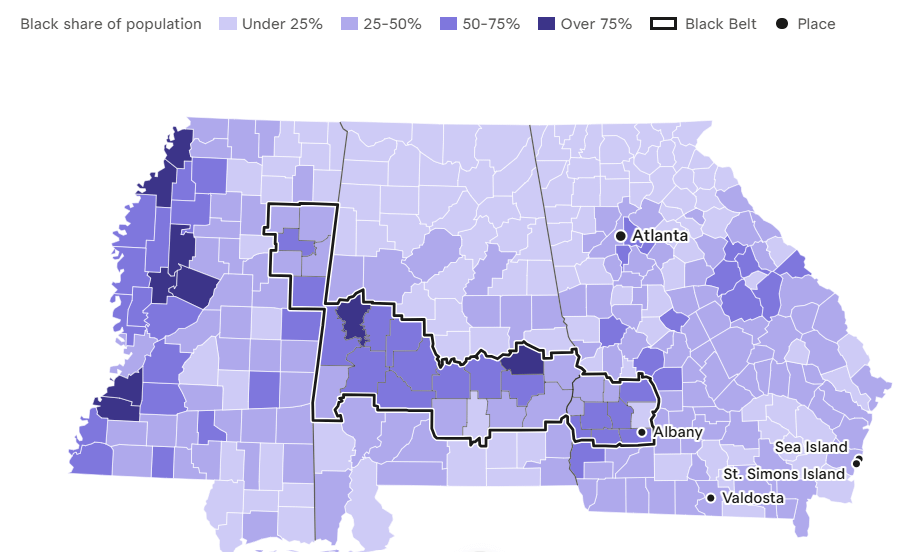
As in much of the geologic and geopolitical “Black Belt” extending from northern Mississippi into southwest Georgia, cotton was the primary crop. The rich soil attracted planters from South Carolina and elsewhere in Georgia, most of whom brought slaves to pick cotton and ship it down the Flint to the Gulf.
We can see why Tift had high hopes for his new town. A Cretaceous sea once coated these plains, with plankton fossils leaving chalk formations that evolved into the fertile soil that made slavery lucrative. As Booker T Washington wrote:
“The part of the country possessing this thick, dark, and naturally rich soil was, of course, the part of the South where the slaves were most profitable, and consequently they were taken there in the largest numbers. Later, and especially since the war, [Black Belt] seems to be used wholly in a political sense—that is, to designate the counties where the black people outnumber the white.”
It still is, as reflected in population patterns depicted below. Albany is the seat of Dougherty County, where the percentage of black residents (71%) remains the highest of any county in Georgia, which is about a third black.
Albany’s factory base fell after Nixon divorced the dollar from gold. A Firestone plant closed in the 1980s. Cooper Tire later took it over, but let it go in 2008 during the Great Recession that wiped out about a third of Albany’s goods-producing jobs. The closure of a textile mill and a Merck plant accelerated the decline.
Natural disasters compounded problems. Tornadoes and hurricanes are common occurrences, and the Flint regularly overflows. Devastating floods in 1994 and 1998 crested forty feet above the banks, destroying much of the city and dislocating half its population.
The poverty rate around Albany approaches 30%. Looking around, that isn’t surprising. As in many struggling rural communities, the government, healthcare, and education “industries” (which are usually indistinguishable) are the biggest employers.
Albany and Valdosta are of similar size. In both cities, blacks earn about 65% of what whites make, and incomes are below the state average.
At this end of the K there are more consumers than owners, so fiat money erodes wealth. Most residents don’t own stocks. Fewer than 40% own their own home, compared to two thirds of all Georgians.
Albany median income is similar to that in Valdosta, as are its primary sources from a military facility and state university. But the city seems worse off. Much of it looks abandoned. Most open establishments are government buildings, almost all of them ugly.
The Chamber of Commerce, which occupies an elegant edifice that probably once housed a bank, is an exception. But amid the town’s dilapidation, I’m not sure what this organization does.
Built in 1906 on the west bank of the river, and heavily damaged by a 1940 tornado, the St Nicholas Hotel survived each subsequent deluge to be one of the nicest buildings in Albany.
Fortunately, that’s where we stayed. With a good restaurant, welcoming bar, and cozy lobby around a warm fire, it’s a refreshing oasis in the urban void.
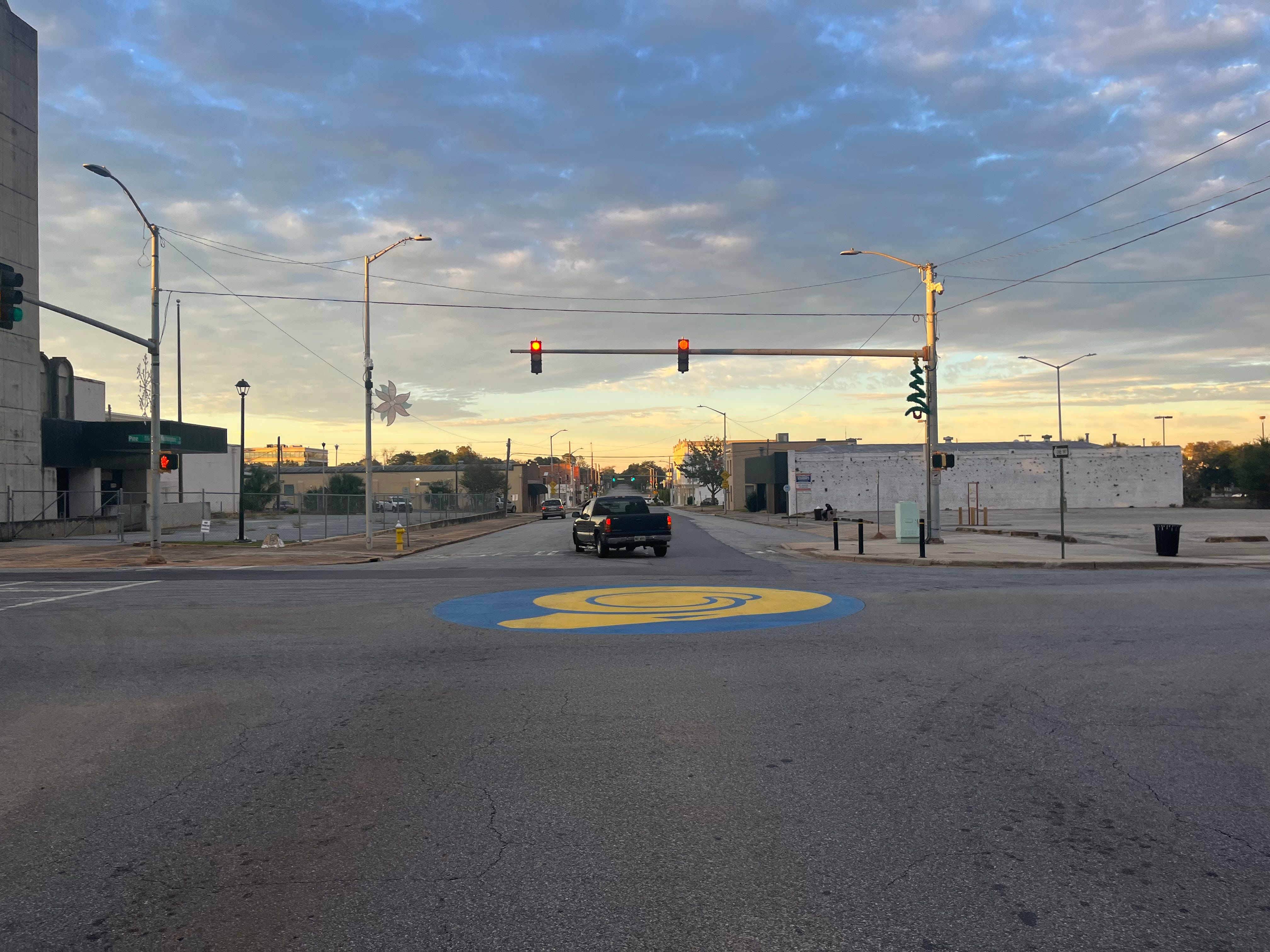
Much of central Albany is a wasteland of empty buildings and paved deserts where no one parks. Aside from a pawn shop and wig dealer, the few retailers are a small coffeehouse, a cookie store, and a smoothie place. An upscale clothier, art vendor, and salon share refurbished buildings across from our hotel.
I hope these sprouts will spread. As in Valdosta, the locals we’ve met are charming. The owner of Cornerstone Coffee apologized for not having “the right size” cup for my order by supplementing my coffee with a complimentary bag of his proprietary beans. I assured him this wasn’t necessary. He told me it was: “I want to do it.”
With any luck, this city will continue to recover, and become a place that’s worthy of these residents.
Manicured Nail
From Albany we returned to the coast, where we’re spending the weekend on the manicured nail on the K’s upper arm. We’ve come back to The Cloister, the luxury resort behind the Sea Island gates.
Sea Island is one of the wealthier places in the United States. Median incomes exceed a quarter million dollars and most inhabitants live on income-producing assets. The local economy is essentially this resort and an expensive community of second homes along the Atlantic.
The Cloister is the major “industry” (we described its story in this essay). Aside from the Glynn County school system, it’s the largest employer in the area… with most workers coming from St Simons or Brunswick.
Across the sound a few miles down the coast, Jekyll Island remains sparsely populated. Visitors now arrive on wheels rather than rail, and pay a toll to enter the island.
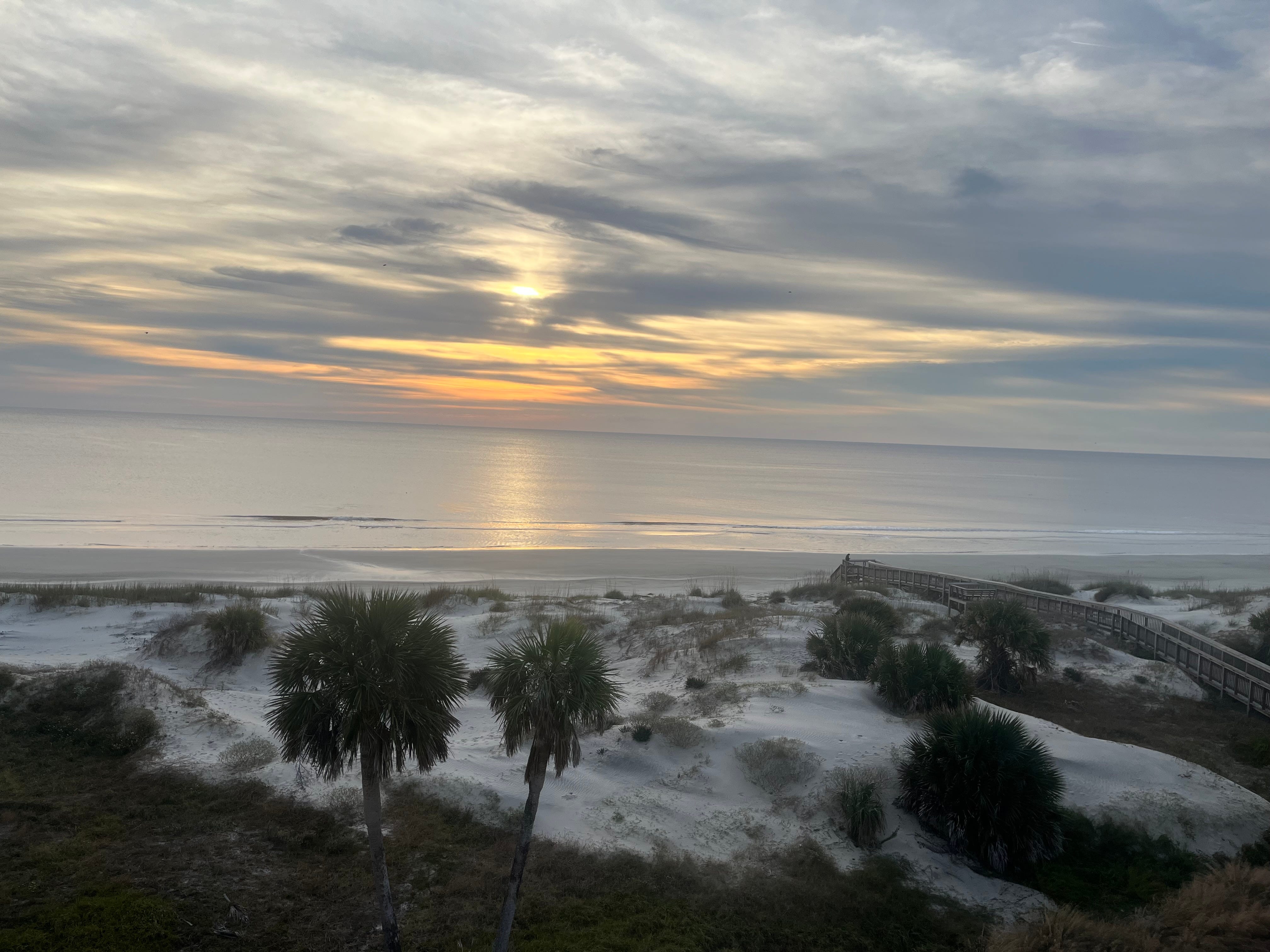
We did so Wednesday evening, for one night before coming to The Cloister. From our balcony overlooking the ocean, we welcomed the sun the next day.
The wide beach was mostly empty, its sand caressed by waves that eased us awake as they lapped the shore, indifferent to which Georgians are on either side of the tracks.
JD
PS - For readers interested in other observations and reflections from continents around the world, this compilation might be of interest:

Your trip was between two extremes: the well to-do and the much less well to-do. Sad history too, and poignant for me to read that portion of your trip-report pertaining to Albany.
My relatives were chased off their farm near Albany by carpetbaggers not long after the War Between the States ended.
Years ago, more than a half century past, while driving from California to Maryland, I swung by Albany to find this farm. Family lore made me do so.
As a youngster, I was regaled by my elders with tales about someone being murdered in the back pasture and a treasure buried by my long deceased relatives. Their valuables were buried in the woods behind their home to keep the Yankees from stealing them.
Lady Luck favored me. While I was rummaging around the basement of the Albany Courthouse looking for deeds, maps, anything that would help me locate the farm, I found a old map; framed, hanging on the stairway wall.
It was a circa 1880 map featuring my family's names and homesteads. A helpful clerk told me which road to take to reach the area. Not long after, I was on a quiet country lane. Never saw a person or car but I did see a church.
While walking through its graveyard, I found my family's predecessors. Lot's of 'em. Their tombstones etched with dates mostly before the Civil War; less so after it ended. And, not long after, I found the family homestead and the woods behind it!
But the biggest discovery was the homestead was modest, made of wood; not brick and occupied by a very elderly woman who turned out to be my Great Aunt. She was as surprised to meet me as I was to meet her!
She sat me down on the porch; gave me a lemonade and, among other tales, told me how her uncle and his brood decamped for Texas after a carpetbagger murdered his brother in an attempt to steal the farm.
But when I asked where in the woods I could find the buried treasure, she had no idea what I was talking about. I decided to probe no further.
As the sun began setting, I bid her farewell and departed. I was and remain eternally glad I met her, but sad that she knew nothing of the treasure in the woods. I ruefully accepted that, if there ever was one, it's forever secure as neither the Yankees nor me will ever find it.
👌👌👌 🎯🎯🎯 🔥🔥🔥 💚💚💚 !!!
Geological- military-, societal-, financial- and economic history very blended !!!