Atlanta, GA
July 28, 2026
I hadn’t planned to see Christopher Nolan’s adaptation of The Odyssey. At least not for a while. As one who loves Homer’s epics, I couldn’t stomach seeing them degraded, or used as weapons in our culture wars.
I’m sure curiosity would’ve eventually compelled me to watch it online. But initial reviews from apoplectic right-wingers left me reluctant to see it in a theater. This weekend, I ignored that instinct.
I’m glad I did.
Purposes of Art
What conservative critics warned about is mostly true. Much of the casting, especially of a tiny actress as a Mycenaean warrior and of an ebony Kenyan as Helen of Troy (described by Homer as “white-armed”) jars preconceived notions of Western viewers. An assortment of Indians, blacks, Hispanics, and East Asians among the Ithaca suitors and Greek crew also seems silly.
Aside from being ahistorical, these “diversity” hires undermine the story the film claims to tell. As several reviewers have observed, if representatives of so many distant races could so easily get to Greece, why did Odysseus have so much trouble traveling six hundred miles to return from Troy?
The conservative reaction is valid (I shared it). But it’s overwrought to the point of appearing performative. We complain about politics infusing everything, yet let tribal identity decide what we’re supposed to enjoy.
As regular readers are aware, I’m as conservative and traditional as anyone. But at some point we need to calm down, stop looking for ways to be offended, and resist every passing temptation to pitch a fit.
Much as I love (and prefer) Homer’s original, I don’t need every remake to be a duplication. What would be the point? It’d be easier to just re-read the book.
Casting, character, and plot discrepancies were all over this movie. This isn’t unusual. But to constantly harp on them is exhausting. And for what? This is, after all, a movie… not a documentary.
Remarkable as they are, most Renaissance paintings aren’t perfect depictions of Greek myth or the Holy Gospels. Nor were they meant to be. To the contrary, artists regularly inserted patrons, lovers, or themselves into paintings and sculptures that would’ve scandalized preceding generations.
I’m not suggesting Nolan’s Odyssey compares to Michelangelo or Caravaggio. Obviously, it doesn’t. My point is simply that we observe an artist’s interpretation to understand his perspective, and how it alters, affirms, or (yes) offends our own.
Among the purposes of art is to elicit personal responses to timeless themes. Disagreement and debate are healthy and welcome. The film has obvious faults that are worth discussing. But they aren’t fatal, and the movie has plenty of merit.
Modern Prism
The undercurrent is Homeric hospitality, and of respecting it by honoring gods who could appear in any guise… a message Christ later preached about Himself.
Yet this homage to xenia was distorted thru a modern prism. The suitors are rightly reviled for abusing it. But an introspective Odysseus beats himself up for wielding generosity as trickery to topple Troy.
Needless to say, no Mycenaean warrior would’ve regretted using guile to overcome an enemy, then emoted to a psychiatric Calypso while numbing himself with lotus leaves. He’d have reveled in the glory, not wallowed in shame… a feeling that existed in ancient war only as a consequence of cowardice, never of cunning.
The recurrent anti-war message was among Nolan’s most appealing deviations. I admit that reflects my own bias, which doesn’t make the penitent protagonist any more realistic.
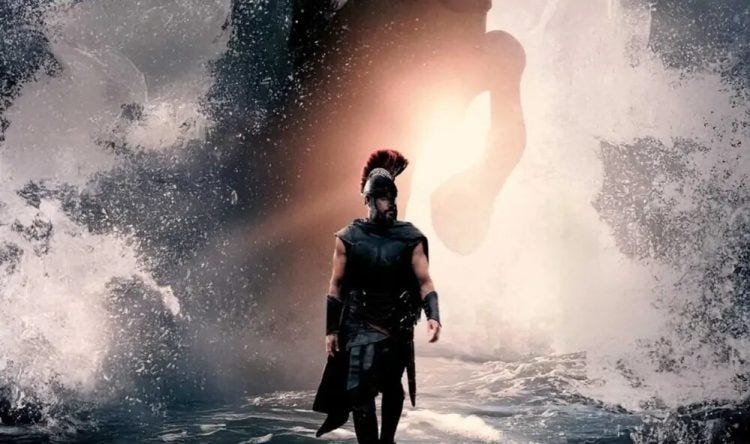
The Trojan Horse is hardly mentioned in the Odyssey (Virgil elaborates more fully in the Aeneid), yet few purists complain about its lengthy inclusion in the movie. And for good reason. It adds useful context as part of the Trojan cycle. References to the Oresteia were also welcome.
After a horrible ten-year war, the horse is a Greek “gift” to sneak behind the walls of Troy. Once inside, the Greeks open the gates to the rest of their troops. As all the world knows, the gambit works.
Odysseus’s horrified reaction watching “ten years of rage” slaughter Trojan women and children was compelling. This is what war does, and it warrants such a response.
But Odysseus wouldn’t have moped about dead civilians after the enemy was vanquished. If anything, he may have joined the rampage, and wouldn’t have been shocked by what usually happened in the course of war. Yet Nolan has the slaughter haunt Odysseus, to the point of having Athena trail him for years as one of the Trojan women his men killed.
The Fulcrum
Curiously absent is the ubiquity of color that graced the ancient Aegean. Mycenean façades, walls, and wardrobes were covered in bright mosaics, frescoes, and fabrics in palettes of decorative paint and brilliant weaves.
Despite the magnificent cinematography of the Odyssey, most of these hues are washed away. It’s as if the Danaans lived in modern ruins.
Overall, the visual effects are excellent and worthy of an award. The sequences hauling the wooden horse toward Troy are outstanding. The cyclops is terrific, the best depiction ever put to film.
The Laestrygonians are rendered as armored giants rather than mountain-sized behemoths who hurl boulders at their prey, perhaps so it’d at least seem plausible that regular men could fight them.
Scylla and Charybdis and the sea scenes enthrall. The vastness and turmoil of open water relative to rickety Achaean boats is ably captured.
How Nolan handles the Sirens is intriguing and well-done. As the ship sails past the island of seductive creatures who lure victims with intoxicating song, Odysseus commands his men to wax their ears and lash him to the mast.
What the Sirens sing remains mysterious; or, rather, varies with the ears of the beholder. As events unfold, the audience takes the perspective of the crew. The sight and sound of the Sirens stays cryptic. Overwhelmed with grief (rather than desire as in the poem), Odysseus is in obvious agony, later relaying that the music contained all he wished he had, wrapped in all the blessings he’d lost.
As in the book, Circe is compelling, wicked, and generous. In the movie, Samantha Morton’s portrayal is harrowingly captivating. To preempt brutality she’s accustomed to seeing, she turns the men to swine while keeping their minds intact. Throughout the encounter, her demeanor shifts from frightened foe to indispensable guide. Nolan called Morton’s performance the “fulcrum” of the film. He was right.
About Us
The movie includes worthwhile historical notes. Over the story looms the existential threat of Bronze Age collapse, something of a Fourth Turning triggered by events and effects of the Trojan War. (Odysseus later referring to his era as the “Bronze Age” is an eye-rolling anachronism.)
The ominous “Sea Peoples” are instrumental to this civilizational destruction. These assorted (and historically uncertain) marauders didn’t exist in Homer’s epic, but arose several centuries before his poems were written. The film’s repeated references to them are chilling, as is the ultimate revelation of who (in Nolan’s telling) they really were.
Most of the acting is competent, not great. Some performances, like Page’s waif or Tom Holland’s Telemachus, are distracting or flat.
In a role more assertive than the poised queen of the poem (or any woman in Mycenaean Greece), Anne Hathaway as Penelope is occasionally gripping, and anchors the Ithaca scenes.
Perhaps arguments over this movie will prompt viewers to read the book. If they do, they won’t recognize the tormented second-guesser Matt Damon depicts. Less vital than the Homeric hero, Damon (an actor I always like) effectively portrays the anguish and fatigue of Nolan’s wanderer.
Homer’s Odysseus is determined, decisive, and unapologetic. To get home he endures years of tumult, the death of his men, and resists Calypso’s temptations of immortality. Circe and (in the book) Nausicaa offer comforts he also declines. Despite enjoying supernatural charms, Odysseus is single-minded about getting to Ithaca.
In the movie, Odysseus has doubts, and is unsure if he even wants to go back. Home isn’t merely where we go but who we are. It’s less a geographical voyage than a personal becoming. This has little to do with Homer. It’s all about us.
Enough to Ask
Despite my misgivings and critiques, I liked The Odyssey. But I didn’t love it. The flaws are real. Many are unforced errors that seem beneath Christopher Nolan. Maybe they’re Hollywood bait to hook an Oscar. Perhaps they make sense that I can’t see (wouldn’t be the first time).
That’s OK.
Like this essay, most outrage is selective and tiresome. We mustn’t let ideology keep us from activities we might enjoy, or from confirming we were right in what we were inclined to avoid. I’m glad I overcame my aversion, and proved I was wrong.
Regardless the hoopla and controversy, the movie was worth seeing. For a few hours with my wife and son, I had a good time doing so. Not long ago, that would’ve been enough to ask.
For me, it still is.
JD


You crafted a great assessment of the movie Odyssey
I especially liked: "Among the purposes of art is to elicit personal responses to timeless themes."