



Atlanta, GA
July 24, 2025
A couple weeks back, we lamented the fall in fertility in the Western world and noted a few reasons it’s occurring.
Among them are the proliferation of women in the workforce, the prevalence of government programs obviating the need for offspring to provide elder care, and a pessimistic perception that the world is too awful a place to bring a child.
But underlying everything is the notion that having kids costs too much money.
Eight years ago, the Department of Agriculture calculated that about $230K was required to raise a child. To account for inflation, the Brookings Institute recently upped the estimate to $310K. This averages to $18K annually… excluding college expenses.
Sounds daunting.
I don’t doubt the data from these studies are factual. But are they truthful? Is this really what it costs to raise a child? Or does it reflect more what parents decide to spend than what they need to pay?
Having raised two children, I know kids aren’t cheap. But they also aren’t prohibitively expensive… or needn’t be. The perceived burden on pocketbooks often comes from flawed assumptions and misplaced priorities.
Many of the presumed expenses of raising kids are for items or activities parents purchase to improve other people’s perceptions. I don’t necessarily blame them. Most of us succumb to these same influences. I did. It can be hard not to.
Parents want what’s best for their kids, and are convinced to equate that with the “finest” school, “nicest” neighborhood, “safest” car, or latest gadget that garners peer approval. But children don’t need a huge house, a fancy car, or an expensive education. Oftentimes, these are costly luxuries they and their families are better off without.
Genuine Challenges
This isn’t to minimize genuine challenges. For most middle class families, taxes alone consume more money than houses, food, and fuel combined. Larcenous monetary policy has transferred wealth to those who already own assets, while wrecking purchasing power of the people being plundered.
Holding the bag after fifty years of inter-generational theft, today’s prospective parents inherited greater financial obstacles than recent generations endured (I’ve discussed some of those extensively, including here). When they notice they’ve been robbed, they’re regularly ridiculed as lazy whiners by oblivious elders who benefited by the heist.
Yet this doesn’t mean children are “unaffordable”, or that they must cost as much as recent studies suggest. That’d be like saying people shouldn’t get married because weddings are too pricey. They can be. But couples don’t need a luxurious rope to tie the knot. The bond is just as sturdy (and often stronger) with more modest material.
“Affordability” is relative. In many cases, it reflects personal priorities and individual preferences. Everything becomes less affordable when we devote our scarce resources to something else.
No one denies that people spend more today than they did fifty years ago, or even at the turn of this century. But they also buy more, often borrowing to do it.
U.S. Consumer Spending (1970 - 2023)
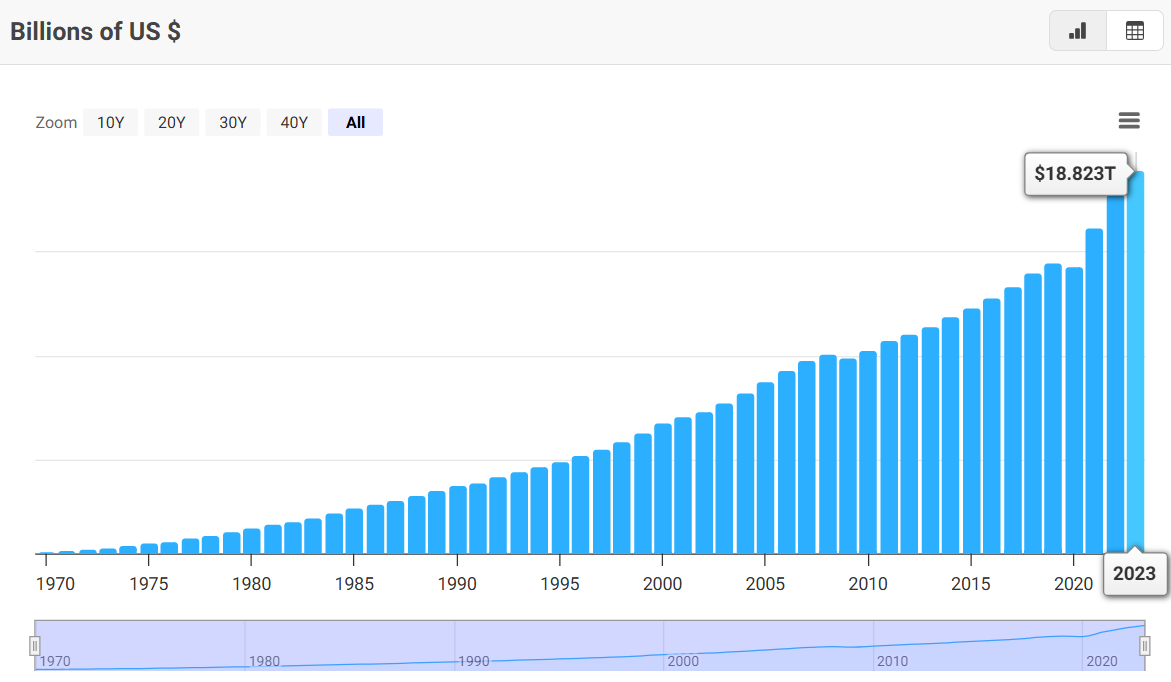
Popular propaganda (which eagerly touts how much kids cost) rarely discourages this. If anything… as with student debt, car payments, or home mortgages… loans are lauded as ways to enhance affordability and availability (which aren’t the same thing).
For a society that supposedly can’t afford anything, consumption has run rampant. Americans are less frequently referred to (or treated like) “citizens” than as “consumers”. Some have earned the moniker, forgoing their first born to facilitate frivolity.
Yet many genuinely fear they can’t afford kids. They’re honestly overwhelmed. When they’re told it requires $300K to be a parent, their concern isn’t unreasonable. But is it legitimate?
It’s Own Impetus
Being “unable to afford a child” isn’t unusual. Historically, most parents were when they first had one. Or at least they thought they were. But almost all of them figured it out. They still do.
Kids undeniably increase costs of certain things, tho’ not necessarily of expenses overall. New parents shift spending patterns, reducing consumption of other items after children arrive.
More important, becoming a father can be its own impetus for enabling men to afford being one. Statistically, having kids increases a man’s earnings. It also tends to mature him (the same is true for women, but they tend to be more mature anyway).
It’s no coincidence that married men with children tend to make more money. Being a father extends horizons, prompting him to save more, invest often, and squander less.
Having kids encourages delayed gratification. This reduced time preference prompts savings, increases wealth, and enriches the family. Many parents become more diligent about their health, which alleviates financial burdens later in life.
But what about expenses after their child arrives? The “kid cost” studies collated child-rearing costs into several buckets. Let’s dip into a couple, and determine if they need to be so deep.
The Biggest Burden
Housing was considered the biggest burden, consuming almost 30% of assumed outlays to raise a kid. Relative to income, these costs have clearly accelerated in recent years.
In nominal terms, the median residence fetches about ten times as many dollars as it did fifty years ago… and almost twice what it did at the start of this decade. As I previously detailed here, real earnings have fallen too. There’s no denying that wages have lagged the price of real estate:
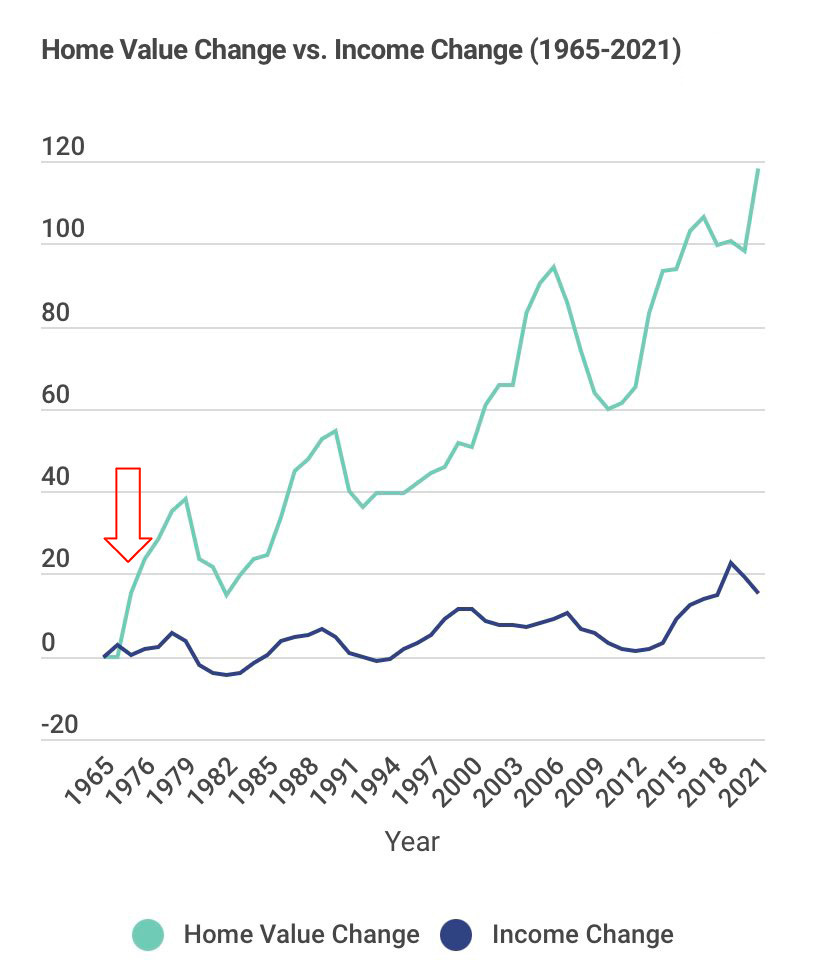
The Brookings study estimated parents pay about $5,500 annually for housing. But this expense isn’t because of children, and having them doesn’t necessarily make it worse.
Potential parents have housing expenses anyway. They need a place to live whether they have kids or not. Having one doesn’t mean they must move.
Likewise, things like elaborate nurseries aren’t necessary. As with many expenses blamed on children, these projects are mostly to enhance the (self-)image of the parents. So long as a room is quiet and warm, babies couldn’t care less about fancy furniture, cute accessories, or the color of the walls.
As families grow, more space may be desirable. But it usually isn’t essential. If anything, it’s probably a signal to shed stuff. Unless a couple lives in a cramped studio in a crowded city, a newborn rarely requires a new house. Two kids typically don’t either.
My paternal grandparents raised nine children, most of them in a modest ranch house in south Tampa. Of course, not all lived there at the same time. Older kids left before the youngest were born. But the place was usually crowded.
Up to five siblings shared one bathroom and several bedrooms. Friction and fights were common among that Irish Catholic brood. But it was fine, and probably preferable to the loneliness many kids now lament. Older siblings also offered free babysitting and hand-me-downs that helped alleviate expenses.
This wasn’t that long ago. Even now, Latin American families continue to raise many children in confined spaces. Grandparents are often part of these multi-generational arrangements.
Yet they’re as happy as American counterparts who have small or fractured families with much more money. The Latin Americans recognize the importance of family bonds, social engagement, and tight-knit community.
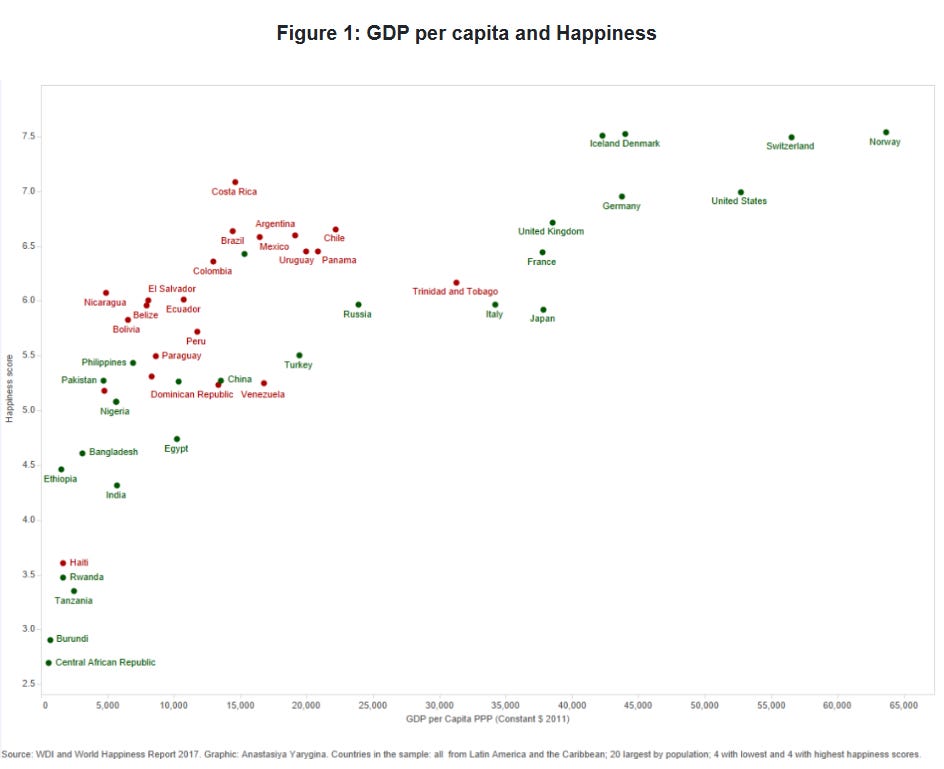
Not that they shun money. They obviously don’t.
But they retain perspective on its purpose. It’s a means to wealth, not wealth itself… a tool to nurture a family and keep it together, not a prize they’d exchange their family for.
Most Americans would claim to agree. But when they refuse to have children because they’re convinced they’re too costly, that’s essentially what they’re doing.
Childcare and Education
“Childcare and education” are estimated at $3,000 annually, about 16% of the assumed cost to raise a child. Some analyses (which themselves are dated) put expenses as high as $10K for those who hire third-parties to watch their children.
Childcare costs assume both parents are working. In some cases, they must… as single parents obviously do. But for many, it’s a preference. Regardless, there are alternatives to these exorbitant expenses.
One parent could choose to stay home. Everything we do involves opportunity costs. This one obviously entails a loss of income. But a chunk of that is taxed, and much of the balance goes to paying people to care for kids. If the second salary is too high to forgo, then (in most cases) affording children shouldn’t be a burden.
Another recourse is moving nearer to family who can help. If more children arrive, older siblings can look after younger ones… which is another argument for more kids. Combining or exchanging care duties with friends is another option. There are more.
The “cost of a kid” studies excluded college costs from their calculations, tho’ many might argue those expenses can’t be wished away.
Why not? For most people, they probably should be. But even if they aren’t, small, regular savings started during pregnancy or after childbirth will compound into enough money for a good college. Or for whatever the child decides on instead.
As has become obvious in recent years… with student debt leaving millions destitute, ideological indoctrination making many of them morons, and the financial reward often revealed as a mirage… overpriced academia often does more damage than good.
Not that college is never a good idea. I went. My sons did too. One is till there. But it’s best suited to certain pursuits. For engineering, medicine, law, and hard sciences, a university education makes sense.
But even then, it rarely does so right away.
Most kids should probably apprentice before they enroll, ideally in several places that expose them to different disciplines and a wider network of potential mentors. Gaining practical knowledge is nice. But exposure to a variety of people of differing experience is essential.
Few eighteen year-olds know what they want to do. How would they? When asked, they say what sounds good. Their parents and peers are impressed at the idea of them being an engineer or a doctor, so that’s what they study.
Many would be better off spending a few years traveling, working, and learning skills (I recently wrote of one young man who’s doing this). This helps affirm (or refute) what they think they want before (or instead of) spending four years and tons of money finding out.
The Other Side of the Ledger
Childhood includes countless costs that may not be necessary, but that parents are taught to take for granted.
Designer clothes, expensive parties, new cars, overscheduled activities, detrimental electronics. Most of these expenses can be reduced or eliminated by simply saying “no”. This has the benefit of saving money by making your child (and yourself) a better person.
This is wisdom borne of experience. We raised our sons doing a lot of the things I’ve said aren’t necessary. Because they’re not. That doesn’t mean they were “wrong”… for us or anyone else.
But they’re also not right for everyone. They aren’t. In retrospect, some probably didn’t make sense for us.
Each family has unique circumstances warranting different ways of raising kids. Many are discovered as we go. But it’s important to realize viable options are there, and to welcome the mistakes that’ll be made along the way.
Errors are unavoidable. Not making them is probably the biggest one. We live and learn, compiling lessons we often forget and that our kids will ignore. But maybe potential parents can abide them, and not let misleading statistics persuade them to reject the greatest joy life can bring.
Our culture encourages couples to focus on one side of the ledger, where kids are a litany of liabilities that induce fatigue, frustration, and strained finances.
Occasionally, they are.
But children are also an asset. This should go without saying. If nothing else, the human race can’t survive without them.
In a way, human beings can’t either. As kids grow, their parents do too. Many people don’t fully mature till they get married and have children. That’s because kids shrink parental time preference, which is the indispensable impetus for people to prosper.
Children extend the lens, encompassing a horizon beyond our lives. Focus shifts from passing fancies and fleeting fads to a line of descent that makes us immortal.
No parent denies that having kids entails sacrifice. Anything worthwhile does. But there are many ways to do almost everything, especially the most essential role in the world.
As more people avoid being parents because they think kids too costly, those who already are can’t imagine life without them. They wouldn’t retroactively return their offspring to alleviate costs, or to retrieve whatever financial flexibility they may once have been reluctant to forgo. The very thought is preposterous and abhorrent.
This is the best evidence children aren’t expensive. After babies are born, parents would give up everything to not lose their kids. They don’t wonder if they can afford to have children.
They know they can’t afford not to have them, and wonder how they ever did.
JD
The current Western civilizational "wave" clearly indicates that "The State" does its best to shift the raising of kids from vernacular families to state-owned entities in order to better stream-line the future slave's residual thinking and make them "love" their AI-serfdom ...
High-time, and again, to remember where the verdant flags are raised ...
Great phrase; says it all: "Children extend the lens, encompassing a horizon beyond our lives. Focus shifts from passing fancies and fleeting fads to a line of descent that makes us immortal."