Savannah, GA
June 4, 2026
A soft breeze lifts the mist from the Savannah River. As the sun ascends, its light reveals a glorious day.
My office this morning is the Gallery Espresso, a charming café off Chippewa Square. I arrived before the rush, grabbed a cappuccino, and nestled comfortably into my al fresco seat.
I was here yesterday too, when the eclectic interior tempted me to one of its plush chairs. But the weather won out, so I snagged a table under the oaks.
Summer in Savannah is like the inside of a bamboo steamer. But not this week. The humidity subsided, heat vanished, and clouds disappeared, defying anyone to stay inside.
This city is lovely in any season. Dignified architecture beautifies every block. Verdant squares adorn a graceful grid (a more thorough overview can be found here).
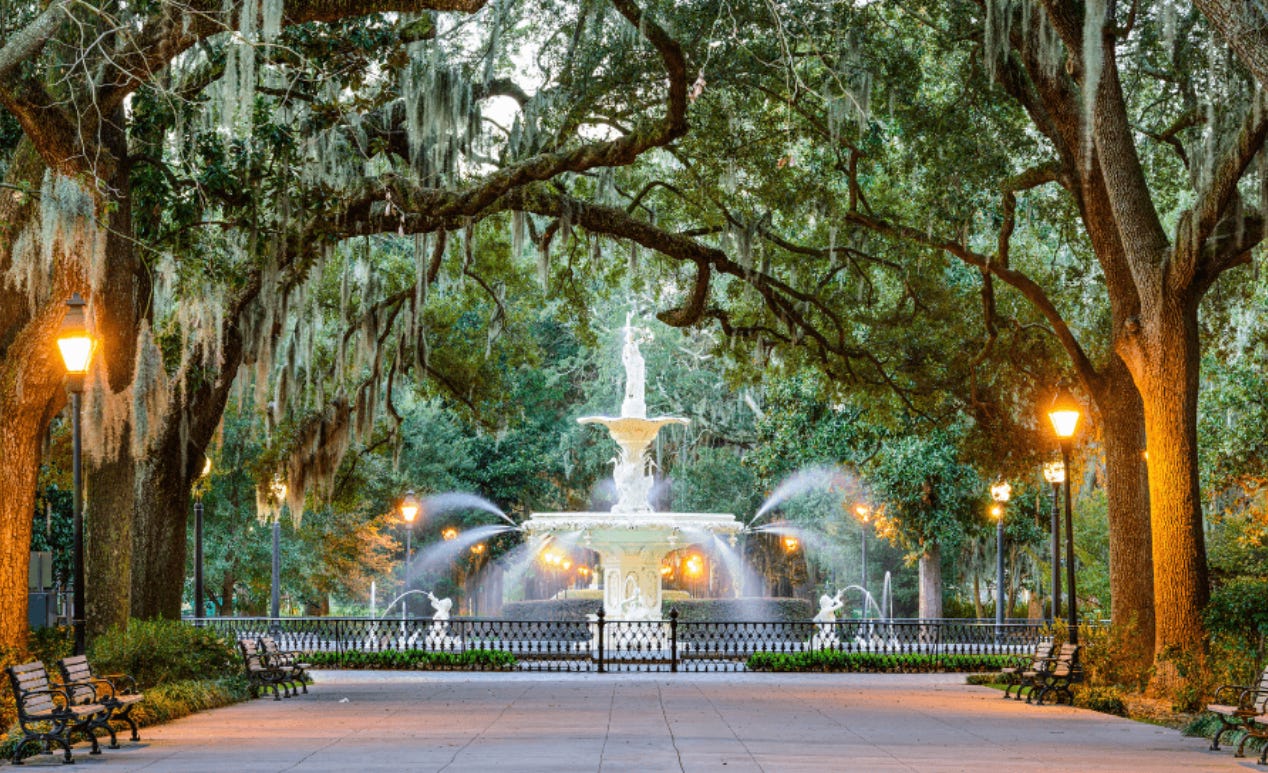
Like silk scarves on elegant ladies, Spanish moss drapes endless canopies of live oak. From a couple dozen churches, a cascade of bells serenades the scene.
This downtown is a designated “Historic District”, an enclave preserving the way America used to live. In most of the U.S., this arrangement would be illegal today.
Businesses and residences coexist. Parking is “inadequate”. Walking is easy. Streets are narrow, and driving is slow. Many are paved with brick, which preserves charm while limiting speed.
Yet everyone seems to love it. Pedestrians are smiling. Many point admirably toward architectural ornaments or commemorative monuments. Tourists must wonder why their own town can’t be more like this.
A thickening throng fills the sidewalk. Inside, the line lengthens to order lattes. My cup empty, I decided to surrender my seat, and go elsewhere to grab breakfast. But first I’d walk to work up an appetite.
Back and forth past refined row houses on either side of stylish streets, I imbibed exquisite examples of what city blocks should be. Front steps meet the sidewalk, which is separated from the street by magnolias, oaks, and bushes that shield traffic and supply shade.
Even Savannah’s wider streets feature leafy medians that preserve the human scale that defines the city.
As I made my way toward the river, I noticed ships gliding into port. This is the fourth largest container harbor in the U.S., behind Los Angeles, Long Beach, and New York. But the bulk of traffic was along the banks and on foot.
As crowds gathered along River Street, I decided to retreat inland. After a lengthy stroll around the city, I’ve returned to within a few blocks of where I started my day. I found a sidewalk table at Collins Quarter café. I placed my order, and resumed writing. But I was abruptly interrupted.
“Are you a local?”
At the table beside me, a young man with a thick book pulled me from my digital page.
“No. From Atlanta. How about you?”
“I’m from Orlando, on my way to North Carolina.”
“How far is that?”, I wondered, “About four hours from here?”
“Yep. A little over.”
“About the same for us, just from the other direction.”
“Really? I didn’t realize Georgia was that big.”
“It’s bigger”, I assured him. “You can go another hour and a half north from Atlanta and still be in the state. It’s the largest state east of the Mississippi.”
“I guess I’m about to find that out!”, he laughed. He pointed at his book. “I’m studying to be a firefighter, so thought I’d spend a week in the mountains where I won’t be distracted. Just grill some steaks, drink some wine, and prepare for my exam.”
“Sounds like a great way to do it”, I agreed as our respective breakfasts arrived. When they did, it was as if we’d entered an elevator. Conversation stopped. I continued writing and he kept reading. After eating, we shook hands. I wished him well, and went on my way.
I’m now in the shadow of the Greene Monument at Johnson Square, the oldest in the city. Greene’s remains repose beneath the obelisk at its center.
On his southern tour during his first term as president, George Washington attended services at the original Christ Church across the street, where John Wesley had been a rector.
At the nearby Gothic-revival Green-Meldrim Mansion on Madison Square, Sherman established his headquarters after reaching the sea.
Legend has it that Savannah’s beauty convinced Sherman not to burn the town. While Sherman admired the city’s aesthetics, he spared it because of its value as a deep water port, and because the Confederates surrendered without a shot.
Having finished her business obligations, my wife joined me for an evening walk. By now the city was bustling. Cafés overflowed, sidewalks filled, and booze replaced coffee in carry-out cups.
We decided to seek serenity.
The first Catholics in Savannah were refugees from the French Revolution and simultaneous uprisings in Haiti. Earlier in the day, I’d crossed Lafayette Square, entered St. John the Baptist Basilica, found a pew, and said a prayer.
The cathedral is gorgeous, under twin spires, guarded by more than a dozen gargoyles, and graced with eighty windows of stained glass. But when I returned with my wife, the church was closed, which shouldn’t be possible.
This isn’t a hardware store or barber shop. Catholic Churches… especially Basilica Cathedrals… should always be open. For centuries, through sacks, sieges, and periodic pestilence, they usually were.
Churches provide spiritual sustenance for their communities. Because they never know when someone might need heavenly nourishment, it’s best to assume they always do. Yet most have succumbed to threats of vandalism or theft, so have locked their doors between certain hours. I get it.
But today we were shooed away not because of potential hooligans, but for choir practice… as if that couldn’t have continued while we walked quietly or sat silently. Even during Mass visitors are allowed to (respectfully) wander the church. Yet choir practice is somehow sacrosanct?
No wonder churches are becoming museums. That’s the way their curators treat them, as if they’re cultural centers with “operating hours”.
Having been booted from the basilica, we decided to find a place to eat. We found it a few blocks away, not far from where my day began.
On the rooftop at The Public, beneath boughs of oak, we claimed a table for two beside the railing overlooking the street. A couple glasses of wine washed down a delightful dinner, as a cool breeze bore the sun toward its western bed.
JD


