


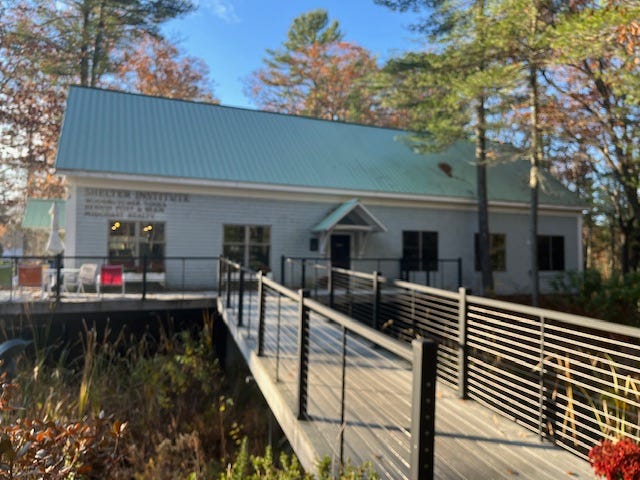
Woolwich, Maine
November 3, 2025
Stationed on the furthest fringe of the eastern frontier, Maine is America’s sentry to the sun: the first state to greet the dawn… and to bid dusk adieu at the end of the day.
This week, that works for me. Sunday’s reversion to Standard Time also helped, activating my circadian rhythm an hour earlier.
Sunlight isn’t the only gift Maine gets first. It sees winter sooner too. This morning my car was frozen. Fortunately, the glaze was thin. But it reminded me to allot extra minutes to clear the windshield.
After grabbing coffee and scraping ice, I drove north under a coat of fog… a brief commute across the Kennebec. By the time I completed the ten minute ride to Woolwich, the fog was gone. During two days in Maine, few clouds have cluttered the sky, and no rain has fallen from it.
That’s about to change.
Relative to the interior, coastal Maine is what people in these parts call “mild”. A few referred to their November weather as “warm”, then wondered why a Southerner would look at them as if he’d received a plate of poutine after ordering a side of fries.
To keep out-of-state interlopers from overwhelming their enclave, these locals asked that I not let anyone know about this balmy outpost. With cold rain coming tonight and tomorrow’s wind speeds expected to exceed its afternoon temperatures, I assured them their secret is safe.
Local Busybodies
But word is out about the Shelter Institute. For two weeks I’m one of three dozen students learning how to build a house. We first met this morning, when eighty year-old founder Pat Hennin welcomed us with warnings about rising authoritarianism.
Uh oh.
I winced… worried we’d be subjected to more unsolicited caterwauling about Donald Trump and DC politics. That’s not what I came here to hear. If anything, it’s what I came to escape.
Yet Pat wasn’t talking about our imperial incompetents. He was referring to local busybodies who won’t leave us alone.
Having run his business more than half a century, Pat lamented that property “owners” find it so much harder to do what they wish with plots they’ve bought.
He was annoyed that permits, codes, and ordinances govern every pane, lintel, and knob of whatever house someone dares to build or has the guts to gut.
OK, good. I was liking this guy more and more.
But like taxes, Daylight Savings Time, or Quantitative Easing, bureaucratic idiocies exist. We can complain about them (and should). But it’s essential to know what they are, and how they affect raising a new residence, razing an old one, or renovating a place we’d like to retain.
Tomorrow we devote an entire morning to that topic, because nothing else matters if we don’t understand it.
Design and Draft
But today began with a birds-eye view of building a nest. After discussing criteria for what a roost could be, what it must do, and potential trade-offs that might be made, Gaius Hennin described ways to pick, apportion, and position the twigs.
Gaius is Pat’s son, and is about my age. Like this author, he’s a Professional Engineer. Unlike me, he still knows what he’s talking about. He does this every day, and it shows.
Gaius kicked us off by emphasizing the essentials. In homebuilding (as in almost any endeavor), philosophy, planning, and preparation are indispensable prerequisites. These are leverage for subsequent phases of any development.
As in investing, decisions compound… and become more expensive (in time, money, and migraines) the later we realize the wrong ones were made. Gaius described the “Design Manifesto”, and six considerations when constructing a home.
He then delved into an engineer’s perspective on building a house. The next two weeks will provide hands-on applications of the principles he espoused. But this overview alone was worth the price of admission.
Remembering What We Forget
After lunch, Gaius’s sister took the stage. Blueberry (Pat and his late wife Patsy gave their kids cool names) provided a workshop on drafting.
Having started my career with Architect scales, T-squares, and triangles, I assumed this would be routine. That was before I remembered how much you can forget in thirty years.
The Shelter Institute does use Computer Aided Design (we’ll get a lesson next week), which was becoming common when I graduated Georgia Tech.
But as Pat put it, when you pick up a pencil you become part of the project in a way pounding keys could never connect you. That’s why the Shelter Institute teaches us like this. It’s almost as if they’ve done it before.
As my wife and mother will attest, I like drawing. I used to make maps as a kid, and designed bridges and buildings as an adult. So for me, this was fun.
But it wasn’t as easy as I’d assumed it would be. I have and use straight edges and scales at home, tho’ there are intricacies I’d forgotten. Blueberry reminded me of many of them while we students compared our evolving prints.
By the end of the afternoon, we’d prepared plans and elevations of a sample house. We were told to keep them, so I assume they’ll be the basis of projects later in the course. Recognizing we were (or she was) bleary-eyed, Blueberry released us.
Dusk descended as our day ended. I returned to Bath for a nice dinner at its eponymous Brewing Company. After a hearty helping of steak tips, I headed “home” to pen this epistle.
Flight from France
When I got here, I recalled the day and how it started. Pat Hennin relayed a story about a French prisoner during the Second World War. Part of his duties were to press the uniforms of German officers.
After months performing this task, the inmate had an idea. Having an aptitude for language, he’d become fluent in German (unlike the undercover soldier in Inglourious Basterds, he apparently never raised the wrong three fingers).
One day after pressing a uniform, he put it on. More audacious than Andy Dufresne in the warden’s shoes, he walked out of the prison. Seeing a car, he ordered the driver to take him away.
They drove to an air strip. The camouflaged captive taught a Nazi attendant how to turn a propeller. The furtive fugitive then boarded the plane, and flew out of France.
And that’s how Pat Hennin’s father came to America.
JD
And some history thrown in for free!
I'm interested to see what the next couple weeks will look like! Also, the stories/history in there is great.