


Atlanta, GA
April 9, 2026
“We appreciate beautiful things not for their utility only, but also for what they are in themselves; or more plausibly, for how they appear in themselves.”
- Roger Scruton
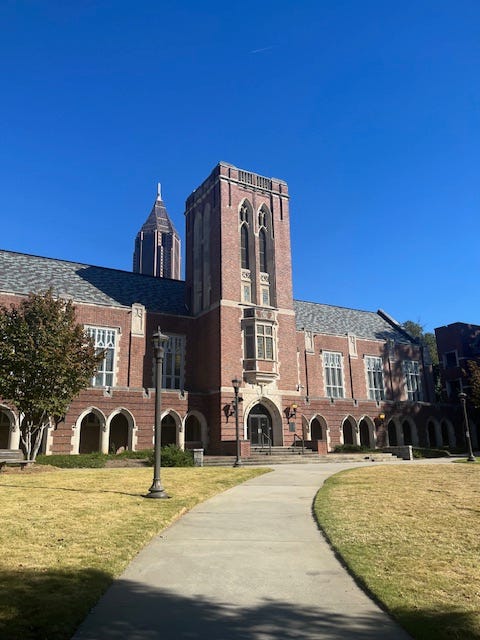
Brittain Hall is what a college building should be. Its neo-Medieval tower, Gothic cloister, and dormitory wings anchor East Campus at Georgia Tech.
Set back from the street, it’s approached across a classic lawn and a traditional quad. Doric pillars adorn the forecourt. On each, a corbel bust depicts a scientist or artist representing the subjects taught at Tech when Brittain Hall was built.
Several Tech departments collaborated on the construction. The School of Ceramics manufactured tiles that formed the tower floors, the Textile College made the tapestries gracing the President’s Dining Room, and Mechanical Engineering provided wrought iron fixtures in the main hall.
The Architecture department, led by Harold Bush-Brown, designed the building. One of its students created the stained glass for the south window, and carved the sculptures extolling Tech’s advocacy of science.
Bush-Brown was a bridge, from the architectural equivalent of charming Parisian side streets to that of an expressway wiping out an urban waterfront.
Apogee of Architecture
Classical education considered architecture an art. Beauty was not only the objective; it was objective… using symmetry, harmony, proportion, and balance to convey internal essence thru external forms.
Two prominent Atlanta firms were largely responsible for Georgia Tech’s earliest edifices. Bruce and Morgan was known for distinctive towered county courthouses around the region, which likely inspired Tech Tower. Within a few years they produced renditions at Samford Hall at Auburn, Tillman Hall at Clemson, and the Bell Tower at Agnes Scott.
Beside Tech Tower sits the stately Carnegie Building of 1906, designed by Morgan and Dillon to house the school library. Among the more elegant edifices on campus, this Beaux-Arts building was among many monuments to Andrew Carnegie’s desire to fund eponymous libraries.
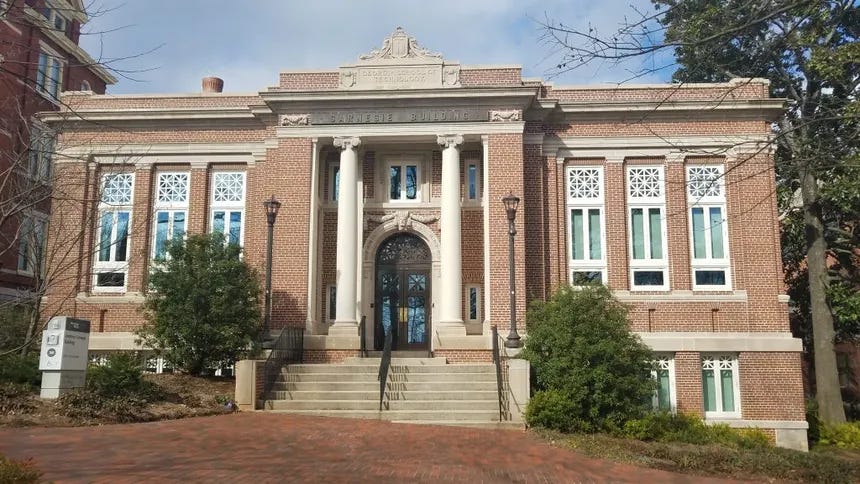
Featuring dignified ornament, noble inscriptions, and classical accents, Bush-Brown’s Guggenheim Aeronautics Building epitomizes the historicist style and Jacobean aesthetic of the original campus.
Elegance and refinement predominated at Tech and around Atlanta between the wars. They were mostly inspired by one man.
Francis Smith, who at 23 was younger than many students today, oversaw the nascent years of Tech’s School of Architecture. In retrospect, his tenure inspired the apogee of architecture at Georgia Tech… and coincided with its final flowering around the West.
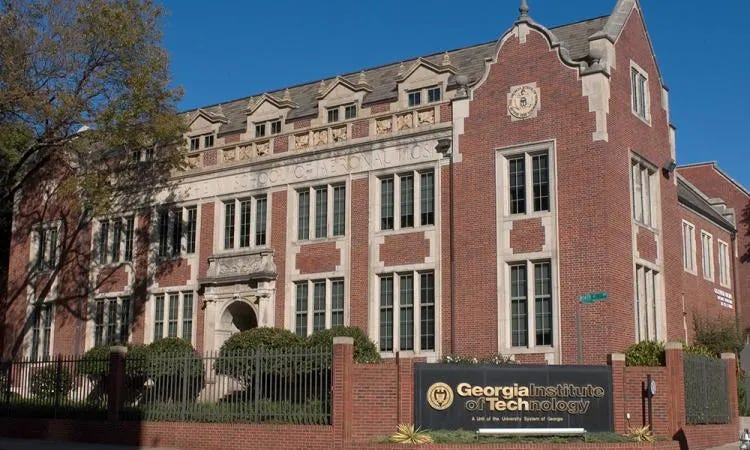
Smith arrived in Atlanta six years before the guns of August. As it did to much of civilization, the First World War shattered conceptions of beauty, and whether it was worth pursuing. Smith insisted it was. With him, Georgia Tech welcomed the Beaux-Arts curriculum from the University of Pennsylvania where he studied.
Smith fathered the Southern School of Classicism. Professional paternity included student Philip Shutze, who designed (among countless gems across north Georgia) the Swan House and the Temple in Atlanta, the Atlanta Academy of Medicine, the East Lake Golf Clubhouse, and Hirsch Hall at the University of Georgia.
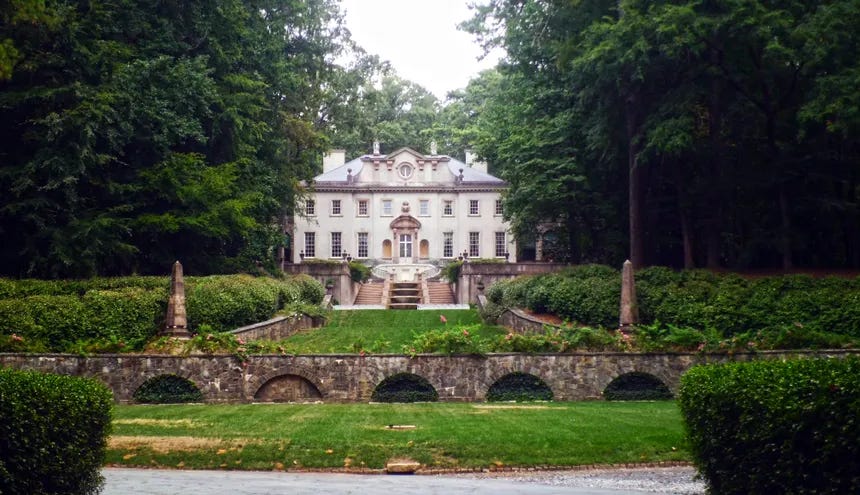
Shutze, whom Henry Hope Reed called “America’s greatest living classical architect”, essentially rebuilt Atlanta during the 1910s and 1920s. Setting a precedent that persisted several decades, Smith and his faculty designed many structures at Georgia Tech.
His legacy includes the original campus architectural plan in the classic style of the Beaux-Arts era. Among his heirlooms was his initial conception… the Whitehead Infirmary erected in 1911.
Smith’s Students produced elaborate renderings worthy of the Grand Prix competition at the École des Beaux-Arts in Paris. Dr. Elizabeth Dowling… who was one of my professors when I studied architecture at Tech… compiled many of these drawings in One Hundred Years of Architectural Education: 1908-2009, co-published with Lisa Thompson.
Architectural Revolutionaries
Bush-Brown retained the tradition… until the Second World War, after which Modern architecture mauled the West. This was when the “International Style” emigrated from Europe. Carrying its baggage were Walter Gropius, Mies van der Rohe, and other cultural Jacobins who despised the bourgeois (whatever that was).
At Georgia Tech, Paul Heffernan led the revolution. A Tech graduate who returned after earning a Masters under Gropius at Harvard, Heffernan presided over the Modernist conquest of Tech’s style. After being trained in (and awarded for) Beaux Arts design, Heffernan began littering the campus with Bauhaus eyesores.
Established at Weimar the year the Treaty of Versailles was signed, the Bauhaus School arose from the rubble of the First World War… among the first artistic compounds of the Avant-Garde. Seeing the shambles the war made of Germany, its young architects were essentially ordered to start from scratch.
Millions were dead, the Kaiser had fled, the Czar was toppled, and the Hapsburgs were deposed. Revolution was in the wind. In the midst of upheaval, bourgeois was out… which stripped rebuilding of antebellum beauty.
And why not? To these architectural revolutionaries, the bourgeoisie caused the catastrophe. The last thing the young socialists wanted was to replicate the culture that caused the war.
“The intellectual bourgeois”, Walter Gropius proclaimed, “was unfit to be the bearer of German culture”. He’d tailor a new architecture to clothe the proletariat.
Gropius founded Bauhaus, which infiltrated Tech when the Institute hired several professors who’d been his students. Its International “Style” (if that’s the right word) relied on rigid lines, austere aesthetic, bland color, and extreme emphasis on function over form. What Roger Scruton called “the cult of utility” was taking over.
Gables, pitches, cornices, and eaves were out - discarded as emblems of “crowns” and nobility that had been swept away. Structural elements remained exposed, unblemished by decorative ornament, appealing facades, or attractive features that exalted the spirit.
Like God, the spirit was dead. Bauhaus buried it. Its acolytes emphasized a grinding “equality”, often expressed in harsh angles, sheer facades, and flat tops (hardly “functional” under heavy precipitation). Gropius detested high ceilings and wide halls, which he considered wasteful grandiosity modernity must (literally) suppress.
“Columns” connoted classicism, so were redesigned and rebranded as “pilotis”, or “piles”, which sounds more workmanlike. Grand entrances were non-existent. Instead, nondescript openings offered almost surreptitious access… as if to sneak entrants into a dystopian speakeasy.
Extolling the efficacy of modern materials, exterior walls went unclothed, boasting the naked prowess of concrete, glass, and steel. To the modernist, “beauty” and “truth” lay in unconcealed architecture… industrial assaults on the visual sense. Fittingly, the actual Bauhaus compound resembled a prison.
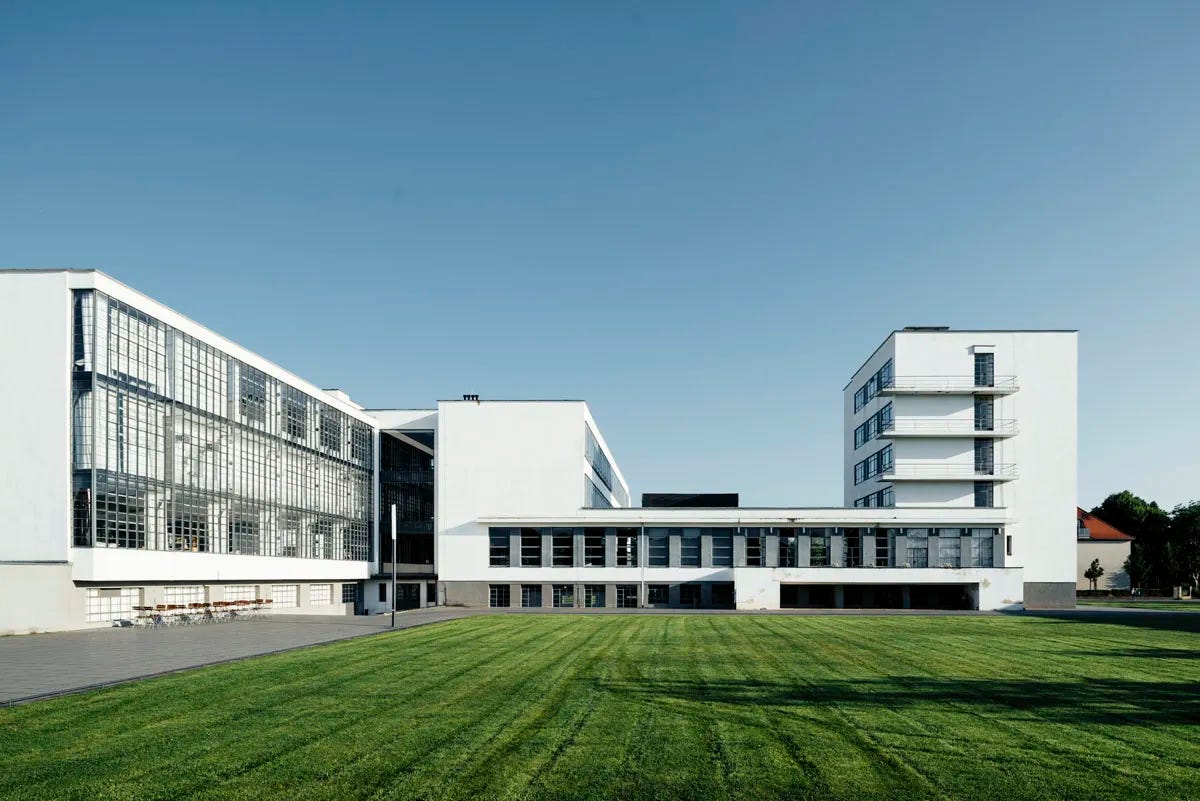
Ostensibly constructed for the proletariat, Bauhaus buildings seem deliberately designed to repel people. Even its skyscrapers are squat boxes of sheer walls and stale palettes. Yet we’re all supposed to pretend these sensual affronts aren’t hideous.
Modern architects subjugate form to function. Historically, as in soaring cathedrals, cloistered convents, airy universities, or stately banks, form connoted function. But it wasn’t buried by it. Building design reflected the activity inside, so that passers-by knew what it was… and were enticed by beauty to want to go in.
Particularly in the post-war era, everything changed. Beauty wasn’t “useful”, so it became irrelevant, and had to go. Even (or especially) the upper crust went along. Corporate chieftains, political potentates, and society’s dignitaries accepted whatever glass box, corrugated concrete, ribbon-windowed outrages celebrity “starchitects” told them to inhabit.
Frying Pan to Fire
When Heffernan became architectural chef at Georgia Tech, one of his first recipes was an awful kitchen. The Architecture Building is a Bauhaus abomination. As one who had to study in that place, I wondered if maybe it were built to show students what “style” to avoid.
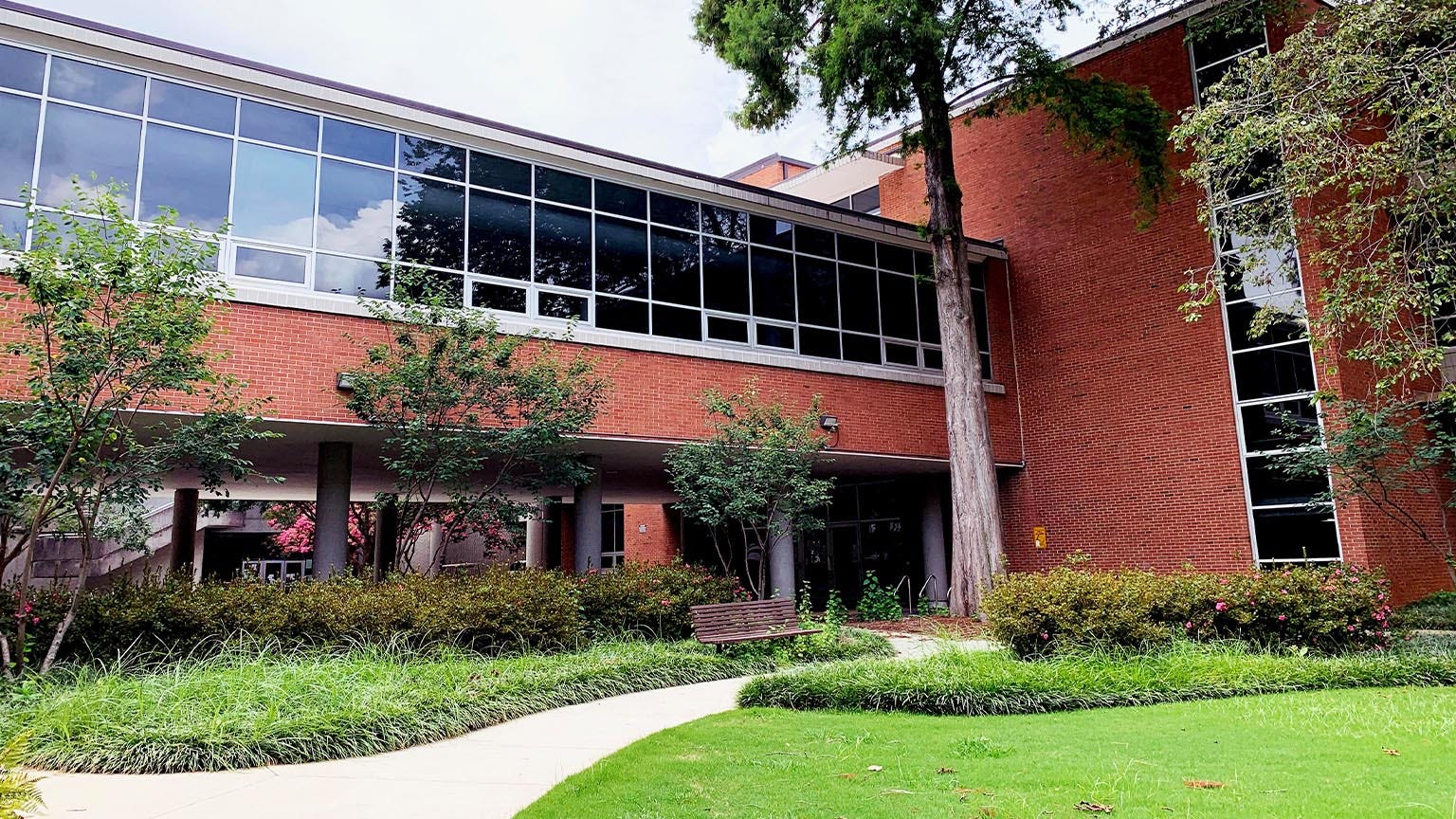
Heffernan would add other soul-crushing atrocities, including the Hinman Building, Rich Computer Center, Gilbert Library, and Textile Building (mercifully razed a couple decades ago) that anchored his “Academic Village”.
Across from the library, the Skiles Classroom is a modernist hate crime committed by Thomas Bradbury. Bradbury designed many awful edifices around Atlanta, mostly bureaucratic buildings surrounding the State Capitol. But considering the source, his Greek Revival Governor’s Mansion is somewhat respectable.
From the Bauhaus frying pan, Tech fell into the Brutalist fire. Monstrous bunkers like the Chemistry compound and mammoth Physics building were windowless penitentiaries for overstressed students.
This was an age when design was wayward around the West. Not only was Atlanta not immune; one of Tech’s “illustrious” alums did considerable damage to the center of the city.
John Portman’s hulking hotels with enclosed gallerias and towering atriums are people-repellent blights that turn their backs on central cities their existence helped exterminate.
His Peachtree Center in Atlanta and its Embarcadero twin in San Francisco, the Renaissance Center in Detroit and the Bonaventure in Los Angeles, are black holes that suck pedestrians off the sidewalks.
To ensure they stay inside, Portman incorporated Le Corbusier’s “streets in the sky” as hamster chutes connecting his insular enclaves. Often filling entire city blocks, his mammoth buildings feature extended stretches of stark street-side walls.
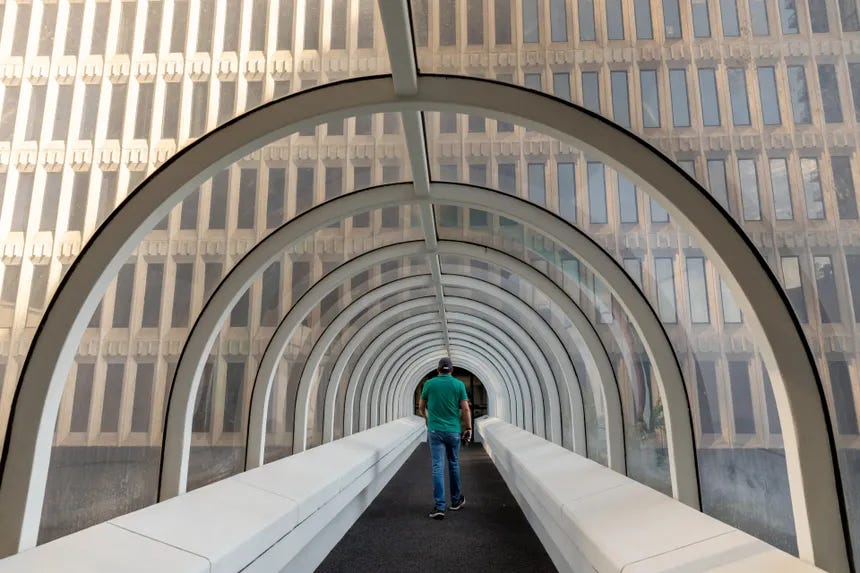
Portman’s interiors are disorienting and isolating, often featuring circumferential balconies soaring hundreds of feet toward receding ceilings. Glass elevators connect concrete floors, which hover over lobbies laden with retail and restaurants that keep inhabitants from engaging with the city fabric these structures do so much to destroy.
Fortifying the Frontiers
Yet there are signs of revival at Georgia Tech and around Atlanta. An expansive green replaced the demolished Textile building. East of campus, Tech has watered Midtown and facilitated its flowering. Its colleges fertilized businesses, residences, and hotels in an area that was a den of derelicts when I was a student.
Like ancient Rome fortifying its frontiers, Tech has spent recent decades securing these surroundings. Carrying Fifth Street from the main campus, a landscaped bridge is an esplanade to an urban village Georgia Tech has built (and continues to construct).
At the far end, Philip Schutze’s Neo-Georgian Biltmore Hotel… now owned by the Georgia Tech Foundation and renovated since I was in school… is a nod to history and a worthy object to which neighboring buildings can aspire.
Unfortunately, they don’t. Most Midtown edifices replicate the boxy hives of glass, concrete, and steel that make cities sterile and indistinguishable… rectangular silos of corporate offices, academic dens, or luxury apartments stacked thirty stories into the sky.
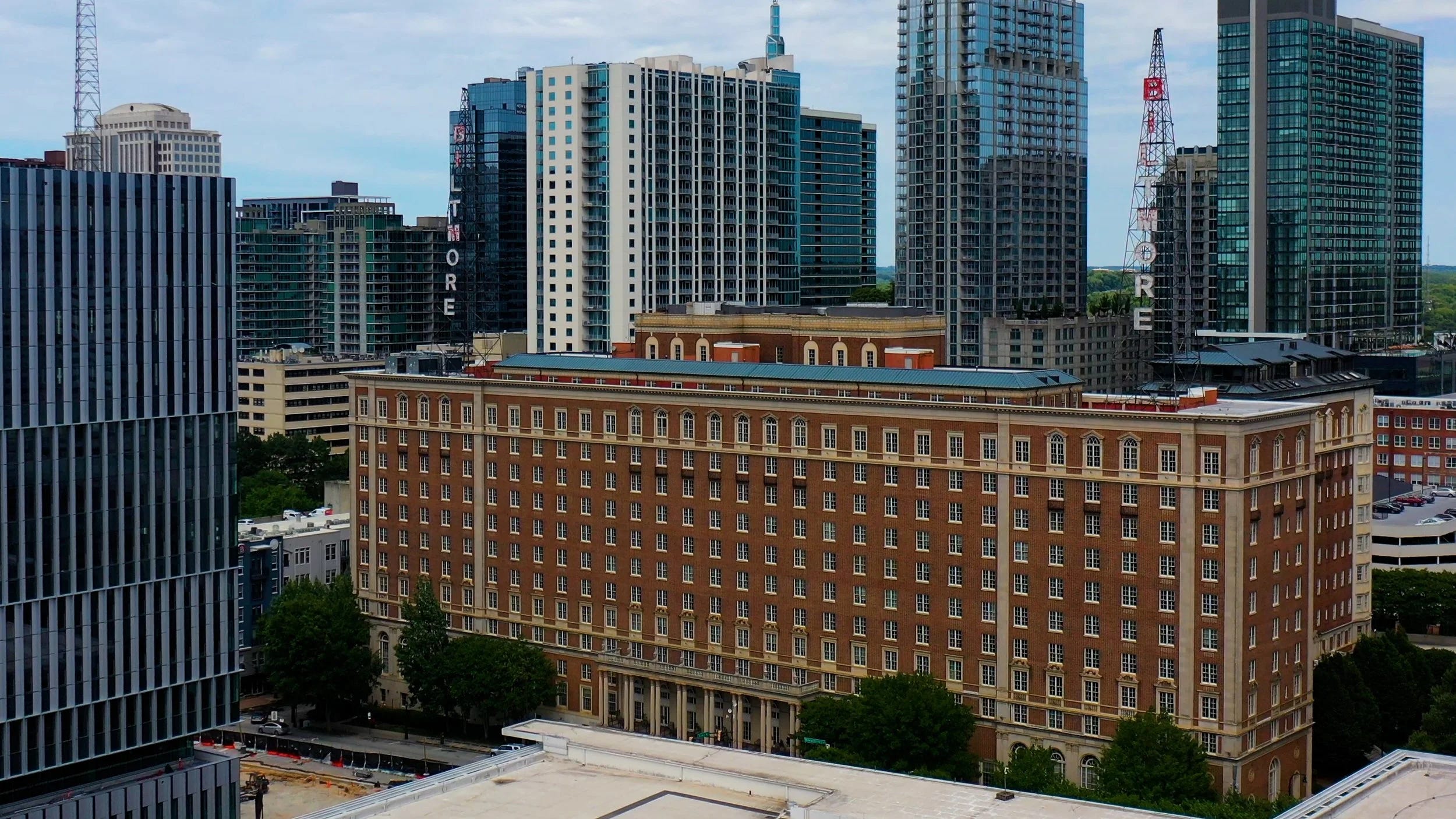
But unlike many enclaves that tarnish downtowns, these structures redeem themselves by facilitating exchange with the street. For one thing, people live in them. Shops and cafés adorn ground level, facilitating foot traffic to and from surrounding sidewalks.
Midtown Atlanta is bustling, which is a debt it owes Georgia Tech. At a time when the wider culture seems to be seeking dead-ends, Tech’s architecture may have turned a corner. I hope that’s a harbinger.
Ears and Eyes
Humans are instinctively attracted to harmony, symmetry, ornament, and order. Modern architecture upends (and insults) all of that. It detests beauty, and abhors true art. Its practitioners strive to be esoteric, to baffle the bourgeoisie (a word they loved to wield), and to reject the notion that a light touch can do heavy lifting.
Most design since the Second World War wasn’t demanded or desired; it was inflicted and imposed. The whole point was to flaunt “novelty”, perplex the proles, and revolutionize the public realm. Architects (like most modern artists) aimed less to uplift and inspire than to shock, disorient, or disturb.
One needn’t be an “expert” to recognize obvious beauty. Mozart symphonies, Michelangelo sculptures, and Shakespearean sonnets don’t need pretentious symposiums or academic tracts to convince us of their value.
Only ugliness requires dissertations and lectures. Beauty simply seduces ears and eyes, and captures hearts that long to feel.
JD
You eloquently expressed my sentiments when you stated, "Only ugliness requires dissertations and lectures. Beauty simply seduces ears and eyes, and captures hearts that long to feel."
Many thanks for letting us participate in your architectural stroll ... 👍👍👍
Times changed, so did objectives, styles, expectations, etc. and all were sacrificed to the god of efficiency, profit and speed ...
Fortunately there still are the likes of Calatrava or Zaha Hadid ...