


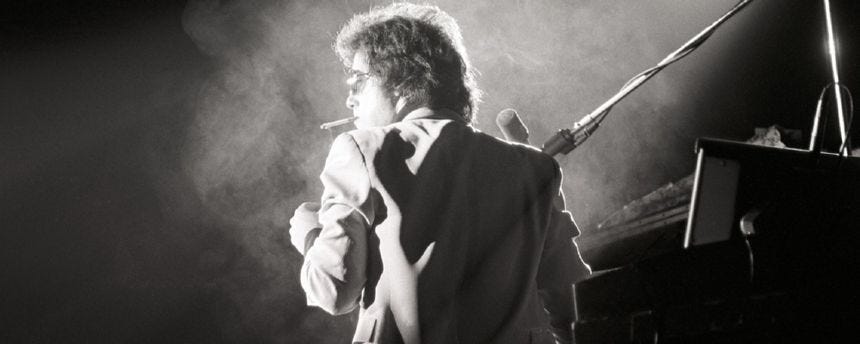
Atlanta, GA
May 21, 2026
“We are forced to recognize our inhumanity / Our reason co-exists with our insanity / And though we choose between reality and madness, it’s either sadness or euphoria.”
- Billy Joel: Summer, Highland Falls
I caught some flak for a recent essay indicting the smartphone as a scourge. But that diagnosis isn’t what raised the ire of several readers.
My offense was calling “We Didn’t Start the Fire” a “bad Billy Joel song.” Upon reflection, I agree that insult was overstated (or, rather, mis-stated) and out of line.
I actually don’t dislike that fast-paced, historical romp through the third quarter of the 20th century. As an avid consumer of history, I’m always snared by the hook beneath such bait.
“We Didn’t Start the Fire” isn’t a bad song. But everything is relative, and I’ve always preferred Joel’s earlier work. Apparently, Joel did too… describing the rapid-fire single as a “terrible piece of music” that resembled a “dentist’s drill”.
As my family will attest, I’m a big Billy Joel fan. For decades, my wife and sons have endured evenings when his music played for what must’ve seemed like endless hours. Because it did.
But most of what I inflicted on them was recorded at least a decade before “We Didn’t Start the Fire” was released.
Dilapidated Scene
I arrived naturally at my tendency to deepen grooves on Billy Joel records. My mother often played his music, so I grew up listening to all the early albums. Even as a kid, the rhythm and writing captivated me. I’d often listen while seated on the floor, reading the lyrics from the liner notes.
To my young ears, the music was mature. To my middle-aged mind, it still is. I was later surprised to learn how young Joel was when he wrote albums of such intricacy and nuance. He was 28 when he released The Stranger, still one of the best records ever produced.
But all his output from that time was terrific. Much of it depicted or reflected the bleakness of New York during the years when the city felt like it was told to “Drop Dead!”.
The covers of the Turnstiles and 52nd Street albums evoke the aura of the era. “Movin’ Out” opens The Stranger by expressing aspirations of the downtrodden to escape the endemic dilapidation. The apocalyptic “Miami 2017” ends Turnstiles by recalling when the Big Apple was blown up.
Piano Prowess
Even to a ten year-old, the phenomenal “Scenes from an Italian Restaurant” (Joel’s best song), the melancholic “Piano Man”, and the nostalgic “New York State of Mind” told absorbing stories with vivid pictures. They only got better as I got older.
“Root Beer Rag” is a rollicking testament to Joel’s piano prowess (do yourself a favor and click this link), while few songs capture the cynicism, decadence, and lavish ambivalence of the mid-Seventies better than “I’ve Loved These Days”.
After saying “Goodbye to Hollywood”, Joel returns to “Summer, Highland Falls”… a seductive roller-coaster of contradictory lyrics and undulating arpeggios that reflect the bipolarity and artistic schizophrenia Joel suffered during this period. A few years later, “My Life” seemed to suggest the singer was pulling things together, and offered a moral too many of us have missed.
But of all Joel’s songs, “Vienna” remains my sentimental favorite. The music is poignant and the message timeless. It’s also personal. After the untimely death of one of her closest friends, my mother used the lyrics to impart a lesson that’s remained with her elder son. (I wrote about that here).
Just because I’m partial to Joel’s mid-Seventies work doesn’t mean he didn’t make great records after 52nd Street. Early ‘80s output like Glass Houses and The Nylon Curtain were more inconsistent, but feature several standout songs.
“Allentown” is a potent reflection on a bright past for one generation, a blighted present for the next, and widespread disillusion that’s probably more applicable now than when it was written.
At Their Peak
Some of my fondness for early Billy Joel is nostalgic. But I think it’s warranted. The Seventies were rife with economic, political, and cultural turmoil, much of which is being revived today.
But the music and movies of that decade were generally intelligent and well-crafted, and usually respected the audience enough to expect its attention.
During the five years between Piano Man and The Stranger, films like the first two Godfathers, Chinatown, One Flew Over the Cuckoos Nest, The Outlaw Josey Wales, Network, Jaws, The Sting, Three Days of the Condor, and The Day of the Jackal were released.
The Beatles were gone, but the Stones were still rolling. Bands and songwriters like The Eagles, Fleetwood Mac, Gordon Lightfoot, Led Zeppelin, Stevie Wonder, Rod Stewart, Bruce Springsteen, and Elton John simultaneously graced the airwaves while at their peak.
So did Billy Joel.
JD
A fan Your are for sure.
All artist go through many stages in their work, I have also, swings of creative endeavor. Nothing stays the same!...