



Atlanta, GA
August 24, 2026
It took two centuries for the US government to dig a trillion dollar hole. As the ditch approached that depth, Ronald Reagan gave an Oval Office address. The president proclaimed that “If we as a nation needed a warning, let [this] be it.”
He then climbed in the excavator and ignored the alert. He wouldn’t be the last.
But at least Reagan recognized the problem, and knew it was big enough that he should talk to us about it. To the extent our current “leaders” bring it up, they do so with a smirk and a shrug. If the debt matters at all, it’s someone else’s mess.
By “someone else”, they mean us.
Stubborn Wrinkles
Today, a trillion dollars seems quaint. The pit Reagan saw couldn’t contain the interest on our current canyon. In his address he warned that, unless action were taken, the debt could reach that level: what Reagan called “literally beyond our comprehension”.
Last week the U.S. government eclipsed forty times that incomprehensible amount. Eighty-five percent of the total was compiled this century. Three quarters came since GW Bush left office, with almost a third amassed under Donald Trump.
Before long, it’ll amount to what Everett Dirksen called 'real money'. Since at least 1971… really since 1913… that's what we haven't had. It’s not happenstance that debt exploded when golden guardrails were removed from the U.S. dollar.
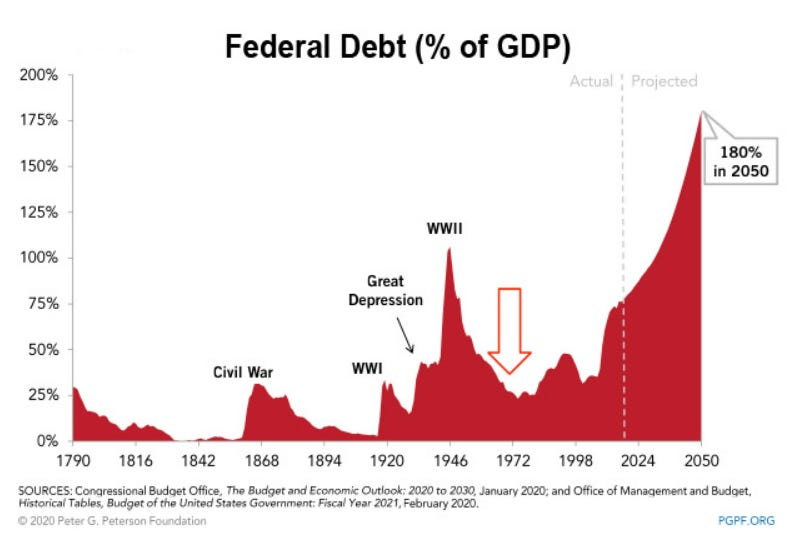
The chart above reflects debt held by the public (now about $32T), excluding intragovernmental debt for Social Security and Medicare. It’s from the CBO and OMB via the Peterson Foundation, which projected debt held by the public to match GDP in 2026.
That happened earlier this year. Gross debt (now $40T) exceeded GDP early last decade, and now races more than a quarter ahead of domestic output. By 2050, previous spikes on this chart will look like stubborn wrinkles on an ironed shirt.
But so what? For decades we’ve been told deficits don’t matter. Superficially, this seems to be correct, confounding doomers who keep predicting collapse. Killjoys have been screaming about “the debt” for fifty years, but everything’s basically been fine.
Or has it?
Steady Erosion
Were the curmudgeons really wrong? Comparing America today with what it was in 1971 (when Nixon took the golden governors off the dollar), it’s hard to deny something’s gone awry.
In many ways collapse has occurred, but it was more a steady erosion than a sudden avalanche. But however it happened, rubble is abundant. For more than fifty years, the future has been stripped to gild the present.
That’s what debt does. That’s what debt is. For the government to spend anything, it must extract resources someone else produced. When it incurs debt, it takes resources someone will produce.
Stocks, bonds, real estate, medical costs, and school tuition all soared since the debt took off. On the ground, real wages lagged as wealth was diverted to support the State.
This delayed and diminished formation of families, while reducing their size. It forced more mothers to work… or for women to forgo having children at all… which hinders future ability to service government liabilities. Young people are saddled with enormous debt they didn’t accrue, and are scolded for being lazy bums.
As with any generation, most older Americans worked hard, earned their keep, and deserve respect. But many also live on assets and property that have been bubbled-up by fake money and phony interest rates. They also receive Social Security (the largest line-item in the budget) and medical benefits (now the third largest, after interest) that come from paychecks of current workers.
I know, I know. Beneficiaries insist they “paid in” to Social Security and Medicare throughout their career. And they did. So did I.
But our money was spent long ago. It’s gone, and it isn’t coming back. The government ripped us off, using our “contributions” to pay current expenses. There’s no “lockbox” where each person’s cash is stored. Social Security isn’t “insurance”. It’s a glorified piece of a general slush fund.
What government did was criminal, and the victims are right to be angry. But they needn’t take it out on today’s workers, whose own pay is being pilfered to support their parents. If a mugger takes our wallet, do we demand he attack our kids to pay us back?
The Precipitating Ailment
Fiat currency and fake interest rates have enabled relentlessly rising costs, reckless spending, resource malinvestment, “quantitative easing”… and a $40T debt. These scourges don’t simultaneously infect an entire economy under sound money, which encourages saving, enables investment, balances trade, limits profligacy, and allows markets to send reliable signals that allocate resources thru a lattice of prices that tend to fall.
Inflation doesn’t merely depress purchasing power. It shortens time horizons and encourages selfishness, which tamps thrift, thwarts family formation, and degrades the culture.
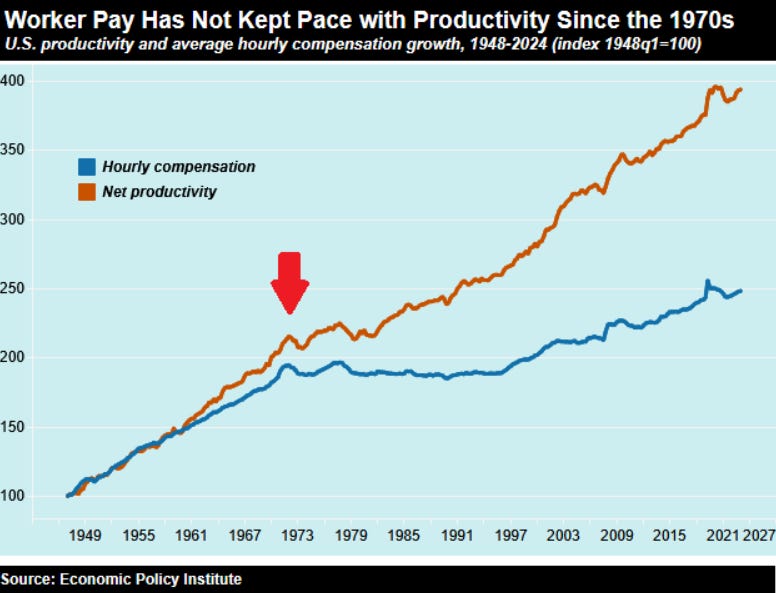
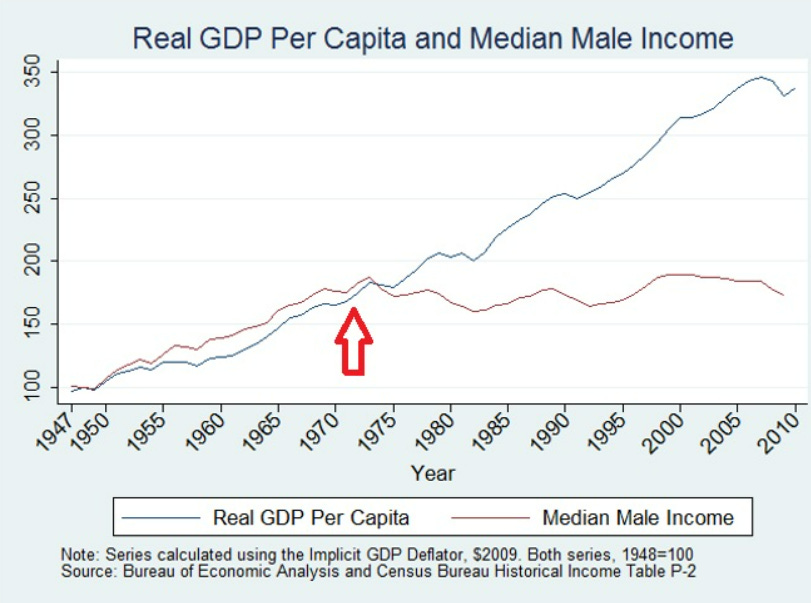
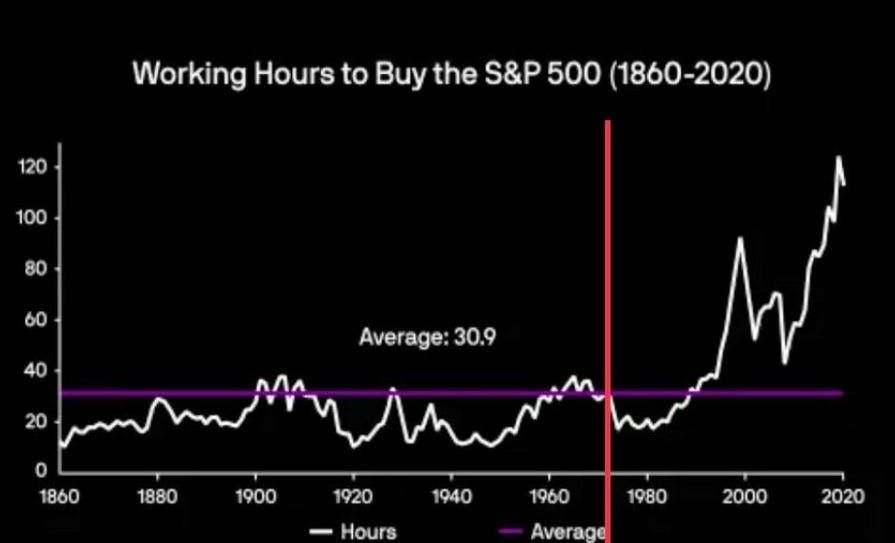
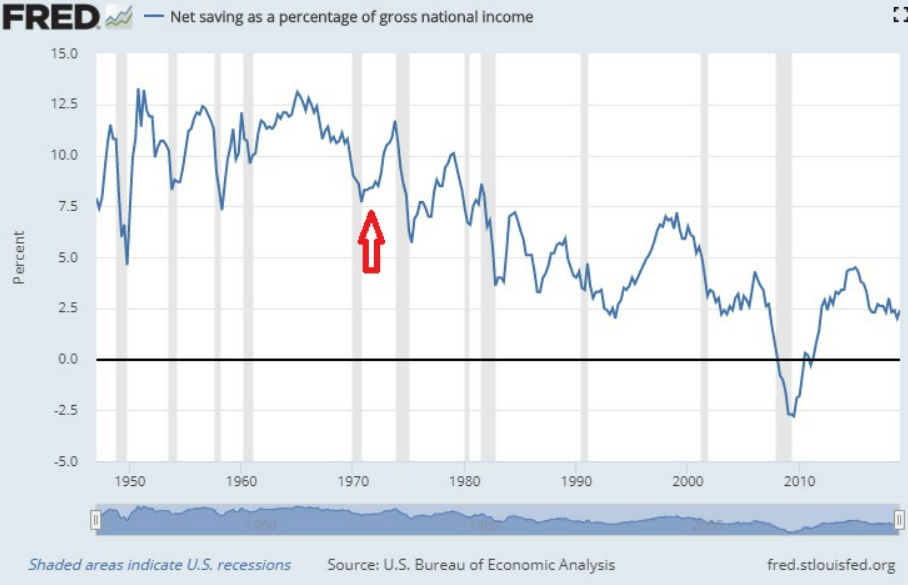
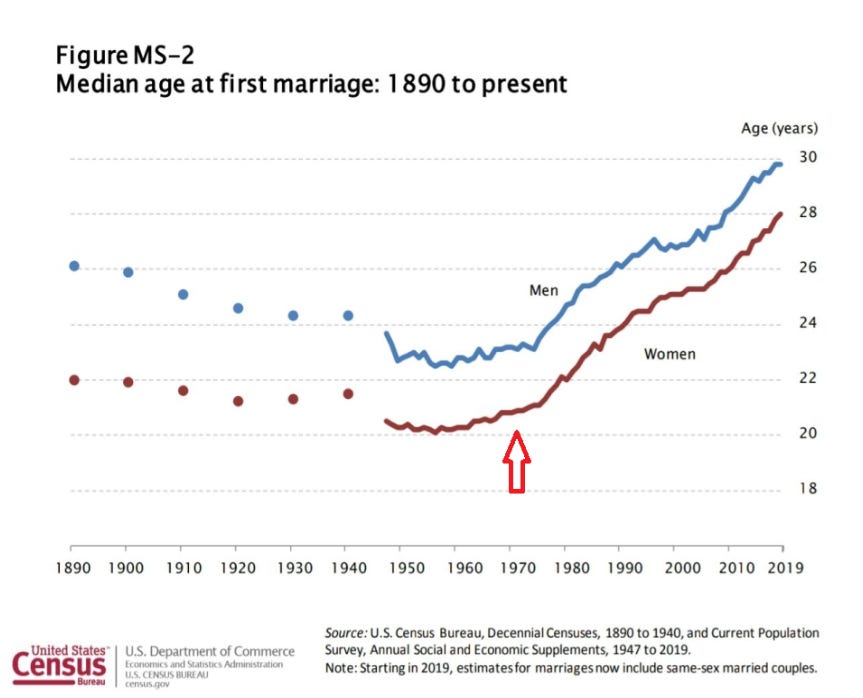
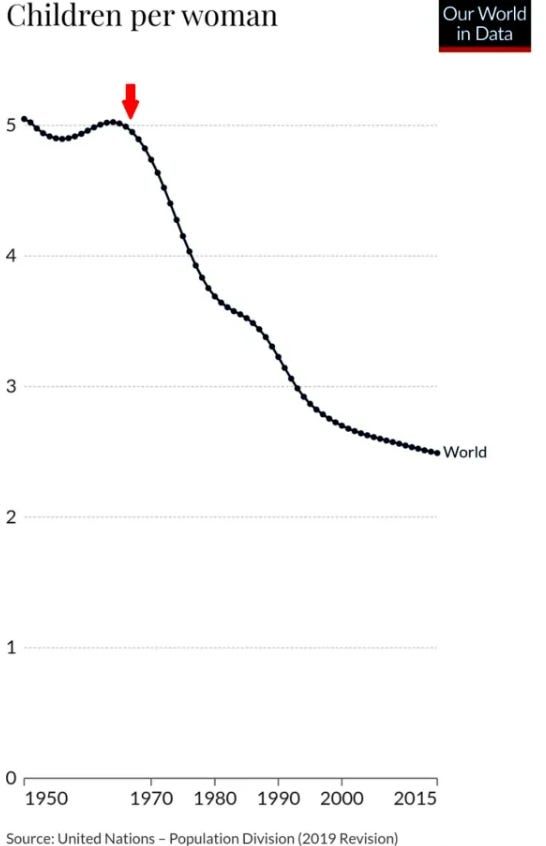
Since 1971 savings have tanked. Worker pay lags productivity. Male income has languished. Working hours needed to buy a house, a car, tuition, and stocks has soared. Uncoincidentally, so has the average age at which Americans marry. Because of this, the typical woman has fewer kids.
Sixty years ago, Detroit, Baltimore, Cleveland, and St Louis were among the wealthiest cities in the United States. Each has since been hollowed out, former powerhouses now filled with abandoned buildings, vacant lots, and violent slums.
Cities aren’t alone. Much of rural America is as bad off if not worse. Across the country, Americans have gotten fatter, dumber, poorer, and more addicted since fiat-fueled debt facilitated more government meddling in education, housing, health, and endless foreign misadventures… which helped dig a $40T hole.
Fake money wasn’t the only impetus for this ubiquitous mess. But like cancer enabling pneumonia, it was the precipitating ailment most other maladies accompanied.
A Slick Attorney
Debt minimizers usually dismiss the burden by comparing it to GDP. But GDP is inherently flawed. Like a slick attorney, it misstates its case in ways that flatter its client.
The notion of combining trillions of individual exchanges into a single figure reflecting “economic activity” is preposterous. Much of that activity depends on the borrowing GDP is employed to dismiss.
Because government infiltrates so much of the US economy, comparing debt to GDP is like comparing debt to itself. Since the 1970s, the US economy has become almost as dependent on credit as wine is on grapes. To the extent borrowing is inhibited, economic activity slows.
About 17% of GDP comprises “government spending” which, if anything, should be deducted from output. Government creates nothing without taxing, borrowing, or inflating money from the private sector.
At best it redistributes the loot; at worst it destroys it. Often it does both. Anything it produces must be at the expense of something private actors would otherwise have done.
Opportunity costs exist in the private sphere too. But in that arena, we can assess what they are. Unlike in government, free markets have a dynamic price mechanism that allocates resources to their most productive use.
Relative profitability affirms that whatever activity is forgone isn’t as valuable as what actually occurred. And if it is, economic loss quickly identifies the error, and shifts resources to their more desired application.
As Mises informed us a century ago, government lacks this calculation function. Without market prices, it’s guided only by political pressure, bureaucratic guesswork, or arbitrary decree.
Removing government spending from GDP (never mind subtracting it) reveals gross federal debt being even more precarious than headline numbers suggest, rising from 126% of GDP to over 150%. Debt held by the public leaps from about 100% of GDP to 120%, leaving aside the innumerable ways government influence disfigures the personal consumption, business investment, and net exports components of GDP.
But government isn’t the only way GDP is warped. The entire concept is convoluted. As more money is spent, GDP goes up. That’s all the number tells us.
Like two neighbors paying each other to paint each other’s house, it makes the economy look larger even if no one’s life is improved or nothing new is produced. Under our fiat monetary system, GDP relies on debt to keep going up.
Because debt is what our fiat monetary system is.
Inevitable Eruption
The Treasury Secretary exclaimed that “Our message to our allies and our trading partners is that global growth is the way to take care of this mountain of debt.”
But this isn’t a mere “mountain”. It’s a volcano.
We can’t control what the government does. Whether it “takes care of” the debt by swamping it with growth as Bessent suggests (entailing an infeasible retrenchment in cronyism, military meddling, and domestic entitlements), by outright repudiating the debt (almost unfathomable given that Treasuries underpin repo market, mutual funds, margin, pensions, and most of the global financial racket) or continuing the inflationary rip-off of the last fifty years (the likely option), our best bet is to keep clear of the slopes.
Debt doesn’t go away. It’s only a matter of who pays. Those responsible for compiling it are doing all they can to ensure it isn’t them.
JD
Excellent explanation. Alas, despite three obvious solutions, I foresee just one that could help reduce but never eliminate our massive deficit, the largest in world history.
The problem was baked in at the get-go; that is, our Constitution does not require a balanced budget.
This failing has created a democracy whereby we elect individuals not because they will be good stewards of the public purse.
Instead, we elect them for their ability to give to us what they can take from it. Consequently, I often wonder how it will all end.
Perhaps as goes Japan, whose budget deficit is twice ours, will show the way.
Already, serious social tremors are being felt. More and more citizens, exasperated with the Silicon Valley spawned wealth divide, are clamoring for redress.
Their solution -- take what others have -- is as timeless as is the reality that there have always been among us some who have more than others.
What acutely disappoints me are our two major political parties. They both fail to make clear that there are only three practical solutions to turn around our Ship of State
They are spend less and/or tax more and/or produce more
Despite Social Security and Medicare impending benefit reductions, the first two options are DOA which leaves "produce more;" i. e., more productivity produces more "things" to tax.
But producing more wealth requires imagination, risk, capital and work.
Instead, what we have are Democratic Socialists who can only peddle failed promises and a Republican president who squanders our money on self-aggrandizing projects and a needless war.
Our future, as of now, looks bleak.
To put blame on the ordinary citizen is not a fair approach in My world . Would our politicians listen to us . Never. They have had their own agenda. So , yes today's worker pays for what the "government" has done to us the ordinary citizen. Fair ? No . Until the ship finishes colliding with the debt ice berg nothing will change.