


Atlanta, GA
October 28, 2026
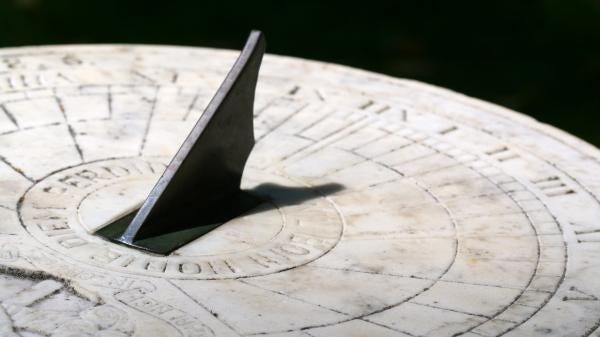
We didn’t used to need governments to tell us the time. For millennia the sun did it for us, enabling our ancestors to get thru the day.
Medieval clocks added some precision. But their main “improvement” (if we want to call it that) on the ancient sundial was they enabled us to tell time at night.
Not that many people cared. In those days, most of them were wise (and tired) enough to use darkness as a signal to sleep.
It wasn’t till the 19th century, when time-pieces proliferated, that businesses, households, and personal pockets began acquiring clocks… and becoming slaves to them.
Around the world, each town kept its own time, based off the moment the sun was directly overhead. Brooklyn ran ahead of Manhattan. It was slightly earlier in Ostia than in Rome. Oakland ate breakfast a few minutes before San Francisco ordered coffee.
Zones of Time
It wasn’t till human locomotion outpaced Apollo’s chariot that the patchwork of times became a problem. That happened when the trains arrived.
But it was tough to keep them running on time. For anyone to know when that was, the railroads needed a schedule.
To enable coordination among local hodgepodges of minutes, competing lines agreed on zones of time… based loosely on the position of the sun. Most government officials were beholden to the industry, and went along.
But train time was a lie, which was patently obvious to anyone standing under the sun. Despite being told it was noon, the average person knew his shadow was too long. Something wasn’t right. Yet there was no hole to which he could retreat.
“Progress” had arrived. Rather than establish a “universal time” (like GMT) from which to set schedules while leaving local time to catch natural rays, railroads established the top-down time zones we have today.
These were agreed upon in 1883, and given force of federal law in 1918. The same statute imposed “Daylight Saving” Time (DST). During the First World War, many combatants had already tried this tactic to fool the sun, under the erroneous assumption that it would conserve energy by “preserving daylight”.
Alas, nature had the last laugh.
Most countries (and most U.S. states) were wise enough to ditch the experiment after the Armistice. But like truth, good sense is a casualty of war. So, a couple decades later, DST returned when fighting resumed. From 1942 - 1945, it became permanent throughout America.
For two decades after the war, states and localities within each time zone set their clocks how and when they saw fit. Within states, some counties adopted DST, others didn’t. This worked well for most Americans, whose communities tended to align time to the actual location of the sun.
But railroads, airlines, broadcasters, and other interstate business interests were frustrated by the fluid patchwork that previously caused them to push for time zones, and lobbied Congress to pass the Uniform Time Act of 1966.
This law established fixed dates each year on which DST would start and end across America, while allowing states to opt out and retain permanent Standard Time. Only a few were wise enough to do so; only Arizona and Hawaii still do.
Those that adopted DST would do so between the same dates, which have since moved earlier in the Spring (actually into Winter) and later in the Fall. As a result, for most of the year we tell time by ignoring nature… like watching flickering shadows on Plato’s cave… a pale reflection of unrelenting reality, further distorted by biannual changing of erroneous clocks.
“Sunshine Protection”
This weekend the hour stolen last Spring will be given back. For the last several months, the President has been trying to keep it. In July, the House of Representatives agreed. They argue we should no longer “fall back”, and abandon the ritual of changing clocks.
Most Americans want to ditch the switch. They also like the idea of “later light”, which is what advocates for permanent DST always emphasize. That’s a smart sales pitch. Anything to avoid reminding everyone what a fiasco it was the last time it was tried.
In 1974, Congress implemented permanent “Daylight Saving”, but abandoned the two-year experiment even before it was set to expire. As children stood at bleak bus stops, commuters drove to work in the dark, and circadian rhythms became confused, people realized they hated the unnatural attempt to monkey with time.
Almost two-thirds of Americans weren’t alive in 1974, and another five to ten percent are too young to remember. They should be reminded what happened so they needn’t relearn the lesson.
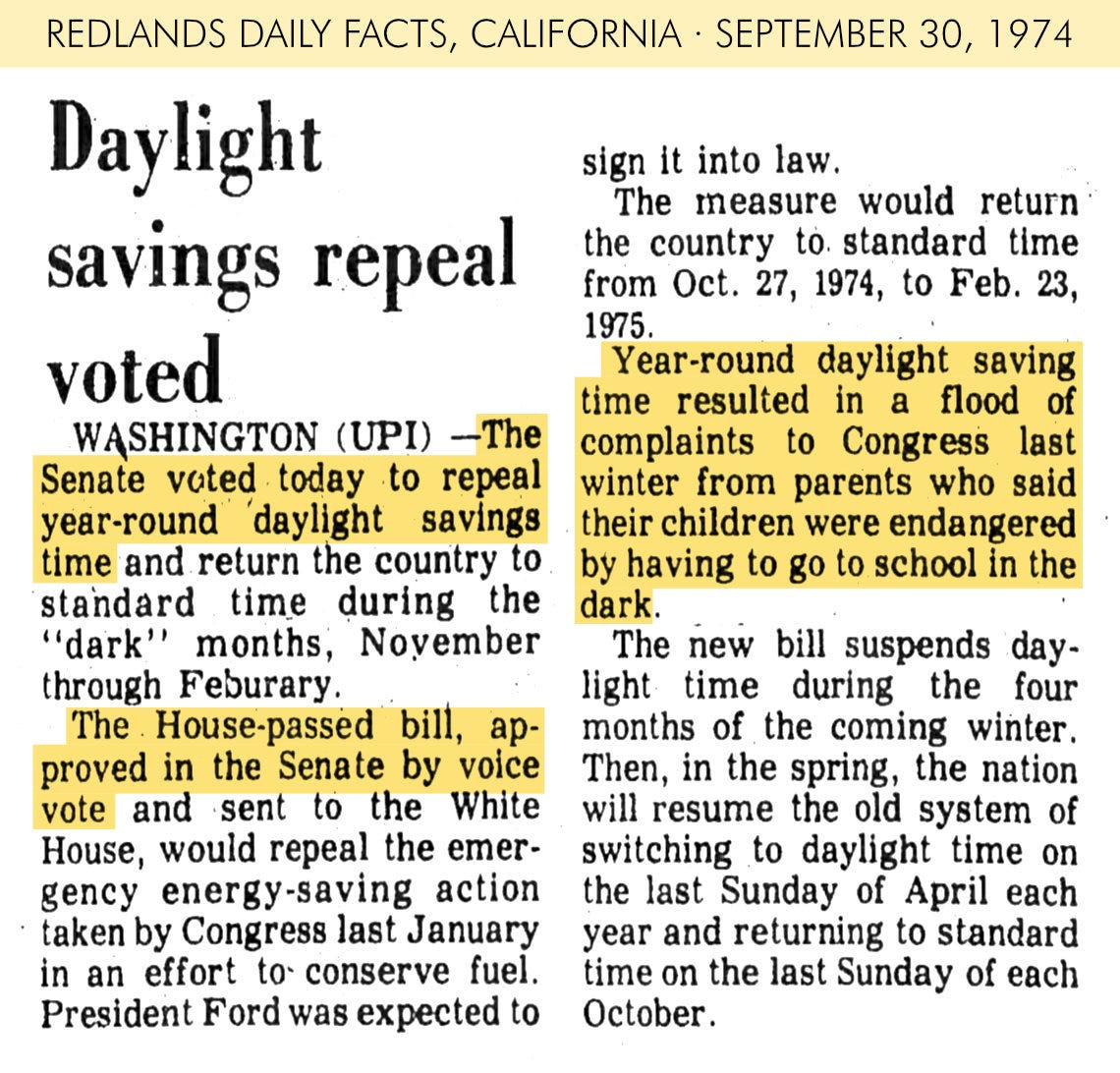
Bad as the biannual time change is, permanent DST is much worse. For years, one house of Congress has voted to repeal the biannual cadence of adjusting clocks. A few years ago, it was the Senate. This year it was the House. But each did so by keeping the wrong time.
Standard Time — which approximates our natural rhythms and the solar cycle — would’ve disappeared. Or, more accurately, as with the local hours from an earlier age, it’d still be there. We’d simply have ignored it, and suffered the consequences, both economic and medical (particularly declines in metabolic, cardiovascular, emotional, and cognitive health).
Fortunately, the “Sunshine Protection Act” keeps withering in one chamber of Congress, proving that even a stopped clock is right twice a day. But, like a seasonal allergy, it keeps coming back.
The notion that an act of Congress can “protect sunshine” is as ludicrous as the concept that passing laws can control the weather, that pulling inches from a foot can make us taller, or that putting more ounces in a pound can reduce our weight.
The “Sunshine Protection Act” is like most legislation. The only thing dumber than the name is the stupidity of the idea. The biannual time change needs to go. But the solar clock needs to stay. About half of Americans tend to agree, with only about a quarter preferring the proposed change:
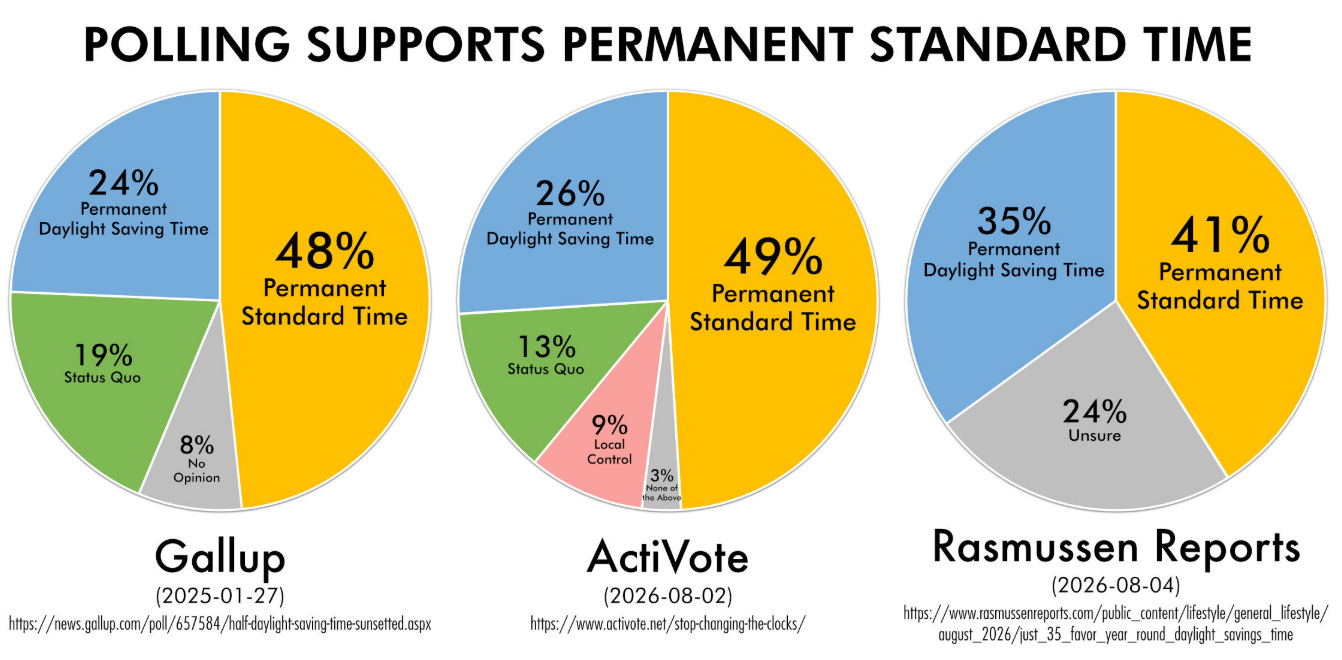
States could adopt permanent Standard Time whenever they want. With such polling data, why don’t they do so, especially in states where favorability is well above average?
As with wars, immigration, and many other government decisions that defy popular desire… what “the people” want often doesn’t matter. With targeted campaign contributions and big marketing budgets, concentrated corporate interests often wield more influence than dispersed voters who endure their laws.
Out of Whack
Where I live, the official time during summer is almost two hours ahead of where the sun actually sits. Since 1941 when it moved from Central Time, Atlanta lies at the western frontier of the Eastern Time Zone, so our local clock always outpaces the stubborn sun. Daylight Saving compounds the problem by putting another hour between ourselves and the sun.
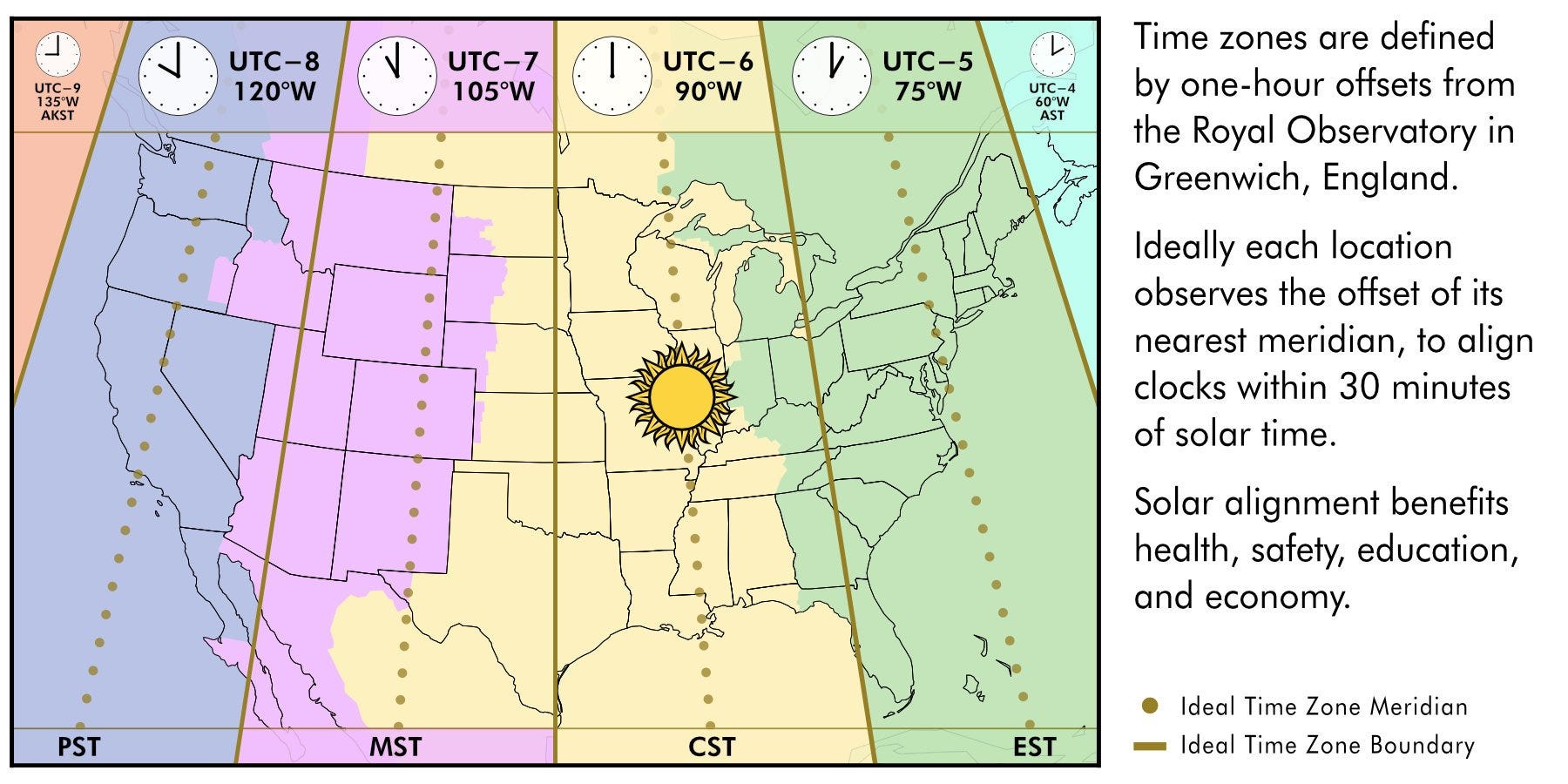
Several states are in the wrong zone. Aside from Pacific Time, each US time zone extends too far west; none go too far east. Most of Georgia should be on Central Time, as should all of Indiana, Michigan, Kentucky, and Tennessee. The Dakotas, Nebraska, and much of Kansas, Oklahoma, and Texas should be in Mountain Time.
If you want to know how wrong time is where you are, check this link or the map below:
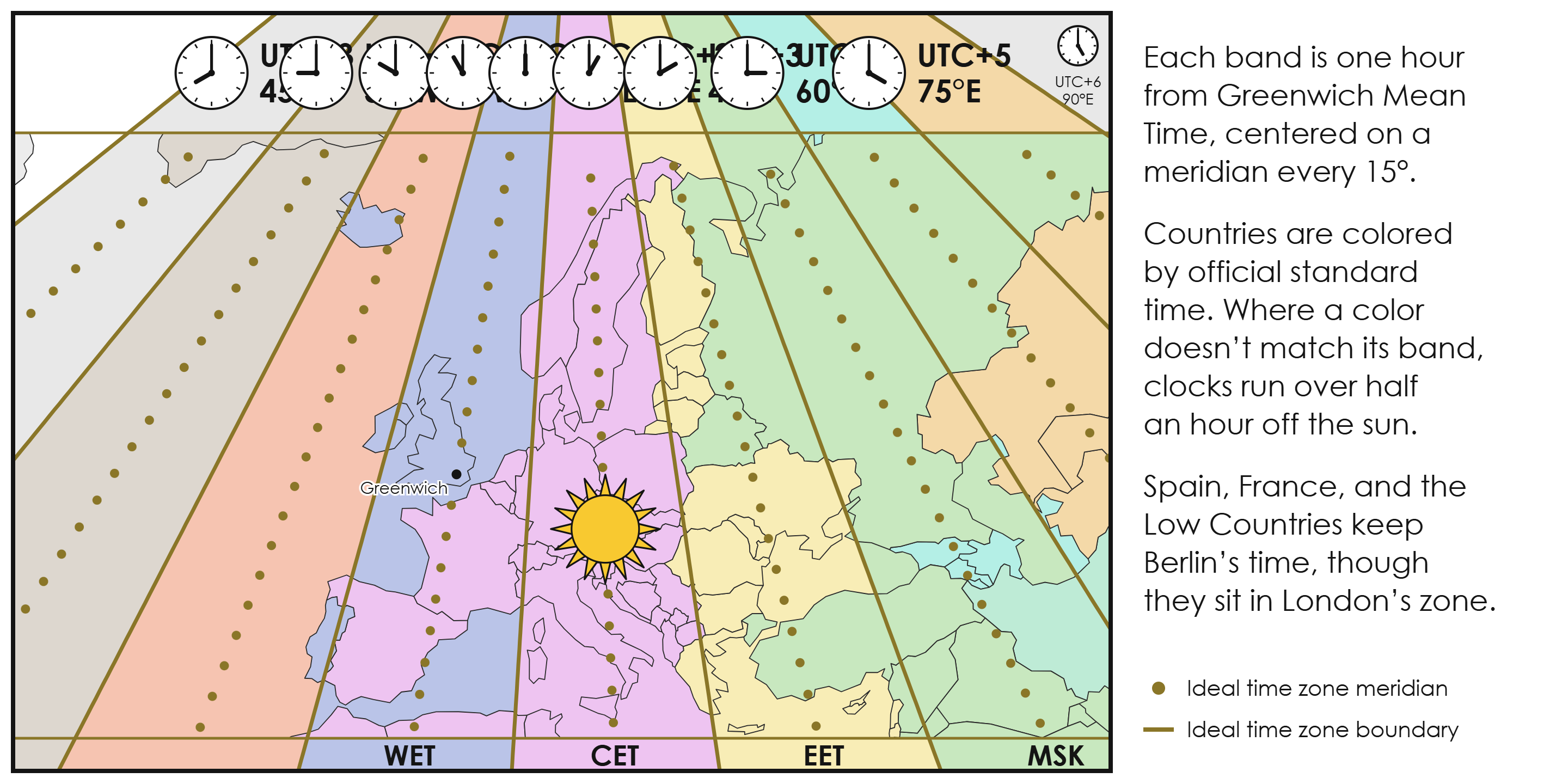
The U.S. isn’t alone being off-kilter. Western Europe is even more out of whack, with time set as much by politics as celestial mechanics.
In solidarity with Germany, Spain advanced its clock in 1940 and never moved it back. Conveniently, Spanish summers being more than two hours awry nicely accommodates the country’s siesta culture and late-night lifestyle.
France and the Low Countries suffered forced conversions. Before the Second World War, France and Belgium had been on Greenwich Time (the Netherlands were twenty minutes ahead). Under the Nazi Occupation in 1940, the Germans aligned Parisian clocks to those in Berlin. Surrounded by countries on Central European Time, after Liberation France permanently relinquished the hour Hitler took.
These countries also advance their clocks each Spring, which amplifies the mess. Portugal is a portent for what permanent DST would do here, and a reminder of what America once did. In 1992, it shifted from Greenwich to Berlin time to be in sync with Spain (if anything, Lisbon should be an hour behind London). As in the U.S. in 1974, it reverted four years later when morning darkness and disrupted sleep aroused vociferous complaints.
Solar Schoolmarm
We live in a world that’s filled with phoniness to indulge our fantasies. Don’t like how light it is at 6p? Just pretend it’s 7p. If nothing else, Happy Hour will start that much sooner!
Each day, like every coin, has two sides. We think we’d enjoy the sun setting after dinner. But will we like it rising a couple hours after breakfast? Will we want to begin each day in the middle of nature’s night? Is it healthy to do so? Do we even care?
And do we really want the sun, like a humorless hall monitor, watching over us so deep into the day? A setting sun is a signal. Time to retreat home from a hectic day…perhaps to open a window in the summer, or light a fire in the winter. We lift our feet, pour some wine, and loosen our limbs. We relax, and let down our hair.
These natural inclinations are less instinctive with a solar schoolmarm standing over us. She has her place. But it’s in the morning, to roust us awake and get us going. We don’t need an intrusive day hanging around at night, when we gather at the table or round the hearth, to talk about it behind its back.
We live in a contentious age when we fight about everything. Yet there’s one thing on which almost everyone agrees. The biannual clock adjustment is silly, harmful, and shouldn’t continue. After this weekend, it’s time to stop.
JD
PS - For those interested as much in place as in time, perspectives on many of them can be found in my book available by clicking the image below:

You crafted a plain truth, one I'll be unable to forget: "The notion that an act of Congress can “protect sunshine” is as ludicrous as the concept that passing laws can control the weather, that pulling inches from a foot can make us taller, or that putting more ounces in a pound can reduce our weight."