Atlanta, GA
May 28, 2026
The best big cities are essentially assemblages of small towns knitted together. Like San Francisco’s districts or the arrondissements of Paris, they’re dozens of unique neighborhoods quilted into a cohesive whole.
America has few cities of such fabric. New York is an obvious exception, with dozens of distinct villages in Manhattan alone. Other boroughs have many of their own.
San Francisco packs dense variety atop its foggy peninsula. North Beach, Nob Hill, Russian Hill, Pacific Heights, Noe Valley, Chinatown, the Mission, Marina, Richmond, and Sunset are but a sampling of the diverse sections of this vibrant city.
Boston, Chicago, Philadelphia, and Portland each feature some compact districts that fit together to form those cities. On a smaller scale, Charleston and Savannah are exquisite examples of what an urban plan should be.
But sometimes a small gem is better than an assortment of jewels. Such hamlets are relatively self-contained and mixed-use, with daily needs within walking distance of any residence. On most days, an automobile should be an afterthought.
Shops, schools, grocers, restaurants, cafes, hardware, and clothiers fill the ground floors of contiguous buildings. Above these upper levels house apartments.
A unity of architectural style and height harmonizes structures on which doorways offer decorative distinctions. First floor facades welcome pedestrians by intersecting sidewalks at grade, with no set-back.
Streets are relatively narrow, connect with every other road on the grid, and are no wider than thrice the height of adjacent buildings. Parallel parking and evenly spaced trees shield pedestrians from passing traffic and the summer sun.
Libraries, civic structures, and performance halls occupy prominent blocks, or act as orienting vistas at the far end of avenues. Parks are scattered at regular intervals, forming plazas anchored by statues honoring local heroes or monuments to shared memory.
Madison, Georgia does all of this. About midway between Atlanta and Augusta, the town was incorporated during the presidency of its namesake. Many of the original settlers fought in the War for Independence, and received land grants as reward for their service.
From the outset it was renowned for “intelligence, refinement, and hospitality” that a contemporary publication proclaimed had “no superior”. Around the central square grand homes sprouted. Sherman spared Madison on his March to the Sea, because local Unionist Joshua Hill was his friend.
Unfortunately, fire found Madison anyway. Four years after Appomattox, flames engulfed many of the town’s shops and homes. The year before, the state capital moved to Atlanta from nearby Milledgeville, and Madison receded.
After the turn of the century, the Boll Weevil threatened terminal decline. Yet the bones remained. In the 1970s, the body was revived. Federal, Italianate, Greek Revival, Queen Anne, and Bungalow architecture adorns every block. The magnificent Beaux-Arts courthouse is how justice is supposed to look, even when elusive.
We were last in Madison a quarter century ago. I recall visiting a couple antebellum mansions and buying a multi-volume history of France from a local bookstore that appears to be gone. But I still have the volumes, which were handy during the Loire voyage captured in this book.
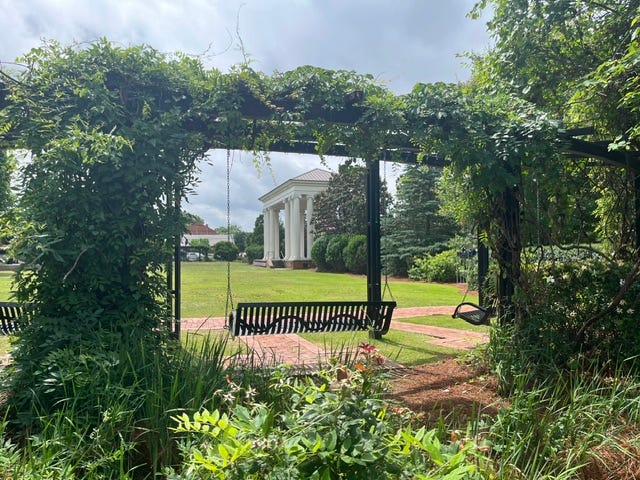
Otherwise, Madison hasn’t changed much. The original square still anchors the town and retains its 19th century layout. Tree-lined avenues lined with residential lots and formal gardens radiate from the city center. A new park fronts the James Madison Inn, with gazebos and swinging benches inviting locals to lounge.
It was Sunday morning, so aside from coffee at The Sinclair, breakfast at Betty Gene’s, and a couple pastries at the Patisserie, our options were limited. But as bells tolled Twelve, latches lifted and shop doors were unlocked.
Proprietors plopped signs on the sidewalk, baiting passers-by with lists of wares that awaited inside. One hook got us to bite. An antique end table caught my wife’s attention. It made its way into our trunk, and now sits beside our sofa.
But bringing it home was a letdown. We left Madison, and drove about a half an hour through the rolling Piedmont of north-central Georgia. Riding west, traffic built as Atlanta approached. After a delightful morning in a lovely town, I couldn’t help but wonder:
Where were all these people going, and why was I with them?
JD


👍👍👍 !!!
Many thanks for your flowery description ...
Unfortunately, the planned 15 minute cities will not have any of this flair ...