


Atlanta, GA
December 5, 2025
The couple emigrated to the United States eleven years apart. They each originated in Germany, met in New York, and married at the start of the 20th century.
Three years later, their third child arrived. Of the four born to Heinrich and Christina, he was the only one to survive infancy.
His father was an epileptic alcoholic who was often unemployed. His mother was a maid, who wanted her son to become an engineer.
To honor her wish, he went to college. Since high school, his athletic prowess attracted attention. A football scholarship carried him to Columbia. But his baseball ability got him noticed, and the New York Yankees offered a contract.
During his sophomore year, his father’s illness strained the family finances. Against his mother’s wishes, Lou Gehrig left Columbia.
Financially, his family was set. But for most of the next two years, Gehrig sat. He was back-up first baseman to Wally Pipp, one of the dominant players of the era.
A couple years later, Pipp’s performance mirrored his age. Complaining of a headache, he made the mistake of giving his understudy an opening.
On June 2, 1925, Lou Gehrig left the dugout to play first base. He’d do so every day for fourteen years, setting a record for reliability that lasted almost six decades.
No one mediocre could accomplish such a feat. In an era before batting helmets, Gehrig was occasionally knocked unconscious by pitches. Later X-rays revealed several fractures that had been undisclosed. Through it all, Gehrig kept playing, and never missed a game.
Talent is needed too. Regardless how dedicated, average players are routinely replaced. But even the best team in baseball needed Lou Gehrig.
He was among the greatest hitters the game’s ever seen. But he was also widely respected for who he was, and the character he exuded.
Dedicated, considerate, and caring, Lou Gehrig was admired by everyone in baseball. Into the late 1930s, he continued to produce. But in the summer of 1938, he suddenly slipped.
Gehrig reported declining strength and persistent fatigue. By the following spring, it was obvious something was off.
Gehrig’s power was gone, his speed had vanished. Some days he could barely walk, and once collapsed during a spring training game.
A month into the next season, as physical deterioration left him unable to perform, Gehrig benched himself “for the good of the team”. He never played another game.
The diagnosis came eight weeks later, on June 19, 1939. Amyotrophic Lateral Sclerosis (ALS) has few treatments and no cure. The condition was identified in 1869 by French neurologist Jean-Martin Charcot, who named it five years later.
It’s a neurodegenerative disorder of two variants. One withers nerves and muscles from the outside in, the other from the inside out. Each entails deterioration of motion, cognition, speech, and breathing.
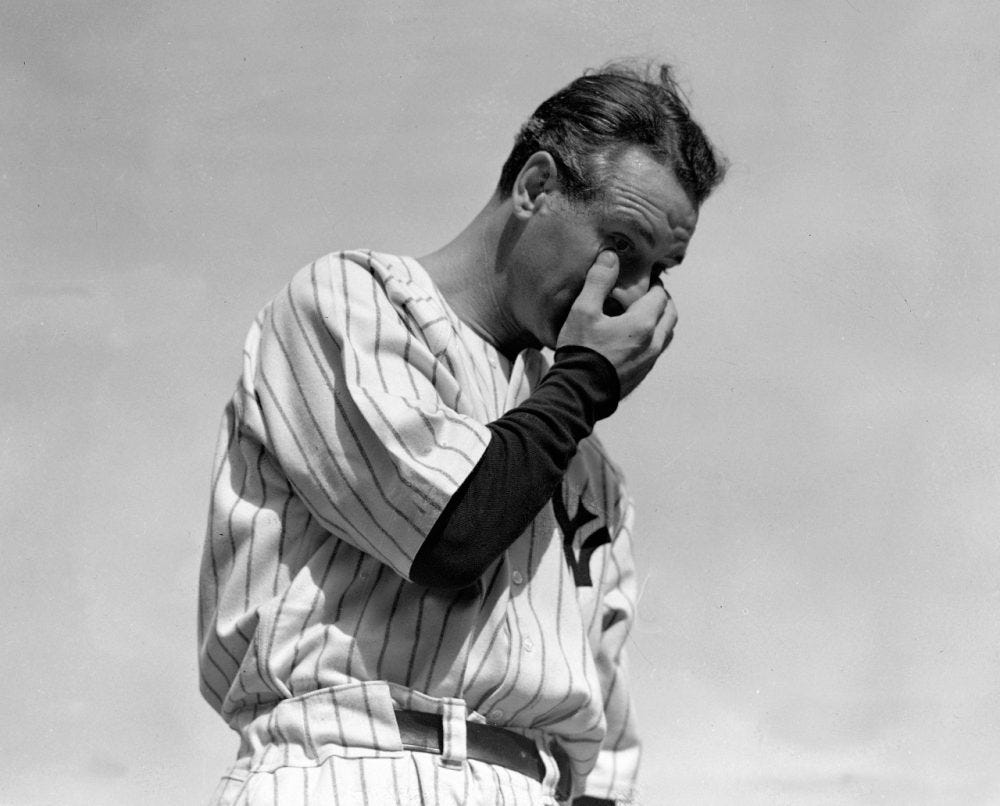
On July 4, 1939, in a short address during a ceremony in his honor, Gehrig acknowledged his “bad break” while appreciating his “luck”. That afternoon at Yankee Stadium, he became the first Major Leaguer to have his number retired.
He died two years later, 16 years to the day after he replaced Wally Pipp.
Close to Home
Like many people, I became aware of Gehrig because of his eponymous disease. But for most of my life ALS was dreadful yet distant, known mostly for the great player it took too soon.
What happened to Lou Gehrig was clearly sad, and obviously a shame. But I had no reason to dwell on his illness. Unless his name came up, I wouldn’t give it a second thought. If I did, it was as a horrible ailment that afflicted a wonderful person.
In recent years, I’ve said that far too often, but not as an abstract afterthought. On too many occasions, ALS has hit close to home.
Three years ago, a fellow Georgia Tech alum succumbed. About that time, a dear cousin was diagnosed. And this Spring, one of our closest friends affirmed her lingering fear.
But my initial reminder came more than a decade ago, when a family friend died of the disease.
Most Poignant Piece
Dudley Clendinen was an accomplished reporter and writer. He married one of my mother’s closest friends, and lived in Atlanta when I attended Georgia Tech.
At the time, Dudley was senior editor for the Atlanta Constitution, after having previously written for the New York Times (where he’d later return). Dudley was also a talented author who wrote a couple books that were widely acclaimed.
But he penned his most poignant piece less than a year before he died. When his ALS was confirmed, Dudley (like most who receive such news) was given less than three years to live.
He confessed to being unsure he wanted to stick around. According to Baltimore radio host Tom Hall, who’d worked closely with Dudley on a series discussing his preparation for death, the disease made the decision for him.
Dudley brought ALS to wider attention, including mine. But for the next decade, it again receded to my mental recesses. That’s natural. Horrible as it is, why dwell on what I’d thought was a rare disease that took one person I’ve known?
Several years ago, it resurfaced… and seems reluctant to go away.
Major Leaguer
Like Lou Gehrig, Jim Poole was a Major Leaguer who studied engineering. Unlike Gehrig, Jim earned his degree. He did so at Georgia Tech, where he was friends with the woman who’d become my wife.
After being drafted by the Dodgers, Jim deferred being an electrical engineer to pursue his dreams on the diamond. Like me, Jim’s wife (who also attended Tech) was a civil engineer, which is how she supported his rise thru the Minor Leagues.
After years in small towns, dingy buses and poor hotels, Jim got the call. In 1990, he made the Majors. In his first game, on June 15, he struck out Tony Gwynn.
He was a good pitcher who played eleven years for eight teams, including three stints with the Cleveland Indians. While there, he became best known in Atlanta for yielding the home run that won the Braves a World Series.
Jim was a great man who’s unfairly remembered for one misplaced pitch. He once joked that he wished the Braves would win a second series, to make people forget the rôle he played when they won their first.
In 2021, the Braves finally granted his wish. Unfortunately, by the time they did, a deadly disease ensured Jim Poole would also be known for something else.
Jim was diagnosed on the thirty-first anniversary of his Major League debut, and eighty-two years to the week after Lou Gehrig received his news.
The optimistic, outgoing man who made good money throwing a ball was unable to pick one up. He couldn’t wield a pen either. But his wonderful wife wrote for him…with grace, dignity, and love.
Drawing on a deep reservoir of noble strength, she updated us on Jim’s decline, and left us wishing we could somehow reverse his dreadful disease. Unfortunately, no one could. Jim died a couple years after his diagnosis.
Intelligence, Charm, and Wit
A few months later, I learned the same scourge afflicted my cousin. Moira is a beautiful woman of intelligence, charm, and wit… traits she inherited from her parents and bequeathed to her kids.
Moira may be resigned to her situation, but she isn’t reconciled to it. A professional architect, she developed a blueprint to fight this foe. Fortunately, she has help.
With assistance from a remarkable family (including a loving husband, marvelous kids, and devoted sister) she’s persevered with grit and grace.
Why wouldn’t she? That’s how she does everything, with poise and character no ailment can abate.
Spray of Foam
This Spring one of our closest friends, who’d married a woman my wife befriended in college, received this dread diagnosis. He’d suffered strange symptoms for more than a year.
As his condition worsened, his wife suspected something serious. She’s a wonderful wife and a marvelous mother. To protect her kids, she kept her worst fear to herself.
But ominous signs mounted, including her husband’s mental lapses, muscle weakness, and inability to walk without a cane, walker, or wheels.
They suspected what was ailing him. But as Dudley Clendinen put it after his own diagnosis, “suspicion and certainty are two different things.” Having previously assumed what we’ve affirmed doesn’t always cushion the blow or alleviate the shock.
When it hits, it’s easy to second guess the ways of God. That’s normal, albeit pointless. As the Monsignor at our church once put it, “God wouldn’t be God if He were God the way we would be God if we were God.”
Like a spray of foam trying to assess the sea, we can’t know why God does what He does. All we can do trust His guidance and beseech His blessings.
It’s fashionable to belittle “thoughts and prayers.” But only among people who haven’t experienced their power.
Moira and I share a paternal grandmother who went to Mass religiously, usually every day. To her prayer was essential, not incidental; a steering wheel, not a spare tire.
Our grandmother didn’t pray only when needed. Prayer was always needed. And now her granddaughter needs it more than ever. So do friends who face a similar fate.
They have mine, and any other support I can possibly provide.
JD
Thank you so much for your very well written post full of empathy and understanding !!! 👍👍👍
Now and with nostalgia where deep thinking is needed more and more, even though it beings sadness as well. Your writing is wonderfull and poignant...