


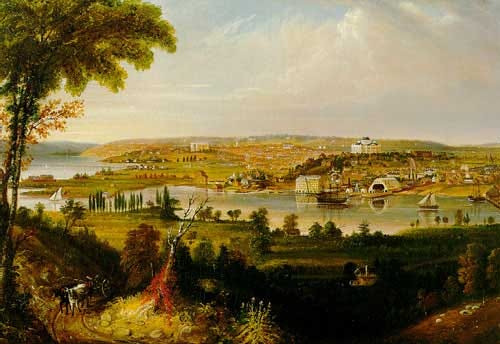
Washington, D.C.
May 17, 2025
“It was thought that by giving [the U.S. Capital] to Philadelphia for ten years, and to Georgetown permanently afterwards, this might, as an anodyne, calm… the ferment.”
- Thomas Jefferson
Thomas Jefferson hoped and expected to return to France. But on docking in Virginia, he learned President Washington had appointed him Secretary of State.
Jefferson had no choice but to accept the post. However much he wanted to return to Paris, he had to honor Washington’s wishes.
He arrived in New York as if he were a stranger… or a hostage. Sentiment had shifted since he’d gone overseas. A centralizing tendency had replaced the republican reflex he recalled in America, and that he’d reinforced in France.
Not long after reaching the new Capital, Jefferson met a disheveled Alexander Hamilton on a Manhattan sidewalk. The duplicitous Treasury Secretary was concerned the new government wouldn’t absorb state debts.
Still unwary of his wily nemesis, Jefferson offered to host a dinner party to discuss the matter. From it came an agreement that Virginia would agree to debt assumption, in exchange for relocating the federal capital to the Potomac.
The deal was done. State debts were assumed. And after shifting to Philadelphia for a decade, the seat of government moved further south.
“Empire of Mud”
The new District would be a 100 square-mile “diamond on the Potomac”… an enormous expanse. Including the separate cities of Georgetown, Washington, and Alexandria, this was too large for the humble capital of a free republic. Tho’ its territory was reduced by a third after Alexandria County was retroceded to Virginia in 1847, it still consumes too much space.
George Washington chose Pierre L’Enfant to design the city that would bear his name. L’Enfant conceived a classical grid overlaid with diagonal avenues, creating circular intersections of plazas and parks to provide artistic perspective and urban reprieve.
One of these boulevards would connect the President’s House to the Capitol building. Perhaps named as consolation to the state that lost the capital, Pennsylvania Avenue was 160’ wide, replicating the minimum span of the Champs Élysées. That was the only similarity between this pestilential marsh and what we know as Paris.
Through a frightening assortment of shacks and slums between the unfinished Capitol and the Executive Mansion, what passed for a “street” was a forlorn path pocked with fetid pits of sewage and sludge.
Muddy or dusty depending on time of year, it was always dangerous between dusk and dawn. Pests and predators wandered on two legs, wallowed on four, or slithered on none. Pigs, rats, snakes, and vermin infested the route.
Disease ran rampant. British ambassadors were permitted to wear short pants and pith helmets since the U.S. capital was considered hardship duty.
Malaria, cholera, and yellow fever reigned over what JD Dickey called The Empire of Mud. It was a seasonal city that essentially shut down in the summer.
Boarding houses and temporary lodging littered the enclaves where members of Congress rented ramshackle rooms. They did so for as few days as their duty allowed.
Residents couldn’t vote, which makes sense. This was neutral territory representing each sovereign state. The design flaw wasn’t insufficient suffrage; it was too much territory.
The capital should’ve been confined to a narrow collection of government buildings… and vice versa. This would include the White House, Capitol, and Supreme Court… plus whatever annexes or offices could be squeezed between (but not beyond) them.
Anyone employed in this area (and wanting to vote) could live in Virginia or Maryland. Thru the War Between the States, either option would’ve been preferable to that godforsaken dump.
“Father of Modern Washington”
L’Enfant’s plan wasn’t implemented till after the Union Army completed its conquest, which revived impetus for an imperial capital. During the war, Lincoln held the city under martial law. Ringed by forts, the District filled with makeshift hospitals as assorted livestock roamed the mall.
Before the war, Montgomery Meigs developed the Washington aqueduct to bring fresh water to the city. He also helped enlarge the US Capitol, including its wings and dome.
A scalawag from Augusta, Meigs decided to seize Robert E. Lee’s Arlington property, and salt it with bones of Yankee dead. Because bodies couldn’t easily be distinguished, many Confederates were buried there too.
A decade later, the Supreme Court ruled the theft of land had been illegal. The estate was returned to Lee’s son, who sold it back to the US government. Arlington has since expanded into the largest graveyard in the National Cemetery System. My paternal grandparents rest peacefully among the honored remains.
The Panic of 1873 interrupted the redesign of the city undertaken by Alexander Shepherd, the “Father of Modern Washington”. Shepherd pressed for the Organic Act of 1871, which repealed the separate charters for Georgetown and Washington.
After Shepherd’s expansion efforts helped bankrupt the city, a territorial District government was established under direct control of Congress. This remained in effect till Home Rule a hundred years later.
It almost became moot. The city was so indebted and delipidated that Congress discussed relocating the U.S. capital to St. louis, Missouri. Shepherd was determined to preserve the District, which required upgraded infrastructure to remain viable.
Open sewers were removed. New water and gas lines were installed. Like an American Haussmann, Shepherd cleared slums, paved roads, and re-graded rail.
Thousands of trees supplied beauty and shade. Horse-drawn carriages provided public transportation. Most of Washington’s marble monuments and political temples weren’t erected till the Twentieth Century. But they’d have a home worthy of hosting them.
The MacMillan Commission helped realize L’Enfant’s vision during the City Beautiful movement of the early 20th century which converted squalid cities into more appealing places.
The redesign of the Mall was the centerpiece of this effort. This insect-infested expanse was converted from a rank pasture filled with pigs to an appealing plaza for museums, monuments, and memorials.
Imperial Colossus
Like Paris, Washington, DC is one of few cities where Baroque urbanism exists on a grand expanse. But as with most of what DC does, it overdid it.
While much of it is charming, the city’s layout poses some problems. Parts are beautiful. Lovely neighborhoods, neoclassical architecture, and walkable districts lend dignity and appeal.
But disproportionate breadth, excessive expanse, and ginormous edifices occasionally disorient, while bureaucratic bulk can sap spirit and overwhelm the eye.
JFK famously called Washington a city of Southern efficiency and Northern charm. It was still segregated till the early 1960s. But the pace was slow, crime contained, and families intact.
That began to change after the Second World War. Unlike the aftermath of earlier conflicts, when the Axis was vanquished the administrative apparatus didn’t recede.
To combat the ubiquitous menace of Soviet Russia, martial misadventures, monetary malfeasance, and mischievous monitoring multiplied. The republican capital Jefferson envisioned was long gone.
For almost a century, the District has been a lucrative locus of global power, political patronage, and government employment. This small southern city has become an imperial colossus, and one of the wealthiest regions in the United States.
A True Gem
But the city was particularly enriched by a long-time resident who’s sorely missed. We’re here this weekend to honor my late uncle Hugh. Two days isn’t near enough to celebrate the life and legacy of this renowned surgeon, fantastic father, and wonderful man.
Hugh loved Washington. Much of the DC history I’ve just relayed (aside from my snide commentary and political snark) is from his elegant disquisitions over bottles of wine. But my uncle was more than just a great conversationist.
He never hesitated to help people he barely knew, and many he’d never met. Among them, almost two decades ago, was one of my employees... whose infant daughter’s life was in doubt. I’d not heard from him in years, until I posted an essay lamenting Hugh’s death.
With his condolences, he sent this note:
“So sorry for your loss. I shared this news with my wife and daughter. It brought back so many memories and a flood of feelings filled with gratitude. In a time when the Internet was only in its first decade of existence, we struggled to find a vascular team that could consult, and intervene surgically when the time came for the youngest addition to our family. At the time, there were simply no vascular surgeons that specialized in infant or child cases. After three complex renal and aortic bypass surgeries that spanned over the course of 15 years, that all came with their share of secondary complications, our daughter is now 22, and will soon have a child of her own. We will forever be indebted to your Uncle for the introductions that led to lifelong partners and good friends with some of the best vascular surgeons in the Country. This is his legacy, and his name will live on with my family as well.”
Far beyond this diamond on the Potomac, Hugh Trout was a true gem.
JD
As I age, and read more eulogies, I’ve come to realize that the most revered are those who have led lives selflessly aiding others. History, however, seems to recognize more often those who destroy.
Case in point: your Washington DC based noble uncle is remembered fondly by a few but the city is adorned by statues of warriors who righteously killed others and destroyed their domiciles
Great read!...