


Paris, France
May 25, 2025
Virgil traced Athenian etymology to a contest between Athēnâ and Poseidon. The one who bestowed the greatest gift would become patron of the polis.
The sea god provided a horse. The goddess of wisdom offered the olive. Cecrops, and history, accepted the bitter fruit of feminine favor.
Dante’s poet assures us his own imperial capital was founded by Aeneas, thru a couple kids nursed by a wolf. One of them left his name on the Eternal City.
Rome, according to romantic accounts and Philippe Auguste, was not the only city derived from Trojan lineage or Olympian immortals.
According to that king’s chroniclers, after capturing Helen and having her launch a thousand ships, the son of Priam fathered the Franks, and a city on the Seine.
Who knows? Before the Age of Discovery brought Iberian ships to American shores, great cities usually emerged from the mists. The grander the site, the thicker the fog.
There are, as always, exceptions that prove the rule. Some European cities had definable starts. St. Petersburg on the Neva, Dublin on the Liffey, London on the Thames, Vienna on the Danube, Madrid on the Manzanares, and Cairo on the Nile all have historic origins, and definitive dates.
OK…so maybe the exceptions are the rule. But Paris is apparently so exceptional that it is an exception to the exceptions. We don’t quite know where it came from, but we know where it started.
Captive Author
The Romans likely planted the first settlement on a small island in the Seine. A few hundred years later, the Emperor Julian thought the village of Lutetia…with its fine vines, sweet figs, and gentle climate on the Île de la Cité…so appealing that he refused to leave it to lead legions to the Middle East.
He was not the last to be captivated by the city’s charm, power, women, and wealth. Over the centuries and from around the world, kings, emperors, courtesans, nobles, philosophers, lovers, tourists, scholars, artists, writers, rouges, religious, ruffians, and revolutionaries have descended on Paris. Many have come to claim the city, only to be captured by what they’ve conquered.
This author is among the captives. After the turn of the century, I was in Paris almost every month. Initially, I’d arrive Monday morning, and depart the following Sunday.
When I became a father, the return flight moved up a day. I haven’t been back since our second son was born.
Because of my affection for each place, Paris and San Francisco were two cities I’d always wanted my sons to see. We’ve been to San Francisco several times, and I’m glad they saw it before its demise.
But Paris, like a lovely lady withholding a secret, has remained elusive. This weekend, we’re finally able to make an introduction.
Fatigued from our flight, we relied on adrenaline and caffeine to survive the day. After clearing customs and discarding our luggage, we hopped the RER and rolled south toward le Sainte-Chapelle.
Its Own Reward
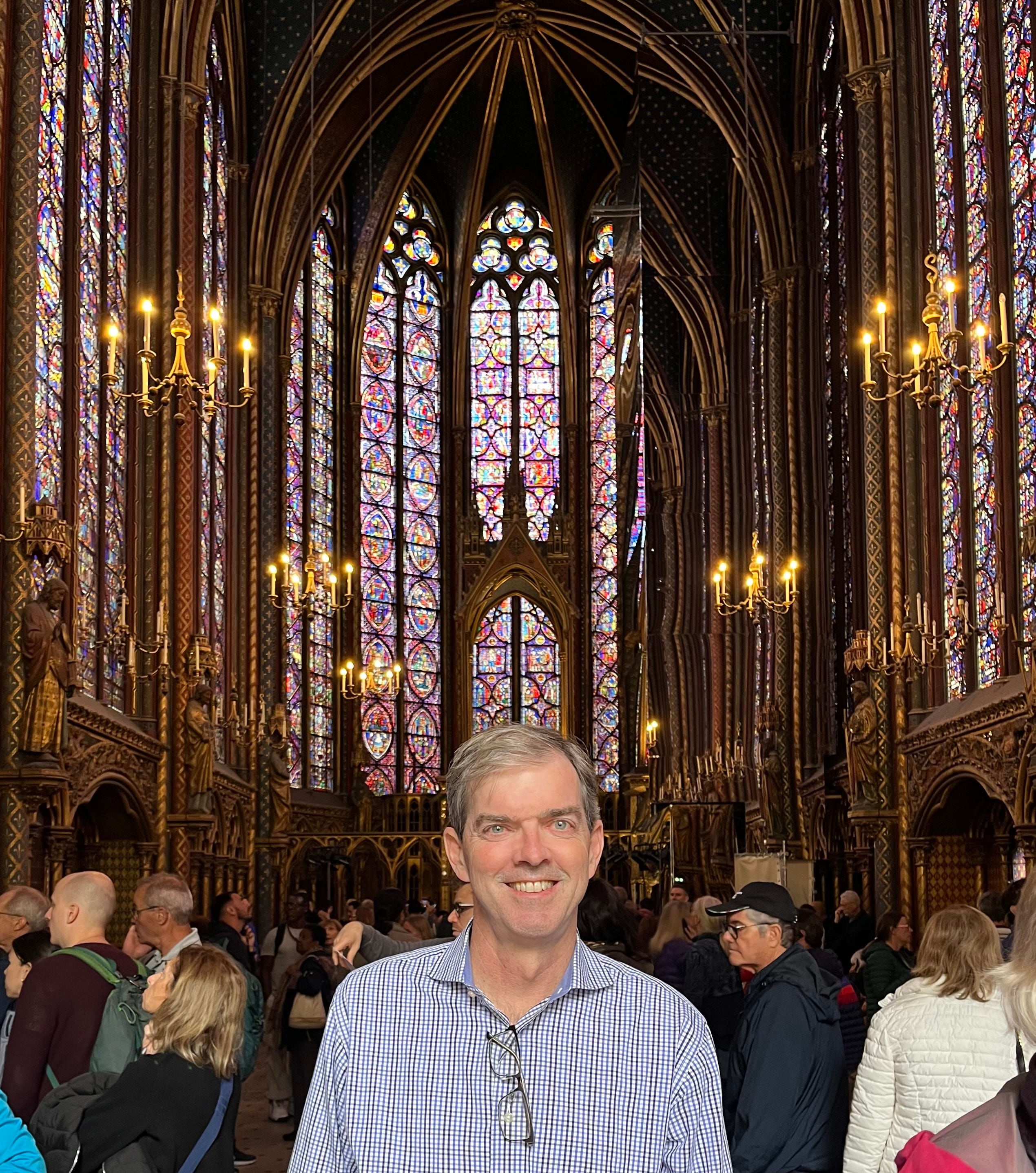
It’s a cliché to call Gothic masterpieces “symphonies in stone”. But this triumph of smithing, iron, painting, sculpture, and glass comes as close to perfection as any edifice on earth.
In 1239, King St. Louis IX placed the Kingdom of France at the forefront of Christendom by acquiring the “Crown of Thorns” from Constantinople.
Within six years (!), Sainte-Chapelle became a resplendent case to house this jewel. These days, it’d take that long to clear the committees who’d announce it would take a decade.
Notre-Dame was begun eighty years earlier, and took almost two centuries to complete. But the intricacies of design, artistry, and engineering are nonpareil at Sainte-Chapelle.
In the lifespan of a first-grader, its builders produced perfection, and an abiding rejoinder to architectural vandals who disgrace modernity while denouncing the “Dark Ages”.
Construction of Ste-Chapelle cost half the price of the relics and reliquaries it eventually hosted. But from the beginning, the building was its own reward.
It captivates on approach, and overwhelms on entry. Yet access wasn’t always so easy.
The chapel originally occupied a private courtyard within royal walls, and was linked to Louis’s apartments by a small gallery. Like palace retainers, we entered thru the lower chapel.
Dedicated to the Virgin, its low star-studded ceiling is darkly mysterious. To the left, a spiral staircase carries crowds toward the main space they came to see.
The slender structure relieved the need for excessive buttresses to support the central vault. This allows larger windows and a more open interior, which enhances the delicacy of the upper level.
The exquisite chapel seems to float. This delicate marvel was the private purview of the king, and douses doubt of the most devout atheist. The masonry seems incidental, almost immaterial.
Everything here is open space, as if the entire edifice is of stained glass. The oldest in Paris, it sheds eternal light thru holy air.
The upper vault sustains its precarious balance atop anchors of sculpted gable and sturdy balustrade. This stunning feat of Medieval engineering has survived without a crack for more than seven centuries.
Rising from the roof, its cedar spire (a nineteenth century replica of the medieval original) springs skywards, a triumph of refinement visible from most points in Paris.
Green Room for the Guillotine
Steps from this piece of Heaven is a castle converted to slice of Hell. The Capetians constructed the original section, initially controlled by the concierge of the king’s mansion.
Part of the Palais de la Cité that also included Sainte-Chapelle, the Conciergerie was converted to a dungeon in the 14th century when Charles V moved the royal residence to the Louvre. Stout pillars, low vaults, and little light are an ominous contrast to the ethereal chapel we’d just left.
During the Terror, the Conciergerie was something of a “Green Room” for the guillotine. Nine of ten inmates would receive a shave from the “national razor”. In little over a year, almost 3,000 prisoners (including Marie Antoinette, but also Marat’s murderer and Louis XV’s lover) met that fate after waiting within these walls.
I’ve been to Paris many times, and visited the Conciergerie on each occasion. The stout pessimism of this Revolutionary slammer, with its sad little court "for the women”, its open washing trough and huge spikes to prevent intruders from climbing into the Palais de Justice, is a stark contrast to the miracle of filagree stonework of adjacent Ste-Chapelle.
Our Lady Revived
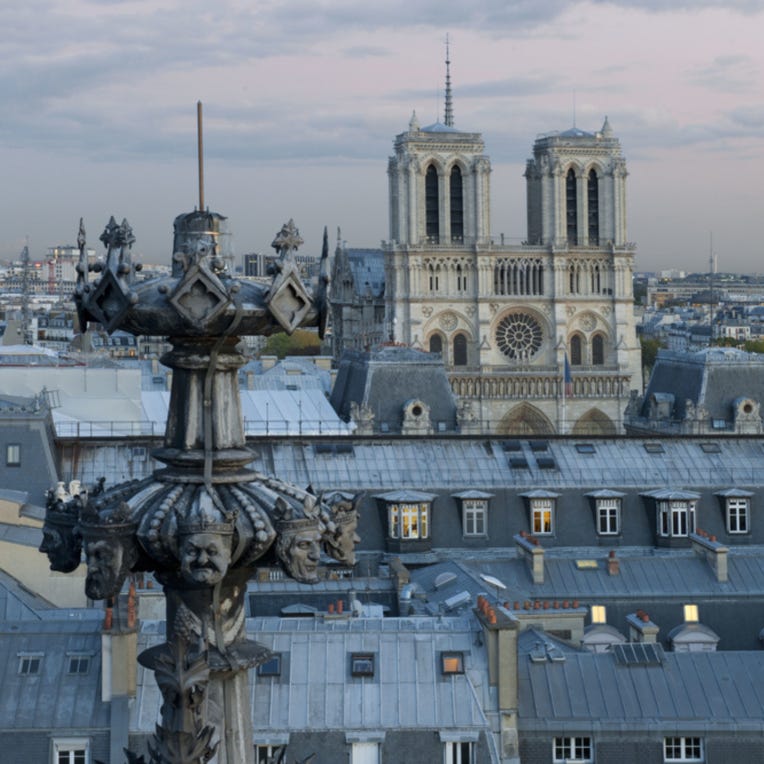
A century before Ste-Chapelle, during the reign of Louis VII and Bishop Maurice de Sully… on an island in the Seine atop the ruins of a Roman Temple to Jupiter… Pope Alexander III laid the foundation of a new cathedral.
In the Middle Ages a church was often likened to a ship steering for harbor. And Nôtre Dame de Paris has stood for almost nine centuries athwart the stern of the Île de la Cité.
Paris adopted the cathedral as its heart, and the nautical image into its coat of arms…including the bold motto Fluctuat nec mergitur – she is tossed on waves but not overwhelmed.
Or so it seemed till fire consumed the structure six years ago. For five years it was kept precariously afloat. Last December, she again set sail.
This glorious church is both a ship and an anchor. And a lodestar. Few edifices rival it as a symbol of what was Christendom, and of what remains of Western Civilization.
Fortunately, they built things better in the Middle Ages than they do today. Fires regularly ravaged these medieval symphonies, displacing notes but preserving the tune.
Composers were masons who hauled stones from quarries miles away, floated them down the Seine, and pushed or dragged them up the Rue Neuve-Nôtre-Dame that was hastily carved through Medieval Paris.
Two centuries later, the work was complete, towering over cramped streets crowded with as many pilferers and prostitutes as prévôts and priests. Not till Haussmann redesigned the city under Napoleon III did Our Lady have room to breathe.
But she’s always extended her arms.
For All of Us
It was to this cathedral that Henri IV came on his knees in 1593 to declare Paris worth a Mass. Here during the Hundred Years’ war Henry VI of England was declared King of France, and during the Wars of Religion Mary Queen of Scots married Catherine de Medicis’ unfortunate son Francois II. Louis XIV hung flags of victory in the same nave in which De Gaulle celebrated liberation with a Te Deum in 1944.
French Revolutionaries (who destroyed everything) never – despite their threats – razed this church. In typically demented fashion, they opted to convert it to a “Temple of Reason”.
They decapitated statues, desecrated the altar, and carried an icon of a “Goddess of Reason” down the aisle. But even these lunatics didn’t bring down Nôtre-Dame.
In the revolutionary wake, Napoleon restored the cathedral so he could be crowned emperor amid its venerable symbols. The dead walls of the dilapidated church were covered with hangings and baldachins to lend sumptuousness to the imperial ceremony.
Almost three decades later, Hugo created Quasimodo and Esmeralda, and gave Nôtre-Dame new life.
King Louis Philippe commissioned Jean-Baptiste-Antoine Lassus and Eugene Viollet-le-Duc (who also created the walled city of Carcassonne) to restore the edifice in 1848, including replacing the original spire removed during the reign of Louis XV. This melted and fell six years ago.
Above all, Nôtre Dame is a Catholic Church: a Shrine to Our Lady and home (since 1806) to the Crown of Thorns placed on Her Son that first Good Friday.
Four decades after Hugo breathed life back into the ailing cathedral, the Paris Commune again tried to kill it …along with other elements of civilization its revolutionary predecessors left standing.
The savages burned the Hôtel de Ville, and made their way to Nôtre Dame. They pulled up the pews, piled them in the center of the nave, and doused them in petroleum. Parisian artists, awed by the beauty of the restored cathedral, talked them out of lighting the match.
So, like punk kids dissuaded from egging one house by the opportunity to toilet paper another, they toppled the Vendome Column instead.
But Nôtre-Dame continued to stand. For Paris, and for France.
And for all of us.
JD
Your smile highlights the jewel behind you...
Thank you JD! Love Paris less than every other part of France, and the residents even less than that. History and your comparison to San Francisco is the proof of that. Such beauty amongst filth…